
A Property Owner’s Guide to the California Property Management Contract
Your property, whether a luxury home in Pebble Beach or a multi-family building in Salinas, is a significant asset. When you entrust its care to a professional, the property management contract california becomes the single most important document protecting your investment. It’s the essential foundation for a transparent, profitable relationship between you and your property manager.
The Blueprint for Protecting Your Monterey County Investment
For discerning property owners and investors in the Monterey Bay Area, a property management agreement is far more than a formality. It’s the architectural plan for your investment’s future. A builder would never start construction without a detailed blueprint, and you should never hand over the keys without a solid, carefully drafted contract. This document provides absolute clarity, mitigates your financial and legal risks, and ensures your goals are perfectly aligned with your manager’s day-to-day actions.
A weak or generic contract, often found through a quick online search, can leave your high-value asset dangerously exposed. These one-size-fits-all templates almost never account for California's intricate legal landscape or the unique market dynamics here in Monterey County—from coastal regulations in Pacific Grove to rental trends in South County towns like Soledad or King City.
More Than a Document—It’s Your Peace of Mind
A professionally prepared contract acts as a critical shield. It defines every component of the relationship to prevent misunderstandings and protect your return on investment. It's the key to achieving the peace of mind that comes from knowing your property is being managed with precision and care, freeing you to focus on your other professional and personal priorities.
Here’s an actionable checklist of protections a strong contract provides:
- Defining Authority: It clearly outlines what your manager can and cannot do regarding repairs, tenant screening, and financial handling. This prevents unauthorized decisions and spending.
- Ensuring Compliance: It guarantees that all activities adhere to California’s complex laws, such as security deposit handling and fair housing regulations. This step alone shields you from potentially costly legal trouble.
- Aligning Goals: The agreement translates your financial objectives into a clear list of duties, ensuring your manager is focused on maximizing your return on investment and preserving your asset’s value.
Ultimately, the contract solidifies the trust you place in your management partner. It is the written promise of professionalism and diligence that owners of high-end properties expect and deserve. To understand what to expect from a top-tier firm, explore our overview of professional property management best practices.
This legal shield is just one part of a comprehensive wealth preservation strategy. For a complete plan to protect your entire financial portfolio, investigating options like asset protection insurance is a prudent step toward securing your financial future. As we delve into the essential clauses of a California contract, remember: this document is your primary tool for safeguarding your investment for the long term.
Key Clauses Every California Property Management Contract Needs
Think of your property management contract as the very blueprint for your relationship with a management firm. It’s what turns conversations and trust into a clear, legally binding set of promises. For savvy investors in Monterey County, getting these clauses right isn't just about legal protection; it’s about making sure your high-value asset, whether it's a classic Pacific Grove home or a new apartment building in Soledad, is managed exactly to your standards.

A robust contract is like providing a pilot with a detailed flight plan before a long journey. It must cover every potential scenario to ensure you land safely and successfully. If clauses are vague or missing, you leave the door open for ambiguity, which can quickly lead to expensive disputes and erode your investment's value.
Core Components of a Rock-Solid Agreement
Every property management contract in California must be built on a foundation of non-negotiable clauses. These are the pillars supporting the professional relationship, protecting both you and your manager. Here’s a breakdown of what you need to look for.
-
Parties to the Agreement: While it sounds simple, this is absolutely critical. The contract must name the legal owner(s) of the property and the full legal name and license number of the property management company. This step ensures accountability is tied to the correct, licensed entity.
-
Property Description: The agreement must specify the address and provide a clear description of the property or properties being managed. If you own multiple properties from Salinas to King City, this prevents any confusion about the scope of your manager’s responsibilities.
-
Contract Term and Renewal: This clause establishes the timeline for the agreement, typically one year. It must also be crystal clear about what happens at the end of the term—does it renew automatically? What is the required notice period if either party decides not to renew?
Actionable Insight for Owners: The strength of a contract lies in its clarity. If a clause feels confusing or open to interpretation, consider it a red flag. A true professional, like our team at Coast & Valley led by Amy Salmina, prioritizes complete transparency and will walk you through every term until you are confident and comfortable.
Defining Authority and Responsibilities
This is where the contract gets into the day-to-day operational details. These clauses empower your manager to act effectively on your behalf while ensuring you retain ultimate control.
Manager’s Authority and Responsibilities
This is typically the most detailed section of the contract, and for good reason. It must list every service the manager will perform. Vagueness is your enemy. You want to see specifics on:
- Marketing and advertising the property
- Screening and selecting tenants
- Collecting rent and other payments
- Handling maintenance requests and repairs
- Performing regular property inspections
- Initiating eviction proceedings if necessary
A vital detail within this section is the spending limit. This sets a specific dollar amount (e.g., $500) a manager can spend on a single repair without your direct approval. This figure should be appropriate for your property; a luxury Pebble Beach estate will naturally have different maintenance costs than a rental in Gonzales.
Owner’s Obligations
The contract also outlines your responsibilities. Typically, this includes:
- Maintaining adequate property insurance.
- Establishing and funding a reserve account for repairs.
- Providing all necessary documents and property history.
- Paying the mortgage, property taxes, and any HOA dues (unless you have contracted the manager to handle these).
Before you sign, every California property management contract deserves a thorough review. Using a comprehensive contract review checklist is a practical step to ensure you understand every clause and have covered all your bases.
Essential Legal and Financial Protections
Finally, a solid contract must include clauses that protect you from liability and guarantee financial transparency. These are non-negotiable, especially when safeguarding a valuable asset in California’s challenging legal environment.
Indemnification and Insurance
An indemnification clause, often called a "hold harmless" clause, shields you from liability if your property manager is negligent. It also protects the manager from blame for issues they did not cause. The contract must also specify the types and minimum amounts of insurance both parties must carry, such as general liability for you and errors and omissions coverage for the manager.
Fair Housing Compliance
Your agreement must explicitly state that the property manager will adhere to all federal, state, and local fair housing laws. This is a crucial protection, as a single violation can lead to severe penalties. Partnering with a local firm that understands the nuances of California's fair housing laws is essential for mitigating this risk.
The U.S. property management market is projected to reach nearly $98.88 billion by 2029. This growth underscores how professional and complex the industry has become. Given that most renters (61%) prefer annual leases, the stability of your contract directly impacts the stability of your cash flow and, ultimately, your ROI.
By ensuring these key clauses are present and clearly defined, you are laying the groundwork for a successful, stress-free partnership. For a deeper dive, explore our guide to property management in California, which offers more context for Monterey County investors.
Understanding Property Management Fee Structures
To maximize your real estate investment's return, you need a crystal-clear understanding of the financial terms in your property management contract california. For owners of high-end properties in Monterey County, evaluating a fee schedule isn't about finding the cheapest option; it’s about identifying the best value and protecting your asset.
A manager offering a low percentage may be omitting crucial services. True value comes from a comprehensive fee that prevents costly vacancies, helps you avoid legal pitfalls, and preserves the condition of your property, whether it's a luxury estate in Pebble Beach or a multi-unit building in Salinas. It’s the difference between a simple rent collector and a strategic partner dedicated to enhancing your investment’s long-term health and your peace of mind.
The image below provides a snapshot of key legal and professional benchmarks that define the property management landscape in California.
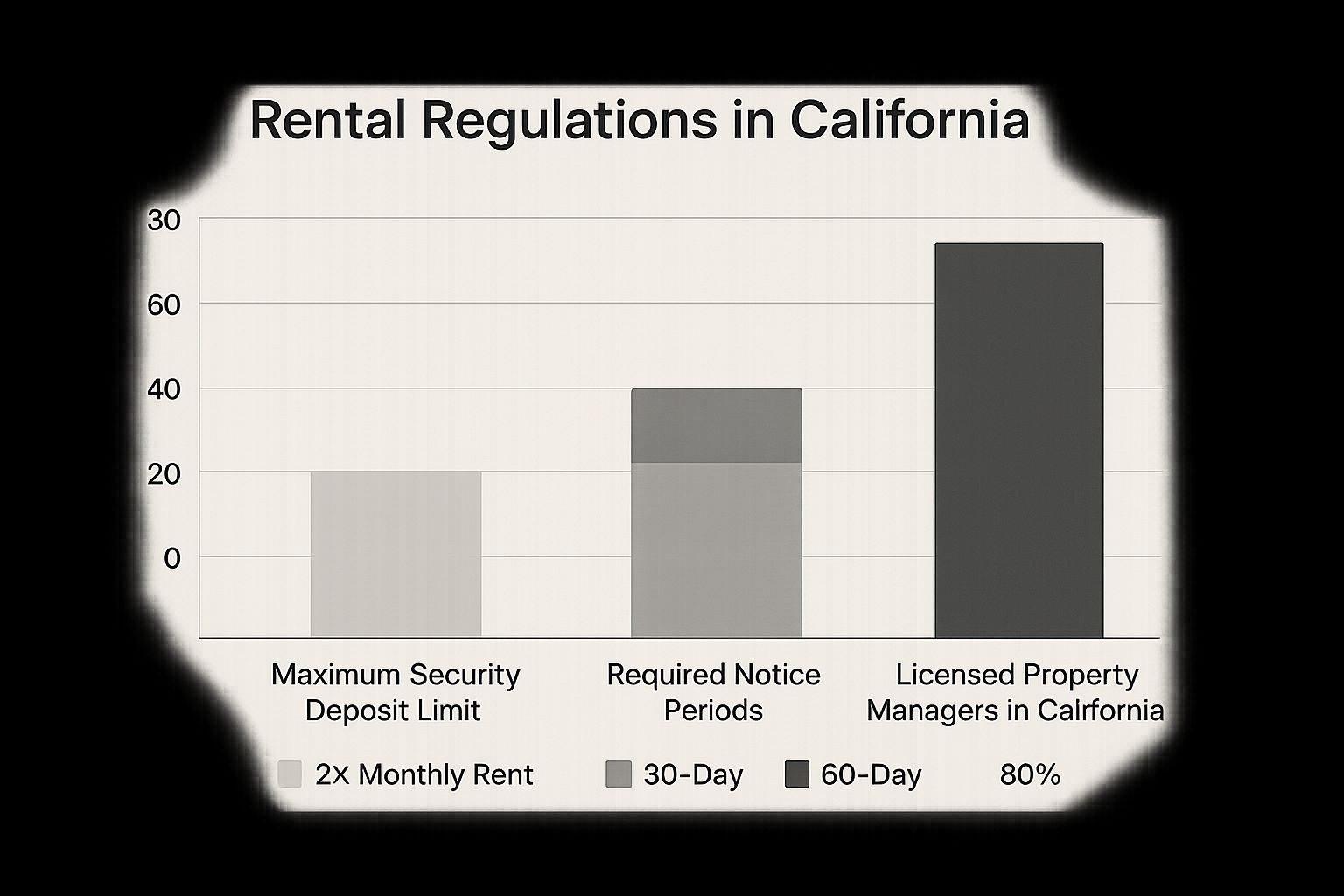
This data highlights the strict legal framework—from security deposit limits to required notice periods—that a professional manager must navigate. It reinforces why partnering with a licensed, knowledgeable expert is critical to your success.
Deconstructing Common Management Fees
When reviewing a contract, you will encounter several types of fees. Understanding their purpose allows you to make an informed decision. Here’s a practical breakdown of what to expect in the Monterey Bay Area.
- Monthly Management Fee: This is the core fee for all day-to-day operations. It's typically structured as either a percentage of the monthly rent collected or a flat fee. The percentage model is most common, as it aligns the manager’s incentives with your goal of keeping the property occupied with a paying tenant.
- Tenant Placement or Leasing Fee: This is a one-time charge for the comprehensive work of finding and screening a high-quality tenant. It covers professional marketing, property showings, in-depth background and credit checks, and lease preparation. This fee is essential for avoiding the significant financial and logistical headaches that come with a poor tenant choice.
Typical Property Management Fee Structures in California
To provide a clearer picture, here’s a table outlining common fees. These are typical ranges for California but can vary based on the property type, location (e.g., Salinas vs. Carmel), and the level of service provided.
| Fee Type | Common Range in California | What It Covers |
|---|---|---|
| Monthly Management Fee | 7% – 10% of collected rent | Ongoing services like rent collection, tenant communication, and property inspections. |
| Tenant Placement Fee | 50% – 100% of first month's rent | Marketing, showings, tenant screening, and lease preparation to fill a vacancy. |
| Lease Renewal Fee | $150 – $300 flat fee | Negotiating and preparing a new lease for an existing, high-quality tenant. |
| Maintenance Markup | 2% – 10% of vendor invoice | Administrative overhead for coordinating and overseeing repairs and maintenance. |
| Eviction Service Fee | $600 – $1,200 plus court costs | Handling the legal paperwork and court appearances required for an eviction. |
These figures demonstrate the importance of looking beyond cost to consider the quality and scope of services you receive.
Additional Fees to Anticipate
Beyond these core charges, a quality property management contract california will transparently list other potential costs. A reputable manager will discuss these upfront to ensure there are no surprises on your owner statement.
- Lease Renewal Fee: A small fee for handling the negotiation and paperwork to extend a lease with a great tenant. This incentivizes the manager to retain good tenants, which is more cost-effective for you than finding new ones.
- Maintenance Markup: Some firms add a small percentage to vendor invoices to cover the administrative work of scheduling, managing, and verifying repairs. This ensures the job is done correctly and efficiently, saving you time.
- Eviction Service Fee: If an eviction becomes unavoidable, this fee covers the manager’s time for filing documents and appearing in court. It’s a service you hope never to need but is vital for protecting your property and your ROI.
The fee structure in your contract should reflect a partnership. When evaluating proposals for your Monterey County property, look beyond the numbers to the value being delivered. A comprehensive, transparent fee schedule from a trusted firm like Coast & Valley is an investment in professionalism, compliance, and your own peace of mind.
How to Navigate Termination Clauses and Exit Strategies
While every owner hopes for a long, successful partnership, a savvy investor knows you must have a clear exit strategy built into your property management contract. This is the purpose of the termination clause. It is one of the most critical yet frequently overlooked sections of the agreement—your parachute if the relationship no longer serves your investment goals. Clarifying this section is not just a good idea; it's a non-negotiable for protecting your asset.

Imagine this scenario: you're unhappy with how your property in a South County town like King City or Gonzales is being managed, only to discover you’re locked in for another year with no reasonable way out. A vague or punitive termination clause can cause significant frustration, trapping you in an underperforming partnership that jeopardizes your ROI. This is precisely why a professional, owner-focused contract is so important.
Terminating With Cause vs. Without Cause
To protect your interests, you must first understand the two primary ways a contract can be terminated. This distinction shapes the entire process, from the timeline to the potential costs of parting ways.
-
Termination "With Cause": This applies when one party fails to uphold their end of the agreement. For a property manager, this could range from negligence and illegal acts to simply not performing the duties specified in the contract. A solid agreement will clearly define what constitutes a breach and outline the steps for termination, which usually involves written notice and a brief period for the manager to "cure" or fix the issue.
-
Termination "Without Cause": This is your no-fault exit strategy. It allows either party to end the agreement for any reason. For a busy professional, this flexibility is invaluable. The key detail here is the notice period, which should always be a reasonable timeframe, typically 30 to 60 days.
Pro Tip for Monterey County Owners: Always insist on a straightforward "without cause" termination clause with a fair notice period. This ensures you are never trapped in a partnership that isn't working for your high-value asset, whether it's a coastal home in Monterey or a multi-family building in Salinas.
An Actionable Checklist for Your Exit Strategy
When you're reviewing a contract, zoom in on the fine print in the termination section. A concierge-level firm like Coast & Valley will always ensure this process is transparent and fair, focusing on a smooth transition instead of punitive fees.
Your termination clause should meticulously spell out the following details:
- Notice Period: The exact number of days required for written notice (e.g., 30, 60, or 90 days) for a "without cause" termination.
- Early Termination Fees: Be wary of excessive fees. A reasonable cost to cover the manager's expenses if you exit early is fair, but it should never be a penalty designed to trap you. A fair fee might be a flat rate or equivalent to one month's management fee.
- Transition of Records: The contract must legally require the manager to promptly hand over all essential documents. This includes tenant leases, payment histories, maintenance records, and keys.
- Transfer of Funds: The process for transferring tenant security deposits and any reserve funds held in trust must be clearly defined to ensure compliance with California law.
A messy termination can become entangled with tenant issues. For instance, if a manager's poor service leads to a situation where an eviction is necessary, you need a seamless handover of all documentation. Knowing how to evict a tenant in California is already complex; your contract must ensure you have the records to proceed legally and efficiently.
Meeting California Legal and Compliance Mandates
Navigating California's labyrinth of landlord-tenant laws is not a task for the uninitiated. For property owners in the Monterey Bay Area, a fully compliant management contract is not just a best practice—it’s your primary shield against significant legal and financial liability. A single misstep can trigger costly penalties, which is why state and local compliance must be the absolute bedrock of your investment strategy.
Your property management contract should serve as a written guarantee that your manager has the legal expertise to operate correctly. The agreement must explicitly state that every action taken will adhere to the complex rules set by the California Department of Real Estate (DRE) and other governing bodies. This is where partnering with a deeply knowledgeable local expert, with roots in communities like Salinas, demonstrates its true value.
Trust Fund Handling and Security Deposits
Of all the areas of California property law, the handling of tenant funds—especially security deposits—is one of the most heavily regulated. The DRE has extremely strict rules to safeguard these funds and prevent commingling with a manager's operating accounts. Your contract must state, in no uncertain terms, that all deposits will be held in a separate, compliant trust account.
This isn't a minor bookkeeping detail; it's a fundamental measure of a manager's professionalism and integrity. The regulations have recently tightened. As of July 1, 2024, Assembly Bill 12 limits security deposits to one month's rent for most residential properties. A professionally drafted contract will reflect this new cap and detail the non-negotiable, 21-day deadline for returning a deposit or providing an itemized list of deductions upon tenant move-out.
Expert Insight: "A professionally managed trust account is non-negotiable. It’s a clear indicator that your manager operates with the transparency and integrity required to protect both your asset and your reputation as a landlord." – Amy Salmina, Owner/Broker, Coast & Valley Properties
Navigating Statewide Rent Control and Eviction Laws
The Tenant Protection Act of 2019 (AB 1482) fundamentally reshaped the rental landscape for landlords across the state. Your contract must demonstrate that your manager has mastered its rules. This law introduced statewide rent caps and "just-cause" eviction requirements that cover many, but not all, rental properties. An experienced manager serving the Salinas Valley knows exactly which properties are exempt and which are not.
Your agreement should authorize your manager to act in full compliance with these laws, protecting you from wrongful eviction lawsuits or disputes over illegal rent increases. For example, if a "no-fault" eviction is required for substantial renovations on a property in Pacific Grove, the contract must empower your manager to serve the proper notices and pay any required relocation assistance. Getting this wrong can be incredibly costly, which highlights the importance of understanding the complex California landlord-tenant laws.
The Unwavering Commitment to Fair Housing
Adherence to federal, state, and local fair housing laws is not optional—it is an absolute requirement. Your contract needs a clause that binds your property manager to comply with all anti-discrimination laws. This protects you from liability by ensuring that marketing, tenant screening, and day-to-day management are conducted fairly and equitably. In California, this includes protecting an applicant's source of income, meaning your manager must have a compliant process for evaluating tenants who use government rental assistance.
Make no mistake, the property management industry in California is a significant economic force, with projected revenues of $18.2 billion in 2024 and over 50,790 businesses statewide. This dynamic market underscores the high stakes and the level of professionalism required to remain compliant. When you partner with a firm that integrates these legal mandates directly into your contract, you're not just hiring a rent collector. You are engaging a compliance expert dedicated to protecting your investment in the Monterey Bay Area and beyond.
Frequently Asked Questions About California Contracts

When navigating a property management contract in California, it's natural for questions to arise, especially for owners of high-value properties in Monterey County. We frequently address these with investors and homeowners in Salinas, Pacific Grove, and the surrounding communities. Below, we've provided clear, actionable answers to some of the most common questions to give you the confidence to move forward.
Does a California Property Manager Need a Real Estate License?
Yes, absolutely. This is a non-negotiable legal requirement in California. Any individual or company managing rental properties for others in exchange for compensation must be a licensed real estate broker or a salesperson working under the direct supervision of a broker. This is a critical safeguard for you as a property owner.
This license signifies accountability to the California Department of Real Estate (DRE). It is your assurance that the manager has met stringent educational requirements and is held to a high professional standard, including the rigorous rules for handling trust funds like tenant security deposits. Never partner with an unlicensed manager—it exposes you to immense financial and legal risk.
What Happens if I Disagree with My Manager Over a Repair Charge?
A professionally written contract will have a clear process for this mapped out. You should never be blindsided by a surprise invoice for a major repair on your property, whether it's in Soledad or Pebble Beach.
Here’s the actionable process a solid contract should include:
- Spending Limit: The agreement must specify a dollar amount (for example, $500) that the manager can spend on a single repair without your authorization. Anything over that limit requires your prior approval. This empowers you to maintain control over significant expenses.
- Dispute Protocol: If a disagreement arises, the contract should outline the next steps. This typically begins with a written notice of the dispute, followed by a period of good-faith negotiation to find a resolution before escalating the matter.
Always review this section to ensure the spending limit and resolution process align with your expectations.
Can I Use a Standard Online Contract Template?
Relying on a generic, one-size-fits-all contract template from the internet is one of the riskiest decisions a property owner can make. For investors with high-value assets in a market as nuanced as Monterey County, these documents are insufficient and potentially dangerous.
Key Risk: Boilerplate templates are not designed for California's unique and complex legal environment. They often fail to address crucial state laws like the Tenant Protection Act (AB 1482) or specific local ordinances in cities like Salinas or Monterey, leaving you exposed.
A custom contract drafted by a local expert like Coast & Valley Properties is tailored to your specific property, your investment goals, and our local market. It ensures you are fully compliant and protected in ways a generic document cannot. The agreement should also clearly define responsibilities; learn more by exploring the differences between landlord responsibilities vs tenant duties in our guide. Achieving this clarity from the outset is essential for a smooth, profitable, and stress-free partnership.
Protecting your investment demands a partnership built on local expertise and absolute trust. The team at Coast & Valley Properties provides the concierge-level service and legal diligence necessary to manage your Monterey County property with precision and care.
Contact us today to schedule a comprehensive evaluation of your property management needs.