
Mastering Your Monterey County Property’s Financial Reports
For any serious property owner in the Monterey Bay Area, true peace of mind goes beyond simply seeing rent hit your bank account. It’s about having absolute financial clarity and confidence in your investment's performance. Property management financial reports are the official story of your asset's health, turning complex data into actionable insights that fuel growth and preserve your property's long-term value.
Your Guide to Financial Clarity and ROI in Monterey County
Whether you own a luxury home in Carmel-by-the-Sea, a multi-unit apartment building in Salinas, or a portfolio of properties across South County towns like Soledad and Gonzales, mastering these financial documents is non-negotiable for maximizing your return on investment (ROI). These reports aren’t just for your accountant at tax time; they are powerful, concierge-level tools that facilitate productive conversations with your property manager, track performance against your goals, and empower you to make savvy, data-driven decisions.
For a busy professional or serious investor, these documents offer a transparent, line-by-line account of every dollar that comes in and every dollar that goes out. They are the foundation of trust and professionalism between an owner and a management team, proving that your high-end property is being handled with precision. This guide will demystify the most important reports, showing you exactly what to look for and how to leverage them to grow your portfolio with confidence.
The Core Financial Reports Every Investor Should Know
At the heart of professional property management accounting are three essential reports. Think of them as a team—each tells a different part of the story, but together they paint the complete financial picture of your investment property.
- Income Statement (P&L): This report details your property's profitability over a specific period, like a month or quarter. It answers the critical question: "Is my property truly generating wealth?"
- Balance Sheet: This provides a snapshot of your property's financial strength at a single point in time, listing assets, liabilities, and your equity. It answers: "What is the overall net worth of my investment right now?"
- Cash Flow Statement: This tracks the real cash moving in and out of your accounts, showing how money is being generated and spent. It answers the crucial question: "Where did my cash go?"
This infographic illustrates how these foundational documents are interconnected.
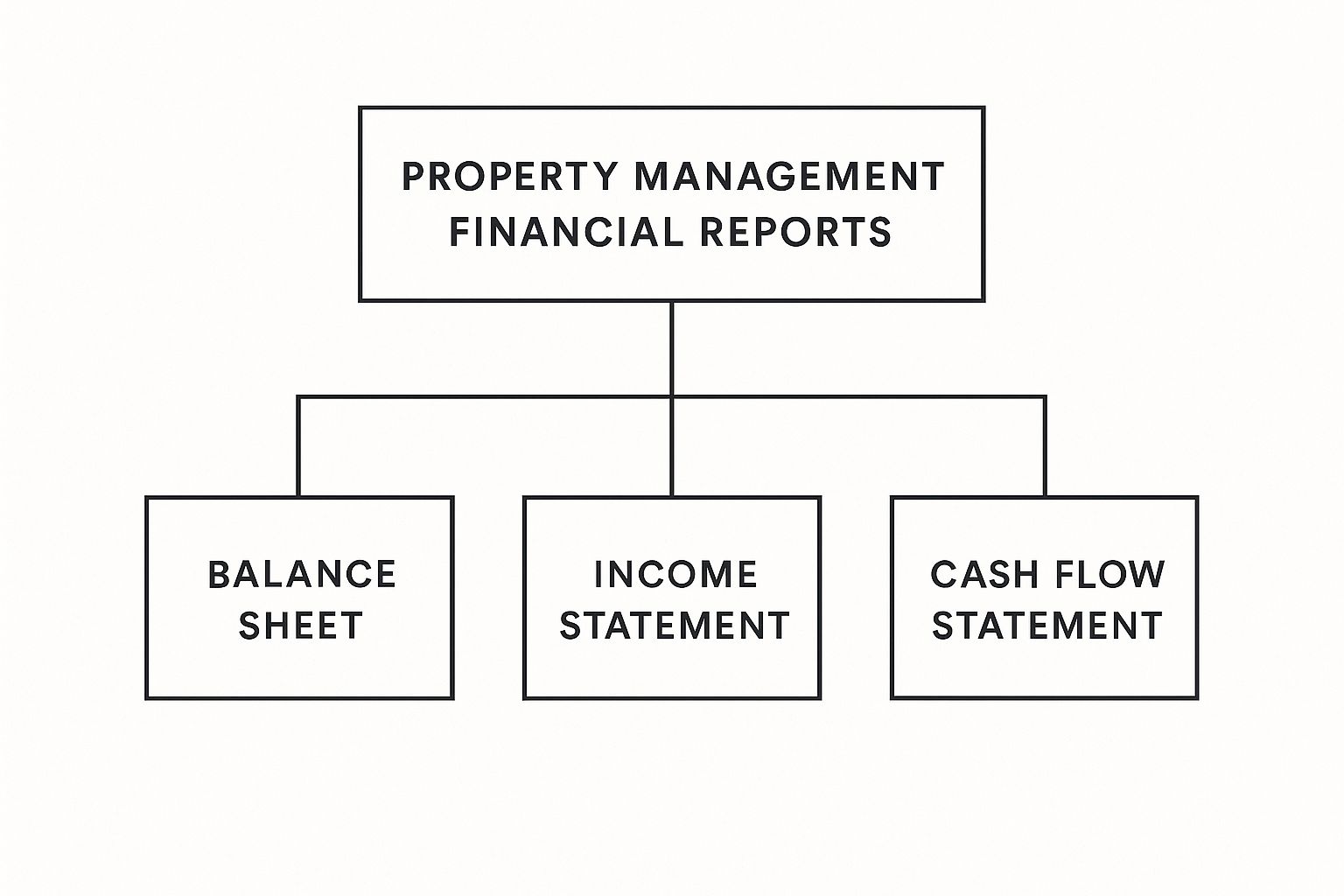
As you can see, each report offers a unique angle. When you review them together, you get a comprehensive financial overview of your Monterey County property.
To help you get a quick handle on this, here's a simple breakdown of the most critical reports and what they tell you at a glance.
Key Financial Reports for Monterey County Property Owners
| Report Name | What It Tells You | Key Question It Answers for an Owner |
|---|---|---|
| Income Statement (P&L) | A summary of revenues and expenses over a period. | Is my property profitable over the long term? |
| Balance Sheet | A snapshot of assets, liabilities, and owner's equity. | What is my property's net worth right now? |
| Cash Flow Statement | Tracks the movement of actual cash. | Where did my money come from and where did it go? |
| Rent Roll | A detailed list of all tenants and their lease terms. | Who is paying, how much, and are they on time? |
| General Ledger | A complete record of every single financial transaction. | Can I see the detailed history of every transaction? |
Understanding these five reports is the first step toward mastering your investment's finances and making truly informed, strategic decisions.
Modern Tools for Ultimate Transparency & Trust
Achieving this level of financial insight is easier than ever with modern technology. At Coast & Valley, we provide our clients with a secure online owner portal, a cornerstone of our commitment to trust and transparency. This gives you 24/7 access to all these reports and the detailed data behind them, reinforcing our authority and professionalism.
This digital-first approach means you’re always in control of your investment, no matter where you are. For a deeper look into how this works, you can explore this strategic guide to cloud accounting solutions. It’s this kind of on-demand, high-end service that discerning property owners from Pebble Beach to King City expect and deserve.
The Owner Statement: Your Monthly Performance Snapshot

If the full suite of property management financial reports tells the complete story of your investment, then the Owner Statement is the executive summary. Think of it as your property’s monthly performance report, designed for the busy investor who demands clarity, precision, and a time-saving solution.
Frankly, it's the single most important document for understanding your property’s immediate cash flow. This statement boils down all financial activity for a specific period—usually one month—into a clear, digestible format. It details every dollar of income collected and every dollar of expense paid, giving you an unambiguous bottom line. This is where you see your gross rental income, any extra fees collected, and all deductions for management, maintenance, and other services.
Ultimately, the Owner Statement answers one critical question for our clients from Salinas to Monterey: "How much cash did my property generate this month, and where did it go?"
Breaking Down a Typical Owner Statement
A well-structured Owner Statement provides a transparent, line-by-line breakdown of your finances. At Coast & Valley, founded on Amy Salmina’s local roots and commitment to professionalism, we ensure every single entry is clear and traceable. Here’s what you can expect to see:
- Income Summary: This section lists all sources of revenue. The main entry is, of course, the rent we've collected. But it might also include other income streams like late fees, pet fees, or application fees, giving you a complete picture of your property's earning power.
- Expense Summary: Here, you'll find an itemized list of all costs. Common expenses include our management fee, landscaping for a Carmel property, a plumbing repair in Soledad, or a pre-approved appliance upgrade you requested to preserve the property's value.
- Owner Distribution: This is the bottom line—the net income paid directly to you after all expenses are covered. It's the actual cash deposited into your account from the month's operations, reflecting your immediate ROI.
A Note on Trust & Transparency: Every expense listed on your Owner Statement is backed by a corresponding invoice. Through our secure owner portal, you can access these documents 24/7. This gives you absolute confidence that your funds are being managed with the utmost integrity and professionalism.
Actionable Insight: Using Your Statement for Strategic Oversight
Your Owner Statement is more than just a receipt; it’s a powerful tool for strategic oversight. By reviewing it each month, you can quickly spot trends, identify unusual spending, and see how your property is performing against your budget.
Actionable Step: When you receive your statement, compare the maintenance expenses to the previous month. A sudden spike in utility costs at your Salinas rental could signal a leak or other maintenance issue that needs immediate attention. This proactive review helps protect your asset.
Understanding this report empowers you to have meaningful, data-driven conversations with your property manager. It’s the foundation for planning future capital improvements and optimizing your ROI. For a detailed walkthrough, you can explore a sample of our comprehensive Owner Statement layout and its components.
This focus on clear, actionable reporting is essential. Globally, real estate performance often hinges on the balance between income and capital growth. For example, recent market analysis showed an 8.1% total return in the UK, driven primarily by income, not asset appreciation. This underscores how vital these reports are for knowing which levers are actually driving your returns, a topic you can learn more about by reviewing insights on global real estate trends from Aberdeen Investments.
Analyzing Your Profit And Loss Statement for Long-Term Growth
While your monthly Owner Statement provides a clear picture of cash flow, the Profit and Loss (P&L) Statement offers a broader perspective on your investment's long-term financial health. Think of it this way: the Owner Statement is a snapshot of the cash in your wallet today. The P&L is your annual financial review, showing if you're truly building wealth over time.
This is the document your accountant will rely on for tax preparation and the report you'll analyze to evaluate how your Monterey County portfolio performed over a quarter or an entire year. It shifts your focus from simple cash-in, cash-out transactions to overall profitability, helping you make smart, forward-looking decisions that enhance your ROI.
From single-family homes in Salinas to high-end rentals in Pacific Grove, understanding your P&L is non-negotiable for any serious investor. It’s the ultimate report card for your property’s financial success.
Cash vs. Accrual: The Story Behind The Numbers
One of the most important concepts to grasp when looking at your P&L is the difference between cash-basis and accrual-basis accounting. This distinction often explains why your P&L might show a healthy profit even when your bank account feels tight.
- Cash-Basis Accounting: This method is straightforward. It records income only when cash is received and expenses only when cash is paid. It mirrors your bank account activity, much like the Owner Statement.
- Accrual-Basis Accounting: This method records income when it's earned (even if the check hasn't arrived) and expenses when they're incurred (even if you haven't paid the bill). Your P&L typically uses this approach to give a truer financial picture.
Here’s a real-world example for Monterey County. Let's say a major roof repair was completed on your Gonzales property in December, but you arranged to pay the contractor's invoice in January. An accrual-basis P&L for December would show that expense, giving you an honest look at that month's profitability. A cash-basis report wouldn't, pushing the expense to January and making your December results look deceptively strong.
Actionable Insight: Identifying Trends And Optimizing Performance
The real power of the P&L is its ability to reveal trends over time. When you analyze your categorized revenue and expense lines month after month, you can uncover powerful insights.
For a discerning investor, the P&L isn't just a tax document—it's a strategic roadmap. It highlights opportunities to enhance revenue, control costs, and maximize the long-term value of your asset.
A detailed review can uncover patterns specific to the Monterey Bay Area. You might notice utility bills spiking during the cooler winter months or see the clear ROI from a recent kitchen upgrade through increased rent potential.
Actionable Step: Lay out your last three P&L statements side-by-side. Look for expense categories that are consistently rising, like "Repairs & Maintenance." This could indicate an aging system that needs a capital improvement plan, rather than continued small fixes. By analyzing your P&L, you can pinpoint areas for improvement and implement proven strategies to save expenses, which goes directly to your bottom line.
This deep dive into your property’s numbers is what allows for truly strategic management. At Coast & Valley, we use these insights to offer proactive advice that helps you meet—and exceed—your investment goals. You can see how we present these crucial numbers by checking out our guide to property management financial reports for Salinas investment properties.
The General Ledger: The DNA of Your Financials

If your Owner Statement is the highlight reel of your property's performance, think of the General Ledger (GL) as the complete, unabridged encyclopedia. It’s the most detailed of all property management financial reports, providing a chronological, line-by-line record of every single transaction. For every summary number you see on another statement, the GL holds the full story behind it.
This is where trust and transparency are truly forged between a property owner and their management team. For the serious investor with assets in Monterey County, the General Ledger offers the ultimate assurance that every dollar is accounted for with meticulous precision, a cornerstone of professionalism.
Tracing Every Transaction with Confidence
The real power of the General Ledger is its ability to trace any financial event from start to finish. Let’s say a necessary plumbing repair was done at your rental property in Salinas. The GL will show you the entire journey:
- The Initial Entry: A charge from the plumbing company is recorded.
- The Payment: A corresponding entry shows the funds leaving the account to pay that invoice.
- The Categorization: The expense is correctly coded under "Repairs & Maintenance."
This creates an unbreakable audit trail. If a tenant in Soledad disputes a charge or you have a question about a specific maintenance cost, the GL provides the definitive answer—often linked directly to the original invoice, which you can access 24/7 in your owner portal.
For discerning owners, the General Ledger is non-negotiable. It transforms financial management from a matter of trust to a matter of verifiable fact, providing absolute clarity and protecting your investment from ambiguity.
Why This Granular Detail Is Essential for High-End Investors
This meticulous record-keeping isn't just for peace of mind; it's a critical business tool that reinforces trust. It guarantees accuracy for tax purposes, simplifies potential audits, and provides the unshakeable documentation you need to resolve any financial question. In an industry where operational efficiency and trust are paramount, this level of detail is a global standard of excellence.
For instance, Europe’s property management market represents over 30% of worldwide revenue in 2025. Markets like Germany are projected to grow 7.3% annually, largely driven by adopting platforms that sharpen financial reporting accuracy. This global shift underscores the immense value of precise systems like a well-kept General Ledger.
At Coast & Valley, we see the General Ledger as a cornerstone of our professional commitment. It is the DNA of your financials, and our team, led by Amy Salmina’s expertise, ensures it’s managed with the integrity your high-end property deserves. To see how we put this into practice, take a look at our overview of professional property management accounting services.
Of all the reports we run for your property, the Owner Statement and P&L are the ones that track performance over time. But there are two other critical property management financial reports that give you a more strategic, big-picture look at your asset's health and future potential: the Balance Sheet and the Rent Roll.
Learning how to read these two together gives a savvy investor like you the full story—not just your investment's current value, but also its power to generate revenue down the road.
The Balance Sheet: A Snapshot of Your Asset's Value
Think of the Balance Sheet as a perfectly clear financial photograph of your property, taken on one specific day. It doesn't track performance over a month or a quarter. Instead, it’s a static snapshot of everything you own (your assets) and everything you owe (your liabilities). The difference between those two numbers is your equity—the true measure of your stake in the investment.
For any property owner in the Monterey Bay Area, the Balance Sheet is built on one simple, powerful equation: Assets = Liabilities + Owner’s Equity.
Let’s break that down with a real-world example for a high-end rental in Pacific Grove:
- Assets: This includes everything of value tied to the property. Your biggest asset is the property itself, listed at its original purchase price. Other assets include cash in the bank and major capital improvements you've made that boosted its value.
- Liabilities: This column lists everything the property owes. It includes the remaining mortgage balance, any other property loans, and tenant security deposits (which we hold in trust and are obligated to return).
- Owner’s Equity: This is the number you really want to watch. It's what’s left when you subtract all liabilities from your assets. It shows you the pure, net value of your investment at that exact moment.
By checking your Balance Sheet regularly, you can watch your wealth grow as you pay down your mortgage and the property appreciates. It's a fantastic motivator and a key indicator of long-term ROI.
The Rent Roll: Your Revenue Engine
If the Balance Sheet shows your asset’s value, the Rent Roll shows its pulse. This report is all about future income potential. It isn't a backward-looking financial statement; it's a dynamic, unit-by-unit look at your current and expected rental income.
For investors with multi-unit properties, whether in Salinas or down in South County towns like King City, the Rent Roll is one of the most important day-to-day management tools you have. It provides a clean, organized list of every tenant and the financial details of their lease.
The Rent Roll is your primary tool for forecasting income, managing lease renewals, and proactively identifying vacancy risks. It transforms your tenant list into an actionable financial document that drives strategic leasing decisions.
A detailed Rent Roll from a professional manager like Coast & Valley will always provide:
- Unit & Tenant Information: Identifies each unit and tenant name.
- Lease Terms: Shows lease start and end dates, critical for planning renewals.
- Rent Details: Lists the monthly rent, security deposit held, and current payment status (e.g., "paid," "past due").
- Market Rent Comparison: A top-tier report compares current rent to the estimated market rate, instantly showing opportunities to optimize rent upon renewal.
Actionable Step: When reviewing your Rent Roll, look at the "Lease End Date" column. If you see multiple leases ending in the same month, contact us to discuss a strategy for staggering renewals to minimize potential vacancy loss. This proactive step helps protect your cash flow and ensures your property performs at its absolute best.
Using Reports For Strategic Growth And Asset Protection
Your property management financial reports shouldn't just be a look in the rearview mirror; they are powerful tools for charting your future. For any serious investor in Monterey County, these documents are the foundation for smart growth, asset protection, and confident decision-making. This is how you move beyond just reviewing past performance and start using financial data to actively build long-term wealth and save valuable time.
Think of your reports as a strategic roadmap. They show you exactly where you've been, but their true value lies in helping you plot the best course forward. A hands-on, concierge-level property manager uses this financial story to offer proactive advice, turning raw numbers into a clear, actionable strategy for your portfolio.
Actionable Strategy: Conducting A Variance Analysis
One of the most powerful things you can do is a variance analysis. It sounds technical, but it’s a straightforward comparison of your actual performance (from the P&L Statement) against your budget. This simple step immediately flags where you're over or under budget.
For instance, say your budget for a Salinas property allocated $500 for landscaping, but the P&L shows you actually spent $800. That’s a significant variance that demands a closer look. Was it a one-time cleanup project, or have your monthly maintenance costs gone up? This analysis gives you the power to control costs with real precision and find new ways to optimize your revenue.
Actionable Strategy: Forecasting Budgets And Capital Expenditures
Your past financial reports are a goldmine of data for planning ahead. By analyzing historical maintenance costs and seasonal utility bills, you can build incredibly accurate operating budgets for the next year. This is especially valuable for properties across Monterey County, where seasonal trends and weather patterns can impact expenses.
For a high-end property owner, this data is essential for forecasting Capital Expenditures (CapEx)—those large, infrequent expenses like a new roof or an HVAC system replacement. By setting aside funds based on data-driven predictions, you turn a potential financial emergency into a planned investment. This protects both your cash flow and your asset’s long-term value.
This proactive financial planning can also strengthen your position at tax time. To get a better handle on how these planned expenses can benefit you, check out our guide on investment property tax deductions for landlords.
Securing Financing For Your Next Investment
When you're ready to grow your real estate portfolio, lenders want to see proof of success. A clean, professional set of financial reports from your current properties is one of the most compelling assets you can bring to the table. These documents prove you know how to manage properties profitably and responsibly.
A strong track record, backed by clear reporting that shows consistent ROI, signals that you are a low-risk borrower. This dramatically improves your odds of securing favorable financing for your next investment, whether it's in Pacific Grove, Carmel, or anywhere else on the peninsula.
Frequently Asked Questions About Financial Reports
Even the most experienced real estate investors have questions about their property management financial reports. That's completely normal—these documents are packed with detail for a reason. For owners with properties in Monterey County, from Salinas to Pebble Beach, having total clarity isn't a luxury; it's the standard of professional service you should expect.
Here are a few of the most common questions we hear, along with the straightforward, transparent answers you deserve.
How Often Should I Receive Financial Reports?
You should expect a comprehensive financial package delivered to you every single month. Timely reporting is essential for monitoring your property's performance and making smart, quick decisions.
At Coast & Valley, we provide our clients with 24/7 access to a secure online owner portal. All your reports are there on-demand, whenever you need them, underscoring our commitment to owner convenience and transparency.
Annually, you will also receive a complete Profit & Loss (P&L) statement and a year-end summary, essential for tax time and for evaluating the big-picture performance of your investment over the past 12 months.
How Can I Verify The Expenses On My Statement?
Trust is everything, but it must be backed by verifiable proof. A professional property manager makes this easy by providing copies of the actual invoices for any work done on your property. Every single expense, whether it's a minor repair in Soledad or a major capital improvement in Carmel, must be documented.
Our Commitment to Trust: Through your secure owner portal, you can pull up and review every invoice connected to your property. This direct 'paper trail' is then cross-referenced in your General Ledger, giving you complete confidence that every charge is legitimate, recorded correctly, and tied directly to maintaining your asset.
What Is The Difference Between Management Fees And Maintenance Costs?
This is a fantastic question because it gets right to the heart of understanding your statements. These are two fundamentally different costs, and they should always be broken out as separate line items for clarity.
-
Management Fee: This is the predictable, recurring cost for our professional, full-service solutions. It’s the agreed-upon rate, usually a percentage of collected rent, for expertly overseeing and administering your property to protect its value and your time.
-
Maintenance Cost: These are the hands-on, variable expenses for the physical upkeep and repair of the property itself. This covers everything from landscaping and plumbing fixes to replacing an appliance or painting a room.
Keeping these two categories separate is vital for accurate budgeting and understanding the true financial health of your property. To get a better handle on this, you can learn more about the critical property management KPIs to track for your investment.
At Coast & Valley Properties, we believe that clear, accurate, and transparent financial reporting is the cornerstone of a successful partnership and exceptional ROI. If you’re ready for a property management experience that provides this level of clarity, trust, and peace of mind for your Monterey County investment, contact us for a consultation. https://coastandvalleypm.com