
What Is Net Operating Income for Your Monterey County Rental?
For any busy property investor in Salinas or Monterey County, one number cuts through the noise to reveal the true health of your asset: Net Operating Income (NOI). It is the single most important metric for judging a rental's financial performance.
Think of NOI as your property's annual profit and loss statement, simplified. It shows you exactly how profitable your investment is from its day-to-day operations, before considering financing or income taxes. It’s like calculating the profit from a Carmel Valley vineyard after paying for staff and supplies, but before you pay the bank.
The True Profitability of Your Monterey County Property
If you're a serious investor with a high-end property in Pacific Grove or a multi-unit building in Salinas, understanding Net Operating Income is non-negotiable. It answers one critical question: Is this property making money from its core business?
A high nightly rate on a Carmel rental might look impressive, but that number doesn't tell the whole story. NOI forces you to look at the complete financial picture by accounting for all the necessary costs of running the property. This reveals its true operational performance, not just its gross revenue.
As your local property management experts, we’ve seen it time and again. A relentless focus on NOI is the foundation of any intelligent investment strategy in the Monterey Bay Area. It’s the difference between a property that looks good on paper and one that actively builds your wealth.
What makes this metric so powerful is its ability to create an apples-to-apples comparison between different properties. It doesn't matter if you're evaluating a single-family home in a South County town like Soledad or a luxury condo overlooking Monterey Bay. NOI standardizes performance by focusing only on the income and expenses you can directly control through expert management—delivering clarity and empowering better decisions.
This diagram breaks down how Gross Income and Operating Expenses flow together to create your property's Net Operating Income.
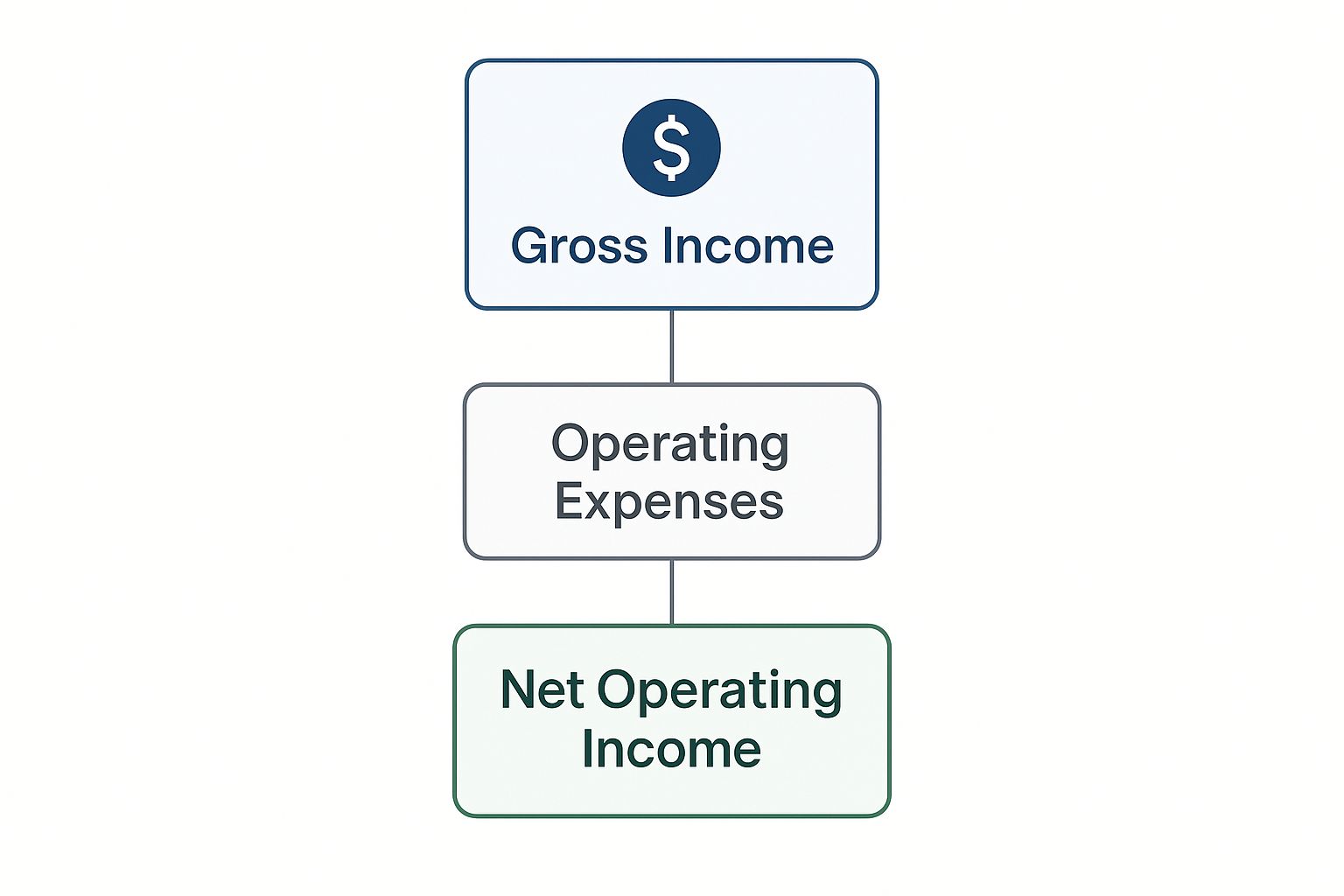
As the visual clearly shows, NOI is the crucial number you get after subtracting all the day-to-day operational costs from your total revenue. It’s the real measure of your property's success and the cornerstone of maximizing your return on investment.
Calculating Your Property's True Revenue

When you think about your property’s income, the monthly rent check is just the beginning. For savvy investors here in Monterey County, understanding every single dollar that comes in is the first step toward getting an accurate Net Operating Income (NOI).
We start with a figure called Gross Operating Income (GOI). This number represents the absolute maximum your property could earn if it were 100% occupied and every tenant paid on time, every time. Think of GOI as the best-case, blue-sky scenario for your investment.
Step 1: Sum Up All Income Streams
To calculate your GOI, you must add up all potential revenue sources. Whether you own a high-end property in Pebble Beach or a multi-unit complex in Salinas, this usually includes more than just the base rent.
- Scheduled Gross Rent: This is the straightforward part—the total rent you’re supposed to collect from all your units each month.
- Additional Income: Don't forget the extras. Revenue from amenities and other services can significantly boost your bottom line. This could be pet fees, laundry machine income, or charges for assigned parking in packed areas like downtown Monterey or Carmel-by-the-Sea.
By tracking these numbers meticulously, you start building a complete picture of your property's total earning power.
Step 2: Adjust for Real-World Conditions with EGI
Let's be realistic: no property stays 100% occupied all year long. To move from a theoretical number to a realistic one, you need to calculate your Effective Gross Income (EGI). This is where professional experience really makes a difference.
EGI takes your Gross Operating Income and adjusts it for the realities of being a landlord, like vacancy periods and credit loss (uncollected rent). It gives you a much clearer, more honest projection of the cash you'll actually have in hand to cover expenses.
For example, a luxury rental in Pacific Grove might sit empty for a month between long-term tenants. A property in a South County town like Soledad or King City might have a tenant who pays late or, worse, defaults on their lease. These are the real-world scenarios you have to account for. For a deeper dive, explore our guide on strategies for higher rental income.
If you're in the vacation rental game, this gets even more complex. Forecasting revenue for a short-term rental requires a different approach, and using specialized Airbnb revenue forecasting tools can offer a huge advantage. By nailing down your EGI, you create a solid, realistic foundation for the entire "what is net operating income" calculation.
Identifying Your Real Operating Expenses

One of the most common—and expensive—mistakes we see investors make is miscategorizing expenses. When you get this wrong, you get a distorted picture of your property’s health, which often leads to poor financial decisions and missed opportunities to improve ROI.
To get an accurate Net Operating Income, you must subtract only the true operating expenses. These are the necessary, everyday costs of keeping your property safe, functional, and generating income. They are the cost of doing business as a landlord, not one-off investments or financing costs.
Fixed vs. Variable Operating Expenses
Your operating expenses fall into two buckets. Mastering both is critical for forecasting cash flow and building a realistic budget, whether you own a single-family home in Salinas or a portfolio of coastal properties.
1. Fixed Expenses: These costs barely change from month to month, regardless of occupancy. They form the predictable foundation of your budget.
- Property Taxes: A significant and unavoidable cost set by Monterey County.
- Property Insurance: Absolutely essential for protecting your valuable asset from liability and unexpected events.
- HOA Fees: A regular expense if your property is in a planned community, which is common in areas like Pebble Beach or parts of Carmel.
2. Variable Expenses: These costs fluctuate based on tenant usage, seasonality, and occupancy levels.
- Utilities: Water, sewer, and trash, if you are responsible for these costs.
- Routine Maintenance & Repairs: This covers everything from landscaping and pest control to fixing a leaky faucet. Get a deeper dive in our guide to rental property maintenance costs.
- Property Management Fees: A key expense that pays for itself in time saved, asset preservation, and professional expertise.
The core idea is simple: If a cost is necessary for the daily operation of the property, it’s an operating expense. If it’s related to your loan, a major upgrade, or your personal tax situation, it doesn’t belong in the NOI calculation.
What to Exclude From Your NOI Calculation
Knowing what to leave out is just as important as knowing what to include. Adding these items will corrupt your numbers and give you a false sense of profitability. These are not operating expenses:
- Mortgage Payments (Debt Service): This is a financing cost related to how you bought the asset, not how you run it.
- Capital Expenditures (CapEx): Big-ticket improvements like a new roof, a full kitchen remodel, or an HVAC replacement are investments that add long-term value, not daily expenses.
- Depreciation: This is a non-cash deduction your accountant uses for tax purposes. No actual money leaves your pocket.
- Income Taxes: Your personal or corporate tax liability is separate from the property's operational performance.
Understanding operating income is fundamental to business, not just real estate. For example, in the U.S. retail sector, operating profits—a metric very similar to NOI—more than tripled between 2001 and 2022, showing how powerful this figure is for tracking performance. While NOI is a key metric, a full financial picture also requires understanding all the eligible tax deductions for rental property you can claim.
How NOI Directly Impacts Your Property's Value

You’ve done the hard work of identifying your property’s true income and expenses. Now we get to the exciting part: turning that NOI number into tangible wealth.
Your Net Operating Income is far more than a performance metric. It's the engine that directly powers your property's market value. For any serious investor in Monterey County—whether you own a multi-unit building in King City or a luxury estate in Carmel—this connection is everything.
The bridge between your annual profit and your property's total worth is a concept called the Capitalization Rate, or "Cap Rate." A Cap Rate is a percentage that shows the expected rate of return on a real estate investment. It’s set by the market and reflects the perceived risk and potential return for similar properties in a specific area like Salinas or the Monterey Peninsula.
The Valuation Formula Every Investor Must Know
The relationship between NOI, Cap Rate, and your property's value is captured in a simple but incredibly powerful formula:
Property Value = Net Operating Income (NOI) / Capitalization (Cap) Rate
Think of it like this: if your NOI is the fuel, the Cap Rate is the engine's efficiency rating. A lower, more attractive Cap Rate means the engine is more powerful—it can convert every dollar of NOI into a much higher property valuation.
A higher, more stable NOI makes your property a premium asset in the eyes of appraisers and potential buyers. It demonstrates proven profitability and lower risk, which naturally commands a higher price and attracts serious, well-qualified investors.
Local Market Forces and Your Property's Worth
Cap Rates are hyper-local. A commercial property in downtown Salinas will have a very different Cap Rate than a vacation rental in Pacific Grove or an apartment complex in Soledad. These rates are constantly being shaped by the local economy, tenant demand, and investor confidence in that specific community.
This is where having a local expert becomes essential. At Coast & Valley, we don't just manage properties; we live and breathe the Monterey County market, so we know the prevailing Cap Rates for assets like yours. By focusing on boosting your NOI through strategic management—like minimizing vacancies and tightening control over maintenance costs—we directly increase the top number in that valuation formula.
Every dollar you add to your NOI has a multiplied effect on your property's value. For example, increasing your annual NOI by just $5,000 in a market with a 5% Cap Rate instantly adds $100,000 to your property’s valuation ($5,000 / 0.05).
That’s how small, consistent operational improvements translate into significant equity growth. Seeing how all your key metrics work together is crucial, which you can explore further in our overview of essential property management KPIs.
Actionable Strategies to Boost Your Rental's NOI
Understanding Net Operating Income is one thing; actively improving it is where savvy investors in Monterey County build real wealth. This is your playbook for increasing profitability. At Coast & Valley, we focus on two fundamental areas to enhance your property’s performance and long-term value: smart revenue growth and strategic expense reduction.
Think of boosting your NOI not just as a real estate task, but as a core business principle. It's a time-tested measure of efficiency and profitability that's been around for over a century. It's not some modern buzzword—it's a foundational concept that smart operators have always used to gauge the health of their business.
Smart Revenue Growth
Growing your revenue doesn't always mean dramatic rent hikes. It often involves a combination of careful analysis, adding value, and minimizing losses from downtime. Our approach for properties from Salinas to Carmel is proactive and data-driven.
- Conduct Thorough Market Rent Analyses: One of the costliest mistakes is under-charging. We continuously analyze comparable properties in your specific neighborhood—be it South County or the Monterey Peninsula—to ensure your rent is aligned with current market demand, preventing you from leaving money on the table.
- Add New Income Streams: High-end tenants will pay for convenience. Consider adding small, revenue-generating amenities like offering paid, secure storage units for recreational gear, or implementing a premium for reserved parking spots in high-demand areas.
- Improve Tenant Retention: Vacancy is the ultimate profit killer. By providing exceptional, concierge-level service and responding quickly to tenant needs, we reduce turnover. A happy, long-term tenant means no lost rent between leases, no marketing costs, and no make-ready expenses. To ensure a steady stream of prospective tenants and maximize your property's revenue, explore additional proven real estate lead generation tactics.
Strategic Expense Reduction
Controlling costs is about being smart and proactive, not just cutting corners. Effective expense management protects your asset and boosts your bottom line simultaneously.
A dollar saved on expenses is a dollar added directly to your NOI. Unlike revenue, which can fluctuate, cost savings deliver a consistent, reliable boost to your property's profitability and overall value.
Here’s our action plan for strategically lowering your operating expenses:
- Leverage Our Vendor Network: With our long-standing relationships with trusted, local Monterey County contractors, we negotiate preferred rates for everything from landscaping to plumbing, passing those savings directly to you.
- Implement Proactive Maintenance: Waiting for something to break is always more expensive. We schedule regular inspections and preventive care to catch small issues before they become costly emergencies, protecting both your budget and your property.
- Install Energy-Efficient Upgrades: Simple changes like installing LED lighting, low-flow fixtures, or smart thermostats can significantly lower utility costs, especially in larger properties. These upgrades not only cut expenses but also appeal to environmentally conscious tenants and may qualify for certain tax benefits. To learn more, read our comprehensive guide on tax deductions for landlords.
Partner with Experts to Maximize Your Investment
Let's be honest—calculating and optimizing your Net Operating Income isn't a "set it and forget it" task. It requires constant attention, a deep understanding of the local Monterey County market, and a solid strategic plan. For any busy professional or serious investor, that’s a massive commitment of time and energy.
This is exactly where professional property management stops being a simple service and becomes a powerful strategic advantage for your high-end Monterey County asset. At Coast & Valley, we take the complex ideas behind what is net operating income and turn them into real, measurable results that boost your bottom line. We treat your property not as a building, but as a business that deserves expert oversight to maximize its ROI.
Your Strategic Advantage in the Monterey Bay Area
Our approach is built on trust, transparency, and two simple pillars: pushing revenue up and keeping costs down.
It all starts with our expert tenant placement process. By finding reliable, long-term occupants, we dramatically cut down on costly vacancies that erode your profits. Simultaneously, our proactive maintenance programs address small issues before they become expensive emergencies, directly lowering your operating expenses and preserving your asset's value.
With deep local roots in Salinas and a reputation for transparent, concierge-level service across the Monterey Peninsula, our founder, Amy Salmina, ensures we manage every property with the care it deserves. We provide the peace of mind that comes from knowing your valuable investment is in expert hands.
Managing a rental is so much more than just collecting a check. As we explain in our article on why rental properties are true businesses, success requires a dedicated, professional focus.
Your property in Carmel, Pacific Grove, or Salinas is a significant investment. Let our team provide a professional analysis of its NOI and unlock its true potential. Your asset deserves nothing less.
Your Top NOI Questions Answered
As property management experts here in Monterey County, we get a lot of questions from savvy investors trying to really nail down the details of Net Operating Income. It's a foundational concept, but the nuances are where the real money is made—or lost. Here are a few of the most common questions we hear, with straightforward answers.
How Often Should I Be Calculating My Property's NOI?
Great question. At a bare minimum, you need to calculate your NOI once a year. This is non-negotiable for tax purposes and for getting that big-picture, annual look at how your investment is performing.
But for active, hands-on management? We strongly recommend a quarterly review, especially for properties in dynamic markets like Carmel or downtown Monterey. Running the numbers every three months allows you to spot trends early, catch rising expenses before they become major problems, and make timely adjustments to your strategy. This proactive approach is key to optimizing your ROI.
Is NOI the Same Thing as Cash Flow?
No, it's not—and this is probably one of the most critical distinctions for any serious real estate investor to grasp. Your Net Operating Income shows you how profitable the property itself is, based purely on its day-to-day operations. It completely ignores your mortgage payment (debt service).
Cash flow is the actual money left in your bank account after you’ve paid the mortgage. Think of it like this: NOI tells you if the property is a well-run business. Cash flow tells you how much profit you personally walk away with after your financing costs are covered.
Can a Property Have a High NOI but Negative Cash Flow?
Absolutely, and it happens more often than you might think, especially in high-value markets like ours. This exact scenario usually pops up with highly leveraged properties—ones where the mortgage payment is hefty relative to the income.
Imagine a well-managed apartment building in Salinas. It could be running perfectly, with full occupancy and controlled expenses, generating a strong, positive NOI. But if the owner's loan payment is too high, it can consume all that operational profit and then some, leaving them with negative cash flow each month. This is precisely why savvy investors look at both metrics to get the full financial story.
It’s also crucial to remember how sensitive income can be to big economic shifts. During the 2008 financial crisis, for instance, the U.S. banking industry’s version of operating income fell to a staggering loss of $35.7 billion in a single quarter. This Statista analysis shows just how quickly external shocks can hammer profitability, a lesson that applies across industries.
Getting the most out of your property's NOI takes expertise and a constant finger on the pulse of the local Monterey County market. Let Coast and Valley Properties provide a professional analysis to unlock your investment's true potential. Contact us today for a comprehensive property evaluation.