
A Property Owner’s Guide to Property Management Workflow Automation in Monterey County
Managing a high-end property in places like Carmel-by-the-Sea or Pebble Beach demands more than just collecting rent; it requires a concierge-level experience where precision and responsiveness are paramount. This is where property management workflow automation becomes a strategic asset. It’s the core system we use at Coast & Valley to handle everything from tenant inquiries to maintenance dispatch, freeing you from tedious tasks so you can focus on what matters most: growing your investment portfolio.

The New Standard for High-End Monterey County Property Management
For savvy investors and owners of luxury properties across the Monterey Bay Area, "good enough" is unacceptable. You expect seamless, proactive service that preserves your asset's value and maximizes your return on investment. This is precisely where property management workflow automation shifts from a nice-to-have tool to an essential component of a successful, modern portfolio.
Imagine a system where rent reminders are sent automatically, maintenance requests are instantly routed to the right local vendor, and lease renewal notices go out 90 days in advance without anyone lifting a finger. This isn't a futuristic concept; it's the operational standard for premier property management today, delivering the peace of mind you deserve.
From Simple Convenience to a Tangible Strategic Edge
Automation isn't just a time-saver—it’s a powerful advantage in a competitive market like Monterey County. By putting routine tasks on autopilot, we virtually eliminate the risk of human error and ensure every action is handled with consistency and precision. Whether your property is a luxury vacation home in Pacific Grove or a multi-family building in Salinas, this operational excellence keeps high-quality tenants happy and encourages long-term stays.
The benefits for busy professionals and serious investors are clear and impactful:
- Enhanced ROI: Automated systems ensure rent is collected on time, every time. They can even support dynamic pricing strategies based on real-time market data, from the Salinas Valley to the Monterey Peninsula coast, ensuring your asset is always priced for optimal returns.
- A Superior Tenant Experience: Your tenants receive faster responses and appreciate the convenience of secure online portals for paying rent and submitting maintenance requests. This concierge-level service leads directly to higher satisfaction and longer, more profitable tenancies.
- Proactive Property Preservation: Automation helps us track and manage all maintenance proactively, preventing small issues from escalating into expensive, complex repairs. This is absolutely critical for protecting the long-term value of your high-end asset.
For our clients, the real value of automation is the peace of mind it brings. Knowing that day-to-day operations are handled flawlessly allows them to focus on their investment goals and their own busy lives. This is the concierge-level experience we are committed to providing.
The following table offers a clear, actionable comparison of manual processes versus the automated systems we implement for our clients.
Manual vs. Automated Workflow: A Side-by-Side Comparison
| Task | Manual Process (The Old Way) | Automated Workflow (The Coast & Valley Way) |
|---|---|---|
| Rent Collection | Chasing tenants via phone/email, processing paper checks, manual ledger entries. | Automatic email/SMS reminders, secure online payment portal, instant payment logging. |
| Maintenance | Fielding calls, playing phone tag with vendors, manually tracking work orders. | Tenants submit requests online with photos; requests auto-route to approved local vendors. |
| Lease Renewals | Manually tracking end dates, drafting and sending notices, following up individually. | System flags upcoming renewals, sends automated offers 90 days out, and tracks all responses. |
| Reporting | Spending hours compiling spreadsheets to create monthly financial statements. | Generate instant, detailed owner statements with one click from real-time, secure data. |
As you can see, the automated approach isn't just faster—it's smarter, more reliable, and built to deliver a superior experience for you and your tenants.
Embracing a Data-Driven, Local-First Approach
Modern automation has become a core operational standard for good reason. Recent data shows that 67% of property management companies have adopted specialized software to improve their processes, and 65% of these firms use AI-powered tools are improving property management for critical jobs like tenant screening. This systematic approach eliminates common errors and guarantees a professional, reliable system for managing your property.
Here at Coast & Valley, our team—led by fourth-generation Salinas native Amy Salmina—integrates this powerful technology with deep, boots-on-the-ground local expertise. We understand the unique demands of properties in our community, from the South County towns of King City and Gonzales to the prestigious estates on the Monterey Peninsula. Our promise is to pair this cutting-edge efficiency with the personalized, trustworthy service you deserve.
Step 1: Mapping Your Workflows to Find Automation Opportunities
Before you can implement property management automation, you first need a crystal-clear picture of your current operations. For property owners across Monterey County, from Salinas to Soledad, this process is often an eye-opener, revealing the hidden costs of inefficiency and pinpointing where technology can deliver the greatest ROI.
The goal is to create a "process map"—a detailed, step-by-step breakdown of your daily, weekly, and monthly tasks. Think of it as a diagnostic tool for your business. It’s not just about listing chores; it’s about understanding the actual time and resources each one consumes.
Actionable Checklist: Identifying Bottlenecks and Repetitive Work
Begin by tracking your most common activities. Be brutally specific. How many phone calls and emails does it really take to coordinate a simple plumbing repair for a rental in Gonzales or King City? How much time do you or your team spend chasing down late rent payments each month?
Use this checklist to document your current processes:
- Daily Tasks:
- Time spent answering tenant questions via phone/email.
- Steps to log a new maintenance request.
- Process for contacting and scheduling vendors.
- Weekly Tasks:
- Time spent following up on open work orders.
- Steps to process and pay vendor invoices.
- Process for reviewing and screening rental applications.
- Monthly Tasks:
- Hours spent on rent collection and follow-up.
- Steps to reconcile accounts for owner statements.
- Process for tracking and managing lease renewals.
This initial review provides the hard data you need to make smart decisions. Skipping this step is like navigating without a map—you risk investing in software that solves the wrong problems.
A process map does more than just spot inefficiencies. It builds the business case for automation by connecting specific operational headaches to tangible solutions. When you can clearly see you're spending 10 hours a month on a task that software could do in minutes, the value is undeniable.
This infographic shows a perfect example of an automated workflow for a common problem—maintenance requests—and the powerful results it can drive.
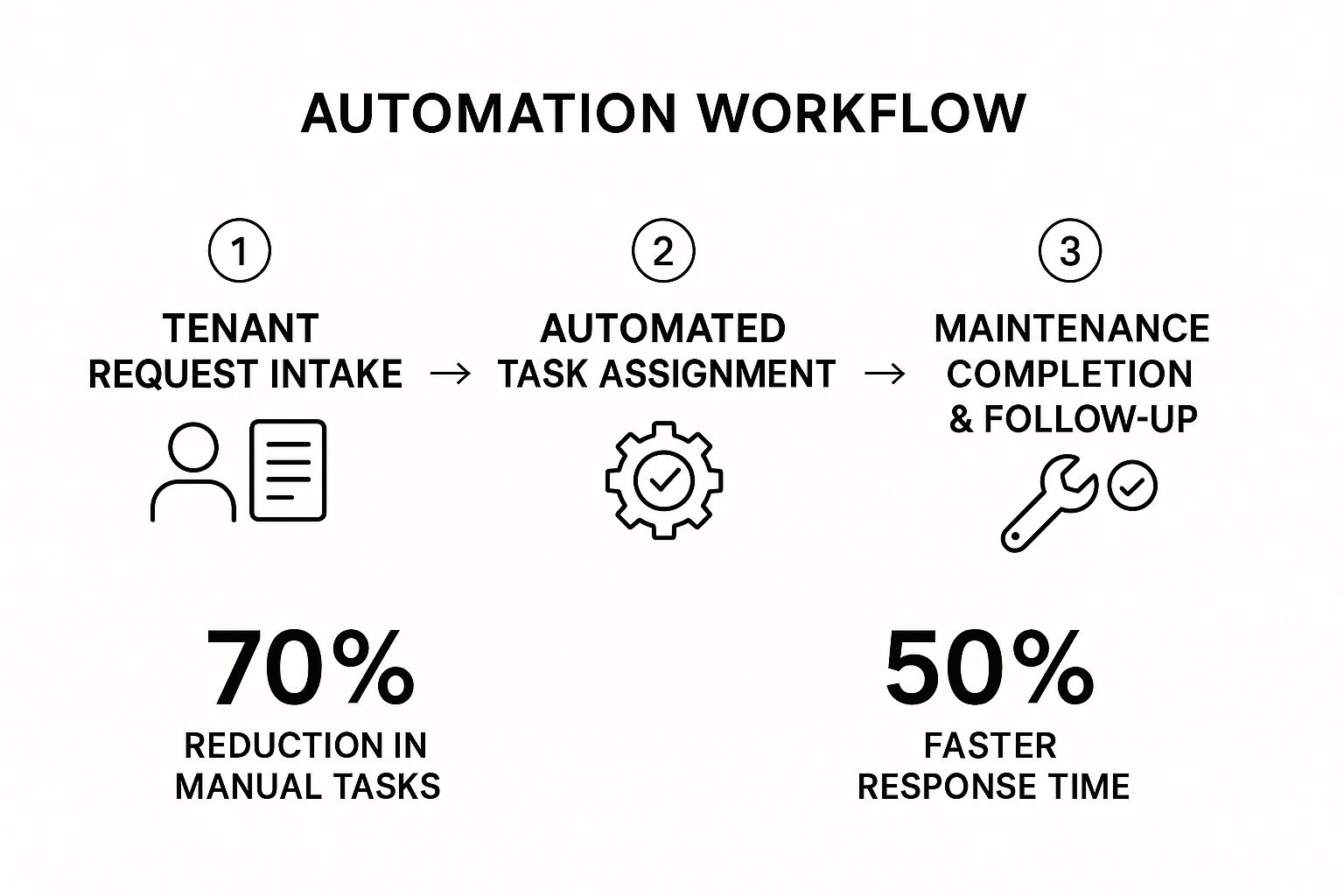
The visual makes it obvious how automation can slash manual effort while delivering faster service to your tenants. A 70% reduction in manual tasks and a 50% faster response time are numbers that speak for themselves, directly impacting tenant satisfaction and your bottom line.
From Audit to Actionable Strategy
Once your process map is laid out, the opportunities for improvement practically jump off the page. You’ll see the patterns of repetitive, time-draining work that are prime candidates for automation. For inspiration, reviewing various workflow automation examples can spark ideas for your own operations.
Your action plan should prioritize tasks that are:
- High-Volume and Repetitive: Such as sending rent reminders or acknowledging maintenance requests.
- Prone to Human Error: Including manual data entry for bookkeeping or tracking lease expirations.
- Critical for Tenant Satisfaction: Like providing rapid responses to inquiries and timely updates on repairs.
This detailed audit sets the stage for everything that follows. The data you gather now will help you define the key performance indicators (KPIs) you'll use to measure success. For a closer look at what to track, you can learn more by mastering property management KPIs and seeing how they tie directly to your investment goals.
Armed with this knowledge, you’re no longer guessing. You’re building a strategic foundation to select the right tools that will genuinely protect and enhance your valuable Monterey County property portfolio.
Step 2: Choosing and Implementing the Right Automation Tools
With a clear map of your processes, you’re ready for the next step: selecting the technology to automate your property management workflows. This is a critical business decision that impacts your property's performance, security, and the high-end experience you deliver.
For investors with properties in Monterey County, this means focusing on tools that offer bank-level security, seamless integration, and absolute convenience for both you and your tenants. The goal is to find a system that protects your investment while making it far simpler to manage.
The right choice will always depend on your specific portfolio. A luxury vacation rental in Pacific Grove has different needs—like managing short-term inquiries and fast turnovers—than a multi-unit apartment building in Salinas, where the biggest wins come from streamlining rent collection and maintenance requests.
Core Features for a Premier Monterey Bay Portfolio
At Coast & Valley, we cut through the sales hype and focus on features that deliver tangible value to our clients, who own high-end properties from the South County towns of Soledad and King City to coastal gems like Carmel.
Here are the non-negotiable features every owner should demand:
- A Secure and Intuitive Owner Portal: This is your 24/7 window into your property’s health. It must provide instant, secure access to financial statements, inspection reports, and maintenance updates with bank-level security.
- A Convenient Tenant Portal: Today's tenants expect to pay rent online, submit maintenance requests with a photo from their phone, and receive quick answers. A great tenant portal is a key factor in attracting and retaining high-quality tenants.
- Integrated Accounting and Reporting: The system must automate the entire financial trail—from rent collection to vendor payments—and generate clean, accurate owner statements with a single click. Manual bookkeeping is a time-sink and risk you can’t afford.
- Robust Maintenance Management: The platform must track a work order from the moment a tenant reports it all the way through to vendor payment. All parties should receive automated updates, ensuring full transparency.
Technology should increase transparency, not complexity. The right platform gives you total oversight and control of your investment, which builds trust and provides the peace of mind that your asset is being managed with precision.
Vetting Software for Security and Reliability
In today's digital world, security is paramount. When evaluating property management software, you are entrusting it with sensitive financial and personal data for both you and your tenants. Due diligence is essential.
Here are actionable questions to ask potential software providers:
- What are your data encryption protocols? Insist on industry-standard encryption for data both in transit and at rest.
- How do you handle data backups and disaster recovery? Your property's data must be protected from any worst-case scenario.
- What security compliance certifications do you hold? Look for SOC 2 compliance, a third-party audit that validates a provider's commitment to security and operational integrity.
This is the exact vetting process we use at Coast & Valley to ensure our technology partners meet the high standards our clients expect. We only work with platforms that have a proven history of security, reliability, and continuous improvement. For more on this, see our overview of current property management technology trends.
A Practical Implementation Plan
After you’ve selected your software, it’s time for implementation. Your process map from Step 1 becomes your guide. A phased rollout is the most effective approach, allowing you and your team to master one function before moving to the next.
Action Plan for a Phased Rollout:
- Start with Automated Rent Collection: This delivers the quickest win. Setting up online payments immediately reduces administrative work and improves cash flow.
- Implement Maintenance Request Automation: Once rent is flowing smoothly, roll out the online maintenance portal to tenants.
- Introduce Automated Reporting: Begin using the system to generate and review financial statements.
- Launch Lease Management: Finally, automate lease renewal tracking and communication.
Remember, a smooth rollout depends on clear communication. When migrating tenants to a new system, provide simple instructions and highlight the benefits for them, such as the ease of online payments or faster repair responses. This thoughtful approach sets the stage for a more efficient, profitable, and professionally managed property.
Step 3: Integrating Automation to Maximize ROI and Tenant Satisfaction
Acquiring property management software is just the start. The real value, especially for discerning investors in Monterey County, comes from the deep integration of that technology into your daily operations. This is when property management workflow automation evolves from a simple tool into a powerful engine for profitability and a superior tenant experience.
Proper integration means weaving these systems into the very fabric of how your property is managed. When done right, this directly boosts your bottom line, creating a more responsive, profitable, and well-maintained investment that meets the high standards of the local luxury market.

Driving Profitability with Intelligent Systems
True integration means using automation to make smarter financial decisions. For a high-value portfolio in places like Carmel or Pebble Beach, this goes far beyond simply collecting rent online. It’s about using data to actively enhance your returns.
- Actionable Strategy: Dynamic Pricing Intelligence. A properly integrated system can analyze local market data—from seasonal demand on the Monterey Peninsula to vacancy rates in the Salinas Valley—to suggest optimal rental pricing. This ensures you're never leaving money on the table.
- Actionable Strategy: Predictive Maintenance. Instead of just reacting to emergencies, automation helps us spot trends. If the data shows frequent minor plumbing calls from a specific building, the system flags it for a proactive inspection. This allows us to prevent a catastrophic—and costly—failure down the road, preserving your asset's value.
This forward-thinking approach is fundamental to property preservation. As Coast & Valley's principal, Amy Salmina, often emphasizes, a well-integrated system is the backbone of the concierge-level service that high-end owners expect. It provides the confidence that your investment is being protected and grown.
Enhancing the Tenant Experience for Higher Retention
For your tenants, a seamlessly integrated system simply feels like superior service. In a competitive rental market, a positive living experience is the most critical factor for tenant retention, and automation is how we deliver that experience consistently.
This is especially true for communication. Timely, clear communication builds trust. When a tenant submits a maintenance request, they should receive an instant confirmation. If they have an after-hours question, an AI-powered tool can provide immediate answers. To elevate the experience, integrating solutions like a specialized answering service for apartments ensures no tenant query ever goes unanswered, day or night.
An integrated system ensures that from the moment a tenant applies to the day they move out, every interaction is smooth, professional, and efficient. This creates a positive feedback loop that leads to longer tenancies, fewer vacancies, and a more stable return for you, the owner.
The impact of these automated functions on efficiency is significant. One recent survey found that 73% of property managers saw improved tenant quality because automated screening speeds up approvals while maintaining accuracy. As bryckel.ai, which details how AI is transforming the industry notes, this technology is a proven force.
Ultimately, this focus on a superior tenant experience directly benefits you. Happy tenants are more likely to care for the property and renew their leases, protecting your cash flow and enhancing your property's reputation.
Reducing Operational Costs Through Smart Automation
One of the most powerful results of embracing property management workflow automation is its direct and measurable impact on operational costs. For serious investors in the Monterey Bay Area, reducing overhead isn't just about saving a few dollars—it’s about creating a more resilient, efficient, and scalable portfolio. Smart automation achieves this by systematically tackling the small, repetitive tasks that represent a significant drain on time and money.
This strategic shift allows a management team to move from reactive problem-solving to high-value activities that grow your investment. Instead of chasing late rent, we can focus on strategic financial planning, market analysis, and strengthening owner relationships—turning property management from a cost center into a value driver.
Where Automation Delivers Tangible Financial Gains
The financial benefits are most evident in daily operations. For properties across our region, from Salinas to the Monterey Peninsula, these small efficiencies add up significantly.
Here are three real-world examples of cost-saving automation:
- 24/7 Tenant Support Without 24/7 Staffing: AI-powered chatbots instantly handle common tenant inquiries about trash day, amenity hours, or rent payments. This provides immediate answers for tenants while freeing up our team to handle complex, human-centric issues.
- Streamlined Maintenance Coordination: An automated system processes a maintenance request the moment a tenant submits it, assigns the job to a pre-approved local vendor, and tracks it to completion, often without manual intervention. This reduces administrative time and leads to faster fixes, preventing small issues from becoming costly emergencies.
- Error-Free Financial Processing: Automation dramatically reduces the risk of human error in accounting. By automating invoice processing and expense tracking, you get cleaner, more accurate financial reports—essential for making informed decisions about your property. You can learn more about what to look for in our guide to mastering your Monterey County property's financial reports.
For a high-end property owner, every dollar saved on operational waste is a dollar that can be reinvested into the property or added to your bottom line. It’s about using technology to achieve greater financial efficiency and scale your investments with confidence.
The ROI of a Smarter, Leaner Operation
Implementing automation is a direct investment in your property's long-term financial health. The return on investment (ROI) appears in two key areas: reduced labor costs for routine administrative tasks and strategic cost control through data analysis.
For example, by analyzing automated maintenance logs, we can spot recurring issues with specific appliances or systems. This data empowers us to negotiate better rates with vendors for bulk repairs or make informed decisions about capital improvements that will save you money in the long run.
Ultimately, a leaner, more efficient operation is a more profitable one. By automating the mundane, we unlock the capacity to focus on what truly matters: preserving the value of your asset and maximizing your return.
Step 4: Measuring Success and Optimizing Your Automated Systems
Implementing property management workflow automation is not a one-time task; it's a living system that requires ongoing refinement to deliver maximum value. For investors with high-value properties in the Monterey Bay Area, the real power of automation is the actionable data it provides. This data transforms your management approach from reactive to predictive, allowing you to constantly sharpen performance and maximize returns.
Good automation provides a steady stream of information. The key is knowing what to look for and how to use those insights to make smarter decisions for your portfolio.
Defining Your Key Performance Indicators (KPIs)
To measure success, you must define the metrics that matter. Key Performance Indicators (KPIs) are the hard numbers that tell you if your automated systems are delivering results. For our clients, who own everything from luxury homes in Carmel to multi-family units in Salinas, we focus on KPIs that directly impact profitability and tenant satisfaction.
Actionable Checklist for Measuring Success:
- Average Time to Resolve Maintenance Requests: Track this monthly. A downward trend indicates improved tenant satisfaction and property preservation.
- Rent Delinquency Rate: Monitor this KPI to see the direct impact of automation on your cash flow.
- Tenant Turnover Rate: A lower turnover rate signifies a healthy, well-run property and reduces vacancy costs.
- Cost Per Maintenance Ticket: Analyze this data to spot trends, negotiate better vendor rates, and plan for capital improvements.
Turning Data Into Actionable Strategy
Once you track these KPIs, your systems become a powerful analytical engine, providing a clear window into your property's operational health. This is where true optimization happens.
It’s about spotting patterns and asking the right questions. For example, if your data shows a spike in plumbing calls at a specific property in Soledad or King City, that's an actionable insight. Instead of reacting to each clog, you can proactively schedule a full plumbing inspection, potentially preventing a catastrophic flood and an expensive emergency call.
The ultimate goal of property management workflow automation is to create a self-improving system. The data from one workflow—like maintenance requests—should directly inform your strategy for another, like long-term capital planning. This interconnected approach is what preserves and enhances the value of a high-end investment.
This proactive mindset is at the core of the concierge-level service we provide at Coast & Valley. We use technology not just for efficiency, but for foresight.
The Power of Transparent Reporting
Your automation software should make accessing and understanding this data effortless. A secure owner portal acts as your command center, giving you 24/7 access to real-time information. This transparency is crucial for building trust and ensuring you always have a clear, unfiltered view of your investment's performance.
You should be able to instantly pull up reports showing month-over-month rent collection trends or see a complete maintenance history for a specific unit. This level of detail empowers you to make informed, data-driven decisions alongside your property manager. For a deeper look at what these summaries should include, our guide on understanding property management reporting offers valuable insights.
By constantly measuring performance and using data to fine-tune your workflows, you ensure your automation systems are always delivering maximum value. This cycle of measuring, analyzing, and optimizing is the key to unlocking the long-term ROI and peace of mind that smart automation promises.
Ready to unlock the full potential of your Monterey County investment property? The experts at Coast & Valley Properties can provide a professional evaluation to identify opportunities for automation that will enhance your ROI and deliver a true concierge-level management experience.
Contact us today to learn more about our full-service solutions.