
How to Calculate Rental Yield for Your Monterey County Investment
Calculating your rental yield is the essential first step to understanding your property's financial performance. As a high-end property owner or serious investor in Monterey County, this simple percentage reveals how much income your asset generates relative to its value.
Think of it as your investment’s annual report card. It cuts through the noise and provides a powerful number that tells you how well your property is performing financially, empowering you to make strategic decisions that protect and grow your wealth.
What Rental Yield Reveals About Your Investment

For any property owner in Salinas, Monterey, or the surrounding coastal communities, mastering rental yield is fundamental to maximizing returns. It's a core metric that answers the most important question: Is my property delivering the return on investment I expect?
However, not all yield calculations provide the same level of insight. For busy professionals and discerning investors, looking beyond a single, simplistic number is critical. This is why we, at Coast & Valley, always focus on two distinct types of yield to provide a complete financial picture.
The Two Essential Yield Calculations
First is the gross yield. This calculation offers a quick, high-level overview of your property's earning potential. It’s an invaluable tool for making rapid comparisons between different investment opportunities, whether you're evaluating a luxury condo in Monterey or a single-family home in a South County town like Gonzales or King City.
The second, and more critical, calculation is the net yield. This is where you uncover your true profitability. Net yield meticulously factors in all the real-world operating expenses tied to your property—from local property taxes and insurance to routine maintenance and professional management fees. It delivers the most accurate and actionable measure of your investment’s financial health.
For our clients, we emphasize that focusing on net yield is non-negotiable. It’s the metric that separates a property that looks good on paper from one that is genuinely profitable, providing the clarity needed to preserve capital and avoid costly surprises.
To clarify the difference, let's break down what goes into each calculation. The table below shows why net yield provides a much clearer financial snapshot for a high-end investor.
Gross Yield vs. Net Yield At a Glance
| Metric | Gross Rental Yield | Net Rental Yield |
|---|---|---|
| Annual Rent | Included | Included |
| Property Purchase Price | Included | Included |
| Property Taxes | Not Included | Included |
| Insurance | Not Included | Included |
| Maintenance & Repairs | Not Included | Included |
| Management Fees | Not Included | Included |
| Vacancy Costs | Not Included | Included |
| HOA Fees | Not Included | Included |
As you can see, net yield accounts for the true costs of ownership, giving you a transparent measure of your return on investment.
Understanding both metrics is fundamental, as is keeping meticulous records of all expenses. Our guide on how to master property management reporting provides the framework you need for tracking the very expenses that define your net yield, reinforcing the trust and transparency we believe in.
Calculating Gross Yield for a Quick Comparison
When evaluating a new investment in Monterey County, efficiency is key. Gross rental yield serves as the perfect "back-of-the-napkin" assessment of a property's income potential before diving into the granular details. Think of it as your initial filter for identifying promising opportunities.
The calculation is refreshingly simple. It only considers two key figures: the property's total purchase price and the annual rental income. By temporarily ignoring operating costs, you can quickly compare the raw earning power of a single-family home in a South County town like Soledad against a luxury condo overlooking the bay in Monterey.
The Gross Yield Formula
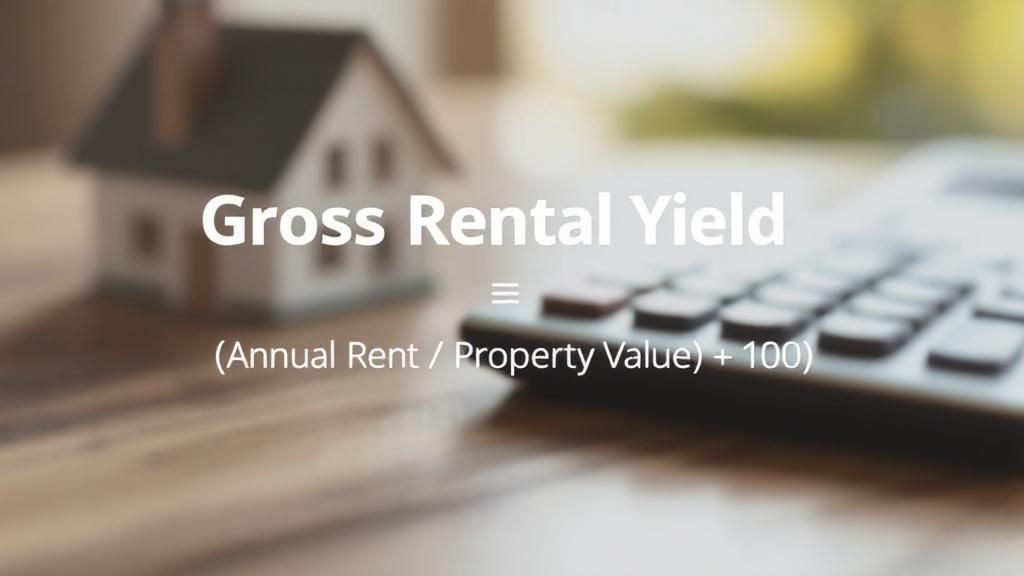
So, how do you calculate rental yield on a gross basis? The formula is a straightforward percentage that shows the relationship between annual rent and property price. For example, a property purchased for $800,000 that generates $48,000 in annual rent has a gross yield of 6%. This is the first number any serious investor crunches.
To see how your property measures up, it can be helpful to review benchmarks like the average rental yields in the U.S., though local context is always paramount.
The formula is:
(Annual Rental Income / Property Purchase Price) x 100 = Gross Rental Yield (%)
Let's apply this with a practical, local example.
A Salinas Duplex Example
Imagine you are considering a duplex in a desirable Salinas neighborhood with a purchase price of $700,000. After conducting thorough market research, you determine each unit can command a rent of $2,000 per month, for a total of $4,000 in monthly income.
Here is the step-by-step calculation:
- Step 1: Calculate Annual Rental Income: $4,000/month x 12 months = $48,000
- Step 2: Divide by the Purchase Price: $48,000 / $700,000 = 0.0685
- Step 3: Convert to a Percentage: 0.0685 x 100 = 6.85%
For this Salinas duplex, your gross rental yield is 6.85%. You now have a concrete baseline figure to compare this property against other potential investments in your portfolio.
Actionable Takeaway: Gross yield is an excellent starting point for quick evaluations. However, its primary weakness is its failure to account for real-world expenses that directly impact your actual profit. It is a tool for initial comparison, not final decision-making.
Calculating Net Yield To Uncover True Profitability
While gross yield offers a useful snapshot, it's only the first chapter for a discerning investor in Monterey County. The true measure of an investment’s health—the number that truly matters for your portfolio’s performance—is the net rental yield. This is where we provide a concierge-level analysis by accounting for all property ownership costs.
This calculation moves beyond a simple income-to-value ratio to reveal what a property is actually earning. It represents the funds remaining after all bills are paid, giving you a transparent view of your cash flow and ROI. For a busy professional, this clarity is essential for making sound financial decisions.
Pinpointing Your Annual Operating Expenses
To calculate net yield, you must efficiently track costs for every aspect of your property. The difference between a high-performing asset and an underperforming one often lies in these details. Every investor in our region must account for a specific set of local expenses.
These are the real-world costs that define your annual profits:
- Property Taxes: Monterey County has specific tax rates that represent a significant and non-negotiable expense.
- Insurance: Coastal properties, particularly in areas like Pacific Grove or the Monterey Peninsula, often necessitate specialized—and more costly—insurance policies.
- HOA Fees: For properties in planned communities, such as those in Pebble Beach or parts of Salinas, HOA dues are a major recurring cost to factor in.
- Maintenance & Repairs: We advise clients to budget 1-2% of the property’s value annually for maintenance. This proactive approach preserves the asset’s value and prevents minor issues from escalating into expensive problems.
- Vacancy Allowance: Realistically, no property remains occupied 100% of the time. We recommend a conservative vacancy allowance (typically 5-8% of gross rent) to ensure a more accurate income forecast.
- Property Management Fees: For owners who value their time and seek professional oversight, our management fees are a key part of the equation—an investment in peace of mind, property preservation, and optimized returns.
Subtracting these operating costs from your gross income yields your Net Operating Income (NOI). Our guide explaining what Net Operating Income is offers a deeper dive into this crucial metric.
This infographic breaks down the clear, three-step process for calculating net rental yield.
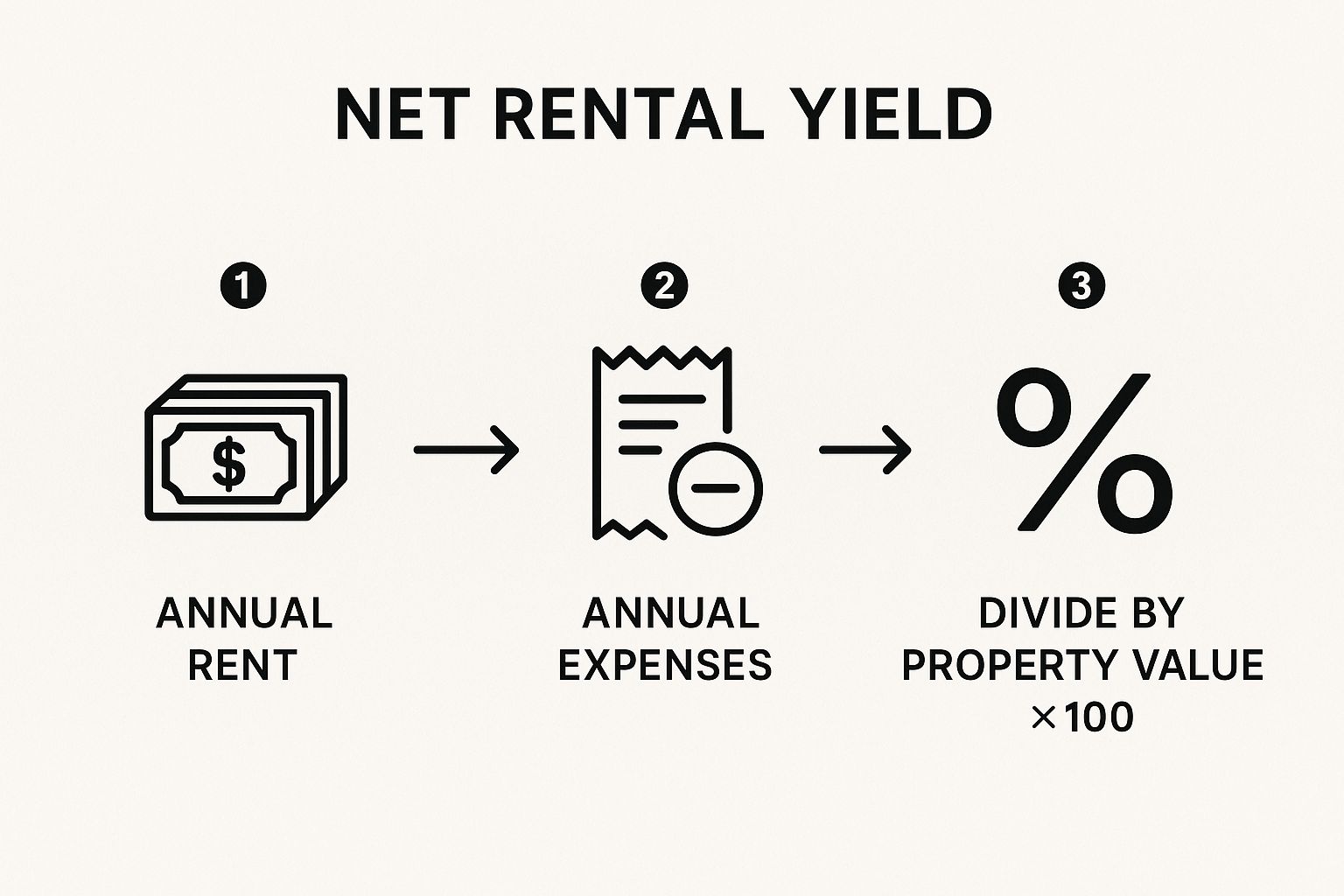
As you can see, you subtract the annual expenses from the rent before dividing by the property's value. This gives you a much more precise profitability metric.
Putting The Net Yield Formula To Work
The formula is straightforward, but ensuring accurate inputs requires more diligence than the gross calculation.
((Annual Rental Income – Annual Operating Expenses) / Property Purchase Price) x 100 = Net Rental Yield (%)
Let's return to our $700,000 Salinas duplex that generates $48,000 in gross annual rent. Now, let’s factor in realistic annual operating expenses.
- Property Taxes (approx. 1.25%): $8,750
- Insurance: $1,800
- Maintenance (1% of value): $7,000
- Vacancy Allowance (5% of gross rent): $2,400
- Property Management (8% of gross rent): $3,840
This brings our Total Annual Expenses to $23,790.
Now, let's execute the formula:
- Step 1: Calculate Net Income: $48,000 (Gross Rent) – $23,790 (Expenses) = $24,210
- Step 2: Divide by Purchase Price: $24,210 / $700,000 = 0.0345
- Step 3: Convert to a Percentage: 0.0345 x 100 = 3.46%
The True Bottom Line: The duplex’s promising 6.85% gross yield is refined to a 3.46% net yield. This isn't a disappointment; it's a reality check. It is the actual return on your investment—the number that truly matters for building long-term wealth and making informed decisions.
A Pacific Grove Case Study in Action

While formulas provide the framework, applying them to a real-world local property is where their value becomes clear. Let's walk through a realistic scenario for a high-end, single-family home in Pacific Grove—a premium market on the Monterey Peninsula where meticulous financial analysis is essential for success.
This example illustrates the critical importance of moving beyond surface-level numbers to understand the true bottom line. It’s a perfect demonstration of why precise financial forecasting is non-negotiable for investors in our unique coastal region.
Setting the Scene: The Property Details
Imagine you are acquiring a beautifully updated home in Pacific Grove with desirable ocean views. The initial investment details are as follows:
- Purchase Price: $1,800,000
- Estimated Closing Costs: $25,000
- Total Initial Investment: $1,825,000
- Competitive Market Rent: Based on our in-depth analysis of local comparables, the property can command a monthly rent of $7,500.
First, let's calculate the gross yield for a high-level assessment.
- Annual Rental Income: $7,500 x 12 = $90,000
- Gross Yield Calculation: ($90,000 / $1,825,000) x 100 = 4.93%
A gross yield approaching 5% is a solid starting point for a luxury coastal property. But as any experienced investor knows, this figure doesn't reflect the true financial story. Now, we must analyze the real-world expenses inherent to owning a high-end property in Monterey County.
Uncovering the True Return: The Net Yield Calculation
To understand how this Pacific Grove investment will truly perform, we must subtract all ongoing costs. This is where professional oversight prevents costly projection errors.
Here is a realistic breakdown of annual expenses:
- Monterey County Property Taxes (approx. 1.2%): $21,600
- Coastal Zone Insurance Policy: $4,500
- Higher Maintenance Budget (1.5% of value for a luxury home): $27,000
- Professional Property Management (8% of collected rent): $7,200
- Vacancy Allowance (5% of gross rent): $4,500
- Annual Landscaping & Pest Control: $2,400
This brings our Total Annual Operating Expenses to $67,200. Now we can calculate the net yield.
- Net Annual Income: $90,000 (Gross Rent) – $67,200 (Expenses) = $22,800
- Net Yield Calculation: ($22,800 / $1,825,000) x 100 = 1.25%
The net yield of 1.25% provides a transparent, realistic expectation of cash-on-cash return. While this figure is lower than the gross yield, it accounts for property preservation costs and professional management, ensuring the long-term health and appreciation of your asset. This is the number that informs a truly sound investment strategy.
Actionable Strategies to Boost Your Rental Yield
Calculating your property's yield is the starting point; actively improving it is where strategic management creates value. For discerning investors in Monterey County, enhancing net profit requires targeted actions that grow income while diligently controlling expenses.
These are the strategies that transform a solid investment into a high-performing one, whether you own a luxury home in Carmel-by-the-Sea or a multi-family building in King City.
High-Impact Tactics for Monterey County Owners
The following are proven strategies we implement for our clients to maximize their returns:
- Implement Strategic Renovations: Focus on high-ROI upgrades that justify higher rents. Modernizing a kitchen in a classic Monterey home, adding smart home technology, or installing high-end, durable flooring can attract premium tenants and increase rental income significantly.
- Optimize Rental Rates with Market Data: The rental market across the Monterey Bay Area, from Salinas to Pacific Grove, is dynamic. We continually analyze local trends to ensure your rental rates are optimized—maximizing income without increasing vacancy risk. This data-driven approach prevents you from leaving money on the table.
- Prioritize Proactive Tenant Retention: Vacancy is the biggest threat to your yield. A robust tenant retention strategy is your best defense. This includes providing exceptional service, responding swiftly to maintenance requests, and fostering a professional landlord-tenant relationship. A happy, long-term tenant saves you the significant costs associated with turnover. Our guide on how to find and keep good tenants details this crucial process.
Reducing Expenses and Protecting Your Bottom Line
Growing income is only half the equation; stringent cost control is equally vital.
A preventive maintenance program is essential. By addressing minor issues before they become major, costly repairs, you directly protect your net operating income and preserve your property's long-term value. This is a cornerstone of our property preservation philosophy.
Securing favorable financing is another powerful lever. The right terms on your investment property loans can dramatically improve your yield from day one, setting a strong foundation for profitability.
Expert Insight from Amy Salmina: "Focusing solely on yield can be misleading. The true performance of a real estate investment is a blend of rental income, income growth, and property appreciation. A sophisticated strategy, tailored to the Monterey County market, balances all three pillars to achieve long-term wealth creation."
Ultimately, boosting your rental yield requires a dual focus: maximizing revenue and minimizing expenses. Professional management is not a cost but a strategic investment in achieving that optimal balance.
Partner With The Right Experts To Maximize Your ROI
Let's be clear: understanding, calculating, and optimizing your rental yield is a detailed process that demands expertise. While it's a fundamental skill for any serious investor, turning raw data into profitable decisions is where deep local knowledge becomes indispensable.
This is precisely where partnering with Coast & Valley Property Management provides a distinct advantage. Our team's expertise is deeply rooted in the local market, from the agricultural heart of the Salinas Valley to the exclusive coastal enclaves of the Monterey Peninsula. This on-the-ground insight ensures our rental rate analysis is precise and our cost management strategies are effective.
We are committed to helping you maximize ROI with the transparency and trust that high-end investors expect. We meticulously analyze every line item—from local property taxes to specialized insurance policies—to provide a clear, honest assessment of your investment's performance.
With Amy Salmina's proven local leadership and commitment to excellence, we deliver the strategic oversight necessary to protect and grow your assets. Our mission is to manage the complexities of ownership, allowing you to focus on your returns.
To further enhance your strategy, consider collaborating with specialists who offer expert financial optimization services. A comprehensive approach also includes savvy tax planning; our guide on tax deductions for landlords in Salinas & Monterey County is an excellent resource for protecting your bottom line.
Ready to unlock your property's true potential? We invite you to contact us for a personalized analysis.
Common Questions About Calculating Rental Yield
Even after mastering the formulas, practical questions often arise when applying them to properties here in Monterey County. Here are answers to some of the most common inquiries we receive from sophisticated owners and investors.
What Is a Good Rental Yield in Monterey County?
There is no single "good" number, as expectations must be calibrated to the specific market. The high property values in premium coastal areas like Carmel or Pebble Beach naturally result in lower percentage yields compared to more affordable inland markets like Salinas or Soledad.
While a national gross yield target might be 5-8%, what truly matters is your net yield. Once all of our region’s unique costs are factored in, a "good" net yield is one that generates positive cash flow and aligns with your personal investment objectives.
Key Insight: Avoid fixating on a universal percentage. The most accurate way to judge your property's performance is to benchmark it against similar local investments—a core component of the analysis we provide for our clients.
How Does Vacancy Rate Affect My Rental Yield?
Vacancy is a direct drain on an investor's profit margin. It reduces your annual income, which is the numerator in both the gross and net yield formulas.
Consider this: just one month of vacancy per year reduces your actual annual income by over 8%. In Monterey County, factors like seasonal demand near agricultural centers or the Naval Postgraduate School can influence vacancy rates. The most effective way to protect your yield is through proactive, professional management that keeps high-quality tenants satisfied and in place.
Should I Use Purchase Price or Market Value to Calculate Yield?
This is an excellent question, and the answer depends entirely on your objective.
- To measure your original ROI: Use the purchase price. This is often called "yield on cost" and tells you precisely how your initial capital is performing.
- To assess current performance: Use the current market value. This calculation is vital for making strategic decisions, such as whether to hold the asset or execute a 1031 exchange to reinvest the equity elsewhere.
For new investors, always use the total acquisition cost (purchase price plus closing costs). For long-term owners, we recommend calculating yield annually using the current market value as part of a proactive portfolio review. For more guidance on selecting the right team, review our guide on the 7 essential questions to ask property management companies.
At Coast & Valley Property Management, we provide the in-depth analysis and strategic oversight you need to maximize your property's performance. As local leaders with deep roots in the community, we are committed to delivering the trust, transparency, and results you deserve.
Contact Coast & Valley Property Management for a Personalized Property Analysis