Whose Problem Is a Spiking Water Bill at Your Monterey County Rental?
Direct Answer: Usually the owner. A sudden spike at a Monterey County rental almost always traces to an irrigation leak on the property, which is an owner repair, though the lease decides who absorbs the bill.
A water bill at a single-family rental comes in at two or three times normal, and nobody can point to a reason inside the house. No running toilet, no dripping faucet, no new people living there.
I see this pattern every year on Central Coast properties, and the cause is almost always on the irrigation side. A cracked lateral or a stuck valve runs underground, where nothing looks wrong from the driveway.
The owner cost is double. You pay for water nobody used, and then you spend weeks arguing about who absorbs it. Below is what actually causes these spikes, why the same leak costs far more in Pacific Grove than it does in Salinas, and how the question of who pays gets decided long before the leak happens.
Why a High Water Bill at a Rental Property in Monterey County Usually Starts Outside
Indoor leaks announce themselves. A toilet that keeps cycling, a stained ceiling, a warm spot on a slab floor. Someone in the house notices and calls.
Irrigation leaks do the opposite. The line is buried, the controller runs before sunrise, and the water disappears into the soil without ever touching the house.
The usual suspects on properties around here:
- A cracked PVC lateral split by root pressure or by a shovel during yard work
- A valve that fails to close fully, so one zone trickles all day long
- A broken or missing sprinkler head that geysers for its full run time
- A drip line chewed or crushed under a planter bed where nothing is visible
- A leaking supply line between the meter and the house, common on older Monterey and Pacific Grove lots
Complaints from renters in this market cluster around the same story. Bills in the low hundreds per month, tied to a sprinkler problem that went unaddressed for weeks, on a lease that also required the yard be kept watered.
That combination is where owner relationships go bad. The tenant is doing what the lease asks, the bill keeps climbing, and the repair sits in limbo.

The Same Leak Costs More on the Peninsula Than It Does in the Valley
This is the part most owners miss, and it is the reason two people with identical leaks get very different bills.
Peninsula properties in Monterey, Pacific Grove, and Carmel are billed on a tiered structure. You get a baseline allotment at the lowest rate, and every gallon past that moves into higher tiers that cost a multiple of the first tier. State regulator documentation for the Peninsula system confirms this escalating tier design, along with water district charges layered onto the base bill.
A slow leak does not add a little to your bill. It pushes all of that extra use into the top tiers, where the rate per unit is several times what you pay at baseline.
Salinas Valley properties buy water through a different local system with a different rate shape. Same leak, different math, and often a much smaller shock.
The practical takeaway for an owner:
- Read the tier lines on the statement, not just the total due
- Compare units used to the same month last year, since rates move but your baseline usage should not
- Check whether district or fixed service charges are rising independently of your use
- Verify the current rates against your own statement, because they change
I have had owners call about a Peninsula bill in a panic when the use barely changed and the charge structure did. I have also had owners shrug off a doubling in usage because the dollar total looked survivable. The units tell the truth.
Who Holds the Account, and Who Usually Eats the Spike
How water is billed at the property decides who carries the cost of a leak. Here is how the three common setups in Monterey County play out.
| Setup | Who gets the bill | What usually happens with a leak |
|---|---|---|
| Single-family home, tenant holds the water account | Tenant pays the utility directly | Tenant absorbs the spike first, then asks the owner for relief. Repair is still the owner’s responsibility. |
| Single-family home, owner holds the account | Owner pays, often as part of monthly management bill payment | Spike shows up on the owner’s statement. Easier to catch early because someone is watching the baseline. |
| Multi-unit on a single meter | Owner pays the utility, then allocates back to units | Residents question charges they cannot see or control. Disputes land on the allocation method, not the leak. |
Who Pays Is Decided by the Lease, Not by the Leak
By the time water is running underground, the answer is already written down somewhere. The question is whether it was written clearly.
On a single-family rental where the tenant holds the account, the tenant pays for water. But a buried irrigation break is a property defect, not consumption, and a reasonable owner credits the overage once the leak is documented. Fighting that one is expensive in ways that never show up on a ledger.
It gets stickier when the lease also requires the tenant to keep the landscaping watered. You have asked someone to run a system you own, on a bill they pay, and you cannot then treat a failure in that system as their problem.
Multi-unit properties on one meter are where this gets genuinely hard. If a fourplex in Salinas or Pacific Grove splits water, sewer, and trash back to the units, you need a written allocation method that holds up when a resident questions it.
What that method should state plainly:
- How the total bill is divided, by unit count, bedroom count, or occupancy
- Which charges are included and which are not
- When the charge appears and how it is shown on the statement
- What happens to the allocation during a confirmed leak period
This is one of the things that changes as a portfolio grows. I have written more about what shifts when you manage a multi-unit property in Salinas, and utility allocation is near the top of the list. How you disclose it matters as much as the dollar amount.
How We Actually Confirm an Irrigation Leak
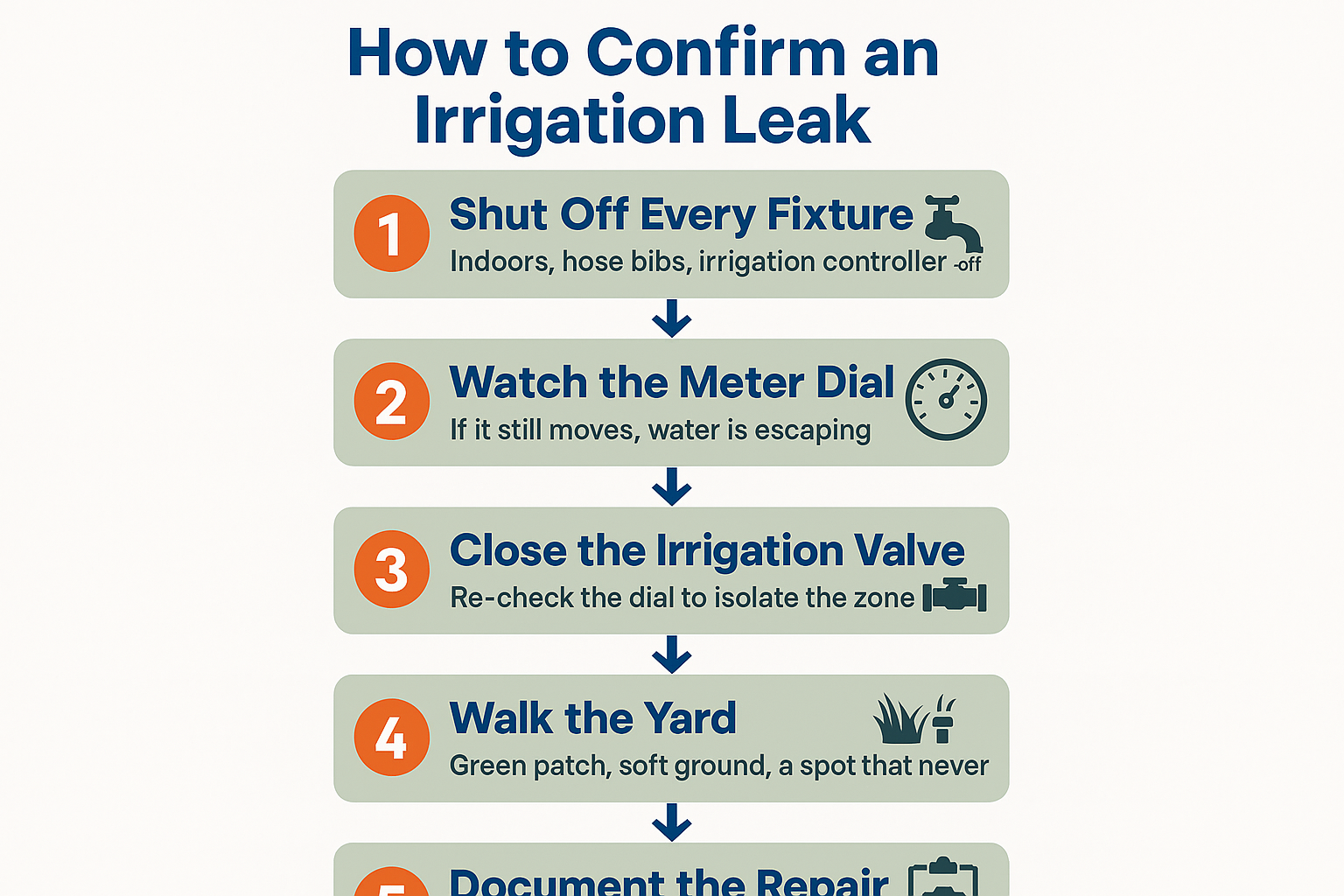
Most owners have never been shown how a leak gets proven, so they take the tenant’s word or dismiss it. There is a sequence, and it takes about half an hour.
Step one: shut everything off. Every fixture inside, every hose bib outside, the irrigation controller set to off. Then pull the meter lid and watch the low-flow dial. If it still creeps, water is moving somewhere.
Step two: isolate the irrigation. Close the valve feeding the sprinkler system and check the dial again. If the creep stops, the problem is on the irrigation side. If it keeps moving, it is the supply line or something inside.
Step three: walk the yard. The giveaways are not subtle once you know them:
- A bright green patch in an otherwise dry lawn
- Soft or spongy ground near a valve box
- A spot that never dries out between watering days
- Gravel or bark that has washed into a small fan shape
Step four is the part owners skip. Document everything with dated photos before and after, and keep the repair invoice showing what was found and what was replaced.
Many water utilities will consider a one-time bill adjustment once a repaired leak is documented. Owners who cannot produce proof of the repair lose that credit even when the leak was completely real. That is where a solvable problem turns into a dispute with a tenant.
The Leak Check, Step by Step
This is the sequence I run before anyone starts digging or calling the water company.
Why These Bills Surface in Late Spring, and What to Do Before They Do
Irrigation faults hide all winter. Everything is green anyway, the controller is off or barely running, and a cracked lateral sits there doing nothing visible.
Then the weather turns dry, the controller starts running real cycles, and the bill shows up as a shock in late spring or early summer. By then the leak has often been there for months.
Two habits prevent most of this:
- Run the system manually, zone by zone, before the season starts. Watch each zone for a head that will not pop, a line that pools, or a valve that keeps weeping after shutdown.
- Handle irrigation and supply lines while the property is vacant. A leak inherited by a new tenant poisons the relationship in month one, and you will never fully get it back.
If a unit is sitting empty between tenants, that is the window. I covered the broader version of this question in whether a remodeled and empty rental is actually ready to list, and irrigation belongs on that list right alongside the obvious cosmetic items.
The paper trail matters as much as the repair. Owners here routinely ask for photos of completed fence, tree, and yard work, and water repairs deserve the same treatment: what was found, what was replaced, what it cost, and what the meter read afterward. That is the same standard I apply to any repair approval at a rental, and it is what makes a utility credit request go through on the first try.
Frequently Asked Questions About Water Bill Spikes at Monterey County Rentals
My tenant pays the water bill. Do I still have to fix an irrigation leak?
Yes. The sprinkler system is part of the property, and repairs to it belong to the owner regardless of whose name is on the utility account. The separate question is whether you credit the tenant for the overage, and in my experience that is worth doing once the leak is confirmed and documented.
Can I get the water company to refund a leak-driven bill?
Many utilities will consider a one-time adjustment once you show a repaired leak. The deciding factor is almost always documentation: the dated repair invoice, before and after photos, and a meter reading taken after the fix. A phone call describing the leak rarely gets it done on its own.
How do I split water fairly on a fourplex with one meter?
Pick a method, write it into the lease, and apply it the same way every month. Unit count, bedroom count, and occupancy are all common approaches. What causes disputes is not the method itself, it is residents being billed for use they cannot see with no written explanation of how the number was reached.
Why is my Pacific Grove water bill so much higher than my Salinas property for the same leak?
Peninsula properties are billed on an escalating tier structure, so leak water gets charged at the upper tiers rather than the baseline rate, and there are water district charges layered on top. Salinas Valley properties buy from a different local system with a different rate shape. Same gallons, very different totals.
How often should irrigation be checked at a rental?
I like a manual zone-by-zone run at the start of the dry season and another look at the annual inspection. On vacant properties, check before the listing goes live rather than after someone moves in.
Questions About a Water Bill That Does Not Add Up?
We have managed both Peninsula and Salinas Valley properties since 2009, which means working in two different water pricing environments and keeping a local vendor bench that can open up an irrigation line without a week of waiting. Utility bill payment on an owner’s behalf is part of full monthly management, so a bill that jumps gets noticed by someone who already knows that property’s normal baseline. If you want to talk through how a spike at your Monterey County rental should be handled, you can reach us at (831) 757-1270 or through the contact form at coastandvalleypm.com.