Your Monterey Rental Goes Vacant in December. Who Moves in the Rain?
Direct Answer: Winter rentals in Monterey County lease to need-driven renters, not browsers. Fewer showings is normal. The bigger decision is writing a lease end date that lands in late spring.
Your tenant hands in notice the week after Thanksgiving. The move-out is set for December 20, the first real storm of the season rolls through, and now you own a cold, empty house with the heat shut off and a listing going live during the quietest two weeks of the year.
I see this every winter across the Peninsula, in Pacific Grove bungalows, Monterey duplexes, and Carmel homes that lease in four days in July and sit for five weeks in January. Owners start calling us in January, which is almost exactly when the renter pool is thinnest.
The good news is that a winter rental vacancy in Monterey County is a solvable problem, and most of the solution is decided before the listing ever goes up. I want to walk you through the part almost nobody thinks about until the second December turnover in a row.
The Most Valuable Number in a Winter Vacancy Is the Lease End Date
Most owners spend their energy on the asking rent. I spend mine on the expiration date of the next lease.
Here is why. A standard 12 month lease signed in January expires the following January, which drops you right back into the same thin market, with the same short days and the same storm season. Do that three years running and you have paid for three winter vacancies instead of one.
Stretch that term so the lease ends in late spring, and everything changes. May and June bring the deepest applicant pool on the Peninsula: families timing a move around the school year, buyers between homes, and relocating households who want to land before summer.
A 13 or 14 month term is the usual fix. On a December or January start I will often go a little longer so the expiration lands in May or June rather than April.
It costs you nothing. It is one line in a lease, and it quietly removes weeks of vacancy from every cycle after that. If you are staring at a January lease expiration right now, this is the first thing I would change.
What a Longer First Term Does to Your Next Turnover
Same house, same rent, different expiration month. This is the tradeoff I walk owners through at the kitchen table.
| Lease starts | 12 month term expires | Longer term expires | Applicant pool at expiration |
|---|---|---|---|
| December 15 | December 14 | 17 months, May 14 | Deep. Spring movers, school-year planners |
| January 1 | January 1 | 16 months, May 1 | Deep. Peak relocation window opening |
| February 1 | February 1 | 15 months, May 1 | Deep |
| March 1 | March 1 | 14 months, May 1 | Deep |
| Any winter month | Same winter month | No change | Thin. Repeat of this year’s problem |

Winter Does Not Empty the Renter Pool. It Changes Who Is in It.
Owners panic when a December listing gets four showings in two weeks. I understand why. But fewer showings does not mean weaker applicants.
Summer renters browse. They tour six homes, compare kitchens, and take three weeks to decide. Winter renters on the Central Coast are usually need-driven, and they move on a hard date rather than a preferred one.
In a typical wet season, the people reaching out to us look like this:
- Households displaced by storm damage or a repair project at their own home
- Professionals relocating into Monterey County with a start date already on the calendar
- Families already in the county whose lease is ending and who cannot wait for spring
- Owners between homes after a sale closed faster than expected
That renter does not need to fall in love with your backsplash. They need a dry, available house near work, and they often sign faster and stay longer than a casual July shopper.
So measure the week by application quality, not foot traffic. Three showings that produce one strong, verified applicant is a better week than nine showings that produce nothing. If you want a fuller picture of who actually leases homes on the Peninsula, that tenant mix holds up year round.
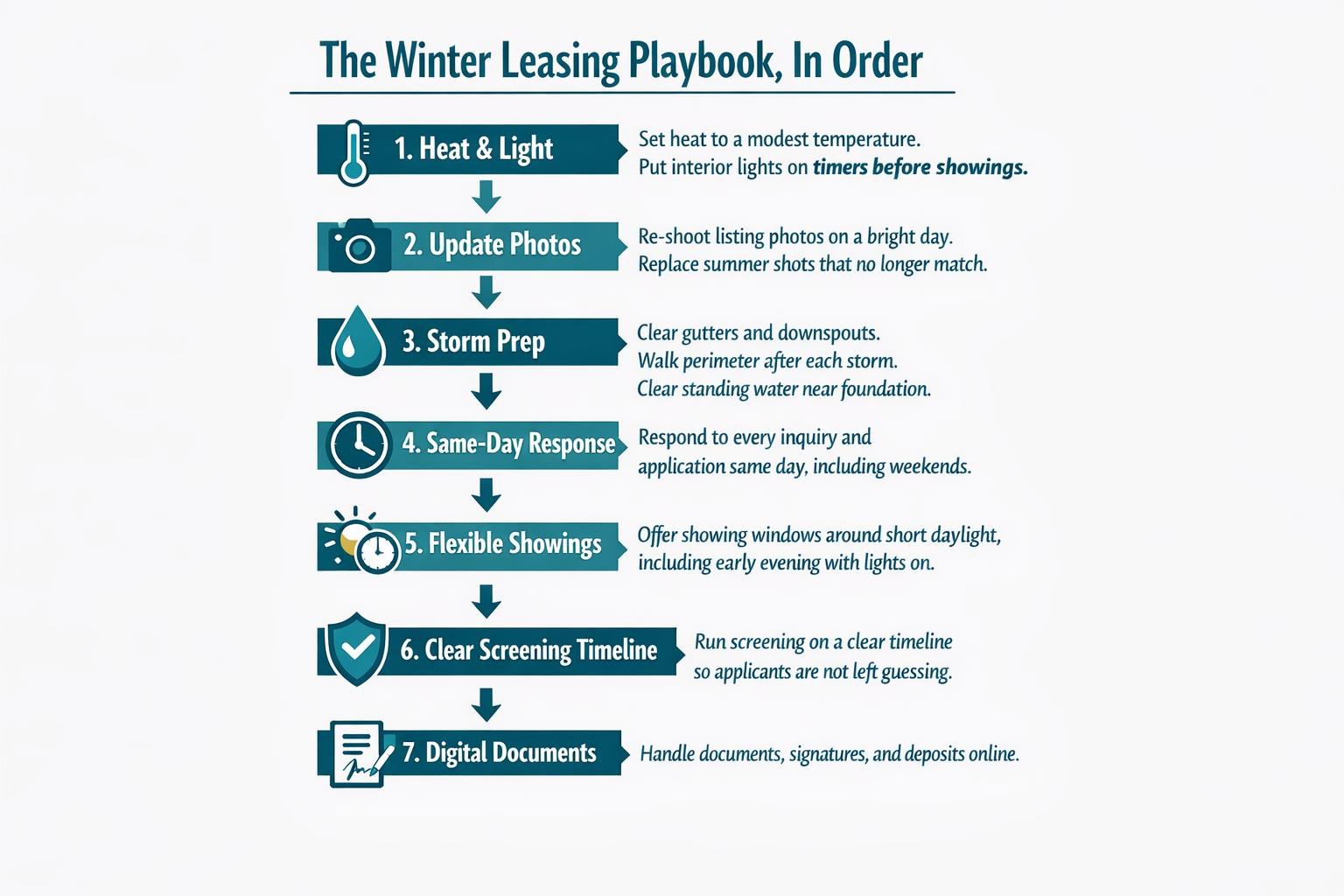
The Winter Leasing Playbook, in Order
This is the sequence I run on a Peninsula vacancy between Thanksgiving and mid-February.
A Cold, Dark House Loses to a Warm One Every Time It Rains
Here is the part owners rarely connect. A well-kept home can get five showings and zero applications for reasons that have nothing to do with the property itself.
Picture the prospect. They drove through rain from Seaside, parked on a wet street, and walked into a house that has been closed up with the power down for eleven days. It is 54 degrees inside, the air is still and heavy, the windows are fogged at the edges, and the only light is whatever gray is coming through the glass.
They are not evaluating the floor plan anymore. They are standing in a cold box wondering what is wrong with it.
The fixes are unglamorous and cheap:
- Leave the heat on at a modest setting, not off
- Keep air moving with a fan or a cracked interior door between rooms
- Put a few interior lights on timers so the house is lit before a late afternoon showing
- Clear the gutters and downspouts so water is not sheeting down a wall during the tour
- Walk the perimeter after each storm and clear standing water near the foundation
- Re-shoot the listing photos on a bright day instead of reusing summer shots that no longer match
Marine layer condensation on the Peninsula is a normal feature of coastal air, not a building failure, and I have written separately about telling marine layer from a real maintenance problem. On the leasing side, the prospect does not make that distinction. A dry, warm, lit house with current photos competes in January. An identical cold one does not. A pre-storm walk of the property handles most of this in one visit.
Run the Arithmetic Before You Hold Out for a Summer Number
I am not going to tell you to drop your rent. I would rather you see the math and decide for yourself.
The comparison is simple. Take the monthly figure you are holding out for, subtract the figure you would accept today, and multiply that gap by 12. That is what the higher rent is worth over a full lease year.
Now count the weeks the house will likely sit while you wait. Multiply your weekly rent by that number. If four to six weeks of vacancy costs more than the annual value of the gap, holding out is a losing trade, and it usually is.
For context, general rent-data sources put Monterey County asking rents across a wide band in 2026. Apartment averages in the city of Monterey ran in the high two thousands, Salinas noticeably lower, and county three and four bedroom houses averaged in the mid four thousands. Those are market benchmarks, not a quote for your home.
And the spread between two similar houses on the same street can be large. Condition, parking, yard, heat source, and view move the number far more than any online estimate does. For how that actually gets calculated, I would read how rent gets set and why online estimates miss, then have someone stand in the house. Broader vacancy patterns are tracked publicly in the Census Bureau’s housing vacancy data, but national numbers will never tell you what a Pacific Grove two bedroom does in February.
The Real Risk Is Not a Slow Month. It Is Week Six.
The dangerous moment in a rainy-season vacancy is not December. It is late January, when an owner who has been empty for six weeks starts talking themselves into an applicant they would have passed on in June.
One owner who contacted our office had a four unit property, remodeled and fully vacant. That is vacancy pressure multiplied across several doors at once, and I have watched that pressure bend good judgment.
The cost of one bad tenancy outruns three months of vacancy. Not by a little.
So put that energy somewhere useful. What genuinely speeds up a winter lease is removing friction, not lowering the bar:
- Same-day responses to every inquiry and application, including weekends
- Showing windows that work around short daylight, including early evening with lights on
- Screening that runs on a clear timeline so applicants are not left guessing
- Documents, signatures, and deposits handled online
That last one matters more than owners expect. One long-term resident put it plainly in a review: “everything was done electronically which made it really convenient” (Mauricio M.). A qualified applicant relocating on a hard date will choose the house they can lock down this week.
If the vacancy itself is the thing keeping you up, I covered the broader picture in what an empty Monterey County rental actually costs.
Winter Leasing Is a Local Knowledge Problem
Marketing a house in January is not hard. Knowing which weeks between Thanksgiving and mid-January are genuinely dead, which applicants are moving on a fixed date, and which vendors will still show up to a vacant Carmel house during a storm is the part that takes years in this county.
We have been running Monterey County turnovers since 2009 under a licensed broker-owner, and most of what I have written here came from winters that did not go smoothly before we adjusted. Staying current with California’s rental laws is its own ongoing job, and it does not pause for the season.
The owners who stop having winter vacancy problems are usually the ones who fixed the lease end date once and never thought about it again.
Frequently Asked Questions About Winter Rental Vacancy in Monterey County
How long should I expect a Peninsula rental to sit if I list it in December?
It varies a lot by home and price point, but I tell owners to plan for a slower first two weeks around the holidays and real activity picking up in January. A well-presented home priced to the current market usually moves inside a few weeks. A cold, dark house with summer photos can sit much longer, and that part is within your control.
Should I just leave it empty until spring?
Almost never. You are paying the mortgage, utilities, insurance, and taxes either way, and an empty house in storm season needs more attention, not less. The better move is to lease it now and write the term so the next expiration lands in late spring.
Do you handle three or four month rentals for people whose home is being repaired?
We get that call every wet season, and I understand the need. We do not handle short-term or vacation rentals. Many displaced households end up signing a standard lease anyway, especially when a repair timeline stretches, and those tenants are often excellent.
Is it worth furnishing the house to attract winter renters?
Sometimes, particularly for relocating professionals on the Peninsula. It is a real decision with tradeoffs on rent, wear, and tenant type, and I would not make it based on the season alone.
How do I know whether my asking rent is actually the problem?
Look at the ratio. Steady showings with no applications usually points to condition or presentation. Almost no showings at all usually points to price or photos. Two weeks of data on a live listing tells you more than any estimate tool will.
Thinking Through a Winter Vacancy on the Peninsula?
We take on a limited number of owners across Pacific Grove, Monterey, Pebble Beach, and Carmel, and we are happy to talk through a December vacancy or a lease end date without any pressure to sign anything. If it would help to have a second read on your timing, Coast & Valley Properties can be reached at (831) 757-1270 or through the contact form at coastandvalleypm.com.