Who Pays the Mortgage, Taxes, and Insurance on Your Carmel Rental Each Month
Direct Answer: You still owe the mortgage, taxes, and insurance. But in a full management arrangement, those bills can be paid out of collected rent first, with the remainder sent to you.
The rent is the part owners think about. The part that wears people down is everything else that keeps arriving whether or not you are in town that month: the loan payment, the water bill, the insurance premium, and the property tax installment.
I talk to owners on the Peninsula who live in the Bay Area, in Arizona, sometimes in another country. They are tracking five due dates on a house they have not driven past in two years. One owner put it plainly in a note to us: managing everything on my own has become increasingly demanding.
Here is my position on it. Most owners assume a property manager collects rent, takes a cut, and forwards the rest. That is only half the picture, because in a full management arrangement those recurring obligations can be paid out of collected rent before anything hits your bank account. Below I walk through how that works in a real month, what can go sideways, and how you verify it without getting in the car.
What property manager bill payment for rental owners actually covers
When owners hear “full service,” they usually picture leasing, rent collection, and repairs. Bill payment is the piece almost nobody asks about on the first call, and it is the piece that changes the most about daily life.
In our residential management arrangement, the bills that can run through the property’s account include:
- Mortgage payment on the property
- Property taxes, which arrive as large installments rather than tidy monthly amounts
- Insurance premiums on the rental
- Utilities that stay in the owner’s name, which on older Peninsula homes is often water, sewer, or trash
- HOA dues, where the property sits in an association
Notice what that list has in common. Every item is a fixed obligation with a hard date and a real consequence for missing it.
It is also worth saying what this is not. We do not manage associations, and we do not handle vacation or short term rentals. This is about the recurring outgoing bills tied to a long term rental you own.
The practical result is one account and one monthly statement instead of five calendar reminders and three autopay logins you set up years ago and have not checked since.

One real month, in order: rent in, bills out, your money last
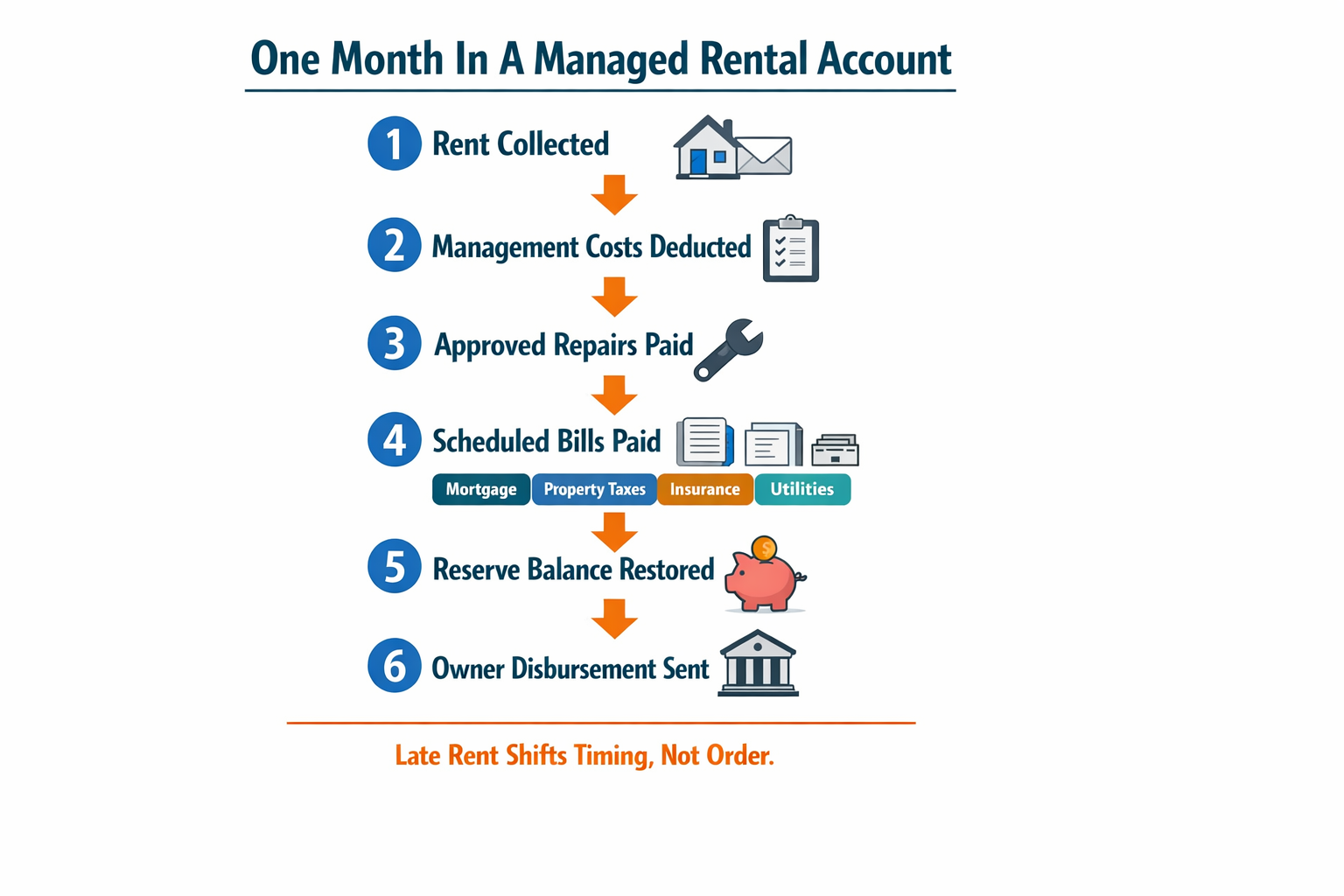
The sequence inside a single month is simple once you see it written down. Rent comes in. Management costs and any approved repair costs come off. Scheduled bills go out. What remains is your disbursement.
Where owners get surprised is the calendar. A mortgage is due on a fixed day. Rent does not always arrive on a fixed day. That gap is the whole reason a reserve balance exists in the account.
Picture a month I have seen play out more than once on the Peninsula. Rent lands a week late because the tenant’s pay cycle shifted. On the Thursday of that same week, the water heater quits and needs replacing, not patching.
So the account is covering a repair and a loan payment in the same stretch, with the rent not yet in hand. The reserve absorbs the gap. Your statement that month shows a smaller disbursement than usual, with the repair itemized and the bills still paid on time.
The following month, assuming rent arrives normally, the account refills the reserve and your disbursement returns to its usual size. That is also why we ask owners to keep a cushion sitting in the account rather than sweeping every dollar out. If you want the mechanics of the payout side, I covered that in detail in how rent money moves from your tenant to your bank account.
How these bills behave, and where they trip people up
Not every obligation on a rental behaves the same way. This is roughly how I think about them when setting up an account for a new owner.
| Obligation | How it arrives | What goes wrong self-managing from a distance |
|---|---|---|
| Mortgage | Same day every month | Autopay drafts a personal account that ran dry during a vacancy |
| Property taxes | Large installments, a few times a year | Easy to forget while traveling, and the amount catches you off guard |
| Insurance premium | Annual or semi-annual lump sum | A card on file expires, the notice goes to an old address, coverage lapses |
| Water, sewer, trash | Monthly or bi-monthly, amount varies | A spike gets ignored for two cycles before anyone asks why |
| Repairs | Unpredictable, sometimes urgent | Owner has to be reachable to approve and fund on the spot |
The order of operations inside one month
Here is the same sequence laid out visually, from rent collection to your disbursement.
The part owners actually lose sleep over: proof
Nobody lies awake wondering how a bank transfer works. What keeps owners up is verification. Did the payment go out? Did the work get done?
One owner used our contact form twice in three months asking whether a fence had been replaced and a tree had been trimmed. Her words: “I would appreciate some pictures of the completed work.” That is a completely reasonable ask, and it tells you what the real product is here. The product is documentation.
A paper trail worth trusting includes:
- A monthly statement showing each payment made, line by line
- Copies of paid invoices, not just a total
- Photos of completed work on anything significant
- A year-end summary your accountant can actually work from
- Portal access that lets you pull all of it yourself at 10pm on a Sunday
That last one deserves a warning. Another owner wrote in because he could not remember whether his portal account had ever been set up, and the password reset email never arrived. Small failure, outsized trust damage, because the portal is where the payment records live.
So confirm your login works on day one, not nine months later when you need a document. I would do the same on the repair side, which I walk through in who approves a repair and how you know it got done.
Why a late payment stings more on a Peninsula property now
Holding costs on the Central Coast have climbed, and insurance has climbed hardest. General market research on California rental property shows landlord policies running meaningfully above a homeowners policy on the same house, with premiums rising as carriers have pulled back from parts of the state. The California Department of Insurance is the right place to read about the broader market.
Treat that as context, not as anyone’s quote. The point is the stakes. A lapse in coverage on a Carmel or Pebble Beach home is not a billing annoyance, it is a liability event on an asset worth a great deal.
And lapses rarely happen because someone decided not to pay. They happen because a large lump sum landed while the owner was traveling, or the renewal notice went to an address from two moves ago.
That is exactly the failure a managed account removes. The bill arrives in one place, gets paid on schedule, and shows up on a statement you can read from anywhere. Higher value homes carry more of this complexity, which I get into in why a Pebble Beach estate needs different management.
Honestly, not every owner needs this
If you live in Monterey, own one rental you drive past weekly, and already have the taxes and premium handled through accounts you check, simple rent disbursement is plenty. Adding bill payment would be process for the sake of process.
Full bill handling earns its place in a narrower set of situations:
- You live out of the area or out of state
- The property sits in a trust, or you share an inherited home with siblings
- You winter somewhere else for months at a stretch
- You have added enough doors that the admin has outgrown a spreadsheet
- Someone else, like an accountant or a family member, needs clean records on demand
Those are the situations that fill our inbox. Owners expanding a small portfolio in the Salinas Valley. A Carmel owner home for a few days who wants to meet at the house. An owner preparing to move out of state before the home goes on the rental market.
If that is you, the question is less about the service and more about whether you trust the records. Start there.
Frequently Asked Questions About Bill Payment on a Monterey County Rental
Does the property manager take on the debt or the liability for my mortgage?
No. The obligation stays entirely yours. We are paying a bill on your behalf, from your funds, on a schedule you approve. Nothing about the loan, the tax bill, or the policy transfers to us.
What happens if rent comes in late and the mortgage is due?
That is what the reserve balance is for. The bills go out on schedule, the account dips, and your disbursement that month is smaller. Once rent lands, the reserve is restored and the next month looks normal. If a tenant goes seriously delinquent rather than just a few days late, we talk to you directly about options instead of letting the account drain quietly.
How much cushion should I keep in the account?
It depends on the property. A home with a large loan payment and an older roof needs more room than a recently updated unit with no mortgage. We set that number with you during the consultation based on your actual monthly obligations.
Will my accountant get what they need at tax time?
That is the goal of the year-end summary and the invoice copies in the portal. Most accountants want the income and expense detail in one place rather than reconstructing it from bank statements. I wrote more about what your accountant asks for if you want the specifics.
What does this service cost?
We do not publish pricing, because it depends on the property, the number of doors, and which services you actually want. A licensed agent walks the property and gives you a specific range in person. Call the office and ask.
Want to see how your bills and statements would be handled?
When the question is who holds the funds that pay your mortgage, the credentials that matter are licensing, local presence, and years in the same county. Coast & Valley Properties is broker owned, has worked in Monterey County since 2009, and runs from an office on Main Street in Salinas, so Peninsula owners deal with the same small team year after year instead of a regional call center. If you would like us to walk you through how bill payment, statements, and portal reporting would work on your property, we are glad to talk at (831) 757-1270 or through the contact form at coastandvalleypm.com.