
A Property Investor’s Guide to Landlord Tenant Laws in California
Navigating California's landlord-tenant laws can feel like a labyrinth, especially for owners of high-value properties. If you own a premium rental anywhere from Salinas to Carmel, mastering these regulations isn't just about legal compliance—it's a fundamental strategy for protecting your asset, maximizing your ROI, and securing your peace of mind.
For busy professionals and serious investors, a misstep isn't an option. One mistake can jeopardize years of hard work. This guide provides clear, actionable insights to help you manage your Monterey County property with the precision and professionalism it deserves.
Making Sense of California's Complex Rental Landscape

Trying to untangle the web of landlord tenant laws in California can feel like a full-time job. This is especially true now, with recent legislative changes piling on new responsibilities for property owners. For those of you with premium properties in Monterey County—whether it's a luxury home in Pebble Beach, a family residence in Salinas, or a multi-unit complex in a South County town like King City—getting these rules right is completely non-negotiable.
Think of these regulations as the foundation for your entire rental business. You wouldn’t build a high-end home on a shaky foundation, and you can't build a successful rental portfolio without a solid understanding of your legal duties. A single misstep, like mishandling a security deposit or issuing an improper eviction notice, can trigger serious financial penalties and damage your reputation as a trustworthy owner.
Key Pillars of California Rental Law
California law dictates every stage of the landlord-tenant lifecycle. For busy professionals and serious investors in the Salinas and Monterey Bay area, mastering these key areas is the first and most important step toward managing risk and protecting your asset:
- Lease Agreements: This document is your most important legal shield. A generic, one-size-fits-all template just won't cut it for a high-value asset. Your lease needs to be customized for your specific Monterey County property, crystal clear, and compliant with state and local laws.
- Security Deposits: The state has very strict rules on how much you can collect, how you must store the funds, and the exact process you must follow for deductions. A huge update to know is that as of July 1, 2024, Assembly Bill 12 (AB 12) now caps most security deposits at just one month’s rent.
- Tenant Protection Act (AB 1482): This landmark law introduced statewide rent caps and "just cause" eviction requirements. It’s absolutely critical to determine if your property is subject to this law or if it qualifies for an exemption, a distinction that directly impacts your ROI.
- Eviction Procedures: The eviction process is unforgiving. It demands perfect, meticulous adherence to all notice requirements and legal steps. One small mistake can force you to start the entire process over again, wasting precious time and money.
Being proactive with legal compliance is the single most effective way to protect your asset. As our founder, Amy Salmina, always emphasizes, when you treat legal diligence as a core part of your management strategy, you stop reacting to problems and start proactively controlling your investment and preventing risks before they arise.
To help you navigate all this, we've put together a quick-reference table summarizing the main legal areas you'll encounter as a Monterey County property owner.
Key Areas of California Landlord-Tenant Law at a Glance
| Legal Area | Core Principle for Investors & Owners | Relevance in Monterey County |
|---|---|---|
| Lease Agreements | Must be detailed, compliant with state law, and customized to protect your specific property and its unique features. | Essential for all properties, from luxury Carmel homes to Salinas family residences, to protect your investment and define responsibilities. |
| Security Deposits | Collection and deductions are strictly regulated. As of July 1, 2024, deposits are capped at one month's rent for most properties. | This new law (AB 12) applies to all Monterey County landlords and requires immediate updates to your leasing policies and trust accounting procedures. |
| Rent Control & Evictions (AB 1482) | Statewide rent increase limits and "just cause" eviction rules apply unless a property is specifically exempt (e.g., newer homes). | Determining your property's exemption status is crucial for setting rents and managing tenant turnover in markets like Salinas or Pacific Grove. |
| Habitability (Implied Warranty) | You are required to provide and maintain a safe, livable environment with essential utilities. | Regular, documented maintenance is key to compliance and preventing costly tenant disputes, protecting the value of high-end homes. |
| Fair Housing | You must not discriminate against tenants based on protected characteristics like race, religion, family status, or source of income. | Crucial for ethical and legal tenant screening and management across diverse communities like Salinas, Seaside, and Monterey. |
This table is a great starting point, but this guide is designed to give you real clarity and actionable insights, not just dense legal jargon. We'll break down what these laws actually mean for you as a property owner right here in the Monterey Bay Area.
Beyond just the rules, understanding how to build a positive and professional landlord-tenant relationship is a huge part of long-term success. Here at Coast & Valley, our deep local expertise, led by Salinas native Amy Salmina, helps turn these legal complexities into a smooth, profitable ownership experience. We handle all the details so you can focus on what matters most: your investment goals.
Crafting Your Ironclad California Lease Agreement
When you own a high-end rental property, your lease is the single most important document you have. It’s what stands between your investment and a world of potential liabilities. For premium homes in places like Pebble Beach or Pacific Grove, a generic template from the internet is a recipe for disaster. A truly ironclad lease is a custom-built legal shield, designed to protect your asset and ensure complete clarity from day one.
Think of it as the foundational blueprint for your relationship with a tenant. A solid, well-written lease agreement clearly lays out all expectations, preempts confusion, and addresses potential issues before they can escalate into expensive disputes. This is especially true when your property has unique or luxury features that require specific care.
Moving Beyond Basic Clauses
For property owners here in Monterey County, a standard lease often misses the critical details that are unique to premium homes. Your agreement needs to be meticulously detailed to cover every single aspect of the tenancy.
Consider adding specific clauses or even entire addendums that address things like:
- High-End Amenities: Be crystal clear about the rules for using and maintaining features like pools, hot tubs, outdoor kitchens, or sophisticated home security systems. Spell out exactly who is responsible for routine servicing and what constitutes tenant misuse.
- Landscaping and Groundskeeping: If your Carmel or Salinas property has significant outdoor space, the lease must explicitly state who handles garden care, how the irrigation system should be used, and any restrictions on planting or making changes to the grounds.
- Unauthorized Alterations: A simple "no alterations" clause isn't enough. Get specific. Prohibit painting, installing new fixtures, or tampering with smart home hardware without your explicit written permission. This is vital for protecting your property's curated aesthetic and high-end finishes.
A customized lease agreement is your first line of defense. By clearly articulating tenant duties and property rules, you create an environment of mutual respect and significantly reduce the likelihood of future conflicts. This proactive approach is fundamental to safeguarding your investment.
Legally Required Disclosures in California
Under landlord tenant laws in California, a compliant lease isn’t just about the rules you set; it's also about the information you are legally required to provide. Failing to include these disclosures can lead to legal penalties and undermine your authority as the owner. Taking the time to get this right demonstrates professionalism and builds trust from the start.
Your lease package absolutely must include several state-mandated disclosures:
- Lead-Based Paint: For any property constructed before 1978, you are required to give tenants an EPA-approved pamphlet and disclose any known lead paint hazards.
- Megan's Law Database: Your lease must inform tenants that they can access the state’s database of registered sex offenders.
- Pest Control: If you have a pest control service on a regular schedule, you must give tenants a copy of the notice provided to you by that company.
- Demolition Permits: If you've applied for a permit to tear down the rental unit, you must disclose this before you accept any money from a prospective tenant.
These are just a few of the big ones, and the full list can change, so staying on top of it is critical. To ensure their agreements are precise and legally sound, many savvy investors use specialized tools. For example, platforms with legal document automation software can be a huge help in ensuring all the right clauses and disclosures are included.
A strong lease agreement is only one piece of the puzzle. It works hand-in-hand with a thorough tenant screening process. After all, even the world's best lease is only as effective as the person who signs it. Knowing how to find and select good tenants is the other half of the equation for protecting your valuable Monterey County property.
Managing Security Deposits Without Legal Headaches

Security deposits are a frequent source of friction between landlords and tenants. But with a precise, professional approach, they don’t have to be a headache. For owners of high-end properties in the Monterey Bay Area, handling these funds correctly is non-negotiable—it protects your investment and keeps the landlord-tenant relationship on solid ground.
California's regulations on this are notoriously strict, leaving absolutely no room for error.
The biggest recent shift comes from Assembly Bill 12 (AB 12), which went into effect on July 1, 2024. This new law caps almost all security deposits at just one month’s rent, a dramatic change from the two or three months' rent landlords could previously collect. There’s a narrow exception for "small landlords" who own no more than two properties, but it's a complicated area you'll want to navigate with professional guidance.
The Right Way To Handle Deposit Deductions
When a tenancy ends, the clock starts ticking. You have exactly 21 calendar days to return the tenant's security deposit. If you make any deductions, you must provide an itemized statement that clearly explains every charge.
This is where many landlords get into hot water. Vague justifications like "general cleaning" or "painting" won't cut it and are often challenged in court. To sidestep costly disputes, your deductions must be specific and backed by solid proof.
Under California law, you can legally deduct for:
- The cost to repair damages that go beyond normal wear and tear.
- Cleaning expenses needed to bring the unit back to the same state of cleanliness it was in at move-in.
- Any unpaid rent the tenant still owes.
The secret to avoiding deposit disputes is meticulous documentation. Think of the move-in and move-out inspections as the two most critical moments in the entire tenancy. This proactive mindset transforms a potential point of conflict into a straightforward financial reconciliation.
A Real-World Example of Proactive Documentation
Let's say you own a luxury property in Carmel. At the start of the lease, you conduct a detailed move-in inspection with the tenant. You walk through the home together, filling out a comprehensive checklist. Critically, you take extensive photos and videos of every room, capturing the pristine condition of the high-end appliances, gleaming hardwood floors, and custom fixtures. You both sign the report.
Fast forward a year, and the tenant is moving out. During the move-out inspection, you notice a deep scratch across the stainless steel refrigerator door that definitely wasn't there before. You also spot a large wine stain on the living room carpet. These are not "normal wear and tear."
Because you have crystal-clear "before" photos and a signed checklist, you can confidently make deductions. You get invoices from a professional appliance repair company and a carpet cleaning specialist. Within the 21-day window, you send the tenant their remaining deposit balance along with the itemized statement and copies of those receipts. This transparent, evidence-based process protects you from legal blowback and cements your reputation as a professional.
This process also underscores the clear line between a landlord's duties and a tenant's responsibilities, a distinction vital for any successful tenancy. To dive deeper into this, you can check out our guide on landlord responsibilities vs. tenant duties.
At Coast & Valley, we manage this entire process for you, from state-of-the-art move-in reports to legally compliant fund handling. Our goal is to take the stress and risk out of security deposits so your investment stays secure.
Cracking the Code on the Tenant Protection Act and Rent Control
California's Tenant Protection Act of 2019, better known as AB 1482, completely changed the rulebook for property owners. If you own high-end properties anywhere in Monterey County, from Salinas to Carmel, getting this law right isn't just a good idea—it's a core part of managing your risk. A simple misunderstanding can lead to hefty fines and legal battles that chip away at your investment's bottom line.
The law is built on two major pillars: statewide rent caps and "just cause" eviction rules. But before we even get into those, the first and most critical question every owner needs to ask is: does this law even apply to my property?
Is Your Monterey County Property Exempt?
Many owners of premium single-family homes or newer buildings are often surprised to find their properties might be exempt from AB 1482. This is a massive distinction, as it directly affects how you can set rents and handle the end of a tenancy.
Generally speaking, your property could be exempt from both the rent cap and just cause rules if it fits one of these descriptions:
- Newer Construction: Any housing that received its certificate of occupancy within the last 15 years is typically exempt.
- Single-Family Homes and Condos: Most single-family homes and condos are exempt, but there's a big "if." This only applies if they are not owned by a real estate investment trust (REIT), a corporation, or an LLC where at least one member is a corporation.
- Owner-Occupied Duplexes: If you own a duplex and live in one of the units, that property is also exempt.
Heads up: for that single-family home exemption to stick, you must include a very specific, written notice in your lease agreement. This clause tells the tenant that the property isn't subject to the rent and eviction controls of AB 1482. If you forget to add this exact language, you could accidentally lose your exemption.
The Two Pillars of AB 1482 for Covered Properties
If your property isn't exempt, then you must play by the law's strict rules. This means you need to be an expert in both calculating rent increases and knowing the legally approved reasons for ending a tenancy.
1. Statewide Rent Caps
For properties covered by the act, you can't just raise the rent to whatever you want. The maximum increase is 5% plus the local inflation rate (as measured by the Consumer Price Index, or CPI), or 10% total in a 12-month period—whichever amount is lower.
So, for a Salinas rental at $3,500 a month, you'd need to find the current CPI for Monterey County and do the math precisely. It's a small detail that demands total accuracy.
2. "Just Cause" Eviction Rules
This is probably the biggest shift the law introduced. You now need a legally valid reason—a "just cause"—to ask a tenant who has lived in the property for 12 months or more to leave. These reasons fall into two camps:
- At-Fault Just Cause: This is when the tenant has done something wrong. Think failing to pay rent, breaking a major part of the lease, or conducting illegal activities on the premises.
- No-Fault Just Cause: This is when the tenant is following all the rules, but you need the property back. Valid reasons include the owner or their immediate family planning to move in, undertaking a substantial remodel, or taking the property off the rental market completely. For these "no-fault" situations, you're usually required to pay for the tenant's relocation assistance, which is typically equal to one month's rent.
The Tenant Protection Act of 2019 represents a significant shift in landlord-tenant regulation, substantially limiting landlords' ability to evict tenants without "just cause," especially in properties over 15 years old. This law requires landlords to provide one of several enumerated legal reasons to remove a tenant. Further tilting the legal balance, a 2023 expansion now allows tenants to sue landlords for up to three times the damages plus attorneys' fees in eviction disputes. You can learn more about how this has impacted California landlords in this City Journal report.
Getting these regulations right takes precision and a forward-thinking approach. At Coast & Valley, we bring the expert oversight needed to make sure every move you make, from a simple rent increase to ending a tenancy, is done in full compliance. We're here to protect your investment and give you peace of mind.
Navigating The California Eviction Process Correctly
Eviction is a legal process that demands absolute precision, a fact that’s especially true under the complex umbrella of landlord tenant laws California. For owners of high-value properties in Monterey County, a single procedural mistake isn’t just a minor hiccup—it can send you straight back to square one, costing you a small fortune in lost rent and legal fees.
Think of it as a high-stakes surgical procedure; every step must be performed flawlessly. This unforgiving nature is why so many experienced investors rely on professional oversight. From serving the right notice to navigating the court system, each move is dictated by strict legal protocols. A misstep, like improper notice delivery or a hint of retaliation, can completely derail your case.
The Critical First Step: The Legal Notice
Before you can even think about filing an eviction lawsuit (known as an unlawful detainer action), you must serve the tenant with a proper written notice. The type of notice you use depends entirely on the reason for the eviction. Using the wrong one is a fatal flaw that will get your case tossed out of court before it even begins.
Here are the most common notices used in California:
- 3-Day Notice to Pay Rent or Quit: This is your go-to when a tenant has failed to pay rent. It gives them a clear, three-day window to either pay the full amount owed or move out.
- 3-Day Notice to Cure or Quit: This notice addresses lease violations that can be fixed, such as having an unauthorized pet or letting the property fall into disrepair. The tenant has three days to correct the issue (or "cure" the violation) or vacate the premises.
- 3-Day Unconditional Quit Notice: This one is reserved for serious lease violations that can't be fixed. This includes things like causing major damage to your Salinas property, engaging in illegal activity, or subletting the unit without permission.
This infographic simplifies the core stages that follow a properly served notice.
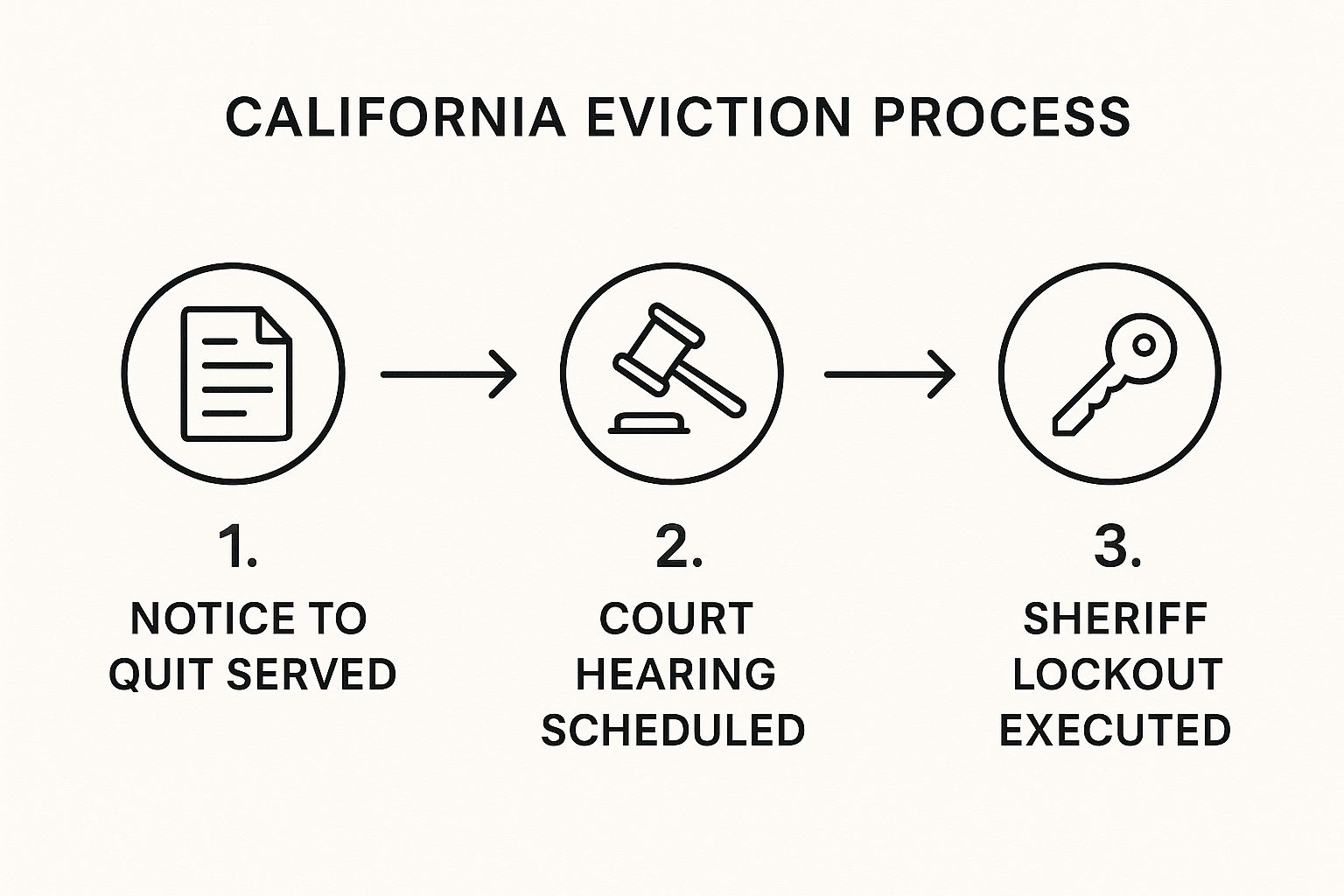
As the visual shows, eviction is a linear, multi-step legal procedure—not a simple request for a tenant to leave. Each stage, from the initial notice to the final lockout, must be executed perfectly to move on to the next.
Navigating No-Fault Evictions And The Ellis Act
For investors weighing their long-term strategy, understanding "no-fault" evictions is crucial. This is particularly relevant under the Ellis Act, a state law that gives landlords the right to exit the rental business entirely. For example, an investor with properties in a South County town like Gonzales or Soledad might decide to remove them from the rental market for redevelopment.
However, the Ellis Act comes with its own set of stringent rules and notice periods. You can’t just decide to do it on a whim. Successfully using this Act requires careful legal navigation to avoid compliance headaches and potential lawsuits.
Eviction is a remedy of last resort, and the legal system is designed to protect tenants from improper procedures. Meticulous documentation and unwavering adherence to legal timelines are not just best practices—they are the only way to successfully regain possession of your property.
Common Pitfalls That Derail Evictions
Even with the right notice in hand, many owners stumble during the process. Some of the most common errors we see include:
- Improper Service: Simply taping a notice to the door isn't always enough. California law has very specific rules for how notices must be delivered to be considered legally served.
- Accepting Partial Rent: If you accept any amount of rent after a notice period expires, you may have just voided the entire eviction notice. You'll likely have to start all over again.
- Retaliation Claims: A tenant can fight an eviction by claiming it's in retaliation for them requesting repairs or reporting a code violation. Proving otherwise requires solid documentation on your part.
The eviction process is riddled with complexities, and getting it right is essential for protecting your investment. For a more detailed breakdown, check out our guide on how to evict a tenant in California, which provides additional context for property owners. At Coast & Valley, we manage this entire process with professional precision, ensuring full compliance and protecting you from the costly risks of a botched eviction.
Protect Your Investment with Proactive Management

Knowing the ins and outs of landlord tenant laws in California is a great start, but it’s only half the battle. For serious investors with properties in Salinas, Carmel, or anywhere in between, real protection comes from putting that knowledge to work through diligent, proactive management. This is where you turn legal theory into a powerful tool for maximizing your return on investment.
Think of compliance not as a chore, but as your strategic advantage. When you handle every detail—from drafting the lease to returning the security deposit—with professional precision, you’re building a fortress around your investment. This approach does more than just sidestep legal headaches; it preserves your property's condition and, most importantly, frees up your valuable time.
The Tangible Benefits of Expert Oversight
For busy professionals and discerning investors, the value of professional management goes far beyond just collecting rent. It's about creating a seamless and profitable ownership experience, even from a distance. The right local partner transforms a tangle of legal complexities into smooth, efficient operations.
This is especially true in a unique market like Monterey County. Our deep-seated local expertise means we don't just know the state statutes; we understand the specific challenges and opportunities that come with managing luxury properties from the Salinas Valley to the coast.
Proactive management is the art of preventing problems before they start. It is the most effective strategy for preserving property value, ensuring steady returns, and achieving peace of mind in California's demanding rental market.
A Partnership Focused on Your Goals
Ultimately, our goal is to align with yours: to protect and grow your real estate portfolio. We get there by concentrating on four key pillars that directly impact your bottom line:
- Mitigating Legal Risks: We ensure every action is fully compliant with ever-changing state and local laws, shielding you from expensive disputes and penalties.
- Securing High-Quality Tenants: Our rigorous screening process is designed to find responsible tenants who will treat your high-end property with the respect it deserves.
- Preserving Property Condition: Through consistent inspections and preventive maintenance, we safeguard the long-term value and appeal of your investment.
- Maximizing Your Time and ROI: We handle the day-to-day operations so you can focus on your broader investment strategy, confident that your property is in expert hands.
For owners of premium properties in Salinas, Pacific Grove, or South County, this level of service isn't a luxury—it's a necessity. It’s the difference between merely owning a property and running a successful, stress-free investment.
If you’re ready to stop reacting to regulations and start proactively managing your valuable asset, Coast & Valley is here to help. Our team, led by Salinas native Amy Salmina, brings the local leadership and high-end solutions you need to navigate California’s rental landscape with confidence.
Protect your investment and unlock its full potential. Contact Coast & Valley today for a complimentary property evaluation and discover the peace of mind that comes with professional management.
Common Questions About California Rental Laws
When you're a landlord in California, especially in places like Salinas and Monterey County, certain questions pop up again and again. Let's walk through some of the most common issues we help property owners navigate.
If My Property Is Exempt From AB 1482, Can I Still Evict?
Yes, you can, but you still have to follow proper procedure. An exemption from the Tenant Protection Act (AB 1482) means you're not held to the statewide rent caps or "just cause" eviction standards.
However, that doesn't give you a free pass. You are still bound by every other state and local regulation. This means serving proper legal notice is a must, as is upholding the tenant's right to a safe and livable home. For a deeper look, check out our property owner’s guide to the warranty of habitability in California.
How Much Can I Raise The Rent In Monterey County?
For any property that falls under AB 1482, the annual rent increase is capped. The formula is 5% plus the local Consumer Price Index (CPI), but it can never exceed a total of 10% in a year. It's absolutely critical to check the current CPI figures for our area, as they are constantly changing.
If your property is exempt from AB 1482, this specific cap doesn't apply. However, any rent increase you implement still requires you to give the tenant proper, formal written notice (typically 30 or 60 days, depending on the amount of the increase).
What Are The Biggest Mistakes To Avoid During An Eviction?
Stepping on a legal landmine during an eviction is easier than you'd think. The most costly errors we see property owners make are:
- "Self-help" evictions: This is when a landlord takes matters into their own hands by illegally changing the locks, shutting off the power or water, or moving a tenant's belongings out. Don't do it.
- Improper notice: Using the wrong legal form or failing to deliver it in the legally required manner can derail the whole process.
- Retaliation: Trying to evict a tenant simply because they asked for a necessary repair is illegal and will backfire.
Making any of these mistakes can get your eviction case thrown out of court. You'll have to start the entire process over from scratch and could even find yourself facing lawsuits and penalties.
Do I Have To Pay My Tenant To Move Out?
Sometimes, yes. This is a common requirement for "no-fault" evictions under AB 1482. A no-fault cause is when the tenant has done nothing wrong, but you need the property back—for instance, if you or a family member plan to move in, or if you're planning a major renovation.
In these specific cases, you are generally required to provide the tenant with relocation assistance. This payment is typically equal to one month’s rent, which is a significant cost you need to budget for ahead of time.
Staying on the right side of these complex laws takes more than just a quick read-through; it requires local expertise and diligent oversight. Coast and Valley Properties delivers the strategic management needed to keep your investment protected and your returns on track.
Explore our full-service property management solutions today.