
A Landlord’s Guide to Lead Paint Disclosure in California
As an owner of a high-end property in California, navigating lead paint disclosure laws is a critical component of protecting your investment, especially if your property was built before 1978. This is a non-negotiable part of the leasing process. Before any tenant signs a lease for a pre-1978 home, you are legally required to provide them with a specific federal pamphlet and a signed disclosure form detailing any known lead-based paint or related hazards.
Your Core Duties for Lead Paint Disclosure in California

If you own a premier property in a place like Pebble Beach or Carmel, you know that compliance is about more than just checking a legal box—it’s a fundamental part of protecting your asset and ensuring your tenants' well-being. The charming, historic character that makes many homes in the Monterey Bay Area so desirable often means they fall under this federal mandate. Any residential property built before 1978 is what the government calls "target housing," and that label triggers specific disclosure duties for you as the owner.
The U.S. government banned lead-based house paint in 1978 due to its severe health risks. To address the issue in older homes, the federal Lead-Based Paint Disclosure Regulation was enacted in 1996. This law requires owners of pre-1978 homes to disclose what they know about lead paint to potential renters before a lease is finalized.
The Two Non-Negotiable Requirements
Your responsibility boils down to two key actions you must take for every single lease involving a pre-1978 property. It doesn't matter if it's a single-family home in Salinas or a multi-unit building in Soledad; the rules are the same.
- Provide the EPA Pamphlet: You must give every new tenant a copy of the EPA-approved pamphlet, "Protect Your Family From Lead In Your Home." This document is designed to educate them on the dangers of lead exposure and how to identify potential hazards.
- Complete the Disclosure Form: You must also correctly fill out and provide the "Disclosure of Information on Lead-Based Paint and/or Lead-Based Paint Hazards" form. This is your official, written statement about your knowledge (or lack thereof) of lead paint on the property.
Key Takeaway for Investors: A verbal heads-up during a showing is insufficient and offers no legal protection. The law demands a clear paper trail—a signed disclosure form and proof you delivered the pamphlet. This paperwork, managed by a professional like Coast & Valley, is your best defense against future liability claims.
While federal law sets the foundation, California often has its own, more stringent requirements that build on these federal mandates, reinforcing the need for local expertise.
Federal vs. California Lead Safety Rules at a Glance
This table helps clarify how California’s rules enhance the federal baseline. While the core disclosure principle is federal, California law often layers on additional requirements, especially concerning property maintenance and renovation.
| Requirement Area | Federal Rule (Baseline) | California Rule (Enhanced) |
|---|---|---|
| Disclosure | Must provide EPA pamphlet & disclosure form for pre-1978 homes. | Follows federal rule but adds state-specific health and safety codes. |
| Maintenance | No specific federal rule for intact paint in rental units. | Landlords must maintain properties in a "habitable" condition, which includes addressing deteriorated lead paint as a hazard. |
| Renovation/Repair | Requires EPA-certified renovators for work disturbing lead paint (RRP Rule). | Adopts the federal RRP Rule and integrates it into state occupational safety (Cal/OSHA) and contractor licensing (CSLB) standards. |
| Tenant Rights | Tenants can terminate the lease if disclosure isn't done correctly before signing. | Tenants have stronger protections and can sue for damages or report landlords to local health departments for hazardous conditions. |
These duties are a critical piece of the puzzle for any landlord. Understanding them, alongside other key regulations, is essential for running a successful and legally sound operation in this state. For a deeper dive into your responsibilities, our guide to California landlord-tenant laws offers valuable insights. At Coast & Valley, we handle this detailed compliance work day-in and day-out, ensuring every 'i' is dotted and 't' is crossed so you can have complete peace of mind.
An Actionable Disclosure Checklist for Landlords
Navigating California’s lead paint disclosure rules can feel complex, but a step-by-step process makes it manageable and secure. For busy owners with properties in Monterey, Salinas, or the surrounding Monterey County communities, a clear plan isn't just about compliance—it's about protecting your investment with professional diligence.
The entire process hinges on one simple fact: the year your property was built. If your rental home in Pacific Grove or an apartment complex in King City was constructed before 1978, these regulations apply directly to you.
Step 1: Gather Your Documentation
Before listing the property, your first move is to pull together all existing records on lead paint. This includes any inspection reports, risk assessments, or notes on past abatement work. Even a report from years ago that found no lead is a valuable asset that must be disclosed.
What if you have no reports or knowledge of lead paint? That’s perfectly acceptable. The law requires you to be transparent about what you know—and what you don’t know. Honesty and accuracy are the goals.
Step 2: Complete the Official Forms
Next is the paperwork. You’ll need to fill out the federal "Disclosure of Information on Lead-Based Paint and/or Lead-Based Paint Hazards" form. On this form, you will:
- State What You Know: Check the box that accurately reflects your knowledge—whether you know of lead paint hazards or have no knowledge of them.
- List Your Records: Check the box to confirm you've provided the tenant copies of any reports you have. If you have none, state that.
- Acknowledge the Pamphlet: Confirm you’ve provided the tenants with the required EPA pamphlet, "Protect Your Family From Lead in Your Home."
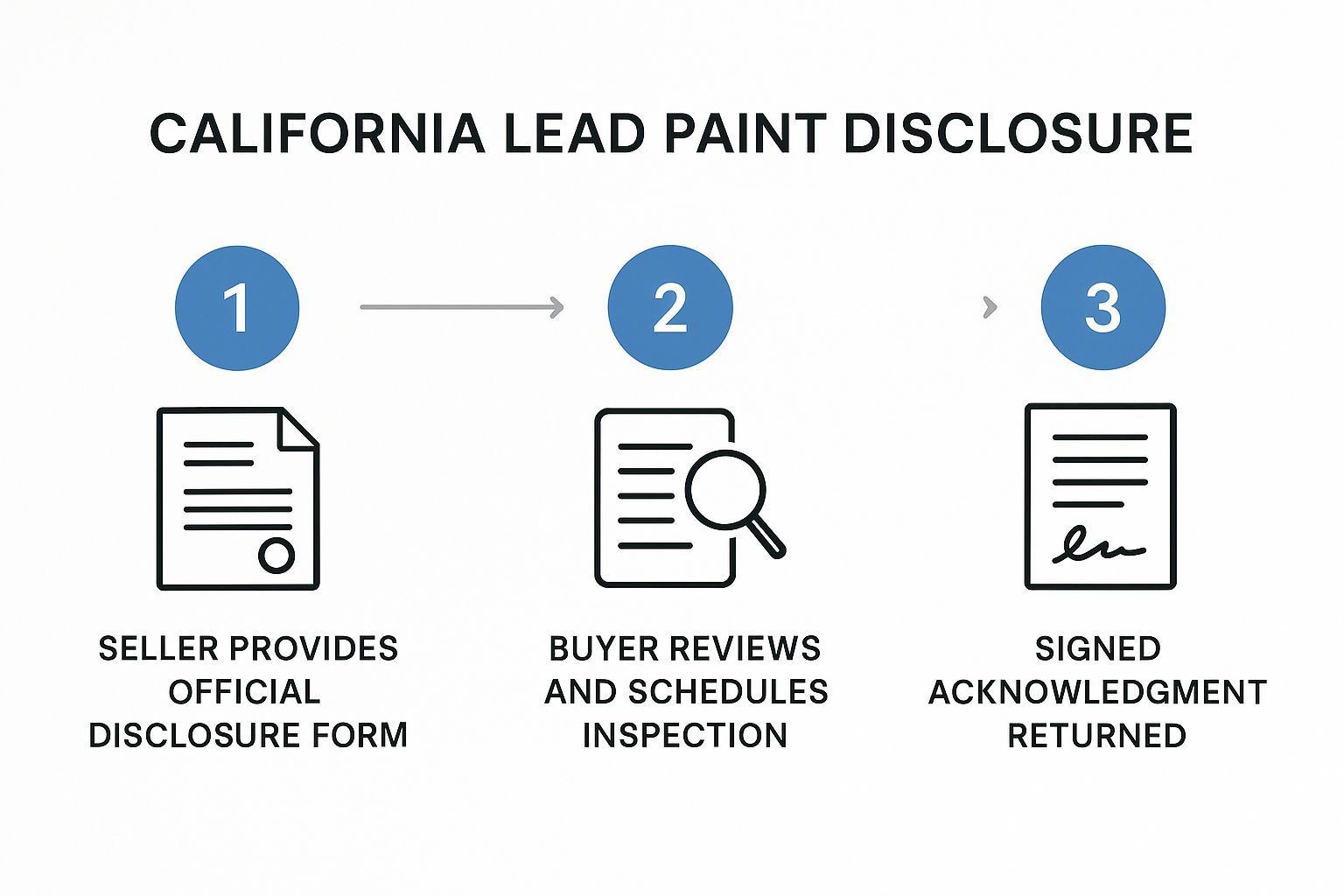
This process ensures everyone is informed and has acknowledged receipt of the information in writing.
Step 3: Finalize and Maintain Records
Getting the right signatures is the final, crucial step. Before a lease is executed, this disclosure form must be signed by yourself (the landlord), your agent (if you use one), and every adult tenant on the lease. A single missing signature can invalidate the document.
Expert Insight from Amy Salmina: "It’s not enough to just get a signature. You must give your tenants a fully signed copy of the disclosure form and the EPA pamphlet for their own records. Then, you must keep your copies for at least three years. At Coast & Valley, we digitize and securely archive these documents for all our clients. It creates an undeniable paper trail that proves compliance and protects your investment."
Properly handling these steps not only safeguards your asset but also builds the kind of trust that attracts and retains high-quality tenants. For a broader overview of your legal obligations, review our detailed guide on landlord responsibilities vs. tenant duties.
Navigating California's Strict Renovation Rules

In California, lead paint compliance extends far beyond the initial lease signing. The rules become even more stringent when it's time to renovate, repair, or repaint.
For owners of properties built before 1978—whether it’s a distinguished home in Carmel or a historic building in downtown Salinas—any work that disturbs a painted surface triggers a new set of requirements. These are not suggestions; they are serious regulations under the California Health and Safety Code designed to protect your tenants, your investment, and your liability from the dangers of lead dust. Since 2008, any such work has required Lead-Safe Work Practices, including meticulous containment and specialized cleaning protocols.
The Mandate For Certified Professionals
Forget about quick DIY touch-ups in an older property. If your building was constructed before 1978, California law is crystal clear: any person or company doing work that could disturb lead-based paint must be EPA-certified. This is a non-negotiable legal requirement.
Whether you're planning a small repair that involves cutting into a wall or a full-scale remodel, the professionals you hire must be trained in specific safety protocols. They know how to:
- Contain the Work Area: Sealing off the renovation zone with heavy-duty plastic sheeting to prevent microscopic lead dust from spreading.
- Minimize Dust Creation: Using techniques like wet sanding and vacuums equipped with HEPA filters to capture hazardous dust at the source.
- Dispose of Debris Properly: Bagging and disposing of all construction waste according to strict environmental guidelines.
Investor Takeaway: Attempting a DIY repair or hiring a non-certified handyman for work on a pre-1978 property is a significant financial risk. A single compliance failure can trigger hefty fines, legal action, and potential harm to tenants. The only prudent choice is to insist on using certified professionals for every maintenance and renovation project.
The Property Management Advantage
For a busy investor with high-end properties, managing this level of compliance is a time-consuming burden. This is where a professional property management team becomes your most valuable partner.
At Coast & Valley, we maintain a vetted network of EPA lead-safe certified vendors in the Monterey Bay Area. We have qualified professionals ready for everything from a simple plumbing repair that requires opening a wall to a major renovation. We ensure every work order for a pre-1978 property is handled by a certified professional, shielding you from legal and financial fallout while protecting your property's value.
While ensuring compliance, it's also a great time to boost your property's value. You might find these tips on rental renovations helpful for maximizing your ROI. Our comprehensive approach to property management in California weaves this compliance oversight into everything we do, giving you total peace of mind.
Common Mistakes and How to Avoid Costly Penalties

Even the most diligent property owners, from Salinas to the South County towns of Gonzales and King City, can make mistakes with California's lead paint disclosure rules. These are not minor slip-ups; they are errors that can lead to serious legal action and fines up to $21,018 per violation. Understanding these common pitfalls is your first line of defense.
One of the most frequent errors is "verbal disclosure." A landlord might casually mention the possibility of lead paint during a walkthrough, believing that's sufficient. It is not. The law is clear: only a properly completed and signed written disclosure form provides legal proof of compliance.
Another critical mistake is forgetting to provide the EPA's "Protect Your Family From Lead In Your Home" pamphlet. It’s a mandatory handout. Skipping this step can invalidate your entire disclosure effort, even if you did everything else correctly.
Incomplete Forms and Poor Record-Keeping
The details matter immensely. This is especially true for leases with multiple tenants. A disclosure form that is perfect except for one missing initial or signature from one of the tenants is non-compliant, opening you to liability.
Finally, sloppy record-keeping can undermine all your hard work. The law requires you to retain signed disclosure forms for at least three years from the lease start date. These documents are your only defense against a future claim.
A Proactive Approach to Risk: "We advise our clients to treat their disclosure records as a critical insurance policy for their asset," says Amy Salmina, owner of Coast & Valley. "We maintain secure digital backups of all compliance documents. This allows us to instantly produce proof, protecting our owners from disputes that might arise years later."
Navigating these requirements demands a robust system. To steer clear of common blunders and the steep penalties they bring, owners should look into effective regulatory compliance solutions that ensure nothing is missed.
Landlord Compliance Risk Assessment
This table shows just how high the stakes are.
| Common Landlord Mistake | Potential Consequence | The Coast & Valley Professional Solution |
|---|---|---|
| Verbal-only disclosure | No legal proof of compliance, fines up to $21,018 per violation. | Standardized, written disclosure forms are used for every lease without exception. |
| Forgetting the EPA pamphlet | Invalidates the entire disclosure process, exposing you to legal action. | Pamphlet delivery is a non-negotiable, checklist item for every new tenancy. |
| Missing signatures/initials | The disclosure is legally incomplete and unenforceable. | A multi-point check ensures all parties have initialed and signed every required field. |
| Not keeping records for 3 years | Inability to defend against future tenant claims or lawsuits. | Secure digital and physical archiving of all documents for the required retention period. |
These are not minor administrative tasks—they are significant legal requirements with major financial implications.
The Professional Management Solution
For discerning investors in the Monterey Bay Area, managing this level of administrative detail is an unnecessary risk and a drain on your time. At Coast & Valley, we have built these compliance checks directly into our property management systems.
Our expert team ensures every form is completed perfectly, every signature is captured, and every document is archived meticulously. We transform a complex legal headache into a simple, worry-free process, allowing you to focus on the growth of your investment, not the paperwork. This ironclad documentation is also a powerful asset when you have to deal with tricky tenants, as it leaves no room for dispute.
Protecting Your Investment and Your Tenants
For any serious investor, the lead paint disclosure in California isn't just another legal hoop to jump through. It’s a core piece of smart asset management, risk mitigation, and building the kind of tenant relationships that last. When you move beyond just checking the boxes, you start preserving your property's value and building a solid reputation in the competitive Monterey Bay market.
This mindset shift—from just a landlord to a responsible steward of your investment—is what separates the pros. It's about creating a safe, quality living environment that naturally attracts and keeps the best tenants. After all, a secure and well-maintained property is exactly what discerning renters are looking for.
From Legal Duty to Smart Investment
Thinking ahead can turn a simple compliance task into a real long-term advantage. For example, if you own a historic property in Pacific Grove or a multi-unit building in Gonzales, consider ordering a professional lead risk assessment. It's a proactive step that lets you spot and stabilize any deteriorating paint before it ever becomes a reportable hazard.
Taking this kind of initiative shows a higher standard of care. This commitment to your tenants' well-being builds a foundation of trust that can seriously cut down on turnover and boost your property's reputation. It sends a powerful message that you're a professional owner, which is a huge differentiator in any rental market. When tenants feel looked after, they're far more likely to take good care of your property in return.
Investor Insight: Think of proactive safety measures as an investment in your property's long-term ROI, not just an expense. A documented history of responsible ownership is a valuable asset that strengthens your position and minimizes liability.
Understanding the history here is important. Even after federal and state laws were passed, lead poisoning from homes was a major issue for decades. A 1990 survey found that around 64 million homes still had lead paint, many with active hazards from shoddy removal attempts and a lack of proper funding. This history shows us that disclosure laws are just the baseline. True asset protection comes from actively reducing hazards and insisting on safe work practices, a point underscored by research on residential lead exposure.
This focus on providing quality, safe housing can also pay off in other parts of your rental business. For example, ensuring a safe environment is a major selling point when you're looking at attracting vacationers and seasonal renters to our beautiful Monterey Bay Area.
At Coast & Valley, we build this philosophy of preventive care into everything we do. We help owners shift from reactive problem-solving to proactive asset preservation, making sure your investment is protected and your tenants feel secure.
Frequently Asked Questions from Monterey County Owners
As seasoned experts managing high-end properties across the Monterey Bay Area, we field a lot of questions from conscientious owners. When it comes to lead paint disclosure in California, the rules can seem a bit tangled. So, we've put together some clear, straightforward answers to the questions we hear most often.
Am I Legally Required to Test for Lead Paint?
Straight to the point: no. Neither federal nor California law requires you to test your property for lead-based paint. The legal obligation is disclosure, not testing. Your duty is to inform prospective tenants about any known lead paint or related hazards.
If you don't know of any and have no reports on file, you simply state that on the disclosure form. Deciding whether to test is a strategic choice for an investor.
- The upside of testing: A certified "lead-free" report can be a significant advantage, especially for a luxury rental in a competitive market like Carmel. It provides tenants with peace of mind.
- The downside of testing: If a test comes back positive, you now have legal knowledge of a lead hazard. You are now required to disclose that positive result to every future tenant and buyer, creating a permanent record for the property.
What if My Property Was Built Exactly in 1978?
This is a classic question for owners with homes in established communities like Monterey or Seaside. The law specifies "pre-1978" housing, leaving that year in a gray area.
Our Professional Advice: Do not take the risk. To be completely safe and eliminate any potential legal ambiguity, always treat a property built in 1978 as if it falls under the rule. This is a simple, zero-cost step that provides total liability protection and is the most professional way to handle the situation.
Do These Laws Apply to Short-Term Rentals?
Generally, no. The federal lead disclosure rules exempt leases of 100 days or less where there's no option to renew or extend the stay. This covers most typical vacation rentals in the Monterey Bay Area.
However, if you offer longer-term furnished rentals—for example, a three-month lease with an option to extend—you would almost certainly need to provide the disclosure. The specifics of the lease term are what matter.
What if a Former Tenant Claims They Never Received the Disclosure?
This is precisely why meticulous, professional record-keeping is non-negotiable. A claim from a former tenant is just their word against yours, unless you have proof. Your definitive defense is the fully executed disclosure form, signed and dated by every adult on the lease.
You must retain these signed forms for a minimum of three years from the tenancy start date. This document is your proof of compliance. Without it, you are exposed to serious claims and penalties. This is why we digitize and securely archive these documents for all our clients—it creates an unbreakable shield against future disputes.
Handling compliance details like these is fundamental to protecting your real estate investment. At Coast and Valley Properties, we manage the complexities of lead paint disclosure and other regulations so you can focus on what matters most. Contact our team today to learn how our professional management services can safeguard your Monterey County properties.