How Tenant Screening Works in California, and Where Owners Get It Wrong
Direct Answer: California tenant screening requires consistent, written criteria applied equally to every applicant, in the order received. Skipping steps or applying standards unevenly creates fair housing exposure that goes well beyond a bad tenancy.
Tenant quality is the single variable that most determines how a Monterey County rental performs over time. I’ve seen a well-screened tenant in a modest Salinas property cause far fewer problems than a poorly screened one in a high-value Pacific Grove home. The property itself matters less than who is living in it.
What surprises a lot of owners is that tenant screening in California isn’t just a judgment call. It operates inside a legal framework that has specific requirements, and applying that framework inconsistently creates exposure that goes well beyond one bad tenancy. California’s AB 2493, which took effect in 2024, added new obligations around application processing order and fee handling that many self-managing owners don’t know exist.
This article walks through what a lawful, defensible screening process actually looks like, where the recurring mistakes happen, and why documentation at this stage protects you in every dispute that comes later. If you’re managing a rental near CSUMB, Fort Ord, or in Pacific Grove where competition for good units can be intense, this process matters even more.
What California Law Actually Requires Before You Accept or Deny
Before I get into criteria, the process itself has a legal shape in California. Under AB 2493, landlords are required to process applications in the order they are received. That sounds simple, but it has real consequences.
If a qualified applicant applies first and you skip to a later one you prefer for reasons you can’t document, you’ve created a problem. The first applicant may have legal recourse, and the reason you skipped them matters enormously from a fair housing standpoint.
The law also limits when you can retain an application fee. If you’re not going to process an application because the unit is already rented, or because you’ve stopped accepting applications, you generally have to return the fee. Keeping it without processing is not allowed.
What this means practically:
- Timestamp every application the moment it comes in
- Process them in order, and keep a written record showing you did
- If you reject a qualified first applicant in favor of a later one, you need a documented, non-discriminatory reason on file
- Return fees promptly when an application is not processed
Owners managing high-demand rentals in Pacific Grove or near the Monterey Peninsula benefit most from having this locked down before a vacancy hits the market. Demand can move fast there, and the pressure to choose quickly is exactly when process discipline matters most.

What Consistent Screening Criteria Actually Look Like
Here is where I see owners get into the most trouble. They screen loosely, applying different standards to different applicants without realizing that inconsistency is its own legal risk, separate from AB 2493.
Fair housing law in California prohibits discrimination based on protected class status. If you set a credit score threshold of 650 for one applicant and waive it for another without a documented, non-discriminatory reason, you’ve opened a fair housing exposure. It doesn’t matter if your intent was innocent. What matters is what the file shows.
The way to protect yourself is simple in concept, harder in practice: write your screening criteria down before you market the property, and apply them identically to every applicant.
A defensible set of criteria typically includes:
- Credit history, pick a minimum score and apply it consistently
- Income verification, the California standard is income of at least three times the monthly rent; ask for pay stubs, tax returns, or employer letters
- Background check, criminal history review within the limits California law allows
- Rental history, prior landlord references and payment track record
Each criterion needs to be applied the same way, every time. If an exception is made, it needs to be documented with a reason that has nothing to do with protected class status. This isn’t just good practice. It’s what protects you if a denied applicant files a complaint. For owners managing multiple units across Salinas, this kind of written policy is even more important because the volume of applications means inconsistency is harder to catch.
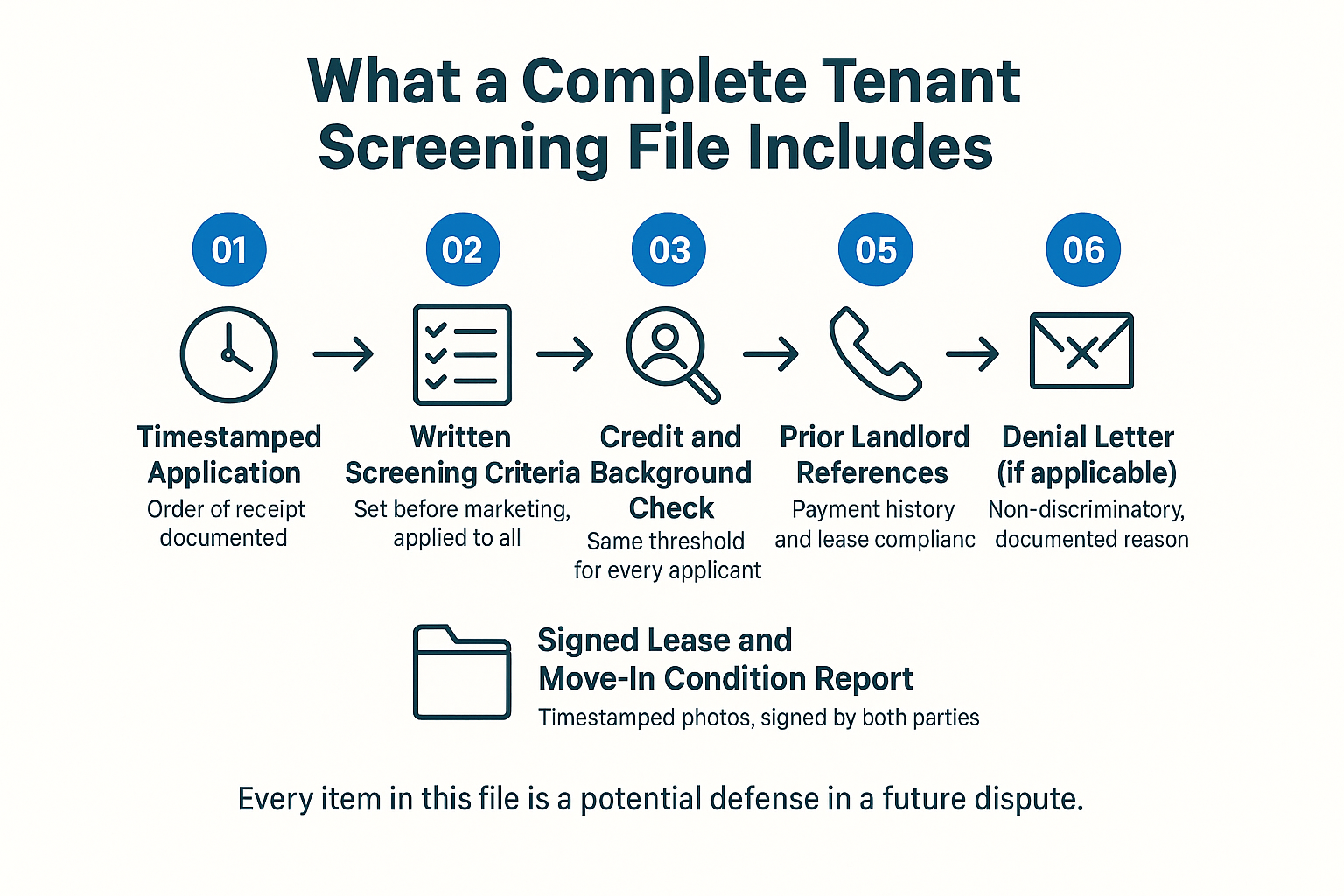
A Complete Screening File: What Every Application Should Include
A thorough move-in file is the foundation of every dispute that may arise later. This breakdown shows what belongs in it and why each piece matters.
When the Applicant Is a Company, Not a Person
One question that comes up more than people might expect involves commercial leases with a residential component. We’ve heard from owners with properties used for employee housing, situations where the lease is signed by a business entity rather than an individual tenant.
This changes what verification looks like. The documents you’d ask for from a corporate tenant are not the same as what you’d ask for from an individual applicant.
For a corporate entity taking on a residential property for employee housing, a reasonable verification package generally includes:
- Financial statements from the business, typically two to three years
- Evidence of operating history, how long has the entity been active and in good standing
- Confirmation of signing authority, documentation that the person executing the lease actually has authority to bind the company
- A personal guarantee from a principal may also be appropriate, depending on the entity’s size and financial history
This is a genuinely different situation from standard tenant screening, and it sits at the edge of where residential landlord-tenant law and commercial lease law overlap. For a deeper look at what California commercial landlord responsibilities look like in practice, this breakdown covers the owner side of that equation.
If you’re navigating a lease structure like this, it’s worth getting professional guidance before you execute anything.
Residential vs. Corporate Tenant: How Verification Differs
The documents you collect depend heavily on who is signing the lease. Here’s a side-by-side look at what each situation typically calls for.
| Verification Item | Individual Residential Applicant | Corporate Entity (Employee Housing) |
|---|---|---|
| Credit check | Personal credit report | Business credit report or D&B |
| Income / financial proof | Pay stubs or tax returns (3x rent) | Business financial statements (2-3 yrs) |
| Identity confirmation | Government-issued ID | Entity formation documents / EIN |
| Signing authority | Not applicable | Board resolution or operating agreement |
| Rental history | Prior landlord references | Prior commercial lease references |
| Personal guarantee | Not typically required | Often appropriate for smaller entities |
| Background check | Standard criminal and eviction check | Background on guarantor or key principals |
Why the Move-In File Is as Important as the Screening Itself
I want to be direct about something: screening well and documenting poorly is almost as bad as not screening at all. The file you build at move-in is what protects you in every dispute that follows, deposit deductions, lease enforcement, property damage claims.
One of the most consistent themes in disputes between landlords and tenants is what the property looked like on day one. If you don’t have a timestamped, photographic condition report signed by both parties at move-in, you are relying on memory. Memory doesn’t hold up in small claims court.
A complete move-in file includes:
- Timestamped application with all supporting documents
- Your written screening criteria (showing they were set before marketing)
- A denial letter, if applicable, with a documented non-discriminatory reason
- The signed lease
- A detailed property condition report with photos, signed by the tenant at move-in
That last item is where a lot of self-managing owners cut corners. They do a walkthrough, note a few things, and don’t get a tenant signature. When move-out comes and there’s a dispute over a damaged wall or a missing appliance, the owner has no baseline to reference.
For owners who’ve already found that documentation gaps create problems, this look at what the move-in process should accomplish covers why the relationship between owner and tenant is shaped well before anyone turns over a key.
California’s Department of Consumer Affairs also publishes plain-language guidance on landlord and tenant rights at entry and move-out that’s worth reading if you want to understand what the state expects from both sides.
Frequently Asked Questions About Tenant Screening in Monterey County
Can I charge an application fee in California, and how much is reasonable?
Yes, California allows landlords to charge an application fee to cover the cost of screening. The amount is tied to the actual cost of the credit and background check, and California law caps it based on a CPI-adjusted figure that changes annually. As of recent years, the cap has hovered around $30 to $60, but you should confirm the current year’s limit before listing a property. Under AB 2493, you also have to return the fee if you don’t actually process the application.
What if two strong applications come in for the same unit at the same time?
This is where timestamps matter. Under AB 2493, the first qualified applicant in line has priority. If you pass on them in favor of a later applicant, you need a documented, non-discriminatory reason. The cleaner approach is to process the first complete application fully before opening the second. In high-demand areas near Monterey or Pacific Grove, this sequence needs to be locked in before a vacancy goes live.
Do I have to give a reason when I deny an applicant?
California requires you to provide an adverse action notice when you deny an applicant based on information from a credit report. That notice must tell the applicant which reporting agency was used so they can request a copy. Beyond credit-based denials, it’s good practice to document your reason in writing regardless, because it protects you if a fair housing complaint follows.
Can I use a higher income requirement for a higher-rent property?
Yes, the three-times-rent income threshold is a guideline, not a legal maximum. You can set a higher threshold if you apply it consistently to all applicants for that unit. What you cannot do is use a different threshold for different applicants on the same property without a documented, non-discriminatory reason.
What happens if I screen someone and later find out I made a fair housing mistake?
Fair housing complaints in California can result in significant financial exposure, including damages, attorney’s fees, and civil penalties. The California Department of Fair Employment and Housing investigates complaints, and the process can be lengthy and costly even if you believe you acted in good faith. Consistent written criteria, applied identically to every applicant, are your best protection.
Is the screening process different for properties in Salinas versus Carmel or Pacific Grove?
The state law requirements are the same across Monterey County. But local demand patterns differ, and that changes how fast you need your process ready. Rentals near CSUMB or Fort Ord can generate multiple applications quickly. Properties in Carmel or Pebble Beach tend to draw fewer applications but often from applicants with more complex financial profiles. Having your criteria written and ready before marketing, regardless of location, keeps you protected either way.
Want a Second Set of Eyes on Your Screening Process?
If you’re managing a rental in Salinas, Pacific Grove, Carmel, or anywhere across Monterey County and you’re not confident your screening process is legally defensible, it’s worth a conversation. Coast & Valley Properties has been handling tenant placement and full residential management in this market since 2009, and we’ve seen what happens when documentation gaps surface at the worst possible time. Reach us at (831) 757-1270 or through the contact form at coastandvalleypm.com.