
Mastering Vendor Management: Best Practices for High-Value Monterey County Properties
For owners of high-end properties in Salinas, Monterey, and across the Bay Area, maximizing returns is not just about collecting rent. It's about preserving asset value through meticulous, proactive care. A crucial, yet often overlooked, component of this strategy is sophisticated vendor management. The quality of your landscapers, plumbers, roofers, and electricians directly impacts tenant satisfaction, long-term maintenance costs, and ultimately, your property's prestige and market value. Poor vendor selection can lead to subpar work, safety liabilities, and costly rework, eroding your investment from the inside out.
This guide moves beyond generic advice to offer actionable vendor management best practices tailored specifically for the discerning property investor in communities from Pebble Beach to King City. We'll detail the precise strategies required to build and maintain a network of elite, reliable, and professional service providers. To gain a broader perspective and delve deeper into established frameworks, you might find valuable insights in a comprehensive guide to vendor management best practices which complements our localized approach.
Below, we will explore nine critical pillars of effective vendor oversight, from strategic selection and robust contract governance to risk mitigation and technology integration. You will learn how Coast & Valley Properties, led by local expert Amy Salmina, leverages these principles to provide a concierge-level experience, ensuring every service partner who steps onto your property meets the highest standards. Our goal is simple: to transform vendor management from a reactive necessity into a proactive strategy that safeguards your valuable asset, enhances tenant relations, and maximizes your return on investment for years to come.
1. Strategic Vendor Assessment and Selection: Building a Roster of Excellence for Your Monterey County Property
The foundation of exceptional property management rests upon the quality of its partners. One of the most critical vendor management best practices is moving beyond reactive hiring and implementing a rigorous, strategic selection process. For a luxury property in Carmel or a multi-unit complex in Salinas, you cannot afford to base a decision on a quick online search. This foundational step is about proactively building a roster of pre-vetted, elite local professionals.
This process involves creating a detailed scope of work for any potential job, conducting thorough due diligence that extends far beyond online reviews, and verifying credentials specific to Monterey County regulations. We treat this as assembling a trusted team, evaluating potential partners on criteria like their local reputation, proof of adequate insurance coverage, proper licensing, and specific experience with the high-end finishes and materials common in premier local properties. When strategically assessing and selecting vendors, a deep understanding of services like Contact Center Outsourcing can be crucial for building a roster of excellence.
Actionable Steps for a Strategic Vetting Process
A proactive approach minimizes risk and guarantees a level of service that aligns with the expectations of discerning tenants and protects the integrity of your investment.
- Step 1: Define Your Needs. For a Pebble Beach property, specify the need for a landscape architect specializing in drought-tolerant, coastal-native plants to enhance curb appeal while adhering to local water conservation mandates.
- Step 2: Conduct Due Diligence. For a Salinas HVAC technician, verify certifications for high-efficiency systems common in newer luxury constructions to ensure optimal performance and energy savings.
- Step 3: Check Local Expertise. When onboarding a King City roofing contractor, confirm they have a proven track record of working with historic tile materials, ensuring compliance and historic preservation.
The following infographic illustrates our disciplined, three-step process for vendor assessment.
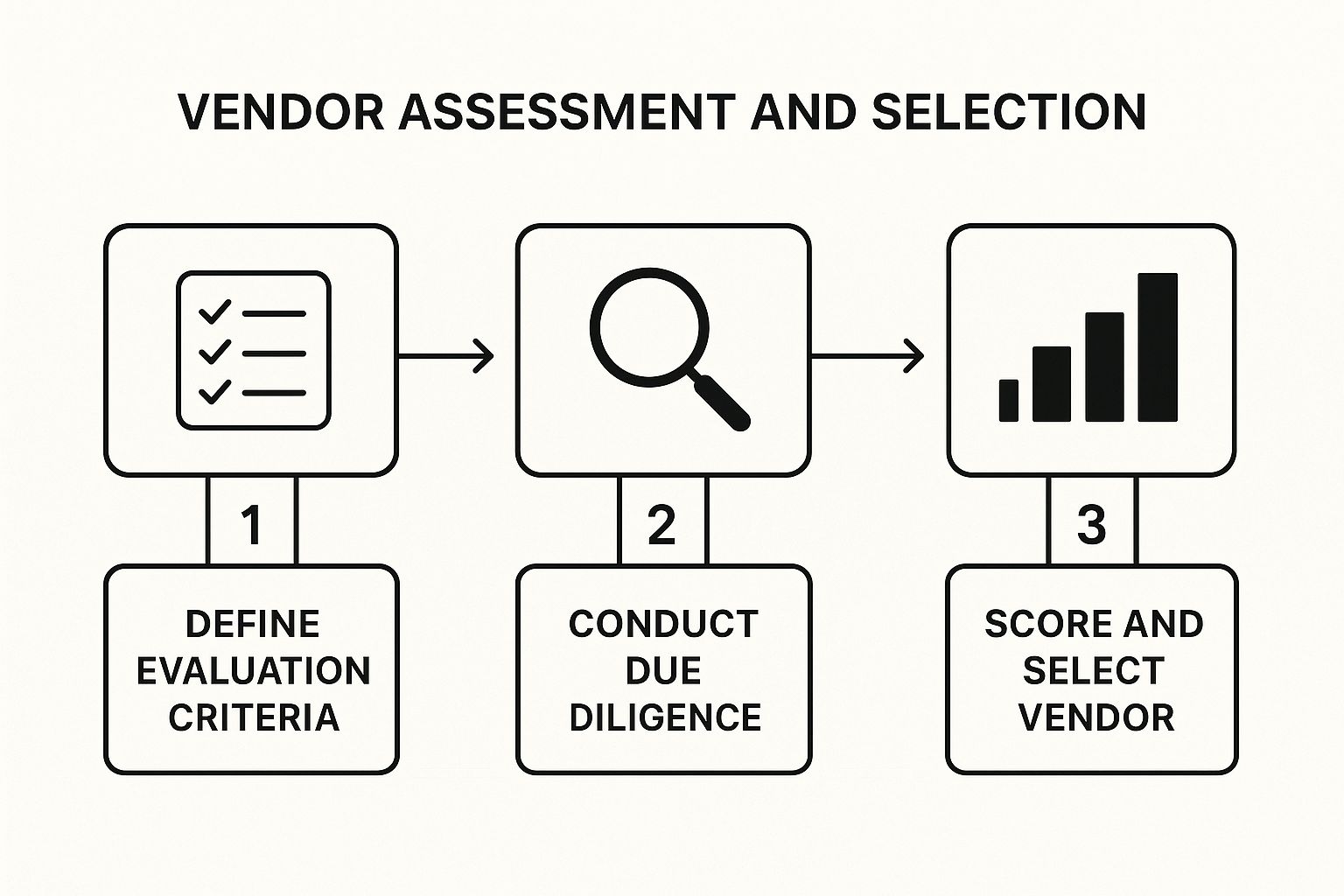
This structured workflow ensures that every vendor is evaluated objectively against consistent standards, removing guesswork and guaranteeing quality. By establishing a pre-vetted list of top-tier local vendors, from Soledad to Pacific Grove, we ensure that when a need arises, we dispatch a proven professional, not a gamble.
2. Robust Contract Management and Governance
Once an elite vendor is selected, the relationship must be defined and protected through meticulous contract management. A handshake agreement or a basic invoice is insufficient for protecting high-value assets in Monterey County. One of the most critical vendor management best practices is implementing a systematic approach to managing vendor contracts throughout their entire lifecycle. This process ensures clarity, enforces accountability, and mitigates risk for everything from routine maintenance in Salinas to a major renovation in Pebble Beach.
This practice involves establishing crystal-clear terms, detailed Service Level Agreements (SLAs), compliance requirements, and governance structures. It ensures both parties fully understand and meet their obligations. A well-structured contract, designed to be both firm and flexible, is the operational blueprint for a successful partnership. It protects your investment by defining expectations around quality, timelines, and costs, preventing misunderstandings before they can begin. For a deeper understanding of the legal frameworks involved, our guide on the property management contract in California offers valuable insights.

A Checklist for a Structured Contract Lifecycle
A proactive and organized approach to contract governance minimizes disputes and ensures that the services delivered consistently meet the high standards expected for premier local properties.
- Monterey Example: A janitorial services contract for a commercial building includes an SLA specifying cleaning frequencies, approved chemical usage, and a 2-hour response time for emergency cleanups, with financial penalties for non-compliance.
- Soledad Example: A contract with a security provider for a multi-unit complex clearly outlines patrol schedules, incident reporting protocols, and data privacy clauses related to surveillance footage, ensuring full legal and tenant compliance.
- Carmel-by-the-Sea Example: An agreement for a historic property renovation includes clauses for regular review checkpoints, allowing for adjustments based on unforeseen structural discoveries while keeping the project on budget and timeline.
By managing vendor relationships through robust and detailed contracts, we transform a simple service agreement into a powerful tool for quality control and risk management. This disciplined governance ensures every dollar spent enhances your property's value and protects your long-term ROI.
3. Continuous Performance Monitoring and KPI Tracking
The initial vetting process is only the beginning of a successful partnership. A core component of modern vendor management best practices is the ongoing measurement and evaluation of vendor performance against predefined metrics. For high-value properties from Marina to Gonzales, simply trusting that a job was done is not enough; you need data-driven assurance that it was done to the highest standard, on time, and within budget. This is where continuous performance monitoring and Key Performance Indicator (KPI) tracking become indispensable.
This proactive approach involves implementing clear dashboards, regular reporting, and structured performance reviews to ensure vendors consistently meet or exceed expectations. It transforms the vendor relationship from a transactional one into a strategic partnership focused on mutual improvement and accountability. For premium property owners, this means every dollar spent on maintenance or repairs is maximized, protecting both the asset's integrity and its return on investment. This data-driven oversight is crucial, and it's a cornerstone of the transparent service Coast & Valley provides.
Actionable KPIs for Your Vendor Framework
An effective monitoring system eliminates ambiguity and empowers data-backed decisions, ensuring that only the top-performing local vendors are retained for your property.
- KPI for a Monterey Multi-Unit: Track a plumbing vendor's average response time for emergency calls, ensuring it stays below the 60-minute KPI to minimize tenant disruption and potential water damage.
- KPI for a Carmel-by-the-Sea Luxury Rental: Monitor a high-end cleaning service's tenant satisfaction scores after each turnover, ensuring they consistently achieve a 95% or higher rating to maintain the property’s luxury appeal and drive positive reviews.
- KPI for a Soledad Commercial Property: Review a landscaping contractor's quarterly performance against budget and work completion timelines, identifying efficiency gains and ensuring adherence to the agreed-upon maintenance schedule.
By establishing and tracking these key performance indicators, we ensure every vendor servicing your Monterey County property is held to the same exacting standards of excellence we set for ourselves. This continuous feedback loop not only guarantees consistent quality but also fosters a culture of accountability and continuous improvement among our partners.
4. Risk Assessment and Mitigation Planning: Protecting Your Monterey County Asset
Engaging a third-party vendor, whether a plumber in Pacific Grove or a security firm in Salinas, introduces inherent risks to your property. A crucial component of vendor management best practices is moving from a reactive to a proactive risk management stance. This involves a systematic approach to identifying, evaluating, and mitigating potential liabilities associated with every vendor relationship, safeguarding your investment and ensuring operational continuity.
This process is about more than just checking for insurance; it’s a comprehensive evaluation of financial, operational, and reputational risks. For high-value properties in Monterey County, this means analyzing a vendor's financial stability to prevent project abandonment, assessing their operational protocols to ensure they align with your standards, and developing contingency plans for any potential service disruption. This disciplined approach protects your asset from vendor-related failures and demonstrates a commitment to professional oversight that busy investors value.
A Proactive Risk Mitigation Checklist
A structured risk assessment process minimizes unforeseen disruptions and protects the value and safety of your Monterey County property, ensuring every partner enhances, rather than endangers, your investment.
- Financial Risk (Carmel): For a high-end renovation, conduct a financial health check on the primary contractor to ensure they have the stability to complete the project, preventing costly delays and liens against the property.
- Operational Risk (Soledad): Establish a relationship with a pre-vetted secondary HVAC vendor as a backup for a multi-unit apartment complex, ensuring that a primary vendor’s scheduling issue doesn't leave tenants without heat or air conditioning during a cold snap.
- Compliance Risk (Monterey): Require a cybersecurity assessment for a new smart-home technology installer to ensure their systems and protocols protect resident data and prevent unauthorized access to integrated building controls.
By systematically identifying potential points of failure before they occur, we transform vendor management from a simple administrative task into a strategic asset protection function. This foresight ensures that from King City to Pebble Beach, your property is managed with an uncompromising commitment to security and operational excellence.
5. Strategic Relationship Building and Communication
Beyond transactional interactions, one of the most impactful vendor management best practices is to cultivate strategic, long-term partnerships. For a high-value portfolio spanning from Carmel Valley to Gonzales, treating vendors as mere suppliers is a missed opportunity. Instead, we view our key partners, from master plumbers to specialized landscapers, as extensions of our team. This approach transforms a simple service call into a collaborative effort aimed at preserving and enhancing your property's value.
This philosophy involves moving beyond operational check-ins to foster genuine professional relationships built on mutual trust and open dialogue. It’s about understanding their business just as they understand the unique demands of your luxury property. Our approach to vendor relationships aligns closely with the broader principles of strategic partnership management, emphasizing long-term value over transactional exchanges. This proactive communication ensures our partners are aligned with our high standards and your investment goals.

Actionable Steps to Foster Collaborative Vendor Partnerships
By investing in these relationships, we create a network of allies dedicated to the success of your Monterey County property, leading to better service, innovative solutions, and priority scheduling. Effective property management communication is the cornerstone of this strategy.
- Hold Quarterly Reviews (Carmel-by-the-Sea): We conduct quarterly reviews with a preferred high-end appliance technician to discuss preventative maintenance schedules for Sub-Zero and Wolf appliances, preventing costly failures in luxury rental properties and saving owners time and money.
- Involve in Planning (Soledad): By involving a trusted local roofer in our annual property planning, we proactively identified a minor issue on a multi-unit building that, if left unaddressed, would have led to major water damage during the winter rainy season. This preventive care protects the property's structure and value.
- Recognize Excellence (Monterey): We publicly recognize an exceptional cleaning service that consistently receives five-star reviews from tenants, reinforcing their value and motivating continued excellence. This builds loyalty and ensures your property is always presented in the best light.
This collaborative approach ensures that every professional who sets foot on your property is not just qualified but also deeply invested in its long-term success. It replaces a reactive, transactional model with a proactive partnership that protects and elevates your real estate asset.
6. Centralized Vendor Management Office (VMO): Scaling Excellence Across Your Portfolio
As your property portfolio grows from a single luxury home in Monterey to multiple units across South County, managing vendor relationships can become fragmented and inefficient. One of the most sophisticated vendor management best practices is to implement a Centralized Vendor Management Office (VMO) model. This dedicated function acts as a command center, overseeing all vendor relationships, standardizing processes, and ensuring consistent, high-quality service delivery across every property, from Salinas to Soledad.
A VMO structure moves beyond individual vendor selection to create a strategic, portfolio-wide ecosystem of partners. It provides a single point of governance, coordination, and expertise, ensuring that every vendor meets our stringent standards for insurance, licensing, and performance. This centralized approach is crucial for maintaining brand consistency, mitigating risks, and leveraging economies of scale for our clients' benefit. For high-net-worth investors, a VMO guarantees that the same level of white-glove service is applied whether we are coordinating a plumbing repair in King City or a landscape redesign in Carmel.
Real-World Benefits of a Centralized VMO Model
This strategic function ensures that every decision is data-driven, compliant, and aligned with your long-term investment goals, providing unparalleled peace of mind and operational excellence.
- For the Multi-Unit Investor: A VMO negotiates a master service agreement with a preferred plumbing company for a portfolio of 15 properties in Salinas, securing priority service and a 10% volume discount on all work orders, directly increasing ROI.
- For the Absentee Owner in Pebble Beach: The VMO team manages the annual contract renewals for landscaping, pool maintenance, and security services, ensuring all providers maintain up-to-date insurance and local certifications, protecting the owner from liability.
- For the Commercial Property in Monterey: A VMO coordinates a complex roof replacement by managing the bidding process with three pre-vetted, VMO-approved roofing contractors, ensuring transparent pricing and adherence to a strict project timeline.
By establishing a VMO, we ensure that every vendor interaction is managed with the same level of professionalism and diligence. This structure transforms vendor management from a series of individual transactions into a cohesive, strategic asset that protects and enhances the value of your Monterey County properties.
7. Technology-Enabled Vendor Management Platforms
In today's fast-paced property management environment, relying on manual spreadsheets and disconnected communication channels is no longer sufficient. One of the most impactful vendor management best practices is leveraging technology through dedicated platforms. For managing a high-value portfolio, whether in Salinas or along the Monterey Bay coast, these integrated software solutions automate everything from onboarding and compliance tracking to work order dispatch and payment processing. This approach replaces administrative burdens with streamlined efficiency and data-driven oversight.
These platforms provide a single source of truth, offering unparalleled visibility into vendor performance, spending, and compliance status. By centralizing contracts, insurance documents, and communication logs, we create a transparent and auditable system that protects our clients' investments. For busy property owners in Monterey County, this means faster response times for maintenance issues, meticulous record-keeping, and the convenience of making informed decisions based on real-time performance data. We offer further insights in our detailed property management software comparison for those looking to understand the technology landscape better.
Actionable Uses of a Centralized Vendor Platform
A centralized platform transforms vendor management from a reactive, administrative task into a strategic, value-adding function, ensuring every interaction is efficient, compliant, and documented.
- Automated Compliance (Monterey): Utilize the platform to automatically flag a plumber whose liability insurance is set to expire, preventing a non-compliant vendor from being dispatched to a luxury condominium complex.
- Efficient Dispatch (Carmel-by-the-Sea): Dispatch an emergency repair request to three pre-vetted electricians simultaneously through a mobile app. The first to accept is automatically assigned the work order, dramatically reducing tenant wait times and protecting your property.
- Data-Driven Negotiations (Soledad): Generate a quarterly performance report from the platform to analyze a landscaping company's average response time and job completion ratings, providing concrete data for contract renewal negotiations.
By integrating robust technology, we ensure that managing vendors for properties across the region, from Pacific Grove to King City, is executed with precision, accountability, and the professional oversight our clients expect. This digital framework is fundamental to delivering a seamless, concierge-level management experience.
8. Vendor Diversity and Inclusion Programs: Strengthening Community and Expanding Excellence
A modern, forward-thinking approach to property management acknowledges that a strong business is built on a diverse foundation. Implementing a vendor diversity and inclusion program is a critical component of today's vendor management best practices. This strategic initiative involves intentionally creating procurement opportunities for diverse local suppliers, including businesses owned by minorities, women, veterans, and other underrepresented groups in Monterey County. For luxury properties from Carmel to Soledad, this is not just about social responsibility; it's about driving innovation and building a resilient, high-quality network of partners.
This practice enriches our local economy and brings fresh perspectives and competitive advantages. By actively seeking out and partnering with a broader range of certified local businesses, we tap into a wider pool of talent, ideas, and specialized skills. A diverse supply chain is inherently more robust, reducing risks associated with over-reliance on a few vendors. This approach aligns with the values of discerning property owners and tenants who appreciate community engagement and often results in finding highly dedicated partners who deliver exceptional service and ROI.
Actionable Ways to Implement a Vendor Diversity Initiative
A commitment to diversity expands our capabilities and ensures we are partnering with the very best professionals our region has to offer, regardless of their background.
- Partner with a Woman-Owned Marketing Firm (Monterey): Engage a local firm to create sophisticated leasing materials that resonate with the luxury rental market, bringing a unique and effective perspective to attract high-quality tenants.
- Engage a Veteran-Owned Security Company (Salinas): Contract a firm to provide services for a multi-unit complex, leveraging their specialized training and commitment to excellence to protect your asset and residents.
- Contract a Minority-Owned Landscaper (Gonzales): Choose a landscaping business known for innovative, sustainable agricultural-themed designs that reflect the heritage of the Salinas Valley, enhancing your property's unique appeal.
By setting measurable goals and partnering with organizations like the National Minority Supplier Development Council (NMSDC), we formalize our commitment to inclusion. Including diversity as a key criterion in our vendor selection process ensures we build a network that is not only highly skilled but also truly representative of the vibrant communities we serve throughout Monterey County.
9. Vendor Exit and Transition Management: Ensuring Seamless Continuity for Your Property
The end of a vendor relationship, whether planned or unexpected, is as critical to manage as its beginning. A poorly handled exit can lead to service disruptions, data loss, and operational chaos, directly impacting your property's value and tenant satisfaction. One of the most overlooked yet vital vendor management best practices is implementing a formal, structured process for vendor offboarding and service transition. For a luxury estate in Pebble Beach or a commercial property in Salinas, this proactive strategy ensures business continuity and protects your investment from preventable setbacks.
This process involves establishing clear exit protocols within the initial contract and executing a detailed transition plan as the relationship concludes. We manage every step, from the final service handover to knowledge transfer and data security, ensuring nothing falls through the cracks. This systematic approach transforms a potentially disruptive event into a smooth, controlled, and professional transition, whether migrating services to a new provider or bringing them in-house. It is about safeguarding the operational integrity of your Monterey County property at all times.
A 3-Step Checklist for a Structured Offboarding Process
A disciplined exit strategy mitigates risks associated with vendor changes and preserves institutional knowledge, protecting the long-term health of your asset.
- Step 1: Knowledge Transfer (Monterey): When transitioning from a long-term landscaping contractor, execute a plan to transfer all irrigation schedules, plant-specific care notes, and seasonal treatment plans to the new vendor, ensuring the grounds remain pristine without a single lapse in service.
- Step 2: Security Handoff (Soledad): For a multi-unit apartment complex changing its security patrol provider, oversee a coordinated transition that includes transferring site-specific protocols, revoking old access codes, and sharing incident history to guarantee uninterrupted security coverage for residents.
- Step 3: Asset Collection (Carmel-by-the-Sea): Upon completing a major renovation, our process ensures the formal handover of all warranties, architectural plans, and a comprehensive list of subcontractors, protecting the owner's long-term investment.
By formalizing the end of a vendor lifecycle, we ensure that every transition is a strategic step forward, not a logistical scramble. This meticulous approach maintains the high standards of service your tenants expect and provides the seamless operational excellence that high-value Monterey County properties demand.
Vendor Management Best Practices Comparison
| Practice | Implementation Complexity 🔄 | Resource Requirements ⚡ | Expected Outcomes 📊 | Ideal Use Cases 💡 | Key Advantages ⭐ |
|---|---|---|---|---|---|
| Strategic Vendor Assessment and Selection | High | Significant upfront investment | Reduced vendor risk, strategic alignment | Selecting optimal long-term vendors | Minimizes costly switches, improves partnerships |
| Robust Contract Management and Governance | Medium to High | Ongoing legal & admin resources | Legal protection, clear SLAs, cost control | Managing contract lifecycle, compliance | Facilitates dispute resolution, enforces SLAs |
| Continuous Performance Monitoring and KPI Tracking | Medium | Data collection & analysis | Proactive issue detection, data-driven decisions | Ongoing vendor performance management | Supports continuous improvement, negotiation leverage |
| Risk Assessment and Mitigation Planning | High | Specialized risk expertise | Reduced disruption, financial protection | Managing vendor-related financial, operational, cyber risks | Ensures business continuity, stakeholder confidence |
| Strategic Relationship Building and Communication | Medium | Time investment from leadership | Innovation, responsiveness, partnership value | Developing strategic vendor partnerships | Drives innovation, improves problem resolution |
| Centralized Vendor Management Office (VMO) | High | Significant organizational investment | Consistent management, optimized vendor portfolio | Enterprise-wide vendor governance | Provides expert oversight, improves compliance |
| Technology-Enabled Vendor Management Platforms | Medium to High | Upfront implementation & change mgmt | Process efficiency, visibility, data-driven decisions | Automating vendor lifecycle management | Reduces manual tasks, enhances control |
| Vendor Diversity and Inclusion Programs | Medium | Additional supplier development | Social responsibility, innovation, supply diversity | Expanding procurement to diverse suppliers | Reduces concentration risk, competitive pricing |
| Vendor Exit and Transition Management | Medium to High | Planning and coordination resources | Smooth transitions, asset protection | Terminating and transitioning vendor relationships | Minimizes disruption, captures lessons learned |
Elevate Your Property's Potential with Professional Vendor Management
Mastering the art and science of vendor management is not just an operational task; it's a strategic imperative that directly impacts your property's value, tenant satisfaction, and long-term return on investment. For discerning property owners in Salinas, Monterey, and across the Central Coast, the difference between an average and an exceptional asset often lies in the quality and oversight of its service partners. The journey from reactive problem-solving to proactive, strategic oversight requires a commitment to the vendor management best practices we've detailed, transforming your property into a well-oiled, high-performing investment.
Navigating this complex landscape involves a dynamic, continuous cycle. It begins with Strategic Vendor Assessment and Selection, ensuring every plumber, landscaper, and technician meets the exacting standards required for luxury properties in communities like Pebble Beach or Carmel. It extends through Robust Contract Management, where clear expectations and legal protections are codified, and is maintained via Continuous Performance Monitoring, using data-driven KPIs to guarantee excellence. This framework is the bedrock of professional property management.
Actionable Takeaways for High-End Property Owners
To truly elevate your property management strategy and protect your time, focus on these critical pillars:
- Proactive, Not Reactive: Shift from calling a vendor when something breaks to building a roster of vetted partners who perform preventative maintenance. For a high-end home in Pacific Grove, this means proactively servicing the HVAC system before the first heatwave, not reacting to a tenant's complaint.
- Relationships are ROI: A strong, communicative relationship with your vendors fosters loyalty and priority service. In a tight labor market like Monterey County, having a reliable contractor who will prioritize your call is invaluable and saves you from costly delays.
- Technology is Your Ally: Leverage platforms for centralized communication and risk mitigation. For busy professionals and absentee landlords, this digital access provides unparalleled transparency and peace of mind, ensuring you're always informed.
- Risk Management is Non-Negotiable: A single lapse in a vendor's insurance or a failure to adhere to safety protocols can create significant liability. A rigorous Risk Assessment and Mitigation plan protects your asset and your financial future.
Ultimately, implementing these vendor management best practices is an ongoing commitment. It requires local expertise, technological savvy, and a relentless dedication to quality. For investors with portfolios spanning from South County towns like King City to the coastal estates of the Monterey Bay, this level of detailed oversight is what separates a passive income stream from a source of constant stress.
By embracing a structured, professional approach to selecting, managing, and optimizing your vendor partnerships, you are not merely maintaining your property. You are actively enhancing its appeal, safeguarding its physical integrity, and maximizing its financial potential. This is the standard of care that every premium property deserves and the level of service that defines true white-glove management.
Ready to implement these vendor management best practices without adding to your workload? The team at Coast and Valley Properties has built a rigorously vetted network of top-tier local vendors and a technology-driven system to manage them, ensuring your Monterey County property receives the concierge-level care it deserves. Contact us today to learn how our proactive management approach can protect your investment and maximize your peace of mind.