
What Happens to Your Rental When California Law Changes Mid-Lease?
Direct Answer: When California law changes mid-lease, the new law typically applies immediately — even if your existing lease says otherwise. Your lease does not protect you from compliance.
You signed a lease. Your tenant moved in. Everything was compliant on day one. Then six months later, Sacramento passes a new law — and suddenly the agreement both of you signed is no longer the whole story.
This happens more often than most Monterey County landlords expect. California has one of the most active rental regulation environments in the country, and local ordinances on top of state law mean the rules can shift without much warning. AB 1482, the City of Salinas Rental Registration Ordinance, and a steady stream of smaller statutory changes all have the ability to reshape what you can legally do inside an existing tenancy.
The key thing to understand is that a signed lease doesn’t freeze the law. If a new statute applies to your property and your tenant, it applies now — not at the next renewal. Here’s what that actually means in practice.
Why Your Lease Doesn’t Lock In the Old Rules
A lease is a contract between you and your tenant. But California law sits above that contract, and the state can — and regularly does — change the terms of that relationship after the fact.
The legal principle here is called statutory supremacy. When the legislature passes a new landlord-tenant law, it doesn’t matter what your lease says. If the statute applies to residential rentals in California, your property is subject to it. Courts have consistently upheld this, and it’s one of the reasons knowing what a property management company actually handles matters so much in this state.
Practical examples of mid-lease changes that have affected Monterey County landlords in recent years:
- AB 1482 (Tenant Protection Act of 2019) imposed rent increase caps and just-cause eviction requirements on properties that weren’t previously subject to rent control — many owners discovered they were covered only after the law passed
- Carbon monoxide alarm requirements expanded to cover more unit types, and landlords had to retrofit existing rentals regardless of lease date — see the full breakdown in our carbon monoxide alarm guide
- The City of Salinas Residential Rental Registration Ordinance (Ord. 2663, 2024) required registration of existing rental units — not just new leases going forward
- Updated security deposit rules under SB 567 changed how landlords must handle and document deposits, effective for existing tenancies
In every one of these cases, the change applied to active leases. There was no grace period tied to your existing lease term.
The Two Types of Mid-Lease Changes That Create the Most Risk
Not all legal changes carry the same weight. Some require you to update a physical feature of the property. Others change what you’re allowed to do with rent, notices, or tenant communication. Both create liability if you ignore them — but they require different responses.
Habitability and safety changes are non-negotiable and time-sensitive. California’s warranty of habitability is a living standard — it gets updated as building codes and safety requirements evolve. If a new rule requires a specific alarm, ventilation upgrade, or structural disclosure, you typically have a short compliance window. These cannot be waived by a lease clause or tenant agreement. Failing to comply exposes you to rent withholding claims and potential liability if something goes wrong.
Rent and notice rule changes are where landlords most often get caught off guard. AB 1482 sets a rent increase cap of 5% plus local CPI, or 10% — whichever is lower — for covered properties. If your property became covered mid-tenancy, any increase you planned based on prior practice may now be illegal. The grace period for rent rules in California also changed in recent years, and the five-day statutory grace period now has stronger tenant protections attached to it.
The practical test for any mid-lease change:
- Does the new law apply to your property type and location?
- Does it affect an active tenancy or only new leases going forward?
- Is there a compliance deadline, or is it effective immediately?
- Does your existing lease contain any clause that conflicts with the new requirement?
If you’re not certain of any of those answers, the default assumption should be that the law applies and you need to act.
Common California Law Changes and How They Affect Active Leases
This table covers the most common categories of mid-lease legal changes Monterey County landlords have faced in the past five years, and what each one required in practice.
| Law / Requirement | Effective for Active Leases? | What Action Was Required |
|---|---|---|
| AB 1482 Rent Cap & Just Cause | Yes — if property is covered | Audit rent history; limit increases to legal cap; update notice language |
| Salinas Rental Registration (Ord. 2663) | Yes — existing units required registration | Register property and pay fee; provide tenant with registration number |
| Carbon Monoxide Alarm Expansion | Yes — retrofit required | Install alarms per updated placement requirements; document compliance |
| SB 567 Security Deposit Limits | Yes — new cap on deposits for most units | Refund excess deposits within required timeframe for existing tenancies |
| Updated 3-Day / 30-Day Notice Rules | Yes — notice format and content changed | Update all notice templates; prior non-compliant notices may be void |
What to Do When a New Rental Law Passes in California
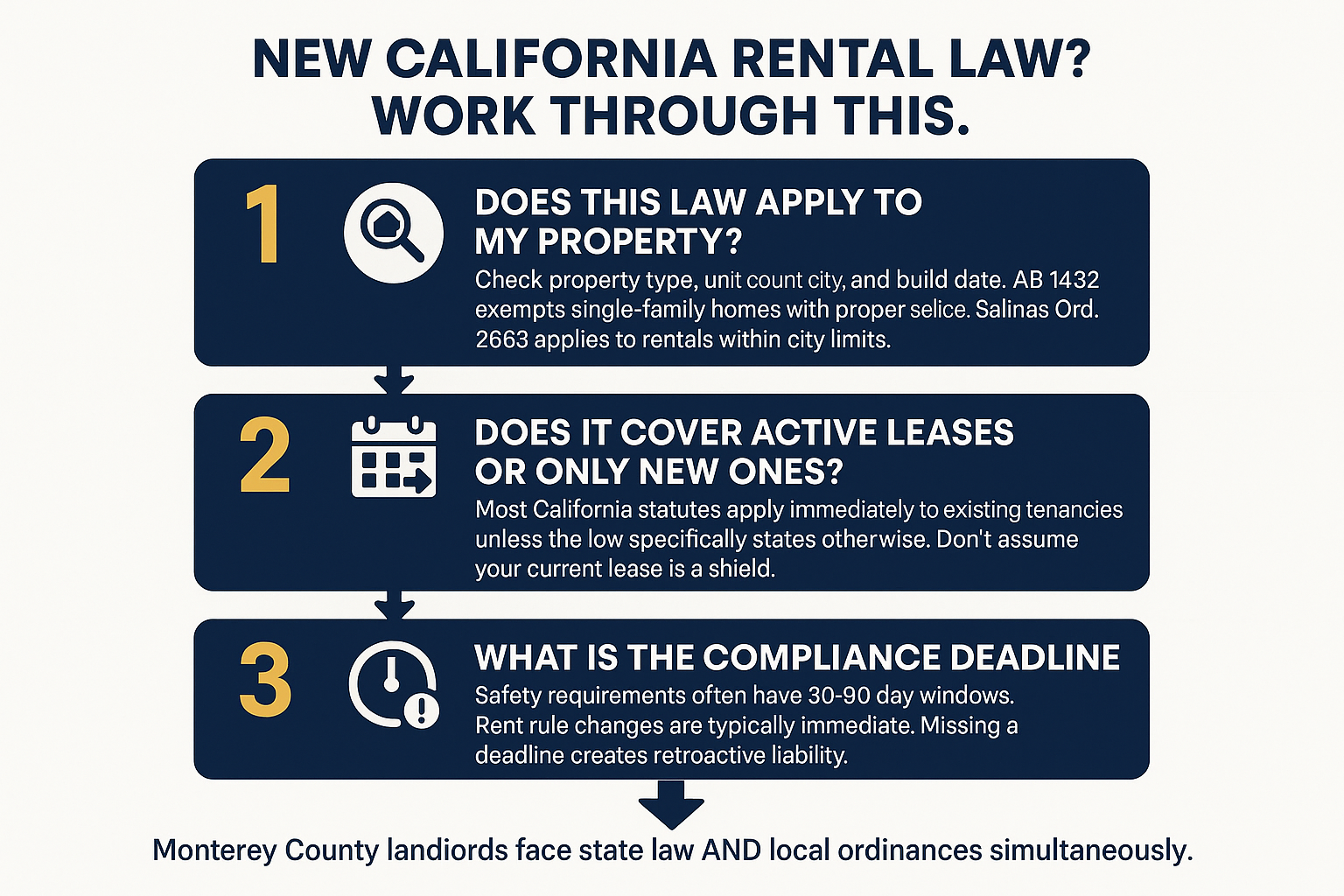
This step-by-step flow shows the four questions every Monterey County landlord should work through when a new California rental law takes effect.
What Self-Managing Landlords Get Wrong Most Often
The biggest mistake we see from self-managing owners in Salinas and across the Monterey Peninsula is treating a lease renewal as the trigger for compliance. They assume they’ll “get current” at the next signing. California law doesn’t work that way.
A second common error is relying on a lease template that hasn’t been updated. Many landlords download a standard California lease form and use it for years. But statutory changes require corresponding updates to notice language, disclosure requirements, and addendum terms. An outdated lease doesn’t just create compliance risk — it can also void notices and, in the worst case, derail an eviction. Our piece on why eviction rules make tenant disputes harder for Monterey County landlords covers exactly how this plays out in local courts.
And because Monterey County sits in a high-cost, high-regulation market, the stakes are higher than in many parts of the state. A missed carbon monoxide requirement in Fresno and a missed one in Pacific Grove both carry the same liability exposure — but in Pacific Grove, the property involved might be worth $1.4 million. The cost of getting it wrong scales with the asset.
If you’re managing your own rental and wondering whether self-management still makes sense given the regulatory complexity, this guide on managing apartment buildings yourself versus hiring a company lays out the honest tradeoffs.
When You Do Need to Formally Notify Your Tenant
Not every new law requires you to send your tenant a formal notice. But some do — and the timing and format of that notice matter.
California law requires written notice of certain material changes to the rental agreement. If a new statute alters a term that was previously spelled out in your lease — rent amounts, entry procedures, notice periods, required disclosures — you typically need to provide written notice before acting on the new terms.
Specifically, watch for these scenarios:
- Rent increase rules change mid-tenancy: You must provide the updated calculation method and comply with the statutory cap before issuing any rent increase notice
- Required disclosures are added: New habitability or safety disclosures often require a signed acknowledgment from the tenant, even mid-lease
- Notice period requirements change: If the state extends or modifies required notice windows (for entry, lease termination, or rent changes), the new periods apply immediately — serving a shorter notice based on your old lease is legally defective
The safest practice is a written lease addendum that references the new statute, confirms the change, and gets a tenant signature. This documents that both parties are aware of the updated terms. It doesn’t require rewriting the entire lease — a one-page addendum with the relevant legal citation is typically sufficient.
Frequently Asked Questions About Mid-Lease Law Changes in California
If my tenant signed a lease before a new law passed, do they have to follow the new rules?
Yes. California statutes that apply to residential rentals generally override existing lease terms. Your tenant can’t waive state law protections, and you can’t enforce lease clauses that conflict with a newer statute. The lease date doesn’t matter — what matters is whether the law applies to your property type and location.
Does AB 1482 apply to my property if I bought it after the law passed?
It depends on your property type and whether the prior owner provided an exemption notice. Single-family homes and condos can be exempt from AB 1482’s rent cap and just-cause eviction rules — but only if the owner provides a specific written notice to the tenant. If that notice was never given, or if your property doesn’t qualify for an exemption, AB 1482 applies regardless of when you purchased. A licensed broker familiar with Monterey County inventory can tell you quickly whether your property is covered.
Can I wait until the lease renews to come into compliance?
For safety requirements like carbon monoxide alarms or habitability standards — no. Those apply immediately. For procedural changes like notice formats and rent increase caps, the rule is also effective immediately for active tenancies. Waiting for renewal is the most common way self-managing landlords create retroactive liability.
What happens if I’ve already sent a notice that doesn’t comply with the new law?
A non-compliant notice is generally considered legally defective, which means it may be void. If you served a rent increase notice with the wrong format or an eviction notice with an outdated cure period, you may need to re-serve the notice correctly before any deadline clock starts running. In Monterey County courts, judges have dismissed eviction cases over notice defects that the landlord considered minor. This is one area where professional management — and regularly updated notice templates — pays for itself.
The City of Salinas rental registration requires me to register my property. Does that affect my current tenant?
The registration itself is an owner obligation, not a tenant obligation. But Ord. 2663 does require you to provide your tenant with documentation of registration, and failure to register can affect your ability to collect rent and pursue certain legal remedies. If you own a rental in Salinas city limits and haven’t registered, that’s a compliance gap that needs to be addressed now — not at the next lease signing.
Questions About Compliance on Your Monterey County Rental?
California rental law changes faster than most landlords can track, and Monterey County adds another layer of local ordinances on top of that. Coast & Valley Properties monitors regulatory changes across Salinas, the Monterey Peninsula, and South County so our owners don’t have to. If you’d like to talk through how a recent law change affects your property or tenancy, reach out directly at (831) 757-1270 or through the contact form at coastandvalleypm.com.