
A Guide to Property Management Accounting in Monterey County
When you hear "property management accounting," it's easy to think it's just about collecting rent and paying bills. But for a sophisticated investor in Monterey County, that’s just the beginning. Think of it as the financial command center for your entire real estate portfolio—the brain behind the operation that gives you the critical data you need to boost your ROI, preserve your asset's value, and achieve total peace of mind.
This guide provides a clear, actionable framework for mastering the financials of your high-end property, whether it's a luxury home in Carmel, a multi-unit building in Salinas, or a portfolio spanning the Monterey Bay Area.
Why Smart Accounting Is the Engine Driving Your Investment

For busy professionals and serious investors, treating property management accounting like a simple bookkeeping task is a massive missed opportunity. It’s much more than that. It's the nervous system for your properties, constantly monitoring their financial health, flagging opportunities for growth, and alerting you to small issues before they snowball into expensive headaches.
This strategic mindset is non-negotiable in a dynamic real estate environment like the Monterey Bay Area. It doesn’t matter if you own a luxury home in Carmel-by-the-Sea, a multi-unit building in Salinas, or rentals near the agricultural fields in South County towns like Soledad or King City—you need meticulous financial oversight to protect and grow your investment.
The Foundation of Strategic Ownership
Professional property management accounting gives you a clear, numbers-driven picture of how your investment is really doing. It’s about moving beyond just tracking money in and money out to get real, actionable insights. This disciplined approach to finances is what empowers you to make smart, data-backed decisions that directly enhance your bottom line.
A professional system, like the one we provide at Coast & Valley, helps you get a firm grasp on:
- True Profitability: You’ll see exactly which properties are your top performers and understand the "why" behind their success.
- Expense Control: Pinpoint exactly where your money is going and uncover hidden opportunities to streamline costs without sacrificing quality.
- Tax Readiness: No more scrambling come tax season. Your financials are organized and compliant, ensuring you maximize every possible deduction.
- Compliance and Security: We maintain airtight records for security deposits and operating funds in dedicated trust accounts, protecting you from legal troubles and financial risk.
As Amy Salmina, our fourth-generation Salinas native and the leader of our team, often says, “Treating your property like a business starts with managing its finances like a business. That discipline is what separates passive ownership from active, successful investing.”
A Growing Field of Expertise
The need for this kind of professional oversight is a clear trend in the real estate world. The U.S. property management market is a huge and growing industry, employing over 910,000 people. This growth highlights just how complex property ownership has become and how much value expert financial management brings to the table for discerning owners.
Ultimately, getting a handle on these financial principles is fundamental to hitting your investment goals. It provides the clarity and control you need to not just hang onto your assets, but to make them more valuable over time. For a deeper look into other key strategies, we've put together a guide on property management best practices.
Decoding the Financial Reports Every Investor Needs

When it comes to property management accounting, everything leads to a handful of clear, concise financial reports. These documents aren't just historical records; they're your strategic playbook, giving you a complete picture of your investment's health. For any sophisticated owner in Monterey County, getting comfortable with these reports is the key to making confident, data-driven decisions about your assets.
Think of these reports as a team of specialists, each offering a unique diagnosis of your property's performance. The Income Statement is the performance guru, the Balance Sheet is the wealth manager, and the Cash Flow Statement is the liquidity expert. Together, they tell the full story.
The Income Statement (Profit & Loss)
The Income Statement, which you'll often hear called the P&L, is the most straightforward of the bunch. Its entire purpose is to answer one critical question: Is my property actually making money over a specific time frame? It gets to that answer by simply subtracting all the operating expenses from the total income generated.
For instance, a P&L for a high-end rental in Pacific Grove would neatly lay out:
- Income: This is your monthly rent collected, plus any extra revenue streams like late fees, application fees, or pet fees.
- Operating Expenses: These are all the day-to-day costs of keeping the property running. Think property management fees, landscaping services in Carmel, routine repairs in Salinas, insurance premiums, and Monterey County property taxes.
By reviewing your P&L monthly or quarterly, you start to see patterns. Are utility costs creeping up? Is maintenance spending higher than you budgeted for? This report is your financial early-warning system.
The Balance Sheet
While the P&L shows performance over time, the Balance Sheet gives you a snapshot of your property's financial standing at a single moment. It’s all based on a simple, powerful formula: Assets = Liabilities + Owner's Equity. This report reveals the true value and financial structure of your investment.
The Balance Sheet is a powerful tool for understanding your asset's long-term health. It helps you see not just what you're earning, but what you own versus what you owe, which is fundamental to building generational wealth through real estate.
For a property anywhere in the Monterey Bay area, the key components are:
- Assets: This includes the property's market value, the cash sitting in your operating accounts, and any security deposits you're holding in a trust account.
- Liabilities: This is primarily the outstanding mortgage balance, along with any other debts, like a loan for a major roof replacement.
- Equity: This is the difference between your assets and liabilities. It’s your actual stake in the property—the part you truly own and a key indicator of wealth growth.
The Cash Flow Statement
The Cash Flow Statement is arguably the most important report for an investor's peace of mind. It tracks the actual movement of cash—real dollars—in and out of your accounts. It shows exactly where your money came from and where it went. This is a crucial distinction from the P&L, which might include non-cash items like depreciation.
This statement helps answer make-or-break questions: Do I have enough cash on hand to cover the mortgage and a sudden, expensive repair? How much cash did my property actually distribute to me last month? This clarity is absolutely essential for managing your liquidity and avoiding financial surprises.
To help you get a handle on these documents at a glance, here’s a quick breakdown of what each report tells you and what to look for.
Key Financial Statements for Property Investors
| Financial Statement | What It Tells You | Actionable Insights to Look For |
|---|---|---|
| Income Statement (P&L) | Is your property profitable over a period (month, quarter, year)? | Trends in vacancy loss, spikes in operating expenses, opportunities to increase Net Operating Income (NOI). |
| Balance Sheet | What is the property's net worth at a specific point in time? | Growth in owner's equity over time, ratio of debt to assets. |
| Cash Flow Statement | Where did your cash come from and where did it go? | Health of operating cash flow, ability to cover debt service and capital expenditures, actual cash distribution. |
These three reports are the foundation of smart financial oversight. For a deeper dive into what to expect from your property manager, take a look at our guide on the essential financial reports for a Salinas investment property.
To present this data effectively to partners or stakeholders, many owners also use specialized investor reporting software to streamline communication and improve transparency. Here at Coast & Valley, we provide all these detailed reports through our secure owner portal, ensuring you always have a clear, accurate, and up-to-date view of how your investment is performing.
Building Your Accounting Workflow for Peak Efficiency
An inefficient accounting process is more than just a headache; it creates financial blind spots and piles on unnecessary stress for property owners. Building a professional, repeatable workflow is how you gain clarity and control. For a high-end investment in Monterey County, this isn't just about bookkeeping. It’s about creating a system that protects your asset, saves you time, and delivers the crystal-clear data you need to make strategic decisions.
The whole system really starts with a solid foundation. This means putting a structure in place that guarantees compliance, transparency, and operational ease right from day one. At Coast & Valley, this is a non-negotiable first step for every single property we manage, whether it’s a luxury home in Pebble Beach or a commercial space in Salinas.
The Critical First Steps: A Checklist
Before a single dollar of rent is collected or any bills are paid, you have to lay the groundwork. This initial setup prevents the commingling of funds—a huge legal and financial risk—and establishes a professional framework for every transaction that follows.
- Set Up Dedicated Bank Accounts: The single most important step. California law is incredibly strict about this. You'll need, at a minimum, a trust account for holding tenant security deposits and a completely separate operating account for rent collection and paying expenses. This is the absolute bedrock of professional property management accounting.
- Choose Your Accounting Method: Next, decide between cash-basis or accrual-basis accounting. Most individual investors prefer cash-basis because it's simpler; you record income when rent actually lands in your account and expenses when you actually pay the bills. Accrual-basis is more complex, recording income when it's earned and expenses when they're incurred. While accrual gives a more precise long-term financial picture, cash-basis is often more practical for day-to-day management.
- Establish a Chart of Accounts: Think of this as a custom-made list of all your income and expense categories. A well-organized chart of accounts is vital. It’s what allows you to track everything with precision, from routine landscaping in Soledad to major capital expenditures, like a new HVAC system in a Monterey property.
A disciplined workflow isn't just for your accountant; it's for you. It transforms a shoebox full of receipts into a powerful decision-making tool, giving you an immediate, accurate view of your property’s performance.
Ongoing Processes for Financial Clarity
Once the foundation is in place, the focus shifts to consistent, ongoing processes. A clean workflow ensures nothing slips through the cracks and that your financial reports are always accurate and ready when you need them. This all comes down to meticulously tracking every dollar that moves in and out of your property's accounts.
Here’s a simplified look at how a professional budgeting workflow keeps your finances on track in property management accounting.
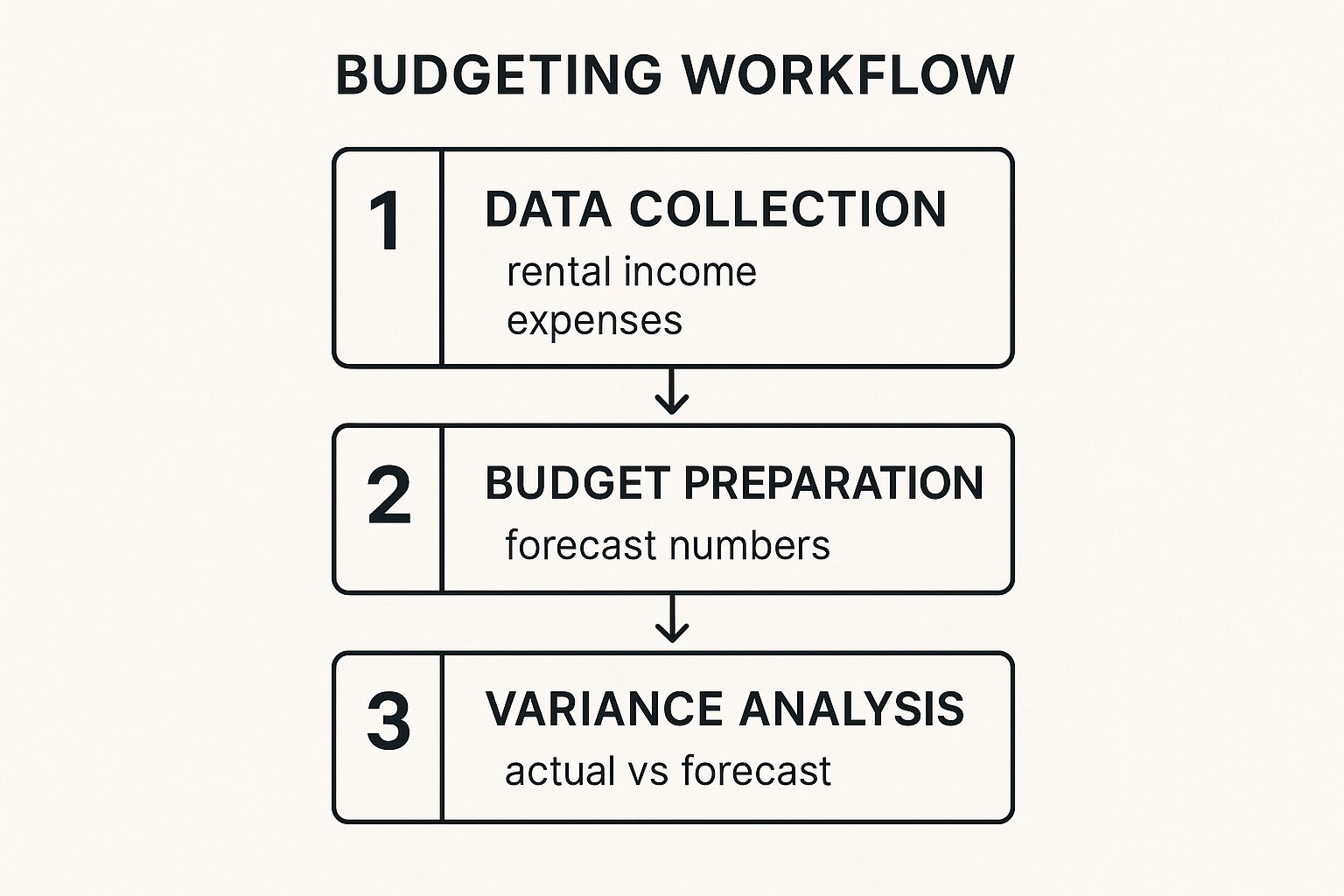
This process really shows that smart financial management is a continuous cycle. It's about constantly collecting data, forecasting, and analyzing so you can make proactive adjustments instead of just reacting to problems.
Key ongoing tasks include:
- Timely Income Tracking: This is more than just logging rent checks. It means diligently recording all income sources—from rent to late fees, pet fees, or laundry income—and making sure they are deposited into the correct operating account.
- Detailed Expense Categorization: Every single expense, no matter how small, has to be categorized correctly according to your chart of accounts. Whether it's a minor plumbing repair in King City or a significant insurance payment, proper categorization is crucial for accurate P&L statements and for maximizing your tax deductions.
- Regular Bank Reconciliation: At least once a month, your bank statements have to be reconciled against your accounting records. This process is your safety net; it confirms every transaction was recorded accurately and helps you catch any potential errors or discrepancies before they become bigger issues.
By building this repeatable, scalable system, you completely eliminate the guesswork. You get the peace of mind that comes from knowing your investment’s finances are managed with professional precision, giving you the clarity you need for tax season and long-term strategic planning.
Using Technology for Seamless Property Accounting

For any busy investor managing high-value assets in Monterey County, modern property management accounting simply runs on technology. The days of manual ledgers and shoeboxes overflowing with receipts are long gone. Thank goodness.
Today, specialized software automates the tedious tasks, bringing a level of efficiency, security, and transparency that was once impossible. This shift from manual chore to automated process is really the heart of the concierge-level service that sophisticated owners have come to expect.
Think about it this way: a tenant in your Salinas property pays rent online. The software instantly logs the payment, automatically sends a receipt, and updates all your financial reports in real-time. If a payment is late, the system can calculate and apply the correct fee based on the lease terms without anyone lifting a finger. This kind of automation all but eliminates human error and ensures every single financial detail is captured accurately.
The Power of an Integrated Platform
The real magic happens when you use an integrated system where all financial activities live in one secure place. At Coast & Valley, we use best-in-class technology that acts as the central hub for your property's entire financial life. This provides a level of peace of mind and operational clarity that’s hard to overstate.
Here are a few key advantages for property owners:
- 24/7 Access Through a Secure Owner Portal: You can log in anytime, from anywhere in the world, to view detailed financial statements, check the status of maintenance requests, and access important documents. This on-demand access means you are always connected to your investment’s performance.
- Streamlined Expense Tracking: Instead of manually keying in invoices, we can scan receipts and bills directly into the system. The software is smart enough to categorize each expense—whether it's a plumbing repair in Soledad or landscaping in Pebble Beach—ensuring every cost is meticulously tracked for tax purposes.
- Instant and Accurate Reporting: Need to see your property's profit and loss for the last quarter? With just a few clicks, the system generates comprehensive reports. You get the data needed to make informed decisions without waiting around.
This level of technological integration is about more than just convenience; it’s about providing you with ultimate trust and transparency. Knowing that your financial data is secure, accurate, and always available is fundamental to a premium management experience.
A Growing Standard of Excellence
The property management industry is expanding quickly, with some projections showing the global market could hit $28 billion by 2028. This growth is being supercharged by technology that makes operations like rent collection and accounting far more efficient.
For a high-end property owner, this means the standard for service is higher than ever. Tools designed for real estate document automation take things a step further by simplifying complex paperwork, ensuring every lease and notice is compliant and handled professionally. This technology isn't just a "nice-to-have" feature; it is absolutely essential for providing the high-touch, efficient service that protects and grows the value of your Monterey Bay assets.
Understanding the role these platforms play is critical, which is why we’ve put together a detailed look into why you need property management software for your investments. At the end of the day, using the right technology transforms property management accounting from a reactive chore into a proactive strategy for your success.
Mastering Taxes and Compliance in Monterey County
When you own rental properties in Monterey County, navigating the tangled web of taxes and local regulations isn't optional. For a busy investor, it's often the most stressful part of the job. But it doesn't have to be. With a proactive approach and a solid accounting system, tax season can transform into a smooth, predictable process that legally shrinks your liability.
The secret is realizing that tax prep isn't just a once-a-year scramble. It's the natural outcome of meticulous, year-round financial tracking. Every rent check cashed and every repair bill paid is a piece of your property's financial story. A professional partner ensures that story is told accurately and in a way that gives you the maximum advantage.
Preparing for a Seamless Tax Season
An organized accounting system is your best friend come tax time. Imagine this: instead of frantically digging for receipts and bank statements in April, you have a clean, comprehensive record of your property's performance ready to go. This level of organization is what separates peace of mind from pure chaos.
Here is an actionable checklist for what a professional manager will handle to ensure tax readiness:
- Issue Form 1099-NEC: That plumber in Salinas or landscaper in Monterey you hired? If you paid them over $600 for the year, they must be issued a 1099. This is a non-negotiable IRS requirement, and failing to comply can lead to hefty penalties.
- Provide Detailed Expense Reports: A well-categorized expense report is the backbone of your deductions. It clearly lays out every legitimate business cost, from management fees to minor repairs.
- Compile Comprehensive Income Statements: This report gives you a clear snapshot of all rental income, late fees, and other revenue, painting a complete picture of your gross earnings.
With these documents organized and accurate, filing your taxes becomes as simple as handing a complete, clean package over to your CPA. For a deeper look, check out our guide on how Salinas landlords can prepare for a stress-free tax season.
Maximizing Your Deductions
Really understanding which expenses you can write off is fundamental to boosting your return on investment. The IRS allows property owners to deduct the "ordinary and necessary" expenses of managing and maintaining their rental properties. This is where that meticulous, year-round bookkeeping truly pays off.
Proactive expense tracking isn't just about compliance; it's about strategy. Every properly documented deduction directly reduces your taxable income, putting more money back into your pocket and improving your property's net return.
Common deductible expenses for rental properties in places like King City, Gonzales, and the wider Monterey Bay Area include:
- Repairs and Maintenance: The costs of routine upkeep, from fixing a leaky faucet to painting a unit between tenants.
- Property Management Fees: Good news—the fees you pay to a professional firm like Coast & Valley are fully deductible.
- Insurance Premiums: This includes your landlord, flood, and liability insurance policies.
- Professional Services: Any legal and accounting fees related to your rental business.
- Travel Expenses: The cost of traveling to manage or maintain your property can often be deducted.
- Depreciation: This is a huge one. It allows you to deduct the cost of the property itself over its useful life, providing a significant non-cash deduction.
Beyond these basics, it’s worth digging deeper. To make sure you’re not leaving any money on the table, you can explore these crucial tax deductions for real estate investors.
Our role at Coast & Valley is to deliver the airtight financial data that makes claiming every deserved deduction straightforward and defensible. We ensure your accounting provides a clear, compliant, and advantageous financial picture, turning a tax obligation into an opportunity to strengthen your investment's bottom line.
Using Advanced Metrics to Fuel Portfolio Growth
For the serious investor in Monterey County, basic property management accounting is just the starting point. While tracking income and expenses is the bedrock of day-to-day operations, true portfolio growth comes from digging into a much deeper level of financial analysis. This is where we shift from simply balancing the books to using key performance indicators (KPIs) to drive smart acquisition and optimization decisions.
Think of it like this: your standard financial reports tell you how your property performed last month. That's looking in the rearview mirror. Advanced metrics, on the other hand, tell you how it’s likely to perform over the next decade and how it stacks up against other opportunities in the competitive Monterey Bay market. This strategic insight is what a true management partner provides—transforming raw data into a clear roadmap for long-term wealth.
Going Beyond Basic Cash Flow
To really evaluate your assets and spot new opportunities, you need to speak the language of sophisticated real estate investment. Mastering a few critical metrics is essential. These KPIs allow you to compare a multi-family unit in Salinas against a luxury vacation home in Carmel on a true apples-to-apples basis.
- Net Operating Income (NOI): This is your property's total income minus all its operating expenses, before you factor in mortgage payments or income taxes. NOI gives you the pure, unvarnished truth about an asset's profitability, completely separate from your financing choices. A consistently rising NOI is a powerful signal of strong management and a healthy property.
- Capitalization Rate (Cap Rate): The Cap Rate (which is simply NOI / Property Value) is one of the most powerful tools for comparing different investment opportunities. For instance, if a property in Soledad generates an NOI of $50,000 and is valued at $1,000,000, its Cap Rate is 5%. This number lets you quickly size up its potential return against other local deals.
- Cash-on-Cash Return: This metric gets straight to the point, answering the question every investor asks: "What is the return on the actual cash I put into this deal?" You calculate it by dividing the annual pre-tax cash flow by the total cash you invested (your down payment, closing costs, etc.). It’s a vital measure of how efficiently your money is working for you.
As our founder, Amy Salmina, often advises clients, "The best investments aren't just about what you buy; they're about how you measure and manage them. These advanced metrics are your tools for making disciplined, unemotional decisions that build real wealth."
From Metrics to Action
Of course, knowing what these numbers mean is only half the battle. The real magic happens when you use them to actively grow your portfolio. By analyzing the KPIs of your current properties, we can pinpoint specific opportunities to boost performance. A deep dive might reveal, for example, that you could significantly increase NOI just by making a few targeted upgrades. Our guide on strategies for higher rental income explores many of these possibilities in greater detail.
When looking at a potential new acquisition in a high-demand area like Pacific Grove, we use these same metrics to forecast its performance and land on a fair offer price. This data-driven approach takes the emotion out of the equation, making sure every move you make is financially sound and perfectly aligned with your long-term goals.
Essential KPIs for Real Estate Investors
For investors ready to graduate to the next level of analysis, the metrics below offer a more nuanced view of an asset's health and potential. These aren't just numbers on a spreadsheet; they are the diagnostic tools that reveal the true story behind a property's performance.
| Metric (KPI) | What It Measures | Why It Matters for Your Monterey County Portfolio |
|---|---|---|
| Gross Rent Multiplier (GRM) | The ratio of property price to its gross annual rental income. | A quick, back-of-the-napkin way to compare the value of similar properties in Salinas, Monterey, or Pacific Grove. A lower GRM can signal a better deal. |
| Vacancy Rate | The percentage of time a unit is unoccupied over a specific period. | High vacancy rates eat into your NOI and can indicate problems with pricing, marketing, or property condition. Tracking this helps you stay proactive. |
| Break-Even Ratio (BER) | The ratio of operating expenses plus debt service to the gross operating income. | This tells you the occupancy level needed to cover all your costs. A lower BER means less risk and a more resilient investment. |
| Return on Investment (ROI) | The total return (appreciation + cash flow) relative to the total cost of the investment. | This is the ultimate measure of an investment's overall profitability, giving you the big-picture view of its performance over time. |
By regularly tracking these KPIs, you move from being a passive property owner to an active portfolio manager. You gain the clarity needed to decide when to hold, when to sell, and where to invest next for maximum growth.
At Coast & Valley, our job is to provide this strategic analysis, helping you not just manage your properties, but actively build a more powerful and profitable portfolio.
Common Property Accounting Questions Answered
Even the most experienced investors run into specific accounting questions. When you own high-value properties in a market like Monterey County, getting straight, clear answers is non-negotiable—it's about maintaining confidence and control over your assets.
Let’s walk through some of the most common questions we hear from our clients. These are the practical, real-world issues that directly impact your bottom line and your peace of mind. Getting them right isn't just good practice; it's the core of professional financial stewardship.
How Often Should I Receive Financial Reports?
For a premium property, you should expect detailed financial reports every single month. This regular rhythm is essential. It gives you a consistent, up-to-date picture of how your investment is performing without any long gaps or surprises.
At Coast & Valley, we provide a secure owner portal with 24/7 access to these statements. You'll always have these at your fingertips:
- Income Statement (P&L): A clear snapshot of your property's profitability for the month.
- Cash Flow Statement: Shows you exactly where the money went—what came in and what went out.
- Expense Register: A detailed, line-by-line list of every single paid invoice.
This kind of regular, transparent reporting is a cornerstone of any property management relationship built on trust.
What Is the Difference Between a Repair and a Capital Improvement?
This is a fantastic question, and the answer is absolutely critical for your taxes.
A repair is an expense that keeps your property in good, working condition. Think of it as maintenance—fixing a leaky faucet in a Salinas rental, replacing a broken window pane in Monterey, or patching a hole in the wall. These costs are typically deductible in the same year you pay for them.
A capital improvement, on the other hand, is a much bigger deal. It's an investment that adds significant value to your property, extends its useful life, or adapts it for a new purpose. We're talking about projects like adding a new bathroom, replacing the entire roof, or installing a brand-new HVAC system. You don't deduct these costs all at once. Instead, they are depreciated over their useful life, which gives you a sustained tax benefit for years to come.
Understanding this difference is key to a smart tax strategy. We meticulously categorize every single expense to make sure you can claim the proper deductions and accurately track your property's cost basis over time.
How Are Security Deposits Handled?
This is a huge compliance area, especially in California. Security deposits are not your income. They are a liability—money you are holding in trust for your tenant.
By law, these funds must be kept in a separate trust account and can never be mixed with your regular operating funds (a practice called commingling). When a tenant moves out, the deposit can be used to cover any damages beyond normal wear and tear or to settle any unpaid rent.
Crucially, you must return the remaining balance to the tenant within 21 days, along with an itemized statement explaining any deductions. Handling security deposits correctly is a major legal responsibility that we manage with extreme care.
Can I Deduct Property Management Fees?
Yes, absolutely. The fees you pay a professional property management company for services like collecting rent, screening tenants, and coordinating maintenance are considered a standard operating expense for your rental business.
This means they are fully deductible from your rental income. It's a straightforward way to lower your overall tax burden.
Navigating the ins and outs of property management accounting takes more than just a calculator—it demands local expertise and a serious commitment to transparency. At Coast and Valley Properties, we provide the detailed financial oversight and strategic guidance you need to protect and grow your investment.
Discover how our full-service management can bring clarity and peace of mind to your portfolio.