
Mastering the Lease Renewal Process for Your Monterey County Investment
A seamless lease renewal process is more than just paperwork—it's a critical financial strategy that shields your investment from the high costs of vacancies and tenant turnover. For owners of high-end properties in competitive markets like Carmel, Salinas, or Pebble Beach, retaining a great tenant is often the single most profitable move you can make. This isn't about avoiding hassle; it's about actively securing your return on investment.

Why a Strategic Renewal Always Beats Tenant Turnover
As a busy property owner or investor in Monterey County, focusing on tenant retention is a direct line to better profits and stability. The costs of tenant turnover can quickly erode your annual returns. You face marketing expenses, deep cleaning, fresh paint, and—most significantly—lost rent during the vacancy. For a premium property in our local market, this can amount to thousands of dollars.
A proactive lease renewal strategy is your best defense. It transforms a routine administrative task into a powerful tool for maximizing your property's performance.
The Financial Upper Hand of Retention
When you handle a renewal with professional care, you're not just keeping a unit filled. You are actively reinforcing the value of your asset. By keeping a proven, responsible tenant in place, you achieve several key financial goals:
- Eliminate Vacancy Costs: Even one month of lost rent in a market like Pacific Grove is a significant financial hit.
- Cut Turnover Expenses: Avoid the bills for painting, repairs, deep cleaning, and advertising required to find a new tenant.
- Maintain Consistent Cash Flow: A successful renewal means your rental income continues without interruption. This predictable revenue is the bedrock of a healthy investment portfolio.
- Build a Stronger Tenant Relationship: A smooth, professional renewal process fosters goodwill. Tenants who feel valued are far more likely to care for your property as if it were their own.
Lease Renewal vs. Tenant Turnover: A Monterey County Snapshot
To see the difference in black and white, let's compare the two outcomes for a typical high-end rental in our area. The financial and operational impact is stark.
| Factor | Successful Lease Renewal | Tenant Turnover |
|---|---|---|
| Income Stability | $0 lost rent, seamless cash flow | 1-2+ months of lost rent |
| Direct Costs | Minimal administrative time | Advertising, cleaning, painting, repairs ($2,000 – $5,000+) |
| Time Investment | A few hours for communication and paperwork | 20-40+ hours for showings, screening, and move-out/move-in coordination |
| Risk Factor | Low; you're keeping a known, reliable tenant | High; a new tenant is an unknown quantity |
| Tenant Relationship | Strengthened, fostering long-term care for the property | Reset to zero, requiring time to build trust and rapport |
The numbers make it clear: retaining a good tenant isn't just easier, it's exponentially more profitable.
"At Coast & Valley, we treat the lease renewal as a key performance indicator for our clients' investments. It’s not about avoiding work; it’s about making the smart financial play that protects your asset for the long term." – Amy Salmina, Owner/Broker
A well-managed renewal workflow is a sign of professionalism. It tells your tenants they're valued, which is fundamental to long-term success. For property owners looking to build strong, lasting tenant relationships, understanding how to earn a lease renewal is the first step toward maximizing your investment's true potential.
Conducting Your Pre-Renewal Property Assessment
A successful lease renewal doesn't happen when you send the offer. For savvy investors in Monterey County, the real work begins 90-120 days before a lease expires. This is your prime opportunity to build a data-backed case for your renewal terms, turning a routine task into a strategic financial move.
This preparation phase is about gathering intelligence to protect and enhance your asset. It starts with a comprehensive review of the tenant's history. Have they paid on time? How have they communicated? A review of their payment ledger and our internal notes provides a clear picture of their reliability. Our rigorous tenant screening checklist sets the initial standard, and their performance since then tells the rest of the story.
Actionable Pre-Renewal Checklist
To ensure a data-driven approach, follow this step-by-step process:
- Tenant Performance Review (120 Days Out):
- Confirm an unbroken record of on-time rent payments.
- Review all communication records for professionalism and responsiveness.
- Note any past lease violations, however minor.
- Detailed Property Inspection (90 Days Out):
- Schedule and conduct a thorough interior and exterior inspection.
- Identify any tenant-caused damage versus normal wear and tear.
- Proactively list any preventive maintenance needed (e.g., servicing the HVAC, checking for leaks). This demonstrates a commitment to property care.
- Hyper-Local Market Analysis (90 Days Out):
- Analyze rental comps for truly similar properties in the specific neighborhood (e.g., comparing a South Salinas home only to other South Salinas homes).
- Factor in unique property features that add value.
- Determine a fair market rent that is both competitive and maximizes your ROI.
A thorough pre-renewal inspection does two things: it protects your investment and gives you the hard data needed to justify your rental rate. It shifts the renewal conversation from a subjective negotiation to an objective, fact-based discussion about the property's true value and condition.
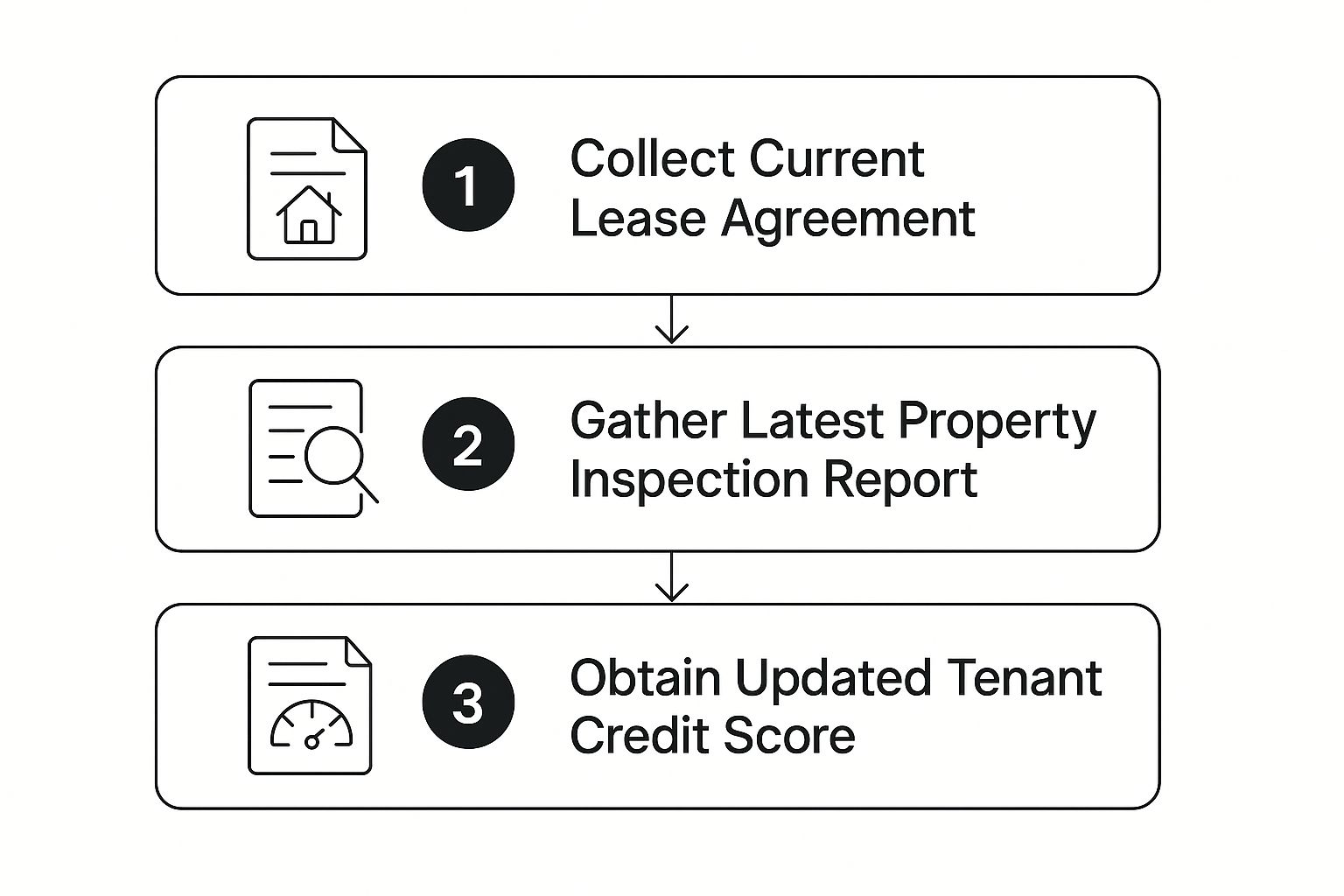
This three-pronged approach—tenant review, property inspection, and market analysis—is the bedrock of a professional leasing strategy. The infographic below gives a great visual of the initial data collection for this critical phase.
By grounding your lease renewal process in solid data, you enter negotiations not with demands, but with a clear, professional, and justifiable position that protects your investment. For busy professionals, leveraging our expertise and commercial real estate technology solutions streamlines this entire process, saving you time while maximizing returns.
Crafting a Compelling and Compliant Renewal Offer
How you frame your renewal offer can be the deciding factor between a smooth, continuing tenancy and a costly vacancy. This isn't just about sending a form; it's about blending concierge-level professionalism with a firm grasp of your property's market value. The goal is to create a proposal that is compelling for your tenant and makes solid financial sense for you. This is where your communication strategy shines in the lease renewal process.

Your first move is a formal, written offer sent with ample notice. It must clearly outline all proposed terms. For example, if your market analysis for comparable homes in Salinas indicates a rent adjustment is warranted, present it with context and professionalism.
An Example of Professional Framing: "We have truly valued having you as tenants. After reviewing current rental rates for similar homes in the area and accounting for rising operational costs, we will be adjusting the monthly rent to $X,XXX for the upcoming 12-month term. We believe this new rate is competitive and ensures we can continue maintaining the property to the high standard you expect and deserve."
This transparency builds trust. It presents the rent adjustment as a fair-market business decision, not an arbitrary increase, showing respect for the tenant relationship while protecting your investment.
Timing and Delivery Are Everything
In California, proper timing isn't just good practice—it's a legal mandate. The delivery of a renewal offer, especially one with a rent increase, must be precise to be legally binding. For any property owner in Monterey County, from Salinas to King City, this is a detail you cannot afford to get wrong.
- For Rent Increases of 10% or Less: You are required to provide a minimum of 30 days' written notice.
- For Rent Increases Over 10%: California law mandates a stricter 90-day written notice.
We always send these notices via a trackable method, such as certified mail or our secure online owner portal. This creates an undeniable digital or paper trail, proving compliance and protecting you from potential disputes.
The financial upside of a well-handled renewal can't be overstated. A recent report from Global Net Lease Inc. revealed that its single-tenant lease renewals in early 2024 locked in an 8.2% rent increase with an average term of 6.6 years. This just goes to show how renewals can often outperform trying to find new tenants in a competitive market. A strategic renewal process directly boosts your bottom line. You can dig into more of these financial trends in the full Q1 2024 report.
At Coast & Valley, we navigate these delicate communications with the concierge-level service your investment deserves. We manage every detail, from drafting compliant offers to justifying terms with hard data, ensuring your renewal process is professional, profitable, and painless.
Navigating Tenant Negotiations Like a Pro
Even with a perfectly fair, well-researched renewal offer, some tenants will want to negotiate. When managing a high-end property in a competitive market like the Monterey Bay Area, this is not a problem—it's an opportunity to reinforce a positive relationship and secure a mutually beneficial agreement. The key is to enter these conversations with a clear strategy and a firm grasp of your financial bottom line.
A counter-offer is a normal part of the lease renewal process. Perhaps they request a smaller rent increase in exchange for signing a longer, 18-month lease. Or maybe they ask for an upgrade, like a new appliance, before committing. These are not unreasonable requests, but each must be evaluated through a strict return on investment (ROI) lens.
Evaluating Tenant Counter-Offers: An ROI-Based Approach
When a tenant proposes different terms, your response must be measured and data-driven, not emotional. A quick "no" can damage a good relationship, but agreeing to every request can erode your profits.
Here’s our framework for evaluating counter-offers:
- Calculate the True Cost: If a tenant asks for $50 less per month than offered, that's a $600 difference over a year. Is retaining a proven, reliable tenant worth that $600 when compared to the thousands in potential turnover costs (vacancy, cleaning, marketing)? In most cases, yes.
- Analyze Upgrade ROI: A request for a new dishwasher isn't just an expense; it's a capital improvement. It enhances your current tenant's experience, increases your property's value, and makes it more marketable for the next tenancy. It’s an investment in your asset.
- Consider Lease Term Flexibility: A tenant offering to sign a longer lease provides you with guaranteed income and stability. This security has tangible financial value and can easily justify a small concession on rent.
Knowing when to be flexible and when to hold firm is a skill rooted in experience and data. Basing your decisions on financial analysis, not emotion, keeps you in control.
The best negotiations are built on transparency. If a request cannot be approved, explain why professionally. For example: "While a full kitchen remodel isn't in our budget this year, we can commit to installing the new dishwasher you requested." This shows you're listening and willing to find a middle ground, even while protecting your financial position.
Document Everything and Finalize the Agreement
During any negotiation, every point of communication must be documented in writing. A phone call to discuss details is effective, but it must be immediately followed by an email summarizing the conversation and any agreements made. This prevents misunderstandings and creates a professional record. A robust real estate follow-up system is invaluable for ensuring no detail is missed.
Once you have a verbal agreement, it’s time to make it official. The final step is to draft a new lease agreement or a comprehensive renewal addendum that details the new terms precisely. This new document must be signed by both you and the tenant before the old lease expires, creating a fresh, legally binding contract that is a cornerstone of effective tenant retention strategies.
Ensuring Legal Compliance and Ironclad Documentation
When managing high-value properties—from family homes in South County towns like Gonzales and King City to coastal estates in Pebble Beach—navigating California's legal landscape is non-negotiable. A seemingly minor paperwork error during a lease renewal can escalate into a significant legal and financial liability. This is where professional diligence becomes your most valuable asset.

California’s landlord-tenant laws are notoriously complex and constantly evolving. Using a generic lease template from the internet is one of the riskiest decisions an owner can make. These documents often lack critical, state-specific clauses and fail to account for local ordinances in cities like Monterey or Salinas, leaving your investment exposed.
Adhering to California’s Strict Notice Requirements
The first legal hurdle in any renewal involving a rent increase is the notice period. Governed by the Tenant Protection Act (AB 1482), these timelines are absolute and must be followed precisely for your new terms to be enforceable.
- For rent increases of 10% or less: A 30-day written notice is required.
- For rent increases over 10%: The requirement increases to a 90-day written notice.
Proper delivery is just as important. We ensure these notices are delivered via a trackable method, creating a clear, defensible record of compliance that protects you from potential disputes.
The Power of a Professional Lease Agreement
A professionally drafted, attorney-vetted lease agreement is the foundation of a secure tenancy. It's a detailed tool designed to protect your rights, clearly define tenant responsibilities, and eliminate gray areas. Finalizing the renewal is also the perfect time to verify insurance coverages and remind the tenant of the importance of renters insurance for their protection.
At Coast & Valley, we never rely on generic templates. Our team, led by Salinas native Amy Salmina, uses attorney-vetted lease agreements that are continuously updated to reflect the latest changes in California law. This provides our clients with ironclad protection and peace of mind.
This level of professional oversight is critical in the current market. With tight supply and high demand across the Monterey Bay Area, landlords have an opportunity to negotiate renewals that reflect a property's true market value. However, this also means that legally sound documentation is more important than ever. This diligence is how we safeguard your ROI and ensure your investment is secure.
Your Monterey County Lease Renewal Questions Answered
The lease renewal process is full of specific questions that every Monterey County property owner will face. Handling these situations with confidence requires a deep understanding of local laws and on-the-ground best practices. Here are clear, actionable answers to the most common challenges we help our clients navigate.
What Is the Required Notice for a Rent Increase in Monterey County?
In California, the notice period for a rent increase depends entirely on the percentage of the increase. This is a strict legal requirement under the Tenant Protection Act (AB 1482).
- For any increase of 10% or less of the tenant's current rent, you must provide a 30-day written notice.
- For an increase of more than 10%, the law mandates a 90-day written notice.
We always advise owners to send these critical notices using a trackable method, like certified mail or our secure owner portal. This simple step ensures compliance and protects you from potential legal disputes.
How Should I Respond If My Tenant Wants to Negotiate Rent?
First, view negotiation not as a confrontation, but as a normal part of business and an opportunity to strengthen your relationship. Listen to your tenant's position, then calmly walk them through the market data supporting your proposed rate.
You can professionally explain that the new rent reflects market rates for similar properties in Salinas or Pacific Grove and covers rising operational costs. If you have flexibility, consider non-rent concessions. For example, you could offer a small property upgrade they've mentioned or propose a longer 18-month lease in exchange for them accepting the new rate. The key is to know your financial bottom line before you begin the conversation.
What if a Tenant Does Not Respond to My Renewal Offer?
Silence from a tenant is not acceptance. If your response deadline passes without a word, you must follow up immediately and in writing. It could be an oversight, or it could signal their intent to vacate.
If they do not wish to renew, the notice-to-vacate terms in their original lease agreement will apply. If the lease is set to convert to a month-to-month tenancy, your properly delivered rent increase notice will still take effect on the specified date. Proactive, documented communication is your best defense against a confusing and costly holdover situation.
Should I Use a New Lease or a Simple Renewal Addendum?
We always recommend using a completely new lease agreement for every renewal period. Landlord-tenant laws in California are complex and change frequently. A fresh, attorney-vetted lease ensures that both you and your tenant are bound by the most current legal standards, disclosures, and protections.
This is also the ideal opportunity to officially incorporate any new property rules, update clauses, or more clearly define expectations around property care. You can find more detail on separating these duties in our guide to understanding landlord responsibilities vs tenant duties. This comprehensive approach provides maximum legal clarity and is standard practice for protecting a high-value asset in Monterey County.