
How to Screen Potential Tenants: A Guide for Monterey County Property Owners
For an owner of a high-end property in Monterey County, tenant screening is single-handedly the most important process for protecting your real estate investment. I’m not just talking about checking a box—this is your first line of defense against income loss, property damage, and massive legal headaches.
In a market as diverse as ours, stretching from Salinas to Pebble Beach, a meticulous, professional screening process is what ensures you place reliable tenants who will treat your property with the respect it deserves. This guide provides an actionable, step-by-step framework for protecting your asset.
Why a Professional Screening Process Is Non-Negotiable
For any serious property owner or investor in Monterey County, knowing how to screen potential tenants is the absolute cornerstone of a successful rental strategy. A haphazard approach sets you up for costly evictions, long vacancies, and significant stress. A structured, professional process, on the other hand, delivers peace of mind and protects your high-end asset.
The global Tenant Screening Services market was valued at around USD 1.76 billion in 2024 and is expected to climb, all because sophisticated landlords and property managers understand its critical role in risk management.
As Amy Salmina, a fourth-generation Salinas native and our firm's leader, often says, “Treating every property like our own starts with finding tenants who will do the same.” This philosophy is the engine behind our concierge-level approach to tenant placement, designed to protect your ROI.
A truly effective screening strategy is built on four key pillars. Getting these right provides consistency, ensures legal compliance, and allows you to make a final decision with complete confidence.
The Four Pillars of an Effective Tenant Screening Process
To achieve that level of confidence, your process must go beyond a quick credit check to create a complete, verifiable picture of each applicant. A great place to start is by reviewing our comprehensive tenant screening checklist, which breaks down these essential steps.
Here’s a quick look at the core components that make up a rock-solid screening process.
| Pillar | Objective | Key Focus Area |
|---|---|---|
| Objective Rental Criteria | Establish fair, consistent standards | Defining income, credit, and rental history requirements before marketing the property. |
| Thorough Verification | Confirm all applicant-provided information | Rigorously checking employment, income, and past landlord references. |
| Legal Compliance | Avoid discrimination and legal trouble | Strictly adhering to all federal, California, and local Monterey County Fair Housing laws. |
| Consistent Evaluation | Ensure fairness and defensibility | Applying your established criteria equally to every single applicant, every single time. |
These pillars aren't just suggestions; they form the foundation of a process that protects your investment for the long haul. When you move beyond a simple gut feeling and adopt a structured approach, you're not just finding a tenant—you're securing a key component of your asset's performance.
Step 1: Establish Your Gold Standard Rental Criteria

Before you even consider listing your property, you must define and document your rental criteria. This isn't just a suggestion; it's a non-negotiable first step. Think of this documented standard as your personal playbook, ensuring every applicant is measured against the same objective, fair, and legally compliant benchmarks.
This is the most effective way to streamline your decision-making and shield your investment. It’s about setting the "house rules" before the game even starts. This isn’t about being overly restrictive; it’s about being clear and consistent, which is absolutely essential for staying on the right side of California's strict Fair Housing laws. Having these standards in black and white is your single best defense against potential discrimination claims.
Defining Your Core Financial Standards
For high-end properties in the Monterey Bay Area, tenant financial stability is paramount. The goal is to set realistic expectations that protect your asset without unreasonably shrinking your applicant pool. For owners of luxury homes, finding tenants who clear these hurdles is essential. We offer more in-depth advice on this in our guide on how to find good tenants.
Here are the key financial benchmarks we establish for our clients:
- Income Requirements: A widely accepted industry benchmark is a gross monthly income of three times the monthly rent. This standard provides a reliable indicator of financial capacity, whether for a luxury property in Carmel or a family home in Gonzales or Soledad.
- Credit Score Threshold: A credit score is a quick snapshot of financial responsibility. We generally look for scores that signal a low risk of default. However, we always analyze the entire credit report for context. A single old medical collection is a world away from a consistent pattern of late payments.
- Employment and Rental History: Stability is a key indicator. Verifying a consistent history of on-time rent payments and positive references from previous landlords is one of the most powerful predictors of future tenant behavior.
Expert Insight: Document every single one of your criteria. Whether it's your income-to-rent ratio, credit score range, or your pet policy, having it in writing and applying it uniformly to every applicant is your legal shield. It’s the cornerstone of a fair and defensible screening process.
Tailoring Criteria to Your Specific Property
While your legal framework must be consistent, your financial standards can be tailored to the property itself. The income required for a prestigious Pebble Beach estate will naturally differ from that for a modern condo in Salinas.
The crucial element, however, is that the method of verification remains identical for every applicant.
By creating your gold standard before you meet a single applicant, you remove emotion and potential bias from the equation. This professional, methodical approach is central to how we screen potential tenants, ensuring you secure a qualified individual who will respect your property and fulfill their lease, protecting your valuable Monterey County investment.
Step 2: Verify Applicant Information to Uncover the Full Story
Once you’ve set your rental criteria, the real work begins: rigorous verification. A signed application is just a starting point. The heavy lifting in tenant screening is methodically confirming every single piece of information provided. This "trust but verify" approach is absolutely fundamental to protecting your high-value Monterey County property.
Think of an application as a series of claims. Our job, as your property manager, is to substantiate those claims with hard facts. A thorough screening process that includes detailed credit checks, income verification, criminal background checks, and landlord references dramatically cuts down on headaches like late rent and property damage. It's the core of smart risk management.
Properly screening tenants is a lot like mastering the qualification process in any professional field. You set clear standards, gather information, and then diligently verify that information.
Beyond the Credit Score
A credit score gives you a quick snapshot, but the full report tells the story. For a luxury property in Pacific Grove or Carmel, a high score is expected, but we always dig deeper to understand an applicant’s complete financial picture.
- Debt-to-Income Ratio: We look at how much debt they're carrying compared to their earnings. A mountain of credit card debt can be a red flag, even with a strong salary.
- Payment History: Are they consistently late on other payments? This is one of the strongest predictors of whether they'll pay rent on time.
- Collections and Judgments: We look for patterns. A single, old medical bill from years ago is a world away from recent, unpaid utility bills or collections from a previous landlord.
This infographic gives you a basic idea of the workflow for confirming income, a key piece of the puzzle.
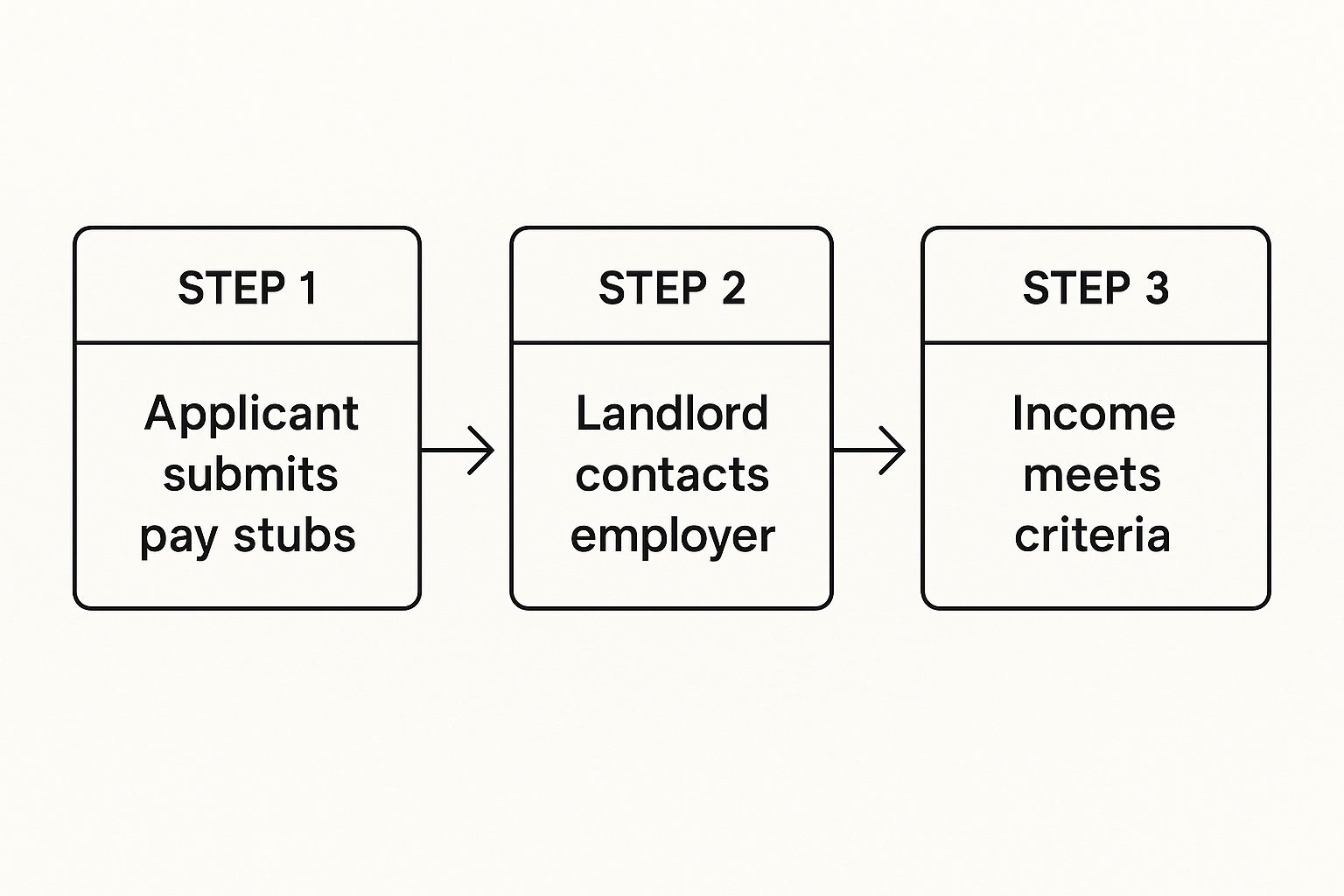
As you can see, it’s a multi-step process that moves from applicant-provided documents to direct confirmation with the source.
The Power of Direct Confirmation
Accepting pay stubs at face value is risky, especially with how easily fraudulent documents can be created. The only way to be certain is through direct verification—a time-consuming but non-negotiable step we handle with practiced efficiency for our clients.
Actionable Verification Checklist:
- Call the Employer: We contact the employer’s HR department directly to confirm job title, employment duration, and salary. This one call eliminates the risk of falsified income information.
- Contact Previous Landlords: This is where you get the most valuable insights. We ask specific, open-ended questions to get the real story:
- "Did they pay their rent on time, every single month?"
- "Were there ever any lease violations or complaints from neighbors?"
- "What was the property's condition when they moved out, allowing for normal wear and tear?"
- "Would you rent to them again?" The answer here is incredibly telling.
Expert Tip: Never use the phone number provided on the application for the previous landlord. We always independently verify the property owner's contact details to ensure we're speaking to the actual owner, not a friend posing as one. This is a critical trust and transparency checkpoint.
This meticulous verification is what separates professional screening from a superficial one. It’s a core component of mastering the Salinas & Monterey rental application process, and it's how you ensure the person placed in your property is the reliable, responsible tenant they appear to be on paper.
Step 3: Navigate California and Local Rental Laws

Legal compliance isn’t just a good idea—it's a non-negotiable part of owning rental property in California's highly regulated housing market. For owners of high-end properties here in Monterey County, from Salinas to the coastal communities, a deep understanding of federal, state, and local laws is the only way to prevent costly lawsuits and protect your reputation.
A single misstep, even an unintentional one, can lead to serious financial penalties. This is why any discussion about how to screen potential tenants must be built on a solid foundation of legal knowledge. It’s about building a fair, ethical, and legally defensible process.
The Fair Housing Act and California's Protected Classes
Every landlord in the country must comply with the federal Fair Housing Act, which prohibits discrimination based on race, color, religion, national origin, sex (including sexual orientation and gender identity), disability, and familial status.
California takes tenant protections even further by adding several more protected classes. This is where many well-intentioned landlords get into trouble.
These additional state-level protections include:
- Source of Income: This is critical in our local market, from Salinas to King City. You cannot legally reject an otherwise qualified applicant just because they use a Section 8 voucher or another form of public assistance to pay their rent.
- Marital Status: Your rental decisions can't be influenced by whether an applicant is single, married, or divorced.
- Age: You cannot discriminate based on an applicant's age.
- Ancestry and Medical Condition: These are also protected characteristics under California law.
Understanding the nuances of these rules is paramount. For a more detailed look, you can explore our guide covering landlord-tenant laws in California, which breaks down these complexities.
A Word of Caution: Accidental discrimination is just as illegal as intentional discrimination. A seemingly innocent comment like, “This home in Pacific Grove is perfect for a young family,” could be interpreted as a preference, creating significant legal risk. Always focus your conversation on the property's features, not on who you imagine living there.
Application Fees and Criminal History Rules
California has specific, strict rules that govern common screening practices. One of the most misunderstood areas is the application fee. You can only charge a fee that covers your actual out-of-pocket screening costs, and as of 2024, this amount is capped and adjusted annually for inflation. You cannot profit from application fees.
How you handle criminal history has also changed dramatically. Recent laws require a more nuanced approach. You can no longer have a blanket policy of rejecting anyone with a criminal record. Instead, you're required to conduct an individualized assessment, considering the nature and severity of the offense and how much time has passed.
Navigating these rules requires precision and constant vigilance. This is where professional property management becomes a powerful asset, ensuring your screening process stays compliant and shields you from legal headaches.
Step 4: Make a Confident and Compliant Final Decision
You’ve done the legwork. You’ve sifted through applications, run the checks, and verified every last detail. Now comes the most important part: choosing your tenant. This is precisely why setting your rental criteria before you list the property is so critical. With the facts in front of you, you can make an objective, systematic choice.
The goal isn't just to find someone who clears the minimum bar. It’s about finding the best possible fit for your property. If you own a premium home in a community like Carmel or Pebble Beach, this decision is directly tied to protecting your asset and maximizing your ROI. Your best ally in this process is consistency. It keeps you fair, objective, and legally sound.
Weighing the Variables
It's rare to find the "perfect" applicant whose every detail lines up flawlessly. Most of the time, you'll be comparing individuals with different strengths. This is where experience and good judgment come into play.
Consider these common scenarios:
- Credit vs. Income: An applicant has a lower-than-ideal credit score due to old medical debt but has a stable job with an income that's 5x the rent. Compare that to someone with a perfect 800 credit score but whose income just squeaks past your 3x rent rule. The first person could be the more reliable tenant.
- Rental History vs. Employment: You have an applicant with glowing references from past landlords, but they just started a new job last month. On the other hand, you have someone who's been with the same company for a decade but had one late rent payment three years ago.
You must weigh these situations against the standards you set from the start. In our experience, a long, positive history of paying rent on time and taking care of a property is one of the strongest predictors of a great tenant.
The cardinal rule here is to apply your logic consistently. If you decide to make an exception for one applicant—like accepting a lower credit score due to high income—you must be willing to make that same exception for any other applicant in a similar situation. Always document why you made your decision.
Communicating Your Decision Professionally
How you deliver the news—good or bad—reflects on you as a professional property owner and builds your reputation in the Monterey County community.
For the chosen applicant, the conversation is straightforward. A clear "Congratulations, you've been approved!" followed by immediate next steps (lease signing, security deposit payment) starts the relationship on a positive, transparent note.
For applicants you didn't choose, your communication must be professional and legally compliant. This is critical. In California, if your decision was based on any information from their credit report or background check, you are required to send an adverse action notice.
This formal letter states why they were denied and must include the name and contact information of the screening company you used. It’s not just a professional courtesy; it’s a legal requirement.
Taking this final step seriously solidifies your entire screening process. A well-documented, fair decision followed by respectful communication protects your investment and establishes you as a top-tier property owner.
Bringing in a Pro for Ultimate Peace of Mind

As you can see, an airtight tenant screening process is a serious undertaking. It demands time, a sharp eye for detail, and a firm grasp of California's ever-shifting rental laws.
For busy owners with high-value properties in Salinas, Monterey, and surrounding South County towns, the complexity and legal exposure can become overwhelming.
This is where you should consider a full-service, professional solution. When you partner with a dedicated property manager like Coast & Valley Properties, you’re not just delegating a task list; you’re investing in a proven system designed to protect your asset, save you time, and maximize your returns.
The Coast & Valley Advantage: Trust and ROI
We don’t just run basic checks. We provide a complete placement service focused on securing high-quality, long-term tenants who will treat your property with respect. Our process is built on years of local Monterey County experience and a simple philosophy: we treat your property like our own.
Here’s how our full-service solution delivers peace of mind:
- We Give You Your Time Back: We handle every step, from marketing your property in Pacific Grove to vetting every applicant in King City. This frees you to focus on your own priorities.
- We Minimize Your Risk: Our team, led by Salinas native Amy Salmina, lives and breathes Fair Housing law. We ensure strict compliance to shield you from costly legal mistakes that can sink an investment.
- We Protect Your Asset: By placing only the most responsible, thoroughly vetted tenants, we actively help preserve your property’s condition and protect its long-term value.
A professional manager's true value is in shouldering the complexities so you can enjoy the benefits of your investment without the day-to-day headaches. It's a direct investment in your time and ROI.
When you weigh the time, stress, and potential legal pitfalls, the argument against self-management becomes compelling. You can dive deeper into why so many savvy investors make this choice and learn why you should not manage your own investment properties.
By working with specialized landlord services, you bring a powerful local ally into your corner—one completely dedicated to helping you achieve your financial goals.
Your Monterey County Tenant Screening Questions Answered
Even the most seasoned investors have questions about the nitty-gritty of tenant screening, especially for high-value properties in Monterey County. Here are some of the most common questions we answer for our clients.
Can I Charge an Application Fee?
Yes, but you must follow California's strict rules. The fee can only cover your actual out-of-pocket screening costs, such as the price of a credit report and background check. You cannot profit from application fees. The maximum amount is capped by law and adjusted annually for inflation, so it's critical to know the current limit.
How Should I Handle Applicants with Pets?
Deciding to allow pets can significantly expand your pool of potential renters. If you go this route, you need a crystal-clear pet policy in writing before listing the property.
Your policy should spell out:
- Pet Deposit: A separate, refundable deposit for pet-related damages.
- Pet Rent: A small, extra monthly fee, if you choose to implement one.
- Restrictions: Be specific about limits on the type, size, or number of pets allowed.
A crucial point: you cannot charge a pet deposit or pet rent for verified service or support animals. Under Fair Housing laws, they are not legally considered pets.
What About Applicants Who Are Self-Employed?
Verifying income for a self-employed applicant simply requires different documentation. Instead of pay stubs, you need other proof of financial stability.
To get a complete financial picture, we ask for the last two years of tax returns, recent bank statements, and a profit and loss statement for their business. This combination provides a much more reliable view of their true financial health and ability to consistently pay rent.
Do I Have to Accept Section 8 Vouchers?
Yes, in California, you absolutely do. Source of income is a protected class. This means it is illegal to deny an otherwise qualified applicant just because they use a Housing Choice Voucher (Section 8) or another form of rental assistance. You must apply all your normal screening criteria—credit history, rental background, etc.—to every single applicant, regardless of how they plan to pay the rent.
Navigating these rules and details is exactly where Coast & Valley Properties steps in. Our team manages every part of the screening process with precision and a deep understanding of California law, ensuring your investment is protected and your mind is at ease.
Ready to experience hands-off, concierge-level property management? Contact us today and let's discuss how we can maximize the potential of your Monterey County property.