
The Expert’s Guide to a California Commercial Rental Agreement
For high-end property owners and investors in Salinas, Carmel, and across Monterey County, your California commercial rental agreement is more than just a document. It’s the single most important tool for protecting your investment, maximizing your ROI, and ensuring long-term profitability. Unlike residential leases, these agreements have few built-in protections, meaning the terms you negotiate are everything.
This guide, written by licensed brokers with deep expertise in high-value commercial real estate, breaks down California's complex laws using real-world scenarios from our experience managing properties in the Monterey Bay Area. Our goal is to provide clear, actionable insights to help you secure your asset.
Your Guide to California Commercial Leases

Investing in commercial real estate in Monterey County is a high-stakes endeavor. Your tenants are businesses, the financial commitments are significant, and the leases are far more complex than anything in the residential market. For a busy professional or serious investor, a poorly written agreement can quickly drain profits and expose you to unnecessary legal risks.
We created this guide to translate dense legal jargon into practical, step-by-step advice you can use immediately—whether you own a premium retail space in Pacific Grove or an industrial facility in South County towns like King City or Soledad. We want you to feel confident that your asset is protected against market shifts and potential tenant issues.
Why a Standard Template Is Not Enough
Using a generic lease template is one of the most common and costly mistakes an owner can make. A one-size-fits-all document fails to account for the unique business climate of the Monterey Bay Area or the specific California laws governing commercial properties.
A strong commercial rental agreement must be tailored to our local reality. Here’s what you need to know:
- No Rent Control: Most commercial properties are exempt from residential rent control laws. This offers flexibility but requires a smart, forward-thinking strategy for setting and escalating rent to maximize your return on investment.
- Everything is Negotiable: From tenant improvement allowances to how Common Area Maintenance (CAM) charges are calculated, nearly every term is negotiable. Your success hinges on having an expert negotiator on your side.
- Sophisticated Tenants: Commercial tenants are businesses, often with their own legal counsel. You need to approach negotiations with the same level of professional preparation to protect your interests.
As our founder Amy Salmina, a fourth-generation Salinas native, often emphasizes, local expertise is essential. A lease for an agricultural business in Gonzales will have vastly different requirements than one for a boutique in Carmel-by-the-Sea.
Think of this guide as your starting point. By understanding the core components of a lease and how to negotiate them, you can transform a simple contract into a powerful tool for asset preservation and growth. For a more comprehensive overview, explore our commercial property management guide. At Coast & Valley, we believe an educated owner is a successful one, and we are committed to providing the resources you need to thrive.
Anatomy of an Ironclad Commercial Lease Agreement
Your California commercial rental agreement is the architectural blueprint for your investment. A weak foundation will lead to costly problems, while a strong, well-defined structure ensures stability and profitability for years. Let’s break down the essential components that make a lease truly ironclad, moving beyond legal jargon to focus on what actually impacts your bottom line and protects your property.
Each clause serves a specific purpose, working together to safeguard your asset. This diagram shows the high-level structure, breaking the agreement into its core pillars.
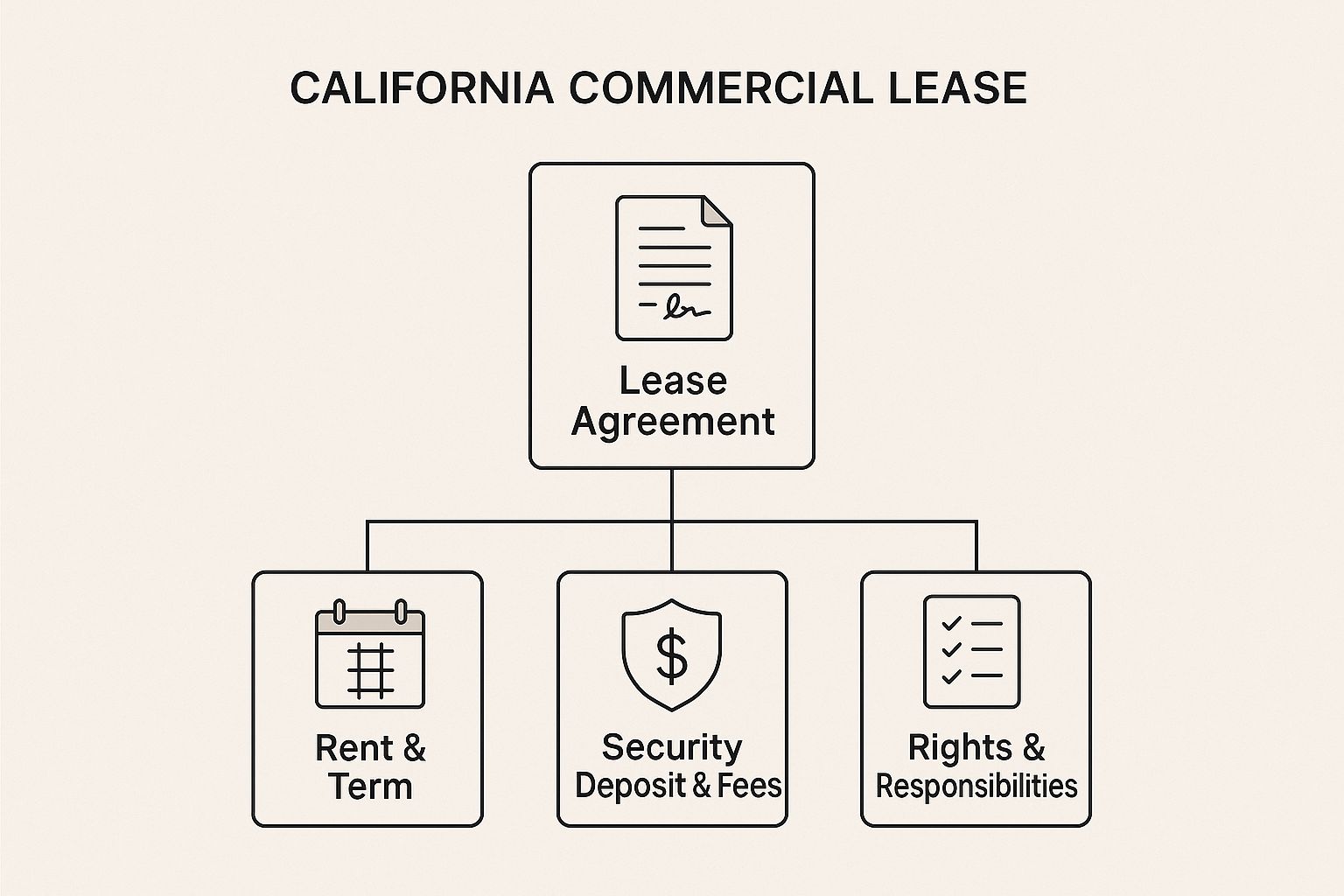
This visual simplifies a complex document, showing how foundational elements like rent structure and lease term support the rights and responsibilities of both you and your tenant.
The Use Clause: Defining Your Property's Purpose
One of the most critical sections is the Use Clause. This clause acts as the private zoning for your property, explicitly stating what business activities the tenant is allowed to conduct—and, just as importantly, what they are not.
Real-World Scenario: In a premium retail space we manage in Carmel, a restrictive use clause limits a tenant to selling luxury apparel. This prevents them from suddenly opening a high-traffic cafe that would disrupt neighboring boutiques, thereby protecting the character and value of the entire property. This precision is a key strategy for property preservation.
Rent Structure and Financial Obligations
Clarity here is non-negotiable. Your lease must detail every financial component to prevent disputes and ensure consistent cash flow. Ambiguity is the enemy of a profitable investment.
Actionable Checklist for Financial Terms:
- Base Rent: Clearly state the fixed monthly amount and specify how and when rent will escalate over the lease term.
- Operating Expenses (CAM): Common Area Maintenance charges cover costs for shared spaces like parking lots and landscaping at your Salinas property. A well-drafted CAM clause ensures these costs are passed to tenants transparently.
- Rent Structure Type: Define the lease type. A Triple Net (NNN) lease, where the tenant pays for property taxes, insurance, and maintenance, is standard for many commercial properties. Understanding the details is vital, which is why we created a breakdown of what is a triple net lease.
Maintenance, Repairs, and Insurance
Who fixes the HVAC system? Who repairs a roof leak? The lease must provide a crystal-clear answer. In our experience managing properties from Monterey to King City, maintenance disputes are a leading cause of friction between landlords and tenants.
A strong commercial rental agreement doesn't just assign responsibility; it creates a proactive framework for property preservation. By clearly outlining maintenance duties, you transition from reactive problem-solving to strategic asset management.
Defining these roles protects your property's physical condition and your financial health. Furthermore, the lease must mandate specific insurance coverage for the tenant, including liability and property damage, and require them to name you, the property owner, as an additional insured. This is a vital layer of protection for your investment. For advanced protection, understanding concepts like piercing the corporate veil in a breach of contract in California is also beneficial.
California Commercial Lease Laws You Must Know

Navigating California's commercial lease laws requires more than a template; it demands a deep, on-the-ground understanding of state regulations. For high-end property owners in Monterey County, knowing these rules is critical for protecting your investment and ensuring your operation is both profitable and compliant.
While commercial leases offer more flexibility than residential ones, California still sets important boundaries. The law views commercial tenants as sophisticated parties, meaning the signed lease becomes the ultimate rulebook a court will use to settle disputes.
Key California-Specific Legal Considerations
For owners of high-value properties, from agricultural hubs in South County to retail centers in Monterey, a few state laws are particularly important. These are not suggestions—they are foundational requirements that carry major financial consequences if ignored.
Step-by-Step Compliance Checklist:
- Understand the Implied Warranty of Habitability: Unlike residential properties, California law does not automatically grant an "implied warranty of habitability" for commercial spaces. You are not required to ensure the property is “fit for a specific purpose” unless your lease explicitly says so. Define your obligations clearly to avoid disputes.
- Define Security Deposit Terms: The state is hands-off with commercial security deposits, but your lease must be crystal clear on the terms for holding, using, and returning the deposit. Ambiguity can lead to legal challenges.
- Assign ADA Compliance Responsibility: Every commercial property must comply with the Americans with Disabilities Act (ADA). Your lease must state, in no uncertain terms, who is responsible for ADA compliance—whether for the building's core structure or for tenant improvements.
Getting these points right is fundamental. For a deeper dive, read our guide on commercial landlord responsibilities in California.
The Commercial Tenant Protection Act (SB 1103)
Staying ahead of legal changes is what sets professional management apart. A perfect example is California's Senate Bill (SB) 1103, the Commercial Tenant Protection Act. This law introduces significant new protections for certain small business tenants—the very kind we see in communities like Salinas and Gonzales.
SB 1103 marks a critical shift in California's commercial leasing world. It pushes landlords to be more transparent and provide extra safeguards, highlighting the need to be proactive and compliant to avoid headaches with smaller, community-focused tenants.
Effective January 1, 2025, this law is aimed at landlords leasing to "Qualified Commercial Tenants" (QCTs), such as a microenterprise or a local nonprofit. The law requires new written notices before a lease is signed, detailed breakdowns of operating costs, and longer notice periods for rent increases. You can review the specifics of SB 1103 on bbklaw.com.
For our clients, this means it’s time to update lease agreements to ensure full compliance. It’s this kind of forward-looking legal awareness that demonstrates Coast & Valley’s commitment to protecting your assets. As licensed brokers with deep roots in Monterey County, our team, led by Salinas native Amy Salmina, translates these complex laws into practical strategies that save you time and preserve your investment.
Lease Negotiation Strategies for Monterey County
A California commercial rental agreement is a powerful financial tool. For high-value properties in Monterey County, a successful negotiation is about more than settling on a rental rate—it’s about crafting a win-win scenario that attracts premier tenants and builds long-term value into your investment.
Real-World Scenario: In a successful negotiation for a prime retail spot in Carmel, we structured a lease with tiered rent increases aligned with the tenant's growth projections. This gave them a manageable starting cost while ensuring our client's returns kept pace with the market—a strategy that secures long-term ROI.
In another case involving an industrial property near Gonzales, we leased to a promising ag-tech startup. We structured the lease to include clauses for future expansion options on the property. This foresight made the property more appealing and locked in a valuable, growing tenant for the long haul.
Leveraging Market Data to Your Advantage
Never enter a negotiation unprepared. Success begins with solid data. Armed with current market intelligence, you gain the leverage to justify your terms with confidence.
Actionable Insight: Commercial real estate trends in California show retail lease rates are projected to hit $3.10 per square foot in 2025, up from $2.90 in 2022. The industrial sector, vital to areas like Salinas and South County, is even stronger, with rates expected to reach $1.40 per square foot. You can find more data in this mid-year 2025 California commercial real estate market outlook. With this data, you can set rental rates that reflect true market value, ensuring you don’t leave money on the table.
Negotiating Tenant Improvements and Renewal Options
Two of the most critical negotiation points are Tenant Improvements (TIs) and renewal options. These clauses significantly impact your upfront costs and your ability to retain great tenants.
- Tenant Improvements (TIs): This is the custom build-out a tenant needs. A common strategy is to offer a TI allowance (a specific amount you contribute to construction). In exchange for a generous allowance, you can often secure a longer lease term or a higher rental rate, turning an initial expense into a driver for long-term ROI.
- Renewal Options: Giving a tenant the option to renew offers them valuable stability. The terms of that renewal are what matter to you. We negotiate renewal options that are owner-favorable, such as setting future rent at "Fair Market Value" (FMV) instead of a small, fixed increase. This protects you from being locked into below-market rates years from now.
A thoughtfully negotiated lease transforms a landlord-tenant relationship from a simple transaction into a strategic partnership. The goal is to create an agreement that incentivizes the tenant's success, because their success is directly tied to the performance of your investment.
The Professional Management Advantage
Expert negotiation demands deep local knowledge, sharp financial skills, and a firm grasp of real estate law. As licensed brokers, our team at Coast & Valley handles these complex negotiations daily. We understand the needs of businesses in Salinas, Monterey, and King City, allowing us to structure agreements that attract the best tenants while protecting our clients' interests. Our full-service approach ensures every clause is optimized for profitability and security, delivering a clear return on investment. Understanding commercial property management fees is a key part of seeing the ROI that professional oversight delivers.
Common Commercial Lease Pitfalls to Avoid

Learning from others' mistakes is one of the smartest things an investor can do. A California commercial rental agreement is a minefield of details where one oversight can become a massive financial headache. At Coast & Valley, our experience helps clients sidestep the common traps that ensnare less-prepared owners.
The Vague Use Clause
A poorly defined Use Clause is a common and disruptive pitfall.
Real-World Scenario: A landlord in Monterey leased a retail space to what they thought was a quiet boutique. The lease stated the space was for "general retail purposes." A few months later, the tenant opened a bustling cafe, creating noise and smells that drove away neighboring tenants and devalued the property.
The Fix: Be surgically precise. Your Use Clause should clearly state what is allowed (e.g., "the sale of luxury women's apparel") and what is forbidden (e.g., "food or beverage service"). This detail is your best defense against unwanted surprises.
Forgetting CAM Audit Rights
Another costly mistake is omitting the landlord's right to audit Common Area Maintenance (CAM) expenses.
Real-World Scenario: We took over management for an owner in King City whose lease lacked this provision. When the tenant, a large distribution company, disputed their share of landscaping and security costs, the owner had no contractual right to review their books, leaving our client liable for thousands in expenses.
- The Fix: Always include a clause giving you the right to audit the tenant's records related to operating expenses. This ensures transparency and gives you the leverage to verify you are being reimbursed correctly.
Inadequate Security Deposits
Underestimating the security deposit can leave you dangerously exposed. Market conditions play a huge role. For instance, with office space vacancies near 15%, some landlords may be tempted to offer concessions like a lower deposit. You can discover more insights on 2025 commercial property trends to see how this varies. A small deposit won't cover the costs of finding a new tenant and making repairs if a tenant breaks their lease. The resulting legal battle can be complex, as outlined in our guide on the eviction process in California.
- The Fix: Calculate your security deposit strategically. It should cover potential damages and at least one to two months of rent to cushion the blow of an unexpected vacancy. For newer businesses, demanding a larger deposit or a personal guarantee is smart risk management.
Download Your Monterey County Lease Checklist
Navigating a California commercial rental agreement requires diligence, expertise, and a sharp eye for detail. To simplify this process, we’ve created a comprehensive checklist specifically for Monterey County property owners.
This isn't a generic template. It’s a strategic guide built from our experience managing premium commercial properties in Salinas, Carmel, and surrounding areas. We’ve distilled years of hands-on management into actionable steps to ensure no critical detail is missed.
What’s Inside Your Localized Checklist
This checklist is packed with items tailored to our unique market to protect your investment.
- Local Zoning Verification: Confirm a tenant's business plans align with city ordinances in Salinas, Soledad, or Gonzales.
- Seasonal Impact Assessment: Crucial for retail and hospitality in tourist areas like Carmel-by-the-Sea, this helps you account for seasonal business swings.
- Clause Verification: A step-by-step review to ensure essential clauses—from CAM charges to ADA compliance—are ironclad and work in your favor.
This checklist is more than just a to-do list; it’s a risk management tool. It's the same proactive, detail-obsessed approach we take at Coast & Valley, turning potential headaches into protected assets.
To prepare even more effectively, we also recommend using a complete commercial lease negotiation checklist.
Ready to use an expert-level tool? Downloading our Monterey County Commercial Lease Checklist is the first step toward a more profitable and secure investment.
[Download Your Monterey County Commercial Lease Checklist PDF Here]
Have Questions? We Have Answers.
When it comes to California commercial rental agreements, a few questions always come up. As experts in the Monterey County market, here are clear, straightforward answers to the most common queries from property owners like you.
How Is a Commercial Lease Different From a Residential One in California?
The biggest difference is the lack of regulation. Residential leases are covered by consumer protection laws, from rent control to strict eviction processes. Commercial leases are not.
This gives you more flexibility but also places the burden on you to create an airtight agreement. Your lease is the only thing protecting you from significant financial risk. A well-crafted commercial lease must be incredibly detailed to protect your high-value asset and preserve your investment.
What Exactly Are CAM Charges?
CAM stands for Common Area Maintenance. It covers the costs of keeping shared spaces—like parking lots, lobbies, and landscaping in your Monterey Bay property—in top shape.
Each tenant typically pays a pro-rata share based on the space they lease. For example, a tenant occupying 10% of the building's leasable area pays 10% of the total CAM costs. A crystal-clear CAM clause in your lease is crucial for transparency and protecting your bottom line.
Can I Just Use a Standard Lease Template for My Monterey Property?
Our answer is always a firm no. Generic templates are a recipe for trouble in a unique market like ours.
A standard form won't account for specific California legal requirements or the local nuances of Salinas or Carmel. They are not designed to protect a high-value investment.
A lease agreement tailored by local experts is the only way to truly secure a high-value commercial investment. It factors in local business trends and recent legal updates that templates completely ignore. Think of a custom lease not as an expense, but as an investment in your property's long-term security and profitability.
Crafting a commercial lease that protects your interests requires deep local knowledge and a proactive mindset. The team at Coast and Valley Properties, comprised of licensed brokers with deep roots in the community, ensures every agreement we manage is optimized to safeguard your investment and maximize your returns. Contact us to evaluate your commercial property management needs today.