
Navigating the Eviction Process in California: A Guide for Monterey County Investors
Successfully navigating an eviction in California isn't just a process; it's a precise legal procedure that demands perfection. As a property owner, you must have a valid "just cause" reason to remove a tenant. The entire process begins with a legally flawless written notice. If the tenant fails to comply, the next step is filing an Unlawful Detainer lawsuit, and only a Sheriff's lockout can officially complete the eviction.
Even a minor procedural mistake can result in the entire case being dismissed. This forces you back to square one, costing you significant rent revenue and valuable time—a risk no serious investor can afford.
Understanding California's Complex Eviction Landscape

For investors and owners of high-end properties in premier locations like Salinas, Carmel, or Pebble Beach, mastering California’s eviction laws is not merely an administrative task—it's a critical component of asset protection. This isn't just about removing a tenant; it’s about professionally and efficiently reclaiming your valuable property while minimizing financial exposure.
The legal landscape is constantly shifting. Success in this arena is built on genuine local expertise, not on a generic form downloaded from the internet. A single misstep can expose your investment to significant financial and legal liability.
The Post-Moratorium Environment and Its Impact
The legal complexity intensified after California's statewide COVID-19 eviction moratoriums expired. Once these protections ended in 2023, eviction filings surged, with many counties seeing numbers that far surpassed pre-pandemic levels. For example, Alameda County recorded nearly 800 eviction cases in June 2023 alone, a stark contrast to the monthly average of 324 in 2019.
This spike reflects a pent-up need for property owners to act. For you, this means the courts are congested, and the margin for error is nonexistent. Whether you own a portfolio of homes in South County towns like King City and Soledad or a luxury property in Pacific Grove, this new reality demands a flawless, professional approach.
Key Takeaway for Investors: The current eviction climate in Monterey County is unforgiving. To protect your ROI, the process must be treated as a structured business procedure. Every document, deadline, and communication must be managed with absolute precision to safeguard your investment.
Turning a Legal Challenge Into a Business Process
This is where professional property management provides immense value. We transform this intricate legal challenge into a predictable, managed system. Rather than reacting to problems, a proactive strategy anticipates them. This involves maintaining meticulous records, ensuring all communications are compliant, and leveraging a deep understanding of both state laws and local Monterey County court procedures.
A foundational step is understanding these laws. You can begin by exploring our detailed guide on landlord-tenant laws in California to build your knowledge base.
Adopting modern tools for efficiency and compliance is also a smart strategy. For example, understanding legal document automation can transform how you handle legal paperwork, ensuring accuracy while saving valuable time. This level of professional oversight is what separates a well-protected asset from a high-risk liability.
At Coast & Valley, we bring this concierge-level professionalism to every property we manage. Led by Salinas native Amy Salmina, our team’s local roots and commitment to excellence provide the trust and transparency high-end property owners expect. We manage the entire process, allowing you to focus on your investment portfolio with confidence.
Serving The Correct Eviction Notice
The entire California eviction process hinges on this first, critical step. Serving the correct notice is not a mere formality; it is the legal foundation of your entire case. For property owners and investors, a minor error here can derail the process, forcing you to start over while losing months of rent and incurring unnecessary legal fees.
This is, unequivocally, the most common pitfall for DIY landlords and a risk no serious investor should take.
Success requires absolute precision in selecting the legally appropriate notice, completing it perfectly, and serving it exactly as the law mandates. This is not a step to be taken lightly, especially when managing valuable assets in Monterey County.
Differentiating Key Eviction Notices
California law provides several notice types, each designed for a specific violation. Choosing the wrong one is an immediate and costly error. The most common are the 3-Day, 30-Day, and 60-Day notices, but even within the 3-day category, there are crucial distinctions.
- 3-Day Notice to Pay Rent or Quit: This notice is used exclusively for non-payment of rent. It must state the exact amount of rent due, the name and address of the person who can accept payment, and their hours of availability. Any mistake, such as overstating the rent owed, can invalidate the notice.
- 3-Day Notice to Cure or Quit: This is for a correctable lease violation other than rent. Common examples include an unauthorized pet in a Carmel rental or unapproved alterations to a Pacific Grove property. The tenant has three days to "cure" the violation (e.g., remove the pet) or vacate.
- 3-Day Unconditional Quit Notice: This is reserved for the most serious violations, such as illegal activity on the premises or causing substantial damage to the property. The tenant has no option to fix the issue; they must vacate within three days.
Real-World Scenarios in Monterey County
The appropriate notice is always dictated by the specific context. Let’s say you own a luxury property in Pebble Beach with a strict "no pets" clause. If the tenant acquires a dog, you would serve a 3-Day Notice to Cure or Quit. This gives them a clear, actionable opportunity to rehome the animal and restore compliance with their lease agreement.
Now, consider a tenant in a Soledad single-family home who is two weeks late on rent. In this instance, a 3-Day Notice to Pay Rent or Quit is the only correct instrument. Using a Notice to Cure for unpaid rent would be legally incorrect, and your case would likely be dismissed if challenged in court.
Investor Insight: The precision required for these notices is non-negotiable. At Coast & Valley, we treat notice preparation as a primary risk mitigation step. Our process, overseen by Amy Salmina's experienced team, ensures every notice is meticulously prepared, compliant, and served correctly, protecting your investment from the very first step.
The workflow for a standard non-payment issue is straightforward but incredibly rigid, as this infographic shows.
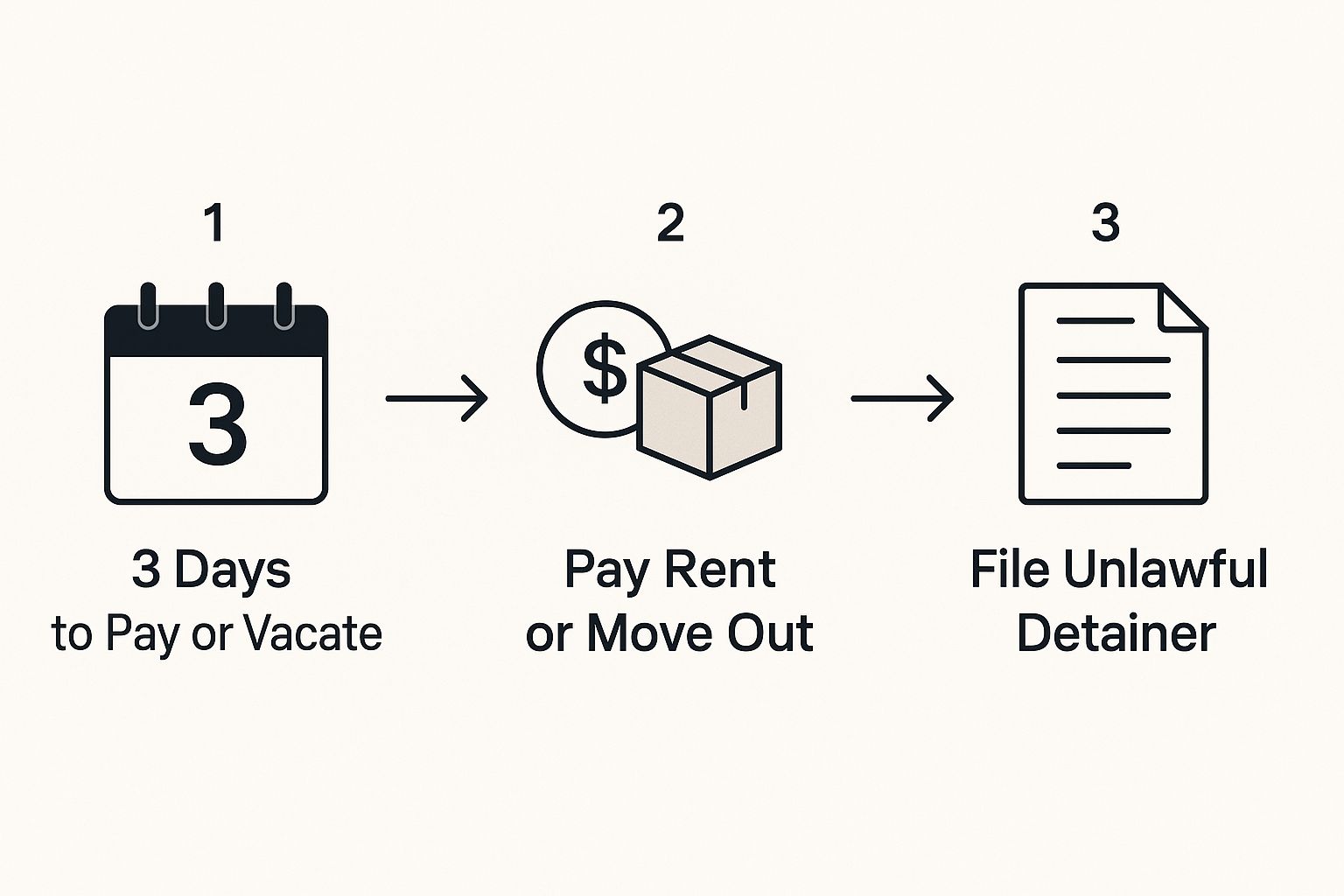
This visual highlights how that simple three-day window is the first legal trigger, leading directly to court action if the tenant doesn't comply.
Beyond the 3-Day: The 30/60-Day Notices
When you need a tenant to vacate for reasons that are not their fault—such as ending a month-to-month tenancy—different timelines apply.
- A 30-Day Notice to Quit is used if the tenant has resided in the property for less than one year.
- A 60-Day Notice to Quit is required if the tenant has resided there for one year or more.
These "no-fault" notices are often used when you plan to sell the property, move in yourself, or undertake substantial renovations. However, under the California Tenant Protection Act (AB 1482), you may be required to state a "just cause" and even provide relocation assistance. This adds another layer of complexity that demands professional guidance to ensure compliance and avoid liability.
To help clarify which notice applies when, here's a quick summary of the common types.
California Eviction Notices at a Glance
| Notice Type | Primary Use Case | Typical Timeframe | Key Consideration for Owners |
|---|---|---|---|
| 3-Day Notice to Pay or Quit | Tenant has failed to pay rent. | 3 business days | Must state the exact rent amount due; any overstatement can invalidate it. |
| 3-Day Notice to Cure or Quit | Tenant has violated a lease term (e.g., unauthorized pet, subletting). | 3 business days | The violation must be "curable." The notice must specify the exact violation. |
| 3-Day Unconditional Quit | Severe violations (e.g., illegal activity, major property damage). | 3 business days | No option for the tenant to fix the issue. Reserved for the most serious cases. |
| 30-Day Notice to Quit | Terminating a month-to-month tenancy for a tenant of less than 1 year. | 30 calendar days | Often requires a "just cause" and may involve relocation assistance under AB 1482. |
| 60-Day Notice to Quit | Terminating a month-to-month tenancy for a tenant of 1 year or more. | 60 calendar days | Subject to the same "just cause" and relocation rules as the 30-Day Notice. |
Understanding these distinctions is crucial for a legally sound eviction process.
Finally, remember that how you serve the notice is just as important as which notice you choose. California law dictates strict rules for "service," including personal delivery, substituted service, or "posting and mailing." Failure to follow these rules to the letter renders your notice legally void. This is precisely the kind of detail-oriented work where professional management from a team with deep local expertise in the Salinas and Monterey Bay Area becomes invaluable, protecting your ROI and saving you significant time and stress.
Filing The Unlawful Detainer Lawsuit

You have served a legally sound eviction notice, but your tenant in Monterey County has not complied. What's next? This is the point where the process transitions from landlord-tenant communication to formal legal action: filing an Unlawful Detainer lawsuit.
For owners of high-end properties, the word "lawsuit" can be intimidating. It's best viewed as a necessary business procedure to reclaim control of your valuable asset. This is not about personal conflict; it is a structured legal process governed by strict rules. The objective is to obtain a court judgment that officially terminates the tenancy, allowing you to regain possession.
Navigating the Monterey County Superior Court system requires absolute precision. This is where professional property management, working in concert with legal counsel, becomes indispensable.
Preparing The Summons And Complaint
The Unlawful Detainer lawsuit begins when you file two critical documents with the court: the Summons (Form SUM-130) and the Complaint—Unlawful Detainer (Form UD-100). These are not just forms; they are the legal backbone of your case.
- The Complaint: This document details exactly why you are legally entitled to evict the tenant. It must accurately list the property address, the tenants, reference the lease, and state the specific grounds for eviction—be it non-payment of rent or another lease violation.
- The Summons: This is the court's official notice to the tenant. It informs them that a lawsuit has been filed and provides a strict deadline—just five business days—to file a formal response with the court.
Accuracy here is non-negotiable. A minor mistake, like a misspelled name or an incorrect rent amount, can provide the tenant with a legal loophole to challenge the suit. This could lead to frustrating delays or, in a worst-case scenario, a full dismissal of your case. For our clients with properties from Pacific Grove to King City, we ensure every detail is meticulously reviewed by legal experts before filing.
The Local Filing and Service Process
Once the paperwork is perfected, it must be filed at the appropriate courthouse—for properties in our region, this is typically the Superior Court of California, County of Monterey. After filing and paying the court fees, you will receive court-stamped copies of the Summons and Complaint.
The next crucial step is service of process. California law is unequivocal: you, the owner, cannot personally serve these documents. Service must be performed by a registered process server or another adult not party to the lawsuit. They will attempt to deliver the documents directly to the tenant. If personal delivery is not possible, alternative methods like "substituted service" can be used, but each has its own strict legal requirements.
Investor Insight: The timeline from filing to service is critical. Delays in properly serving the tenant postpone the entire court schedule. Our role is to coordinate seamlessly with trusted local process servers to ensure this step is executed swiftly and in full legal compliance, keeping your case moving forward without preventable setbacks.
While the eviction process in California is known for its complexity, the state historically maintained lower eviction filing rates than other large states. Before the pandemic, California averaged 2.2 eviction filings per 100 rental households, a fraction of states like Michigan (16 per 100). The average rent owed at filing was $3,987.85, a figure that highlights our region's high rental values and underscores the significant financial impact of a non-paying tenant. You can find more data on California eviction filing rates at AAGLA.org.
This financial reality reinforces why a precise, legally compliant approach is essential from day one. Mastering this phase is fundamental to protecting your investment. For a more detailed overview, read our comprehensive guide on how to evict a tenant in California.
Navigating Court Responses and Tenant Defenses
Once you have filed the Unlawful Detainer and served the tenant, the process enters a new phase. The ball is now in the tenant's court, and they have a legal right to respond. Their next action—or inaction—will determine the timeline, cost, and ultimate outcome of your eviction. For any property owner, preparing for this stage is not just about a legal fight; it's about making a sound business decision under pressure.
After being served, a tenant has only five business days to file a formal response, typically an "Answer," with the court. If they miss this deadline, you can move for a default judgment—the quickest path to resolution. However, a savvy tenant, particularly one with legal aid, will likely file an Answer, signaling the start of a potential court battle.
Common Tenant Defenses And How To Counter Them
When a tenant files their Answer, they must list their defenses—the legal reasons they believe the eviction is invalid. Your ability to refute these claims depends almost entirely on the quality of your documentation and your adherence to the law up to this point. This is where proactive, professional management becomes your most powerful defense.
A few common defenses appear repeatedly:
- Improper Notice: The tenant argues the eviction notice contained errors (e.g., incorrect rent amount, wrong dates) or was not served according to California's strict rules. This is the most frequent defense and the most preventable with meticulous oversight.
- Breach of the Warranty of Habitability: A serious claim that the property was unlivable due to major, unaddressed maintenance issues like a broken heater, a leaking roof, or a severe pest infestation.
- Retaliatory Eviction: The tenant claims the eviction is punishment for them exercising a legal right, such as requesting a major repair or reporting a code violation to the city of Salinas.
- Waiver: This defense applies if you accept rent for a period after the notice to quit has expired. By accepting payment, a tenant can argue you have "waived" your right to proceed with that specific eviction.
The Power Of Proactive Documentation
Imagine a scenario: You are evicting a tenant from a high-end Pacific Grove rental for non-payment of rent. They file an Answer claiming the eviction is invalid because an unresolved plumbing issue has rendered the unit uninhabitable. A DIY landlord with poor records is immediately on the defensive.
For a Coast & Valley client, our response is immediate and evidence-based. We access our secure online portal and retrieve the complete, time-stamped record: the tenant's initial maintenance request, proof of our prompt response, dispatch of a licensed plumber within 24 hours, and the signed work order confirming the repair was completed to their satisfaction. This meticulous documentation neutralizes the claim and demonstrates to the court that you have acted professionally and in good faith.
A firm grasp of the clear lines between landlord responsibilities vs. tenant duties is critical to preventing these claims from gaining traction.
It's also wise to know what tenants can and cannot legally do. For instance, understanding the tenant's rights regarding changing locks provides important context if a dispute becomes complex. Ultimately, robust documentation and legal expertise transform potential liabilities into proof of your professionalism.
Settlement Vs Trial: A Cost-Benefit Analysis
When a tenant contests the eviction, you face a critical decision: negotiate a settlement or proceed to trial? This must be a business calculation, not an emotional one.
| Factor | Negotiating a Settlement | Proceeding to Trial |
|---|---|---|
| Timeline | Faster. Typically resolves in days or weeks, allowing you to re-lease the property quickly. | Slower. Securing a court date in busy Monterey County courts can take weeks or months. |
| Cost | Lower. Avoids significant attorney and court fees. May involve a "cash for keys" offer. | Higher. Incurs substantial legal fees, court costs, and possible jury fees. |
| Certainty | Guaranteed outcome. You control the terms of the tenant's departure and move-out date. | Uncertain outcome. A judge or jury could rule against you, regardless of your case's strength. |
| Risk | Minimal. The primary risk is the cost of the settlement payment itself. | High. If you lose, the tenant stays, and you could be ordered to pay their legal fees. |
A settlement often takes the form of a "cash for keys" agreement, where you offer the tenant a sum of money to vacate the property by a firm deadline, leaving it in good condition.
While paying a tenant who has not paid you can feel unfair, it is often the most prudent financial decision. It eliminates the risk of losing in court and, most importantly, stops the financial drain from lost rent. This allows you to regain possession, prepare the unit, and place a new, qualified tenant to restore your cash flow. Our team at Coast & Valley can help you analyze the specific ROI of this critical decision for your property.
Securing and Executing the Writ of Possession
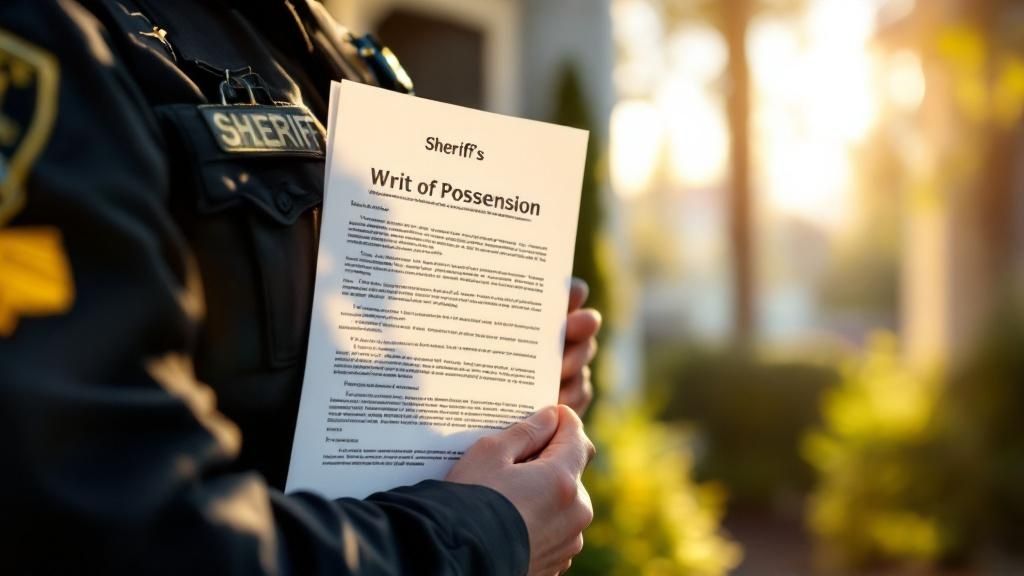
You have successfully navigated the court process and obtained a judgment in your favor. This is a significant milestone in the eviction process in California, but the task is not yet complete. A common misconception is that this court order grants you the immediate right to change the locks. It does not.
The judgment authorizes you to obtain a Writ of Possession. This is the official court order directing the county Sheriff to physically remove the tenant. It is the final, crucial step, and proper execution is essential to avoid last-minute legal complications.
The Sheriff's Role and the Lockout Timeline
Once the court clerk issues the Writ of Possession, it is sent to the local Sheriff's office, such as the Monterey County Sheriff's Department. From this point forward, the Sheriff, not you, controls the timeline.
A Sheriff's deputy will visit the property and post a Notice to Vacate on the front door. This notice serves as a final warning, giving the tenant five calendar days to leave voluntarily. If they remain after this period, the Sheriff will schedule a date and time to meet you (or your property manager) at the property to perform the final lockout.
This waiting period can be stressful for property owners. Before the pandemic, eviction lockouts were common, with the San Francisco Bay Area alone exceeding 6,000 per year. When moratoriums took effect in March 2020, that number dropped to nearly zero, demonstrating how quickly legal shifts can halt the process. Now, with moratoriums lifted, these actions are increasing as owners work to reclaim their properties.
Professional Tip: Be prepared for lockout day. The moment the Sheriff grants you possession, a locksmith should be on standby to change all locks. This is the official act that restores possession to you and secures your valuable asset.
Handling Abandoned Personal Property
It is common for evicted tenants to leave personal items behind. California has incredibly specific and strict laws governing how you must handle this abandoned property. A single misstep can result in significant financial penalties, even after you have won the eviction.
Here is the required actionable checklist:
- Inventory Everything: Create a detailed list of all items left behind. Documenting items and their condition with photos or video provides a clear record.
- Assess the Value: Make a good-faith estimate of the total resale value of the items. This is a critical step, as the value dictates the subsequent legal requirements.
- Provide Formal Notice: Send a written "Notice of Belief of Abandonment" to the tenant's last known address. This notice must describe the property, state its storage location, and provide a deadline for the tenant to claim it (at least 15-18 days, depending on the delivery method).
If the property's total value is less than $700, you may dispose of it if it is not claimed by the deadline. However, if the value exceeds $700, you are legally required to hold a public auction, following a highly specific sale process. You can use the proceeds to cover storage and sale costs, but any remaining funds must be turned over to the county. This is a common and expensive error for DIY landlords.
Navigating this final stage requires meticulous attention to detail and a thorough understanding of the law. It is another reason why having an experienced team like Coast & Valley is so valuable—we ensure the process concludes cleanly, restoring your property to your control so you can focus on what matters: preparing the unit for a new, qualified tenant and getting your investment back on track. This also reinforces the importance of a professional tenant-landlord relationship from the outset.
Common Questions About California Evictions
The California eviction process can feel like a labyrinth, especially for owners managing high-value properties in the Monterey Bay Area. Even with a clear understanding of the steps, specific questions often arise. Here are some of the most frequent inquiries from property owners and investors.
How Long Does The Eviction Process In California Typically Take?
For an uncontested eviction—the best-case scenario—the timeline is generally 30 to 45 days from serving the initial notice to the Sheriff's final lockout.
This timeline changes significantly if a tenant contests the eviction. If they file an Answer with the court or demand a jury trial, the process can easily extend to 60-90 days or longer. The duration depends heavily on the Monterey County Superior Court's caseload and the complexity of the tenant's legal arguments. This is precisely why flawless execution from day one is critical to avoiding costly, preventable delays.
Can I Evict A Tenant Without Giving A Reason?
In most situations, no. The California Tenant Protection Act (AB 1482) requires a "just cause" to terminate most residential tenancies. You must provide either an "at-fault" reason (like non-payment of rent or a lease breach) or a specific "no-fault" reason (such as intending to move into the property yourself).
For luxury rentals in communities like Carmel or Pacific Grove, navigating the interplay of state and local ordinances can be complex. Attempting to terminate a tenancy without a legally sound "just cause" is one of the quickest routes to facing a wrongful eviction lawsuit.
What Are The Most Common Mistakes Owners Make?
The costliest mistakes are almost always procedural. It's surprisingly easy for well-intentioned landlords to undermine their own case. Common missteps include:
- Serving a faulty notice: This is a frequent error, ranging from miscalculating rent owed to failing to deliver the notice in the exact manner prescribed by law.
- Accepting partial rent: Taking any amount of rent after a notice has expired can legally void that notice, forcing you to restart the entire process.
- Attempting "self-help" evictions: Illegally changing locks, shutting off utilities, or removing a tenant's belongings will backfire dramatically, exposing you to severe legal and financial penalties.
- Poor documentation: In court, a weak paper trail of communications, lease violations, and repair records makes it significantly harder to prove your case.
Professional management is your shield against these preventable setbacks. As Amy Salmina and our team know, strict compliance is not optional; it is the cornerstone of protecting your investment and its ROI.
What Happens To The Security Deposit After An Eviction?
Once you have legally regained possession of your property, a 21-day clock starts on the security deposit. You have exactly 21 days to either return the full deposit or provide the former tenant with an itemized statement explaining all deductions.
You can deduct for unpaid rent, necessary cleaning, and repairs for damages beyond normal wear and tear. You must include copies of receipts for any work performed. Meticulous records, including photos and invoices, are essential for justifying every deduction, especially following a contentious eviction. You can familiarize yourself with these and other landlord responsibilities by reviewing these essential California landlord-tenant laws.
Navigating the eviction process successfully requires more than just knowledge—it demands precision, hands-on local experience, and an unwavering commitment to legal compliance. At Coast & Valley Properties, we provide the professional oversight necessary to protect your assets and your peace of mind.