
How Multi-Unit Owners in Monterey County Stay Legally Compliant
Direct Answer: Multi-unit owners in Monterey County stay compliant by tracking California statewide rent control laws, registering units under local ordinances, maintaining habitability standards, and keeping lease terms current with each regulatory change.
Owning two or three rental units in Monterey County feels manageable — until California adds another layer to the legal stack. Between AB 1482, the City of Salinas Residential Rental Registration Ordinance, and the state’s habitability requirements, the compliance picture for multi-unit owners is genuinely more complicated than it was even three years ago.
And the consequences of missing something aren’t minor. A wrongful eviction claim in California can cost a landlord two to three times the monthly rent in statutory damages, on top of attorney fees. For owners in Salinas or Monterey who are managing a duplex or small apartment building on their own, one procedural error can turn a routine tenancy into a costly dispute.
This article focuses on the two or three compliance areas that actually carry the most risk for multi-unit owners in this county — not a laundry list of every rule on the books, but the ones where real owners run into real problems.
AB 1482 and What It Actually Means for Your Building
AB 1482 — California’s Tenant Protection Act — went into effect in January 2020 and it still catches owners off guard. If your building was built before January 1, 2005, and it isn’t a single-family home or condo, it’s almost certainly covered. That means two things: rent increase caps and just cause eviction requirements.
On rent increases, AB 1482 caps annual increases at 5% plus local CPI, with a hard ceiling of 10%. For 2025, the Monterey County area CPI figure puts that effective cap around 8.8% for most covered units. If you raise rent above that without documentation, you’ve created a problem even if the tenant doesn’t immediately challenge it.
The just cause requirement is where multi-unit owners get hurt most often. You can’t end a tenancy on a month-to-month lease just because you want to. You need a qualifying reason — non-payment, lease violations, owner move-in, or similar grounds. And even then, the process has specific notice requirements. If you’re unsure where your property stands, understanding what happens when California law changes mid-lease is worth reading before you make any tenancy decisions.
Key AB 1482 checkpoints for multi-unit owners:
– Confirm your building’s construction date against county records
– Review every lease for proper AB 1482 exemption disclosures if applicable
– Document all rent increase notices with the correct calculation
– Never serve a termination notice without confirming just cause applies
The Salinas Rental Registration Ordinance — What Multi-Unit Owners Must Do Now
If any of your units are in the City of Salinas, the Residential Rental Registration Ordinance (City Ordinance 2663, adopted 2024) applies to you. This is a local layer on top of state law, and it requires residential rental property owners to register their units with the city.
The ordinance was designed to give the city better oversight of housing conditions and renter protections in Salinas — a city where roughly 60% of households are renters, one of the highest ownership-to-rental ratios on the Central Coast. Registration isn’t optional, and operating unregistered units puts you at risk of fines and complicates any future legal action against a tenant.
What registration generally requires:
– Contact information for the property owner and any local agent
– Unit count and address documentation
– Proof of habitability compliance or pending inspection scheduling
– Renewal on the city’s established cycle
Owners with multiple units in Salinas need to track each unit separately. A four-plex is four registrations, not one. If you also own units in unincorporated Monterey County, the city ordinance doesn’t apply there — but state law still does, fully.
For owners who self-manage, this administrative layer adds real time. For those who’ve been asking whether to manage an apartment building themselves or hire a company, registration compliance is one of the most practical arguments for professional management.
AB 1482 vs. Salinas Rental Registration: What Applies to Your Units
These two compliance requirements overlap but cover different things. Here’s a quick reference to help you identify what applies to each property you own.
| Requirement | Who It Applies To | Key Risk If Ignored |
|---|---|---|
| AB 1482 Rent Cap (5% + CPI) | Most CA buildings built before Jan 1, 2005 | Illegal rent increase, potential damages |
| AB 1482 Just Cause Eviction | Same covered buildings, month-to-month tenants | Wrongful eviction claim, attorney fees |
| Salinas Rental Registration (Ord. 2663) | All residential rentals within City of Salinas | Fines, registration violations on record |
| CA Warranty of Habitability | Every residential rental in California | Habitability lawsuit, rent withholding |
| Lead Paint Disclosure | Any building built before 1978 | Federal fine up to $11,000 per violation |
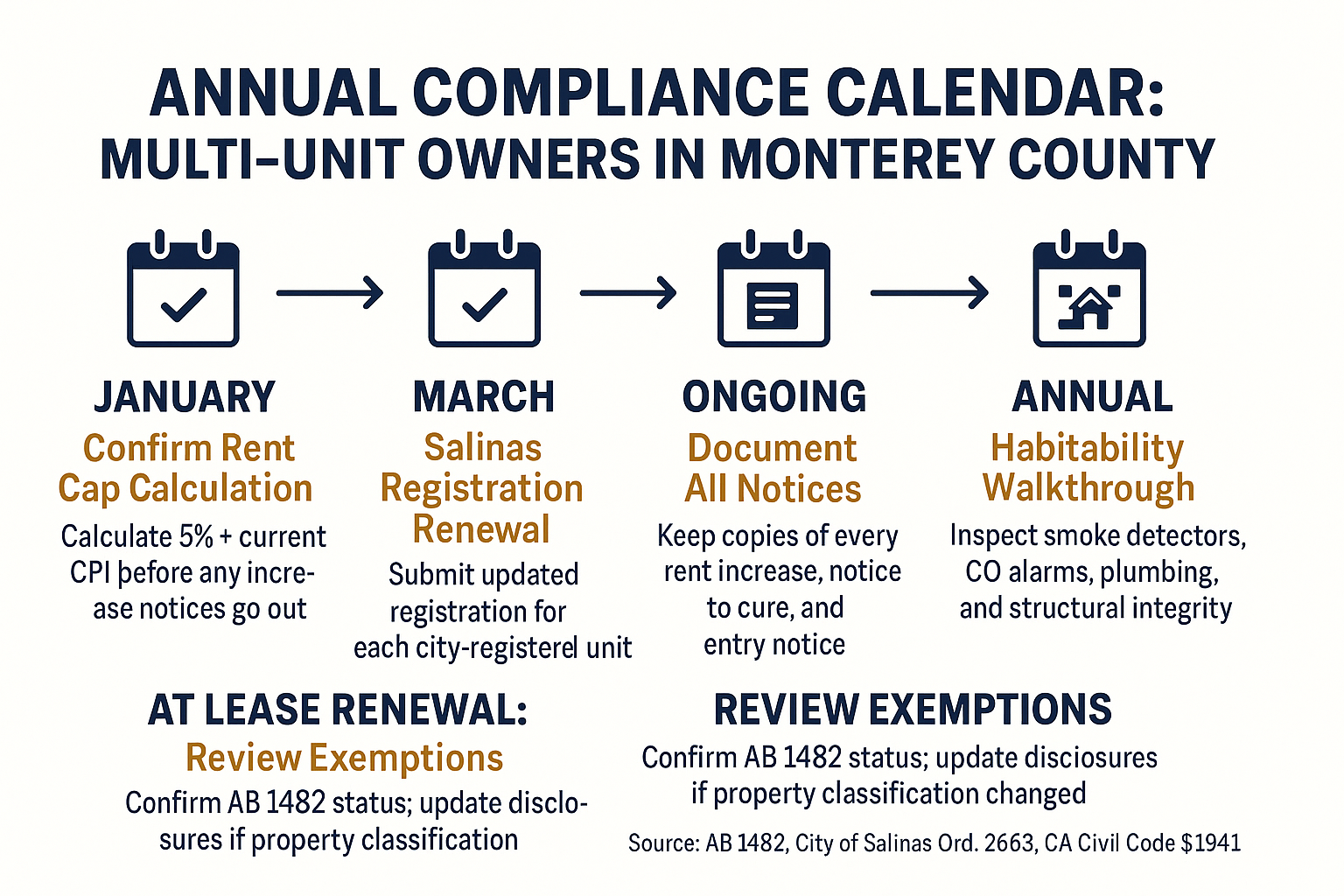
The Compliance Timeline for a Multi-Unit Building in Monterey County
This shows the recurring compliance touchpoints a multi-unit owner needs to manage across a typical year — not a one-time checklist, but an ongoing calendar of obligations.
Habitability Requirements Across Multiple Units — Where Owners Miss Things
California’s warranty of habitability under Civil Code §1941 applies to every unit you own, regardless of how long a tenant has been there or how good your relationship is with them. For multi-unit owners, the challenge is that one deferred maintenance issue in unit three doesn’t stay contained to unit three — if a tenant documents it and reports to code enforcement, it creates a record that can affect all your units.
The most commonly overlooked habitability items in Monterey County properties:
– Smoke detector placement — required in every bedroom and on every floor
– Carbon monoxide alarms — required in units with attached garages or gas appliances; the rules here are more specific than most owners realize
– Weatherproofing — particularly relevant in older Salinas homes built in the 1940s–1960s where window seals and door frames have deteriorated
– Functioning heating — California requires a heating system capable of maintaining 70°F in living areas
– Pest and rodent control — the landlord’s responsibility to address if it affects habitability
For a multi-unit building, a single annual professional walkthrough doesn’t cut it. Conditions change between units and between seasons. Owners who track inspections property-by-property and document findings in writing are in a much stronger position if a dispute ever arises. What a property manager looks for during a rental walkthrough covers the specific items that matter most.
The Record-Keeping Reality Nobody Talks About
Compliance isn’t just about knowing the rules — it’s about being able to prove you followed them. In California landlord-tenant disputes, documentation wins cases. And for multi-unit owners, the volume of records grows fast.
For each unit, you should be maintaining:
– Signed lease agreements with current addenda
– All written notices served to tenants (with proof of delivery)
– Rent increase calculation worksheets
– Maintenance request logs and repair invoices
– Move-in and move-out inspection reports with photos
– Registration records and renewal confirmations
Salinas and Monterey County courts see eviction and habitability cases regularly. A landlord who shows up with organized records — timestamped photos, signed notices, maintenance receipts — is in a fundamentally different legal position than one who can’t find paperwork from 18 months ago.
Good bookkeeping for landlords also matters here beyond taxes. Financial records that show rent payment history are often the first thing needed in an eviction proceeding. Owners managing two, three, or four units manually — often across spreadsheets or handwritten logs — are quietly accumulating risk every month they don’t have a system.
For owners who want to understand what can go wrong when eviction rules intersect with tenant disputes in Monterey County, that’s a useful place to understand the legal terrain before it becomes a problem.
Frequently Asked Questions About Multi-Unit Compliance in Monterey County
Does AB 1482 apply to every building I own in Monterey County?
Not necessarily. Single-family homes and condos are exempt if the owner has provided a written exemption notice to the tenant. Buildings constructed after January 1, 2005 are also generally exempt. But multi-unit buildings — duplexes, triplexes, apartment buildings — built before that date are almost always covered. If you’re unsure about a specific property, pull the county assessor’s construction date and compare it against your current lease disclosures.
I own a duplex in Salinas. Do both units need to be registered separately?
Yes. Under City Ordinance 2663, each residential rental unit requires its own registration — not just the property address. A duplex is two registrations.
What happens if a tenant claims my unit isn’t habitable?
Under California law, a tenant can withhold rent, repair and deduct, or sue for damages if a landlord fails to maintain habitable conditions after receiving written notice. Courts take habitability claims seriously. The owner’s best defense is always documented notice, documented response, and documented repair — ideally with dated photos and contractor invoices. If the issue wasn’t reported in writing and you didn’t know about it, that matters too, but don’t count on it being enough on its own.
Can I raise rent on a long-term tenant in a covered building by more than 5%?
Under AB 1482, the cap is 5% plus the local CPI figure, with a hard maximum of 10%. For most Monterey County owners in 2025, that puts the ceiling around 8.8%. Going above that — even accidentally — creates legal exposure. Calculate before you send any increase notice.
My units are in unincorporated Monterey County, not in the City of Salinas. Does the rental registration ordinance apply?
No. Ordinance 2663 applies only within Salinas city limits. If your properties are in unincorporated areas — Prunedale, Spreckels, parts of South County — the city ordinance doesn’t reach them. But AB 1482 and state habitability law apply everywhere in California.
How often should I inspect my multi-unit property?
California law requires 24-hour written notice before entering an occupied unit for non-emergency inspections. Most experienced property managers schedule two formal inspections per year per unit — one mid-lease and one at turnover. For older buildings in Salinas or Seaside, more frequent checks on plumbing, roofing, and heating systems are worth the time before a small issue becomes a habitability complaint.
Questions About Your Specific Properties?
Compliance questions are usually best answered with the details of your specific building in front of someone who knows Monterey County law. Coast & Valley Properties works with multi-unit owners across Salinas, Monterey, Carmel, and the surrounding communities — and we’re happy to talk through what applies to your situation. Reach us at (831) 757-1270 or through the contact form at coastandvalleypm.com.