
The Difference Between a Good Tenant and a Great One Starts Before Move-In
Direct Answer: A great tenant isn’t just someone who pays rent on time — they’re found through a consistent, thorough screening process that happens before the lease is ever signed.
Most landlords say they want a great tenant. But when you ask them how they find one, the answer is usually something like: ‘I go with my gut.’ That’s where the trouble starts.
In Monterey County, the stakes are especially high. California’s tenant protections — including AB 1482 and the City of Salinas’s Residential Rental Registration Ordinance (City Ord. 2663) — make it difficult and expensive to remove a tenant who turns out to be the wrong fit. One bad placement can cost you months of headaches, legal fees, and lost rent.
The good news is that most tenant problems are preventable. And prevention starts well before move-in day — with how you screen, what you look for, and how consistently you apply your own standards.
What ‘Good Enough’ Screening Usually Misses
A lot of landlords check the basics: credit score, employment verification, maybe a reference call. And for many rentals, that feels like enough — until it isn’t.
The problem with bare-minimum screening is that it tells you what a tenant has done financially, but not much about how they’ll treat your property or handle problems. A person can have a 720 credit score and still leave a rental in poor condition, ignore maintenance issues, or create friction with neighbors.
What gets missed most often in casual screening:
- Rental history depth — Did they pay on time, or did they frequently pay just before a late fee kicked in? There’s a difference. The grace period for rent rules in California exist for a reason, but a tenant who routinely uses every day of that window is showing you a pattern.
- Communication style — How does this person respond to follow-up questions? Are they clear and direct, or vague and slow to respond? Tenant communication during the application process often mirrors how they’ll communicate during tenancy.
- Reason for moving — A tenant leaving because a lease ended naturally is very different from one who’s been asked to leave or is fleeing a troubled rental situation.
- Consistency of income — Gross monthly income should typically be at least 2.5 to 3 times the monthly rent. But income type matters too — a freelancer with variable monthly income carries different risk than a salaried hospital worker at Community Hospital of the Monterey Peninsula.
None of these factors require special tools. They require asking better questions and actually listening to the answers.

The Screening Criteria That Actually Predict Tenancy Quality
There’s a meaningful difference between screening to avoid a bad tenant and screening to find a great one. The first approach is defensive. The second is strategic.
Great tenants tend to share a few predictable traits that show up consistently before move-in — if you know what to look for.
Stability of residence and employment
A tenant who has lived in the same place for two or more years and held the same job for a similar stretch is telling you something important: they don’t uproot easily. Frequent moves — say, three addresses in three years — may indicate financial instability, conflicts with landlords, or a lifestyle that doesn’t lend itself to long-term tenancy. In a market like Salinas or Monterey, where vacancy costs can run $1,500 to $2,500 per month in lost rent alone, tenant stability is a real financial variable.
Verifiable landlord references — not just personal ones
Personal references are nearly useless. A previous landlord reference, especially one you actually call and ask specific questions, is worth far more. Ask things like: Did they give proper notice? Would you rent to them again? Were there any maintenance issues they didn’t report promptly? The answers reveal a lot more than any form.
How they treat the property during showings
This one sounds minor, but it’s not. A prospective tenant who shows up to a showing and immediately asks about parking, storage, and what’s included is thinking about their life in the space. One who walks through looking for defects to negotiate on or asks immediately about subletting is showing you a different set of priorities. First impressions in the application process are often more accurate than landlords give them credit for.
For owners managing more than one unit, staying legally compliant across a portfolio adds another layer to why consistent screening matters — your criteria must be applied uniformly to avoid fair housing exposure.
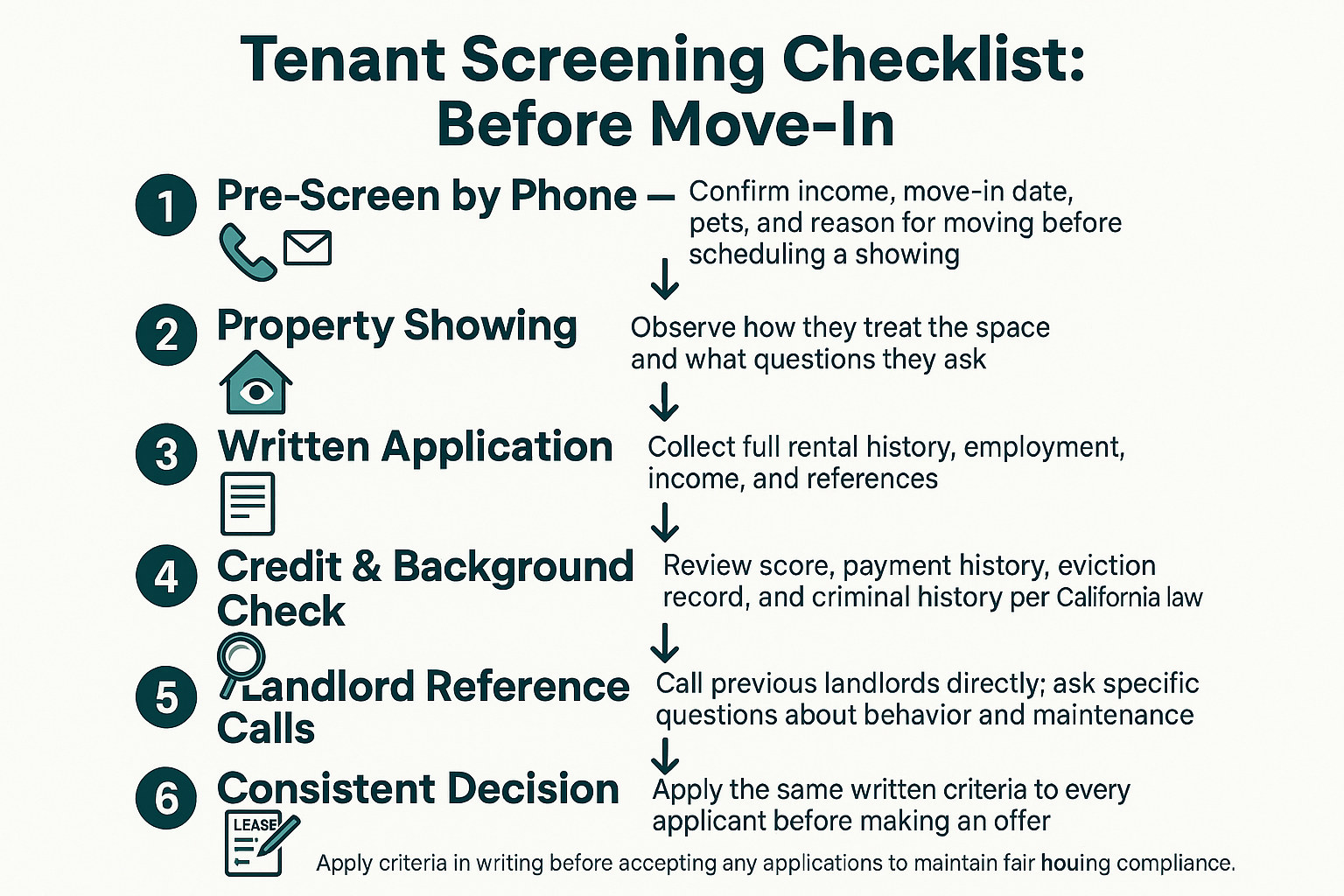
The Tenant Screening Checklist: Before Anyone Signs
This checklist walks through the key screening steps in order — from first contact to lease signing. Use it as a reference for where most landlords cut corners.
Why Consistency Matters More Than Instinct
One of the most common mistakes landlords make — especially those managing their first or second rental — is applying different standards to different applicants. Sometimes unconsciously. Someone seems more likable, or their story feels more sympathetic, and the bar quietly shifts.
Under California’s Fair Employment and Housing Act (FEHA) and federal Fair Housing Act, inconsistent screening criteria can create serious legal exposure. This is true even when the intent isn’t discriminatory. If your written criteria say one thing and your decisions show a pattern that says another, you have a problem.
The solution isn’t complicated: write down your criteria before you accept any applications. Set your minimum income threshold, your minimum credit score, your policy on past evictions, and your requirements around rental history length. Then apply those standards the same way every time, for every applicant.
This also protects you from yourself in a tight market. When a property has been vacant for six weeks and you’re fielding a marginal application, having written criteria makes it easier to hold your standard rather than fill the vacancy out of pressure. The hidden workload of managing even one rental home grows considerably when you’re also dealing with a difficult tenancy — so getting placement right the first time has real value.
And once that great tenant is in place, the relationship doesn’t run itself. Clear expectations at move-in — written lease terms, a documented property condition report, and a clear process for maintenance requests — set the tone for everything that follows.
Good Tenant vs. Great Tenant: What the Difference Looks Like
These aren’t rigid rules — they’re patterns that show up consistently when comparing tenancy outcomes over time.
| Screening Factor | Good Tenant | Great Tenant |
|---|---|---|
| Credit Score | 650–699, no major derogatory marks | 700+, clean payment history across all accounts |
| Income Verification | Meets 2.5x rent minimum | Stable employment 2+ years, meets 3x rent or more |
| Rental History | 1–2 prior landlord references | 2+ verifiable references, long lease terms, no early terminations |
| Communication | Responds within a few days during application | Responds promptly, asks clear and practical questions |
| Reason for Moving | Lease ended, relocating for work | Lease ended on good terms; prior landlord would rent to them again |
| Move-In Readiness | Ready within the week with deposit in hand | Prepared with all documentation before the showing ends |
What Happens When You Skip Steps
There’s a version of tenant screening that moves fast because the landlord is eager to fill the unit. References go unchecked. Income docs are taken at face value. The application looks fine on paper and the person seemed pleasant at the showing — so the lease gets signed.
Six months later, the rent is consistently late. There are maintenance issues the tenant didn’t report, and now there’s water damage behind a wall. Or a neighbor complaint about noise. Or an unauthorized occupant.
None of those outcomes are guaranteed by skipping steps. But they’re far more common when screening is rushed. In a market like Monterey County — where eviction proceedings can take three to six months from notice to resolution, and where AB 1482 limits removal options for covered properties — a problematic tenancy isn’t just an inconvenience. It can tie up a significant asset for the better part of a year.
The cost of a thorough upfront screening process — in time and any third-party background check fees, typically $30 to $75 per applicant — is almost always less than one month of vacancy, let alone the cost of a contested tenancy. That math is simple. The discipline to actually follow through on it, especially when a vacancy has been sitting for a while, is where most self-managing landlords struggle.
Frequently Asked Questions About Tenant Screening in Monterey County
Can I reject an applicant because of a low credit score?
Yes, as long as your written criteria establish a minimum credit score threshold that you apply equally to all applicants. Under California and federal fair housing law, the issue isn’t the standard itself — it’s inconsistent application. Set your floor before you accept applications, document it, and stick to it.
How many previous landlord references should I require?
At minimum, two verifiable previous landlord references. Personal references from friends or employers don’t tell you much about how someone lives in a rental. And ‘verifiable’ means you actually call — don’t just accept names on a form.
What income standard should I use for Salinas or Monterey rentals?
The standard most property managers use is gross monthly income of 2.5 to 3 times the monthly rent. For a $2,400/month rental in Salinas, that means looking for applicants earning at least $6,000 to $7,200/month before taxes. For a $3,500/month rental in Monterey or Pacific Grove, that threshold climbs to $8,750 to $10,500/month.
Does California law limit what I can charge for a credit or background check?
Yes. California limits screening fees to the actual cost of the background and credit check, capped at an amount adjusted annually for inflation — in 2025, that figure is approximately $65 per applicant. You cannot charge more than that, and you must provide an itemized receipt if the applicant requests one.
What’s the biggest screening mistake landlords in Monterey County make?
Skipping the landlord reference call. It’s the step that takes the most effort and gets skipped most often. A previous landlord will almost always tell you things a credit report never will — how the tenant communicated, whether they reported maintenance issues promptly, and whether they left the unit in good condition. That information changes placement decisions.
Is it worth hiring a property manager just for tenant placement?
That depends on the management company and their structure. Some firms offer placement-only services. Others require full management. Either way, a professional who screens tenants daily in the local market will often identify red flags that a first-time or occasional landlord would miss. Understanding what a property management company actually does can help you decide whether placement alone is enough or whether ongoing management makes more sense for your situation.
Looking for Help With Tenant Placement in Monterey County?
Coast & Valley Properties handles tenant screening for residential properties throughout Monterey County — from Salinas and Soledad to Carmel and Pacific Grove. If you’d like to talk through your current screening process or learn how we approach placement, reach out directly at (831) 757-1270 or through the contact form at coastandvalleypm.com.