
The Hidden Workload Behind Managing a Single Rental Home
Direct Answer: Managing a single rental home involves far more than collecting rent — it includes legal compliance, maintenance coordination, tenant communication, and financial tracking that can easily consume 10 or more hours per month.
Most property owners in Monterey County go into self-management thinking it will be manageable. One house, one tenant, one rent check a month — how complicated can it be?
The answer surprises almost everyone. The actual workload behind a single rental home spans legal compliance, maintenance calls, tenant disputes, financial recordkeeping, and a growing stack of California regulations that change whether you’re paying attention or not.
This article breaks down what that workload actually looks like in practice — not in theory — so you can decide whether you’re taking it on with eyes open.
What Landlords Actually Spend Their Time On Each Month
The visible tasks are easy to list: collecting rent, handling repair requests, maybe doing a drive-by. But the invisible tasks are what eat your time.
On a quiet month with a stable tenant, a self-managing landlord in Salinas or Monterey might spend 4 to 6 hours on routine work. That includes tracking rent, responding to tenant questions, following up on a minor maintenance issue, and keeping basic financial records.
But months are rarely quiet. One repair request escalates into two vendor calls. A tenant asks a question about their lease that requires you to actually read the lease. A late payment triggers a conversation about California’s grace period rules that you may not have memorized.
Here’s what a typical month’s workload actually looks like:
- Rent collection and late payment follow-up (1–2 hours)
- Maintenance coordination — getting bids, scheduling, confirming completion (2–4 hours)
- Tenant communication — questions, complaints, requests (1–2 hours)
- Financial tracking and receipt filing (1 hour)
- Regulatory check-ins — lease compliance, notice requirements, inspection records (30–60 minutes)
Add a turnover or a repair emergency and that number jumps to 20+ hours in a single month. For most owners, that’s a part-time job they didn’t sign up for.

The Compliance Layer Most Self-Managing Landlords Underestimate
California landlord-tenant law is not simple, and Monterey County adds its own layer on top of it.
The City of Salinas Residential Rental Registration Ordinance (City Ord. 2663, enacted 2024) requires landlords renting within city limits to register their units, pay annual fees, and pass inspections. Miss a deadline and you’re looking at fines, not just a warning.
AB 1482 — the statewide Tenant Protection Act — caps annual rent increases for many properties and requires “just cause” for most evictions. If your property qualifies, your lease language, your notices, and your rent increase timing all have to align with rules that change how you handle mid-lease situations in ways most owners don’t anticipate.
There’s also the California warranty of habitability, which obligates landlords to maintain rental units in livable condition — and the timeline for responding to certain repairs is not optional. Combine that with carbon monoxide alarm requirements and lead paint disclosure rules, and you have a compliance checklist that grows every year.
A few areas where self-managing landlords most often fall short:
- Serving legally valid notices — wrong format, wrong delivery method, or wrong timeline can void the notice entirely
- Handling security deposits — California has strict rules on deductions, documentation, and the 21-day return window
- Lease renewal language — failing to update terms when state law changes can expose you to liability
- Inspection documentation — without written records, move-in and move-out disputes are almost impossible to win
None of this is obscure law. It’s the standard operating environment for any Monterey County landlord, and staying current with it takes consistent attention.
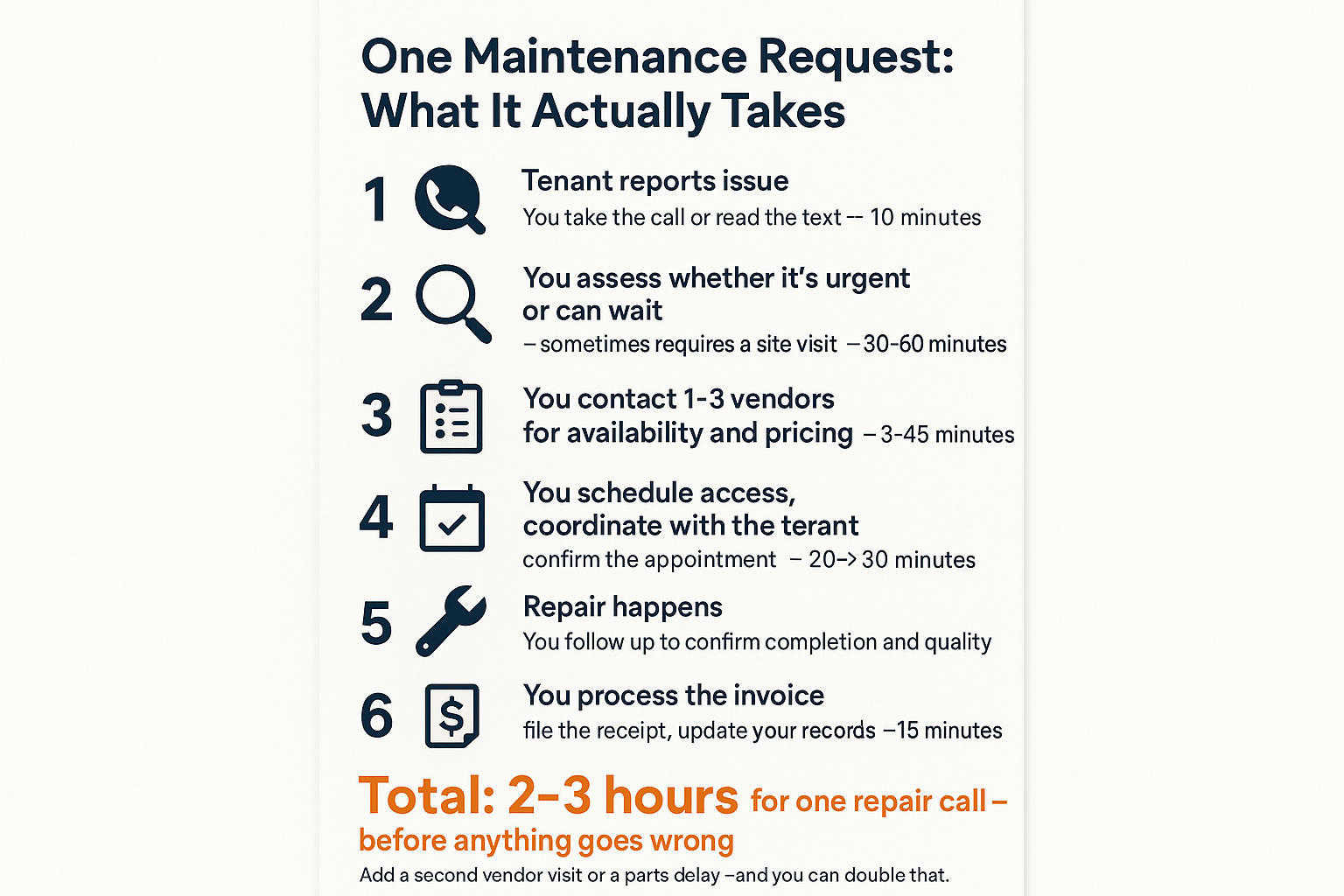
How a Single Maintenance Call Turns Into a Half-Day Project
A tenant reports a leaking water heater. Here’s what actually happens between that call and resolution — and where most of the landlord’s time goes.
Tenant Turnover: The Month That Costs You the Most
Nothing exposes the full weight of self-management like a tenant moving out.
A turnover in Monterey County — even for a single-family home — typically takes 3 to 6 weeks from move-out to a new tenant moving in. During that window, you’re paying the mortgage without rental income while also managing a long list of tasks.
Here’s what a turnover actually involves:
- Move-out inspection with written documentation and photos
- Security deposit accounting — itemized within 21 days under California law
- Cleaning and paint touch-up — expect $300–$700 for a standard Salinas-area home
- Any deferred maintenance repairs that were invisible with a tenant in place
- Photography and listing across rental platforms
- Showings — often 6 to 12 before a qualified applicant applies
- Tenant screening — credit check, background check, rental history verification, income verification
- Lease preparation and signing
If you’re managing your own property and you haven’t done a turnover before, budget at least 30 to 40 hours of your own time for that cycle. That’s on top of the one-to-two months of lost rent while the unit sits vacant.
A poorly screened tenant who turns over again in 8 months costs far more than any management fee would have.
Monthly Time Estimate: Self-Managing One Rental Home
These are real-world estimates for a single-family rental in Monterey County — not best-case scenarios.
| Task | Quiet Month | Active Month (repair or dispute) |
|---|---|---|
| Rent collection & follow-up | 1–2 hrs | 2–4 hrs |
| Maintenance coordination | 1–2 hrs | 4–8 hrs |
| Tenant communication | 1 hr | 3–5 hrs |
| Financial recordkeeping | 1 hr | 1–2 hrs |
| Compliance & legal review | 30 min | 2–4 hrs |
| Total estimated time | 4–6 hrs | 12–23 hrs |
The Financial Recordkeeping Nobody Talks About
Running a rental property means running a small business — and the IRS expects you to treat it that way.
Every repair receipt, every mortgage statement, every mile driven to your property for management purposes is potentially deductible. But only if you tracked it. Most self-managing landlords keep records inconsistently, and that costs them real money at tax time.
California also adds complexity. If you own property in Salinas or elsewhere in Monterey County and have an LLC or trust involved, the recordkeeping requirements go up another level. Bookkeeping for rental properties isn’t complicated in concept, but it requires discipline that’s easy to let slip when you’re already juggling maintenance calls and tenant texts.
The practical minimum for clean records on a single rental home:
- A dedicated bank account for rental income and expenses
- Monthly reconciliation of all income and expenses
- Receipts filed within 30 days of the transaction
- A mileage log if you’re driving to the property for management tasks
- Year-end 1099 preparation for any vendor paid more than $600 in the year
If you’re not doing all of this already, you’re either leaving deductions on the table or setting yourself up for a messy tax season.
Frequently Asked Questions About Managing a Rental Home in Monterey County
How many hours per week does it really take to manage one rental home?
On a calm month, most Monterey County landlords spend 1 to 2 hours per week on a single home. But that average hides the spikes. A repair emergency, a late-paying tenant, or a lease renewal can push one week to 8 or 10 hours without warning. The workload isn’t steady — it clusters.
Do I have to register my rental with the City of Salinas?
Yes, if the property is within Salinas city limits. City Ordinance 2663, enacted in 2024, requires landlords to register rental units, pay annual fees, and comply with inspection requirements. Penalties for non-compliance are real. Check the City of Salinas website or consult a local property manager for current deadlines and fee amounts.
What happens if I don’t return a security deposit on time?
California law gives landlords 21 calendar days after move-out to return the deposit with an itemized statement. Miss that window and you can forfeit your right to make deductions — and expose yourself to a small claims lawsuit for up to twice the deposit amount if a court finds bad faith.
Can I manage my rental myself if I live out of the area?
Technically yes, but the practical challenges multiply fast. Coordinating vendors, conducting inspections, responding to emergencies, and serving legally valid notices from a distance is workable in theory and exhausting in practice. Out-of-state owners who self-manage typically find that one emergency makes the math on professional management look very different.
What’s the biggest mistake first-time landlords make in Monterey County?
Underestimating tenant screening. A qualified tenant who pays on time and stays for two or three years is worth far more than a slightly higher rent from someone who doesn’t. California’s eviction process is slow and expensive — a disputed eviction in Monterey County can take four to six months and cost $3,000 to $7,000 in legal fees. Screening is where you protect yourself before a problem starts.
Want a Clear Picture of What Professional Management Actually Covers?
If this article made the workload feel bigger than you expected, that’s because it is — especially in a market as regulated as Monterey County. Coast & Valley Properties works with property owners across Salinas, Monterey, Carmel, and the surrounding area who want the income without the time burden. Reach out at (831) 757-1270 or through the contact form at coastandvalleypm.com to have a straightforward conversation about what full-service management looks like for your specific property.