Renting Out a Carmel Home You Still Use Part of the Year
Direct Answer: A long term lease gives a tenant exclusive use for the full term. The real question is not how to split the year, but whether you can hand over the key for twelve months.
Most owners who call me about a Carmel house are not leaving. They still come back for a few weeks in the summer, or a month around the holidays, and they want the other part of the year to carry itself.
That is a very different situation from the owner who is moving away for good and handing over an empty house. And it runs straight into one hard fact about a long term lease: the tenant gets exclusive possession of the home for the whole term. You are not renting out ten months and keeping two.
So the real question is not how to split the calendar. It is whether you are willing to give up the key for twelve months. Below I walk through that decision, the furnished versus unfurnished question every part-time owner asks, and the things about Carmel homes that catch owners off guard.
The Real Question Behind Renting Out a Second Home in Carmel
One note on scope before anything else. Everything here is about long term leasing. Short stay hosting runs by an entirely different set of rules, and it is not something we take on.
When a tenant signs a twelve month lease, that home is their home. You cannot drop in for a week in August, and you cannot store your visits into the agreement and expect it to hold up in practice. Even when a tenant agrees to it verbally, the arrangement tends to sour by month four.
So owners in this spot usually land on one of three paths:
- Lease the full year and stay somewhere else on the Peninsula during visits, treating the rent as what pays for that
- Keep the house for yourself and accept the full carrying cost of an idle property
- Look at a company held lease, where an employer signs the paper for relocating staff, which sometimes fits owners who want a cleaner, more predictable counterparty. I wrote more about that in leasing a Monterey home to a company for employee housing
The owners who do best are the ones who make this call up front instead of hoping a tenant will be flexible later.
Furnished or Unfurnished: The Question Every Part-Time Owner Asks
This comes up in almost every inquiry from a part-time owner. One owner asked us plainly what her home would rent for unfurnished, and then what it would rent for furnished. It is the right question, and the answer is rarely a simple number.
Furnished can help in certain pockets of the Peninsula. Relocating professionals, visiting physicians, and people arriving mid-career without a moving truck all shop furnished first, and that can shorten vacancy.
Furnished also costs you in ways that do not show up in the monthly figure:
- Turnovers take longer, because every item has to be checked, cleaned, and accounted for
- Move-out accounting gets messy, since the deposit now has to cover a sofa and a dining set, not just the walls
- Your belongings are inside the risk equation instead of safely out of it
- Some strong long term tenants skip furnished listings entirely because they own their own things
As for what your home would actually bring either way, I will not guess at that from a desk. Rent on a Carmel property depends on the block, the light, the parking, the condition of the kitchen, and what has leased nearby in the last sixty days. I explain that in more detail in how rent gets set on a Monterey County rental. A walkthrough gives you a real range. An online estimate gives you a rounded number that ignores half the house.
Furnished vs Unfurnished for a Part-Time Carmel Home
Here is how the two options tend to compare for owners who still use the property part of the year.
| Consideration | Unfurnished | Furnished |
|---|---|---|
| Typical tenant | Local families and long stay renters | Relocating professionals, contract and academic tenants |
| Vacancy time | Steadier, broader pool | Can be shorter in the right pocket, thinner pool overall |
| Turnover work | Clean, paint, touch up | Clean plus a full inventory check on every item |
| Move-out accounting | Deposit covers the building | Deposit has to cover furniture, linens, and dishes too |
| Owner risk exposure | The structure and finishes | The structure plus everything you left inside |
| Owner storage needed | Larger, since almost everything leaves | Smaller, but the valuables still have to go |
Personal Property Is the Sleeper Issue
This is the part part-time owners underestimate. A house you still use is full of your life: art, family furniture, a wine collection, the sideboard your grandmother left you.
Every one of those items needs a decision before a tenant walks in. There are only three good answers for each thing:
- Remove it and store it off site
- Insure it specifically, in writing, at a value you would actually accept
- Secure it in a locked owner storage area that is written into the lease as off limits
That last one is the piece owners skip. If you want a locked closet, a locked garage bay, or a sealed storage room, it has to be named in the lease with clear terms about access. A verbal understanding is not a term.
Then photograph everything before move-in. Not a quick phone sweep, but a real item by item record with condition notes. The owners who argue about a scratched sideboard eighteen months later are almost always the ones who never built that inventory.
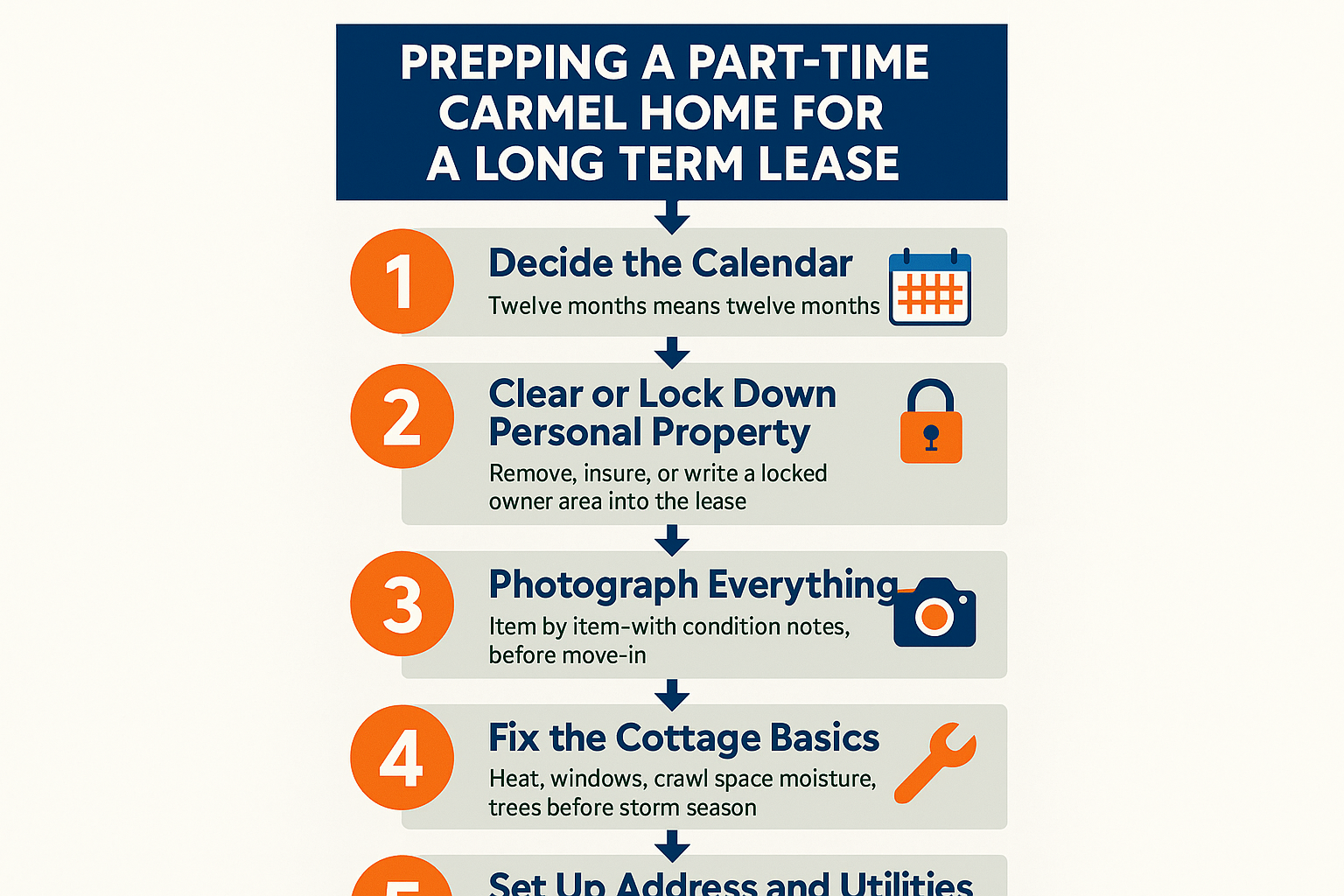
Prepping a Part-Time Carmel Home for a Long Term Lease
Five steps I walk owners through before we ever list a home they still use part of the year.
What Makes a Carmel Home Different From Anything Else in the County
Carmel-by-the-Sea has practical wrinkles no other town around here has. Many homes are identified by cross streets and house names rather than numbered addresses, and there is no mail delivery to the door.
For an owner who has known the system for thirty years, that is charming. For a tenant arriving from out of the area, it is a series of small failures: a listing that maps to the wrong block, a furniture delivery that cannot find the house, a utility account that will not accept the address format, mail that never arrives.
Someone has to walk the tenant through all of it in the first week. If you are not local that month, that someone is not you.
The housing stock adds its own list. Older cottages here commonly bring:
- Single pane windows that leak heat and collect condensation in a damp winter
- Quirky heating, from wall units to floor furnaces to a fireplace doing more work than it should
- Crawl space moisture that goes unnoticed in a house nobody visits between owner stays
- Mature trees, oaks and cypress, that need limb work before the first real storm rolls through, not after
That pre-storm tree work is worth putting on the calendar every fall. The National Weather Service is a reasonable place to watch the pattern, but the honest version is that anyone who has owned here through a wet winter already knows what a saturated root ball does to a shallow rooted cypress.
An Empty House Is Not the Safe Option
Owners sometimes tell me the low risk choice is to just leave it empty between visits. In my experience that is backwards.
A vacant home has nobody to notice the slow supply line leak, the raccoon in the crawl space, or the pilot light that went out in November. By the time you arrive in March, a small problem has had four months to grow.
Insurance treats it differently too. Many policies handle a home that sits unoccupied for an extended stretch under different terms than an occupied one, and coverage can narrow in ways owners do not discover until they file. Worth a direct conversation with your carrier, and the California Department of Insurance has consumer guidance if you want a neutral starting point.
A good long term tenant is often the least expensive form of monitoring you can put on a Carmel house. Someone is in it every day, running water through the pipes, noticing the ceiling stain, and calling it in.
The tradeoff, of course, is that a tenant creates work. That workload is real and steady, and I broke it down in the hidden workload behind managing a single rental home. It is the same reason many Peninsula owners eventually stop self-managing, something I also covered in renting out a home in Pacific Grove.
Frequently Asked Questions About Renting Out a Carmel Second Home
Can I write a few weeks a year for myself into the lease?
In practice, no. A long term lease gives the tenant exclusive possession for the term, and carving out owner stays creates conflict fast. If you need the house on a set schedule, long term leasing is probably not the right fit for that year.
Should I rent my Carmel home furnished?
It depends on your tolerance for turnover and for risk to your own belongings. Furnished can widen the pool of relocating professionals and shorten vacancy in some pockets, but it makes every move-out an inventory exercise. If you own pieces you would be upset to lose, unfurnished is usually the calmer path.
What should I do with my art and family furniture?
Remove it, insure it at a real value, or secure it in a locked owner area that is named in the lease. Then photograph the inventory with condition notes before anyone moves in. The photos are what settle disagreements later.
How much rent will my Carmel home bring?
I will not put a number on that without seeing the property. Block, light, parking, condition, and recent comparable leases all move the figure, and furnished versus unfurnished moves it again. An in person walkthrough produces a range you can actually plan around.
Will the address format cause problems for my tenant?
It can, and it is worth getting ahead of. Deliveries, utility setup, and mail all need to be sorted in the first week for a tenant who is new to how Carmel addresses work. Somebody local should be walking them through it.
Thinking Through a Carmel Home You Still Use?
If you own a home in Carmel, Pebble Beach, or elsewhere on the Peninsula and you are weighing whether a long term lease fits around your own use of the property, a walkthrough answers more than any online tool will. Coast & Valley Properties has worked with part-time owners across Monterey County since 2009, and we are glad to talk it through at (831) 757-1270 or through the contact form at coastandvalleypm.com.