New emergency rent cap now applies to leases longer than one year
Direct Answer: SB 1365 removes the exemption for leases longer than one year, so California’s 10 percent post-emergency price gouging limit applies to rental housing regardless of lease length starting January 1, 2027.
If you own a rental on the Peninsula and your tenant sits on a two or three year lease, you have probably been told that California’s emergency price gouging rules did not reach you. That stops being true soon.
On September 30, 2026, Governor Newsom signed SB 1365, which brings rental housing under the state’s price-gouging law regardless of the initial lease term. The change takes effect January 1, 2027.
I work with owners in Carmel, Pacific Grove, Monterey, and Pebble Beach who hold long leases on purpose, and most of them have no idea this is coming. Below is what actually changed, why it lands harder in Monterey County than in most of the state, and what I would line up before the new year.
What the SB 1365 price gouging rent cap actually changes for long term leases
SB 1365, authored by Sen. Ben Allen, D-Santa Monica, amends Penal Code Section 396. That is California’s price-gouging statute, and the part owners care about is the 10 percent limit that kicks in after a declared emergency.
Until now, rental housing with an initial lease term longer than one year sat outside that limit. SB 1365 removes that exemption. The Governor’s office announced the signing on September 30, the last day he could sign or veto bills that year, and the California Apartment Association flagged it for owners the next morning.
Stripped down, here is what shifts:
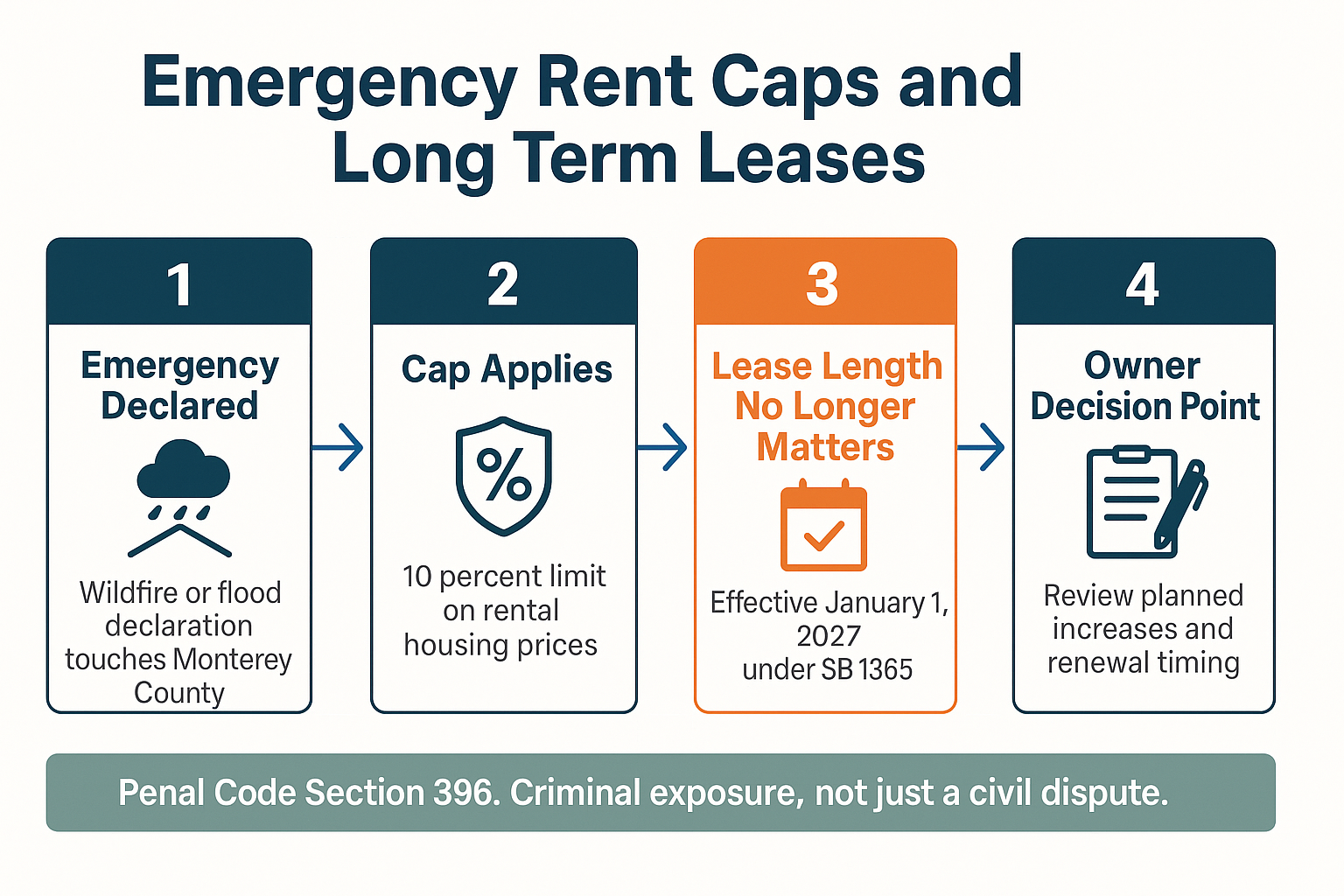
- The 10 percent post-emergency cap applies to rental housing no matter how long the initial lease term is
- A multi-year residential lease no longer sits outside the rule the way it used to
- The effective date is January 1, 2027, so this is a 2027 planning problem, not a 2026 one
- Because this lives in the Penal Code, we are talking about criminal exposure, not only a civil dispute with a tenant
That last point is the one I keep repeating to owners. Most rent rules in California get sorted out in civil court or at a hearing. This one is a crime statute, and the standard does not care whether you meant any harm.
Why this lands harder on Monterey County owners
Declared emergencies are not rare here. Between wildfire seasons in Big Sur and the hills above Carmel Valley and the atmospheric river flooding that hits the Salinas Valley and the Pajaro area, Monterey County spends a meaningful share of most years under one declaration or another.
That matters because the cap is triggered by the declaration, not by your intentions. An owner in Pebble Beach who scheduled a rent adjustment eight months ago can find that adjustment landing three weeks into a flood declaration.
The second piece is demand. After a storm event, our office hears from displaced residents almost immediately. One visitor asked whether we had anything available for three to four months while their flooded house was being remodeled, and that kind of request shows up in clusters after a bad week of rain.
That demand spike is exactly what the statute is designed to catch. Prices climb because supply vanishes, and the law treats a large jump during that window as gouging whether or not the market would have supported it.
Third, long leases are common on the Peninsula. Owners renting out a Carmel home they still use part of the year often write a longer term on purpose, to cut turnover and keep a steady, screened household in the house. Those are precisely the leases that lose the exemption.
Before and after January 1, 2027
A simplified look at how the change reads for three common Monterey County situations. This is general context, not legal advice on your specific lease.
| Lease situation | Treatment before Jan 1, 2027 | Treatment starting Jan 1, 2027 |
|---|---|---|
| Standard 12 month residential lease | Already covered by the 10 percent post-emergency limit | No change, still covered |
| Initial term of 18 months, 2 years, or longer | Sat outside the price-gouging limit because of the lease-length exemption | Covered. The 10 percent limit applies regardless of initial lease term |
| Month to month after a long initial term | Analysis depended on the initial term | Rental housing is covered regardless of initial lease term |
How the post-emergency window works
A quick visual on the sequence owners need to understand, from declaration to rent decision.
What I would line up before January 1, 2027
None of this requires a panic. It requires records and timing, which is most of property management anyway.
Here is the short list I am working through with owners right now:
- Document your baseline rent in writing for every unit. The 10 percent figure is generally measured against what was being charged just before a declaration, so you want a clean, dated record rather than a memory.
- Pull the initial term on every lease you hold. If you own a small portfolio, you probably have a mix, and the long-term ones are the ones whose status changes.
- Map renewal and increase dates against the calendar. Our rainy season and our fire season are both predictable windows. A renewal that lands in the middle of one deserves a second look.
- Keep your cost documentation organized. The statute has narrow exceptions, they are fact-specific, and they are only useful to an owner who can produce records. Ask your attorney before relying on one.
- Decide who is watching for declarations. Somebody has to know a declaration happened before a rent notice goes out.
If you set rent by pulling a number off a listing site, this is a good moment to change that habit. How rent actually gets set on a Monterey County rental matters more when the number you pick carries criminal exposure attached to it.
The owners most exposed are the ones furthest away
In my experience, the highest risk sits with two groups. The first is the out-of-area owner who inherited a Peninsula property and manages it from Sacramento or Scottsdale. The second is the owner who self-manages one or two long-term tenancies and handles the rent increase with a letter once a year.
Neither group is tracking county emergency declarations. Both send notices on a schedule.
It is also a busy stretch for California rental law generally. Between this change and the other items in what the new California landlord laws mean for Monterey County owners, plus local measures that Salinas voters have been weighing in on, the rules governing a single Peninsula rental have moved more in the last two years than in the prior ten.
Staying current with rules that keep shifting is a real part of the job. That is just as true for a four-unit building in Monterey as it is for a Pebble Beach estate on a multi-year lease, though the dollar consequence of a mistake is very different.
Frequently Asked Questions About the SB 1365 Emergency Rent Cap
My tenant signed a three year lease in 2025. Does this reach me?
The change takes effect January 1, 2027 and brings rental housing under the price-gouging law regardless of the initial lease term. How it interacts with a lease you already have in place is a question for your attorney, because it depends on your specific document and what you are proposing to do.
What counts as a declared emergency?
The cap is triggered by an official emergency proclamation that covers the area. In Monterey County that has historically meant wildfire and flood declarations, which is why owners here run into this more often than owners in parts of the state that rarely see one.
Is the 10 percent measured against market rent or against my current rent?
Generally it is measured against what was being charged just before the declaration, not against what a comparable unit down the street is getting. That is why a dated, documented baseline rent matters so much.
Does this apply to commercial property?
SB 1365 is specifically about bringing rental housing under the price-gouging law regardless of initial lease term. Commercial space is a separate analysis, and if you hold commercial leases in Monterey County you should raise it directly with counsel rather than assuming either way.
What actually happens if an owner gets this wrong?
Because the rule lives in the Penal Code, the exposure is criminal rather than purely civil. That is the single biggest reason I would not treat this as a wait-and-see item.
Thinking through how this affects your Peninsula rental?
If you own long-leased property in Pacific Grove, Monterey, Pebble Beach, or Carmel and you want a second set of eyes on your lease terms and renewal calendar before January 1, 2027, we are glad to talk it through. Coast & Valley Properties has been working with Monterey County owners since 2009, and a conversation costs you nothing but the time. You can reach our office at (831) 757-1270 or through the contact form at coastandvalleypm.com.