What New California Landlord Laws Mean for Monterey County Owners in 2026
Direct Answer: Several new California landlord laws took effect January 1, 2026, covering appliance requirements, security deposit returns, bundled service billing, and lease disclosures — all of which directly affect Monterey County rental property owners.
Every January, California adds new requirements to an already complicated landlord-tenant framework. But January 1, 2026 brought a batch of changes that I think are genuinely consequential — not the kind you can set aside to review later. Four new laws hit simultaneously, and the owners most likely to get caught off guard are the ones who haven’t touched their lease templates, their deposit processes, or their billing arrangements in a year or two.
I work with property owners across Monterey County every day — from Salinas and Gonzales to Carmel and Pacific Grove. And the pattern I keep seeing is that owners assume compliance is static. They got it right once, so they’re still fine. That assumption is what turns a minor oversight into a real legal exposure.
This article walks through the four changes that matter most to residential landlords in our market, and explains exactly what you need to review now — before a lease renewal, a new tenant, or a move-out creates a problem you can’t undo.
AB 628: Working Stoves and Refrigerators Are Now a Legal Requirement
This one surprised a lot of owners I’ve spoken with, because the question of who provides appliances has always been treated as a matter of lease negotiation — not law. AB 628, effective January 1, 2026, changes that for most residential rentals.
Landlords are now required to provide a working stove and refrigerator in most residential rental units. For existing month-to-month tenants, the law may not automatically apply until there’s a change in lease terms. But any new lease or renewal signed after January 1, 2026 triggers the requirement — full stop.
Where this gets complicated is with older properties. I’ve seen Salinas owners with units built in the 1960s and 70s where the understanding has always been that tenants bring their own appliances. That arrangement doesn’t work for a new tenancy under this law. If the unit doesn’t have a landlord-provided stove and refrigerator, you need to either supply them or get clear legal advice about your specific situation before signing a lease.
The cost of adding appliances isn’t enormous, but the cost of a habitability dispute — especially under California’s warranty of habitability — can be. What happens to your rental when California law changes mid-lease is exactly the kind of question this law raises for owners who didn’t see it coming.
AB 1414: The Bundled Internet Billing Trap
Over the past few years, some landlords — especially in multi-unit properties — started adding bulk internet or cable service packages to their leases and passing the cost through to tenants as part of monthly billing. It simplified vendor management and gave the building a competitive edge in the rental market. I get why it caught on.
AB 1414 makes that arrangement legally risky for any tenancy that is month-to-month or that renews on or after January 1, 2026. The law requires landlords to give tenants the option to opt out of bundled subscription service charges — things like internet or cable that are billed through the landlord.
And here’s the part that really matters: if a tenant opts out and the landlord continues charging anyway, the tenant can legally deduct those costs from their rent. That’s not a gray area — it’s a defined remedy under the statute.
If you have a bulk internet arrangement at a Salinas fourplex or a Monterey multi-family property, you need to review whether your current lease and billing setup accounts for this. Many owners added these packages without any opt-out language because none was required at the time. That lease language has a shelf life now, and it expired.
AB 414: Security Deposit Returns Just Got More Complicated
California already had strict rules around security deposit accounting — 21-day return deadline, itemized statements, documentation of deductions. AB 414 adds a new layer: if a deposit was paid electronically, landlords are now generally required to offer electronic return of that deposit.
I want to frame this as what it really is: a documentation and process issue. If your deposit accounting still runs on paper checks and handwritten statements, you’re not just behind on technology — you may be out of compliance.
The practical risk shows up at move-out, which is the worst possible time to discover a process problem. Tenants who paid digitally and receive a paper check may have grounds to dispute the handling. Combine that with any weakness in your itemized statement — missing photos, vague descriptions, undocumented deductions — and a routine move-out can turn into a dispute that costs far more than the deposit itself.
Owners who want to understand what good move-out documentation actually looks like should read what Salinas property owners get wrong about self-managing. Deposit disputes are one of the most consistent pain points I see, and almost all of them trace back to process gaps that were entirely preventable.
Four Laws, Four Action Items: Your 2026 Compliance Checklist
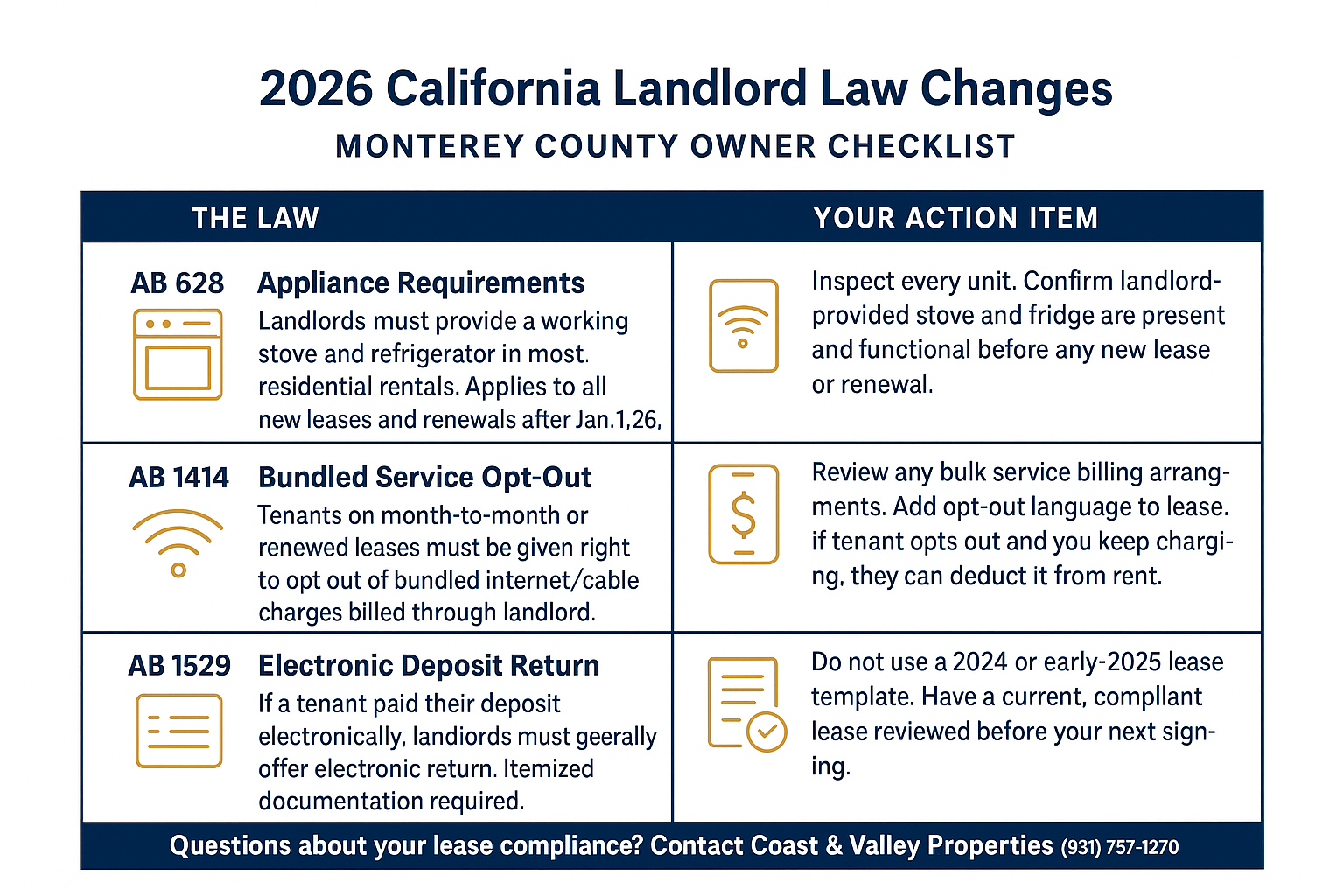
Here’s a quick reference showing what each new law requires and what Monterey County owners should do right now.
AB 1529: Your Lease Template Probably Has an Expiration Date
This one is the easiest to overlook and, in my experience, the most common compliance mistake I see Monterey County owners make.
AB 1529 allows landlords to embed AB 1482 Tenant Protection Act disclosures directly within the lease body rather than attaching them as a separate addendum. On the surface, that sounds like a convenience — one less document to track.
The trap is this: that flexibility only works if your lease template actually contains the updated 2026 disclosure language. A lease form from 2024 — or even early 2025 — likely doesn’t. If you’re using last year’s template, you may think you’re covered because you’ve always included the AB 1482 addendum, but the embedded language required under the new provision may be missing or out of date.
Lease templates have a shelf life. If you downloaded one from a legal forms site two years ago, printed a stack, and have been reusing it, that stack is now a liability. Every lease signing is an opportunity to get this right — or wrong. And wrong in California landlord-tenant law rarely comes with a warning before it comes with a consequence.
For owners managing multiple units in Salinas, where local rent ordinances are actively evolving, this is doubly important. AB 1482 rent caps and local ordinance compliance have to coexist in your lease documents, and keeping both current requires more than an annual glance at your paperwork.
How the Rules Stack Up Across Monterey County Markets
One of the most common misconceptions I hear from owners is that there’s one set of rules for all their properties. There isn’t. The table below shows how the regulatory picture differs across the markets we work in.
| Market | AB 1482 Rent Cap Applies? | Local Rental Ordinance | Key Complexity |
|---|---|---|---|
| Salinas | Yes (where applicable) | City Ord. 2663 — Residential Rental Registration (2024) | Must register rentals AND comply with state rent cap; ballot measures active |
| Monterey | Yes (where applicable) | No citywide rent control ordinance currently | State AB 1482 is primary framework; verify property-by-property |
| Carmel | Yes (where applicable) | Limited local rental regulations | Smaller rental market; individual property review essential |
| Pacific Grove | Yes (where applicable) | No current rent control ordinance | AB 1482 applies; city rules differ from Salinas |
| Unincorporated County | Yes (where applicable) | Monterey County STR Ordinance (Oct. 2024) — long-term rules separate | County vs. city jurisdiction must be determined per property |
Why the ‘One Set of Rules’ Assumption Causes Most Compliance Problems
The layering of city, county, and state regulations is what makes property management in Monterey County genuinely complex — more so than most California markets. A rule that applies in Salinas may not apply in Pacific Grove. An exemption that covers one property type may not cover another unit in the same portfolio.
I’ve talked with owners who manage properties in both Salinas and the unincorporated county, and they’re often surprised to learn that their compliance obligations aren’t identical across those properties — even when the properties look similar on paper. How multi-unit owners in Monterey County stay legally compliant gets into this in more detail, but the short version is: you cannot apply a single template to a geographically diverse portfolio and assume you’re covered.
And that’s before you layer in the four new 2026 state laws on top of existing AB 1482 rent cap rules, Salinas’s rental registration ordinance (City Ord. 2663, passed in 2024), and the Monterey County Short-Term Rental Ordinance that took effect in October 2024.
The owners who stay out of trouble are the ones who treat compliance as a living process — not a one-time setup.
Frequently Asked Questions About California Landlord Laws in Monterey County
Do these new 2026 laws apply to my existing tenants, or only new ones?
It depends on the law. AB 628 (appliance requirements) and AB 1414 (bundled service opt-outs) generally apply to month-to-month tenancies and any lease that renews on or after January 1, 2026. They don’t automatically rewrite a fixed-term lease mid-term in most cases, but once that lease ends or converts to month-to-month, the requirement kicks in. AB 414 (deposit returns) and AB 1529 (lease disclosure language) apply going forward with any new or renewed lease. When in doubt, have your current lease reviewed against the 2026 requirements before the next renewal date.
My lease template is from 2024 — is it really that outdated?
For AB 1529 purposes, yes — it likely is. The 2026 embedded disclosure language for AB 1482 compliance is updated, and a 2024 form almost certainly doesn’t include it. Using an outdated template isn’t just a technicality; it can affect your legal standing if a tenant challenges the disclosure. This is one of the most preventable compliance errors I see, and it’s worth a legal review before your next signing.
What exactly is the AB 1482 Tenant Protection Act, and does it apply to my property?
AB 1482 is California’s statewide rent cap and just-cause eviction law, in effect since 2020. It limits annual rent increases to 5% plus local CPI (up to 10% total) for covered properties and requires landlords to have a qualifying reason before terminating a tenancy. However, it has significant exemptions — single-family homes where the owner has provided proper notice, certain condos, and properties built within the last 15 years are often exempt. Whether your specific property is covered depends on property type, age, ownership structure, and local ordinance overlap. This is not a question to guess at.
I include internet in my rent — do I need to change my lease right now?
If you have tenants on month-to-month agreements, or if any leases renew after January 1, 2026, then yes — AB 1414 requires you to offer an opt-out from those bundled charges. If you don’t update your lease and a tenant opts out but you keep charging them, they can legally deduct the amount from rent. Updating your lease language before the next renewal is far simpler than unwinding a billing dispute after the fact.
Is the Salinas rental registration ordinance different from what AB 1482 requires?
Yes. City Ord. 2663 — Salinas’s Residential Rental Registration Ordinance, passed in 2024 — is a separate local requirement that applies on top of state law. It requires landlords with covered properties in Salinas to register those units with the city. AB 1482 is a statewide rent cap and just-cause eviction framework. Both can apply to the same property simultaneously. Owners with Salinas rentals need to be aware of both layers — and those rules are still evolving. Salinas’s rent ordinances are heading to voters in 2026, so this is a moving target worth watching closely.
How do I know if my deposit accounting process is compliant with AB 414?
Start by answering one question: did your tenant pay their deposit electronically? If yes, you now need to be able to return it electronically and document the return. Beyond that, your itemized move-out statement needs to be detailed, timestamped, and supported by photos or receipts. If you’re still doing deposit accounting on paper with handwritten notes, that process is a liability waiting to surface. The time to fix it is before a tenant moves out — not during a dispute.
Questions About How These Laws Affect Your Monterey County Properties?
We work with property owners throughout Monterey County — from Salinas and Gonzales to Carmel and Pacific Grove — and staying current on California landlord law is a core part of what we do. If you’re not sure whether your leases, deposit processes, or billing arrangements are aligned with the 2026 requirements, Coast & Valley Properties is a good place to start. You can reach us directly at (831) 757-1270 or through the contact form at coastandvalleypm.com.