
What Salinas Property Owners Get Wrong About Self-Managing
Direct Answer: Most Salinas property owners who self-manage underestimate California’s legal requirements and the real time cost of managing tenants, repairs, and compliance on their own.
A lot of Salinas property owners look at professional management fees and decide they can handle it themselves. On paper, it seems straightforward — collect rent, fix what breaks, find a new tenant when one leaves. But the owners who call us after a year or two of self-managing almost always say the same thing: they didn’t know what they didn’t know.
Monterey County’s rental market carries some of the most complex landlord obligations in California. The City of Salinas passed Ordinance 2663 in 2024, which requires residential rental registration and adds a layer of compliance that many owners still aren’t aware of. That’s before you get into state-level rules under AB 1482, security deposit changes under SB 567, and the warranty of habitability requirements that apply to every rental in the state.
This article covers the two areas where self-managing landlords in this market tend to get hurt the most — not to scare anyone, but because understanding the real risks is the only way to make a sound decision about how to manage your property.
The Legal Exposure Self-Managing Landlords Don’t See Coming
California is one of the most tenant-protective states in the country. That’s not an opinion — it’s reflected in the volume of landlord-tenant legislation that passes in Sacramento every year. For a property owner in Salinas or Monterey, that means the rules governing your rental can change while a tenant is already living in the property.
Most self-managing landlords find out about new requirements after something has already gone wrong. A notice served in the wrong format. A security deposit held too long. A lease clause that’s no longer enforceable. Each of those mistakes can expose an owner to legal liability that far exceeds whatever they saved by not hiring a manager.
Some of the compliance areas that trip up Salinas owners most often:
- AB 1482 rent increase caps — most owners in Salinas are covered, and violating the cap (even unintentionally) can trigger tenant claims
- City of Salinas Ordinance 2663 — the 2024 rental registration requirement that many owners haven’t completed
- SB 567 security deposit rules — as of 2024, deposits are capped at one month’s rent for most residential rentals, with limited exceptions
- Just cause eviction requirements — Salinas tenants who have lived in a property for 12 months or more are protected, meaning many common termination scenarios require documented cause
- Lead paint disclosure requirements — mandatory for any home built before 1978, with specific language required in the lease
If you want to understand how these rules interact across a multi-unit portfolio, how multi-unit owners in Monterey County stay legally compliant breaks down the compliance picture in real detail. And if a law changes while your tenant is already in place, what happens to your rental when California law changes mid-lease explains exactly what you’re responsible for.

The Time Cost That Never Shows Up in the Math
When property owners calculate whether self-management makes financial sense, they almost always leave out one number: their own time. And in Salinas and across Monterey County, self-managing a single-family rental typically runs 5 to 15 hours per month — more in months with a vacancy or a maintenance issue.
That’s not theoretical. Think about what actually happens in a year:
- Fielding maintenance calls (including the ones at 9pm on a Sunday)
- Getting quotes from contractors and following up when the work isn’t done
- Handling late rent situations without violating the three-day notice requirements under California law
- Conducting move-out inspections, documenting condition, and returning deposits within the 21-day legal deadline
- Re-marketing the unit when a tenant leaves, which in Salinas’s competitive rental market still takes real work to do right
- Keeping records organized for tax purposes
Most working professionals or retirees managing one or two properties didn’t plan for this when they acquired the asset. The property was supposed to generate income, not a second job.
For a closer look at what the actual workload looks like on a single rental, the hidden workload behind managing a single rental home lays it out week by week. It’s a useful gut check before deciding how much of this you actually want to own.
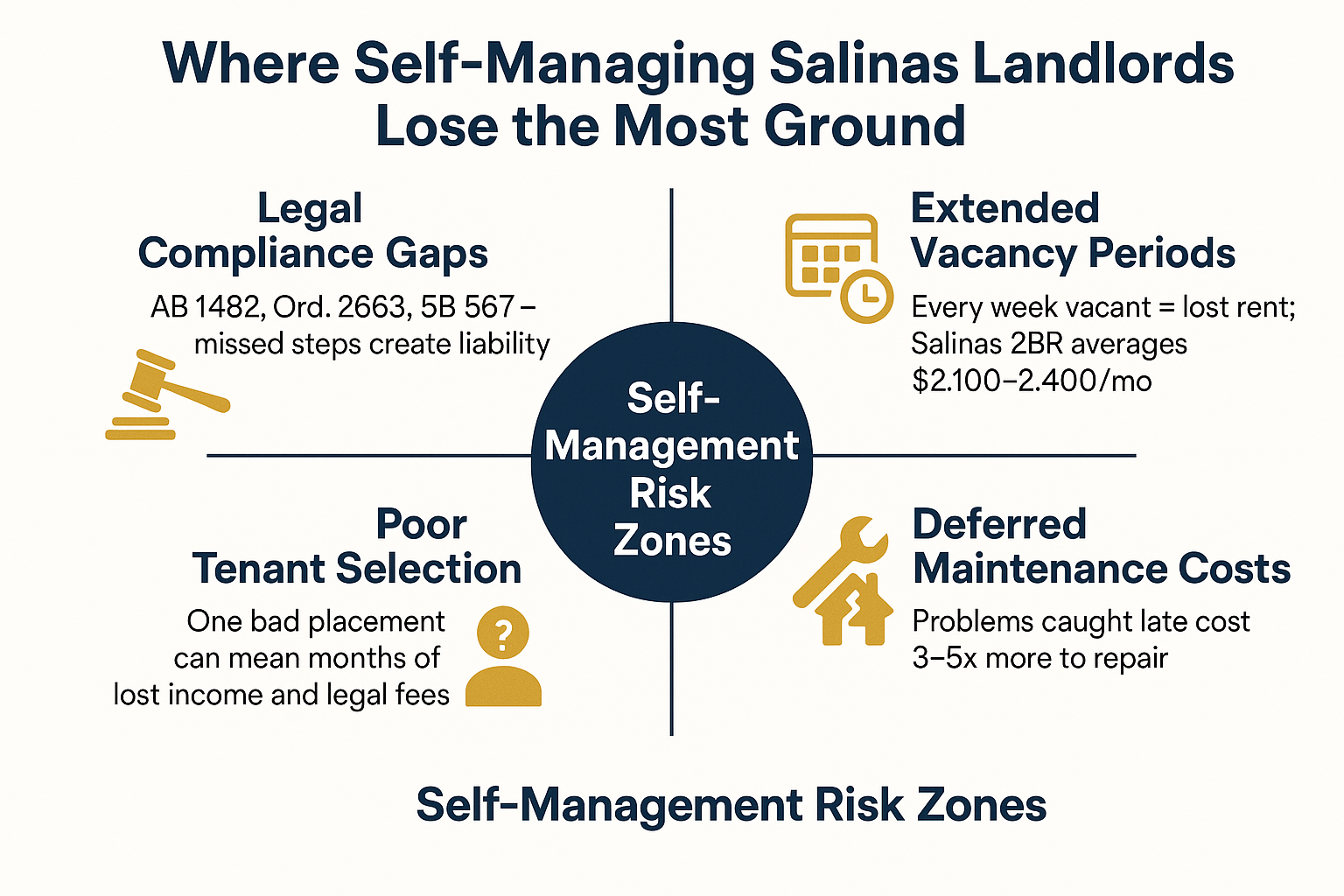
Where Self-Managing Landlords Lose the Most Ground
This breakdown shows the four areas where self-managing property owners in Salinas tend to absorb the biggest costs — and what drives each one.
Tenant Screening Is Where Most Self-Managing Owners Cut Corners
The biggest single mistake self-managing landlords make in this market isn’t a legal violation — it’s choosing the wrong tenant.
Screening a tenant properly takes time, the right tools, and knowledge of what to look for. A credit score alone doesn’t tell you much. You need to understand income verification relative to Salinas rent levels, rental history, eviction records, and how to evaluate applications without running into fair housing violations under California’s FEHA and federal law.
Many self-managing owners in Salinas admit they’ve approved a tenant because they seemed nice, showed up on time, or offered to pay the first month upfront. Those aren’t screening criteria. And once a tenant is in the property with a signed lease, the process of removing them for non-payment or lease violations in California is slow and expensive — often three to six months from notice to possession, even in straightforward cases.
The decision you make before someone moves in determines almost everything that follows. The difference between a good tenant and a great one starts before move-in explains what a professional screening process actually looks at — and why the gap between a good tenant and a great one matters a lot in this market.
Self-Managing vs. Professional Management: What the Real Comparison Looks Like
This isn’t a features comparison — it’s a practical look at what each approach typically costs a Salinas property owner when things don’t go perfectly.
| Scenario | Self-Managing Owner | Professionally Managed |
|---|---|---|
| Extended vacancy (30+ days) | Full month of lost rent — $2,100–$2,400 on a 2BR in Salinas | Faster re-marketing typically shortens vacancy to under 3 weeks |
| Tenant dispute or wrongful eviction claim | $3,000–$15,000+ in legal exposure depending on the violation | Documented compliance and proper notice procedures reduce risk significantly |
| Missed AB 1482 rent increase cap | Potential tenant claim for overpayments plus penalties | Rent increases tracked and applied within legal limits |
| Deferred maintenance discovery at move-out | $1,500–$8,000+ depending on what was missed | Regular inspections catch issues before they compound |
| Time cost (estimated monthly) | 5–15 hours per month of owner time | Typically less than 1 hour of owner involvement per month |
Frequently Asked Questions About Self-Managing in Salinas
Is self-managing a rental property in Salinas actually illegal if I don’t register it?
Under City of Salinas Ordinance 2663, which took effect in 2024, residential rental units must be registered with the city. Operating a rental without completing that registration can expose you to fines and enforcement action. It’s one of those requirements that flew under the radar for a lot of owners when it passed.
How do I know if my Salinas rental is covered by AB 1482?
Most single-family homes, condos, and multi-unit buildings in Salinas that are more than 15 years old and not owner-occupied are covered. AB 1482 caps annual rent increases at 5% plus local CPI (or 10%, whichever is lower) and requires just cause for eviction after 12 months of tenancy. There are exemptions — single-family homes where the owner has provided a specific written exemption notice, for example — but assuming you’re exempt without confirming it is a common mistake.
What’s the biggest financial risk of self-managing a rental in Monterey County?
Probably a bad tenant placement. One tenant who stops paying rent, causes property damage, or requires formal eviction proceedings can cost a Salinas landlord $5,000 to $20,000 or more when you add up lost rent during the eviction process, legal fees, repairs, and re-leasing costs. California’s eviction timeline makes that exposure worse than in most states.
Can I manage my own property and still have someone handle just the legal stuff?
You can, but it gets complicated. A real estate attorney can review your leases and notices, but they won’t be managing your day-to-day relationship with the tenant, responding to maintenance calls, or catching compliance issues in real time. Most owners who try this hybrid approach find that the legal review happens after a problem has already developed — not before.
How do eviction rules in California affect self-managing landlords specifically?
Self-managing owners are far more likely to make procedural mistakes that slow down or invalidate an eviction. California has strict requirements for how and when notices must be served, what language they must contain, and what just cause is required. One wrong step resets the clock. Why eviction rules make tenant disputes harder for Monterey County landlords covers the specific pitfalls in detail.
Want a Clearer Picture of What Your Property Actually Needs?
If you’re managing a rental in Salinas, Monterey, Carmel, or anywhere across Monterey County and you’re starting to wonder whether the workload and risk are worth it, Coast & Valley Properties is happy to talk it through — no pressure, just a straight conversation about your property and what full-service management would actually look like for you. Call us at (831) 757-1270 or reach out through coastandvalleypm.com.