Salinas’ Rent Ordinances Are Going to Voters — What Owners Need to Know Now
Direct Answer: All four Salinas rental ordinances remain fully in effect through at least November 2026. Property owners with covered units must comply with registration, rent caps, just cause eviction rules, and anti-harassment requirements right now.
On September 23, 2025, the Salinas City Council voted 4-3 to send four rental ordinances to the November 3, 2026 general election ballot. Voters will decide whether to repeal them. But here’s what matters most to you as an owner right now: every one of those ordinances is still the law today.
Several owners reaching out to Salinas property management firms recently have expressed real confusion — some assuming the ballot vote means the rules are paused or softened. They are not. Non-compliance between now and November 2026 exposes you to enforcement actions, legal liability, and penalties that won’t disappear regardless of how the election goes.
This article walks through what the four ordinances actually require, where owners most commonly get it wrong, and how to think about planning your leasing and management strategy in the face of genuine uncertainty.
The Four Ordinances — and What Each One Actually Requires
The City of Salinas enacted four rental ordinances that work as a package. Understanding what each one does is the starting point for any owner of covered residential property in the city.
- Ord. 2663 — Residential Rental Registration: Requires landlords to register covered rental units with the City annually. Properties not registered within the first 30 days of the calendar year receive a delinquency notice. From that notice, owners have 45 days to pay before additional enforcement follows.
- Ord. 2681 — Rent Stabilization: Caps annual rent increases on qualifying multi-family units built before February 1, 1995 at 2.75% — meaningfully below the statewide AB 1482 ceiling of 5% plus CPI.
- Ord. 2682 — Just Cause Eviction: Requires landlords to have a legally qualifying reason before issuing any termination notice to a covered tenant. A standard lease expiration alone is not enough.
- Ord. 2683 — Tenant Anti-Harassment: Defines prohibited conduct by landlords and creates legal exposure when tenant complaints are mishandled, ignored, or met with retaliatory action.
All four ordinances apply to covered properties in Salinas — and whether your specific unit is covered depends on property type, build date, and other factors worth confirming before you assume either way.
Rental Registration: What It Actually Takes to Comply
Ord. 2663 is the ordinance owners most often underestimate. Registration is not a one-time formality — it is an annual requirement, and the timeline matters.
Owners of covered units must register each calendar year. If you miss the first 30 days of the year without registering, the City sends a delinquency notice. You then have 45 days from that notice to pay and complete registration before additional enforcement steps begin.
Several Salinas landlords have contacted property managers recently with a straightforward question: does my property even need to be registered? The confusion is understandable. Single-family homes rented under certain conditions, newer construction, and some owner-occupied duplexes may fall outside the ordinance’s reach. But assuming you are exempt without verifying it is the kind of oversight that generates delinquency notices.
What registration actually involves:
- Submitting unit information to the City of Salinas
- Paying the applicable registration fee for each covered unit
- Keeping registration current — it does not carry over automatically year to year
- Maintaining records that confirm your compliance status if enforcement questions arise
For owners managing multiple Salinas units, staying on top of annual registration across a portfolio is one of the more practical arguments for working with a Salinas property management firm that tracks these deadlines on your behalf.
Rent Stabilization: Which Cap Applies to Your Property?
This is where owners most frequently make costly mistakes. California’s AB 1482 Tenant Protection Act sets a statewide rent increase ceiling at 5% plus the local CPI, with a hard cap of 10% in any 12-month period. The Salinas Rent Stabilization Ordinance (Ord. 2681) sets a stricter local cap of 2.75% for qualifying units.
Which cap applies to your property depends on several factors:
- Build date: Salinas rent stabilization covers multi-family properties built before February 1, 1995. Newer construction is generally exempt from the local ordinance but may still fall under AB 1482.
- Property type: Single-family homes and condos rented by individual owners operate under different rules than multi-family buildings under both state and local law.
- Ownership structure and exemptions: Certain ownership categories affect AB 1482 applicability — this is a detail many owners get wrong when relying on template lease language.
If you own a pre-1995 multi-family building in Salinas and issue a rent increase notice based on the AB 1482 ceiling rather than the local 2.75% cap, that notice is non-compliant under city ordinance. A non-compliant notice can expose you to tenant legal action and may require you to rescind the increase entirely.
The safest approach is to determine which framework governs your specific unit before issuing any increase notice — not after. What happens to your rental when California law changes mid-lease is a question that applies directly here, and owners who have not revisited their compliance position recently are most at risk.
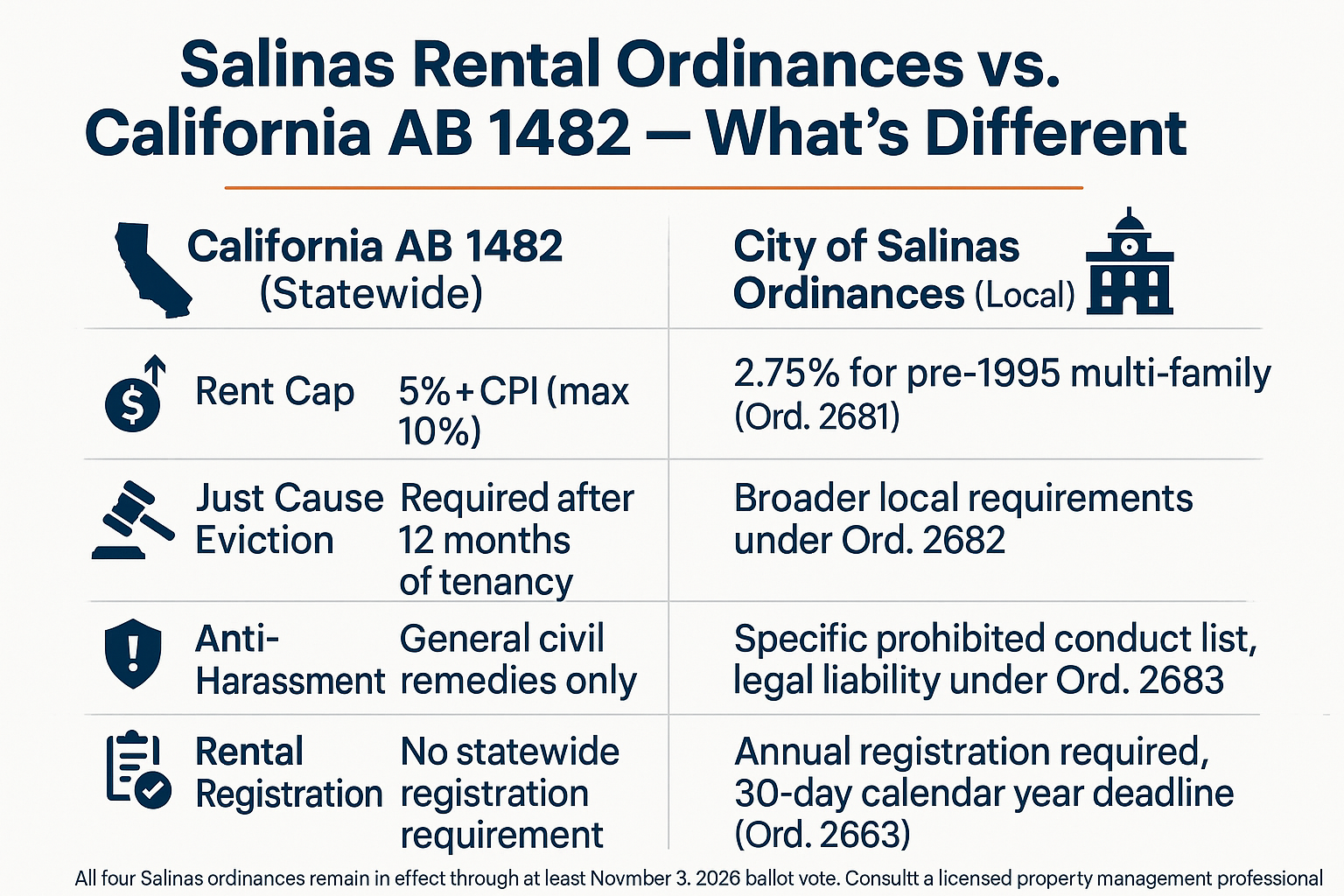
How the Four Salinas Ordinances Stack Up Against State Law
This comparison shows where Salinas goes further than California’s baseline AB 1482 protections — and where the two frameworks intersect.
Just Cause and Anti-Harassment: The Most Underestimated Part of This Package
Most Salinas owners who are aware of these ordinances focus almost entirely on the rent cap. The just cause eviction and anti-harassment requirements are far less understood — and in our experience, they carry the highest liability risk for owners who rely on standard lease templates and informal management practices.
Ord. 2682 — Just Cause Eviction means you cannot terminate a covered tenancy without a legally qualifying reason. Lease expiration alone does not qualify. Selling the property requires specific procedures. Owner move-in evictions carry strict requirements and relocation assistance obligations. Issuing a notice that does not cite a qualifying just cause gives a tenant grounds to challenge the eviction and potentially seek damages.
Ord. 2683 — Tenant Anti-Harassment defines a list of prohibited landlord behaviors — including unreasonable entry, interference with quiet enjoyment, threats, and conduct that pressures a tenant to vacate. A mishandled maintenance complaint or a poorly worded communication can create liability that a judge may view as harassment under the ordinance.
The practical gap here is significant. A lease drafted from a generic California template will not include the procedural language these ordinances require. An owner who self-manages and responds to tenant complaints informally may not recognize when a communication crosses a line. What Salinas property owners get wrong about self-managing covers this gap in broader terms — but with these four ordinances in place, the stakes for getting it wrong are higher than they have been in years.
Salinas Ordinance Compliance at a Glance
Here is a quick reference for the key requirements under each of the four ordinances currently in effect.
| Ordinance | What It Requires | Common Owner Mistake |
|---|---|---|
| Ord. 2663 — Registration | Annual registration of covered units; 30-day deadline from start of calendar year | Assuming the property is exempt without verifying |
| Ord. 2681 — Rent Stabilization | Max 2.75% annual increase on pre-1995 multi-family units | Issuing notice at the AB 1482 rate instead of the local 2.75% cap |
| Ord. 2682 — Just Cause Eviction | Termination notice must cite a qualifying legal reason | Using a standard 30-day or 60-day notice without just cause language |
| Ord. 2683 — Anti-Harassment | Prohibits specific landlord conduct; creates tenant legal remedies | Informal communications that could be read as pressure to vacate |
Planning Around the November 2026 Vote — Without Betting Your Compliance on the Outcome
The November 3, 2026 ballot measure is a genuinely contested issue in Salinas. There is organized advocacy on both sides, and the outcome is uncertain. Some owners are privately hoping the ordinances get repealed and are informally deferring compliance decisions until after the vote. That is a real risk.
Here is why: the ordinances are the law on the ground today. A rent increase issued above the 2.75% cap is non-compliant now — regardless of what voters decide 12 months from now. An eviction notice served without just cause is challengeable now. Registration delinquency generates enforcement action now.
Even if all four ordinances were repealed in November 2026, that repeal would not retroactively protect an owner from actions taken in violation of the current law. Any enforcement action, tenant legal claim, or administrative penalty filed before the vote date survives regardless of election results.
The prudent approach is to operate in full compliance through the vote, maintain clear documentation of every rent notice and tenant communication, and then reassess your strategy in late 2026 based on the actual outcome. Understanding what full-service property management actually covers gives context on how a professional management relationship can absorb this kind of ongoing compliance burden so individual owners do not have to track it themselves.
Frequently Asked Questions About Salinas Rental Ordinances
Do these ordinances apply to single-family homes I rent out in Salinas?
It depends. Single-family homes are generally treated differently than multi-family units under both state law and the Salinas ordinances, but ownership structure matters. An individually owned single-family rental may qualify for AB 1482 exemptions that a corporate-owned property would not. The registration ordinance may or may not apply depending on the specific property classification. Do not assume you are exempt — verify your property’s status.
My building was built in 1998. Does Salinas rent stabilization apply to me?
Probably not under Ord. 2681 specifically — that ordinance covers multi-family properties built before February 1, 1995. But your 1998 building may still fall under AB 1482’s statewide rent cap of 5% plus CPI depending on property type and ownership structure. You could also still be subject to the just cause eviction, anti-harassment, and registration ordinances. Build date is only one piece of the analysis.
What happens if I issued a rent increase above 2.75% to a covered tenant?
A non-compliant rent increase notice can be challenged by the tenant. In the worst case, you may be required to rescind the increase, issue a corrected notice, and potentially face a tenant claim for the overpayment. Document everything and consult a property management professional or real estate attorney as soon as possible — do not wait for the tenant to raise the issue first.
Can I wait until after the November 2026 vote to register my units?
No. Registration is required now under Ord. 2663, and the 30-day deadline runs from the start of each calendar year. Waiting for the vote does not suspend your registration obligation, and delinquency triggers a formal notice and enforcement timeline. The election outcome does not retroactively excuse a missed registration deadline.
What counts as a ‘qualifying reason’ for eviction under just cause?
Qualifying reasons under Ord. 2682 include things like non-payment of rent, material lease violations, criminal activity on the premises, and owner move-in — but each comes with specific procedural requirements. Owner move-in and substantial rehabilitation evictions also require relocation assistance payments to the displaced tenant. A general desire to re-rent the unit at a higher rate or bring in a new tenant does not qualify. Always consult a licensed professional before serving any termination notice on a covered unit.
Questions About How These Ordinances Apply to Your Property?
Coast & Valley Properties works with residential rental owners across Salinas, Monterey, Carmel, and the broader Monterey County area who need someone to stay on top of exactly this kind of regulatory complexity. If you are not certain whether your units are registered, which rent cap applies, or how to properly document a lease action on a covered property, a direct conversation is the fastest way to get clarity. You can reach us at (831) 757-1270 or through the contact form at coastandvalleypm.com.