
What Full-Service Property Management Actually Covers — And What It Doesn’t
Direct Answer: Full-service property management covers everything from tenant screening and rent collection to maintenance coordination and legal compliance — but it does not include short-term rental management, HOA oversight, or services outside your signed agreement.
A lot of property owners in Monterey County sign a management agreement expecting one thing — and discover something different when a problem surfaces. The phrase “full-service” gets used loosely in this industry, and the gap between what an owner assumes is handled and what’s actually in the contract is where most frustrations start.
If you own a rental in Salinas, Carmel, Pacific Grove, or anywhere else in the county, understanding exactly what your property manager is — and isn’t — responsible for protects you from expensive surprises. It also helps you evaluate whether the firm you’re considering is actually offering what the label suggests.
This guide breaks down what full-service residential and commercial property management genuinely covers, where the common gaps are, and a few things that no property manager handles — no matter what they call their service.
What Full-Service Actually Means — The Core Services
A full-service property management firm should be handling every meaningful responsibility of ownership except writing checks and making major financial decisions. If you’re still fielding maintenance calls at 10 p.m. or chasing down rent, something is missing from the arrangement.
On the residential side, a true full-service offering covers:
- Marketing and listing — professional photos, syndicated listing distribution, and active showing coordination
- Tenant screening — credit checks, background checks, income verification, and rental history review
- Lease preparation and negotiation — using California-compliant lease documents that protect the owner
- Rent collection — consistent monthly collection with clear grace period enforcement (California gives tenants 3 days after the due date before a lawful notice can be served)
- Maintenance coordination — fielding requests, dispatching vetted vendors, and tracking work to completion
- Property inspections — move-in, move-out, and periodic inspections to document condition and catch issues early
- 24/7 emergency response — someone available when a pipe bursts or a furnace fails at midnight
- Financial reporting — monthly owner statements, year-end summaries, and bill payment including mortgage, HOA fees, and utilities where applicable
For commercial properties, full-service typically adds lease compliance oversight, vendor coordination, and insurance coordination on top of the financial management functions.
The hidden workload behind managing a single rental home is real — and most of the items above represent tasks that self-managing owners either underestimate or handle inconsistently.

The California Compliance Layer — What It Adds to the Job
Managing a rental in Monterey County is not the same as managing one in Texas or Arizona. California’s landlord-tenant laws are among the most layered in the country, and Monterey County adds local requirements on top of the state baseline.
A full-service property manager in this market is expected to stay current on and actively apply:
- AB 1482 (Tenant Protection Act) — statewide rent caps and just-cause eviction requirements that apply to most properties built before 2009
- City of Salinas Residential Rental Registration Ordinance (City Ord. 2663, 2024) — rental units in Salinas must now be registered, and failure to comply carries real penalties
- California warranty of habitability — owners are legally required to maintain habitable conditions; a missed repair can expose you to rent withholding or litigation
- Lead paint disclosure requirements — mandatory for properties built before 1978, and the paperwork must be documented correctly in the lease file
This is why what happens to your rental when California law changes mid-lease matters — and why a property manager who isn’t tracking legislative updates is leaving you exposed.
A firm with deep local roots handles these requirements as part of the standard workflow. A national firm working from a template often doesn’t know what’s changed until a complaint or fine arrives. The difference in that knowledge base is not minor — multi-unit owners in Monterey County staying legally compliant often say compliance management alone is worth the management fee.
The Full-Service Management Scope at a Glance
This breakdown shows what falls inside and outside a full-service management agreement for Monterey County rental properties.
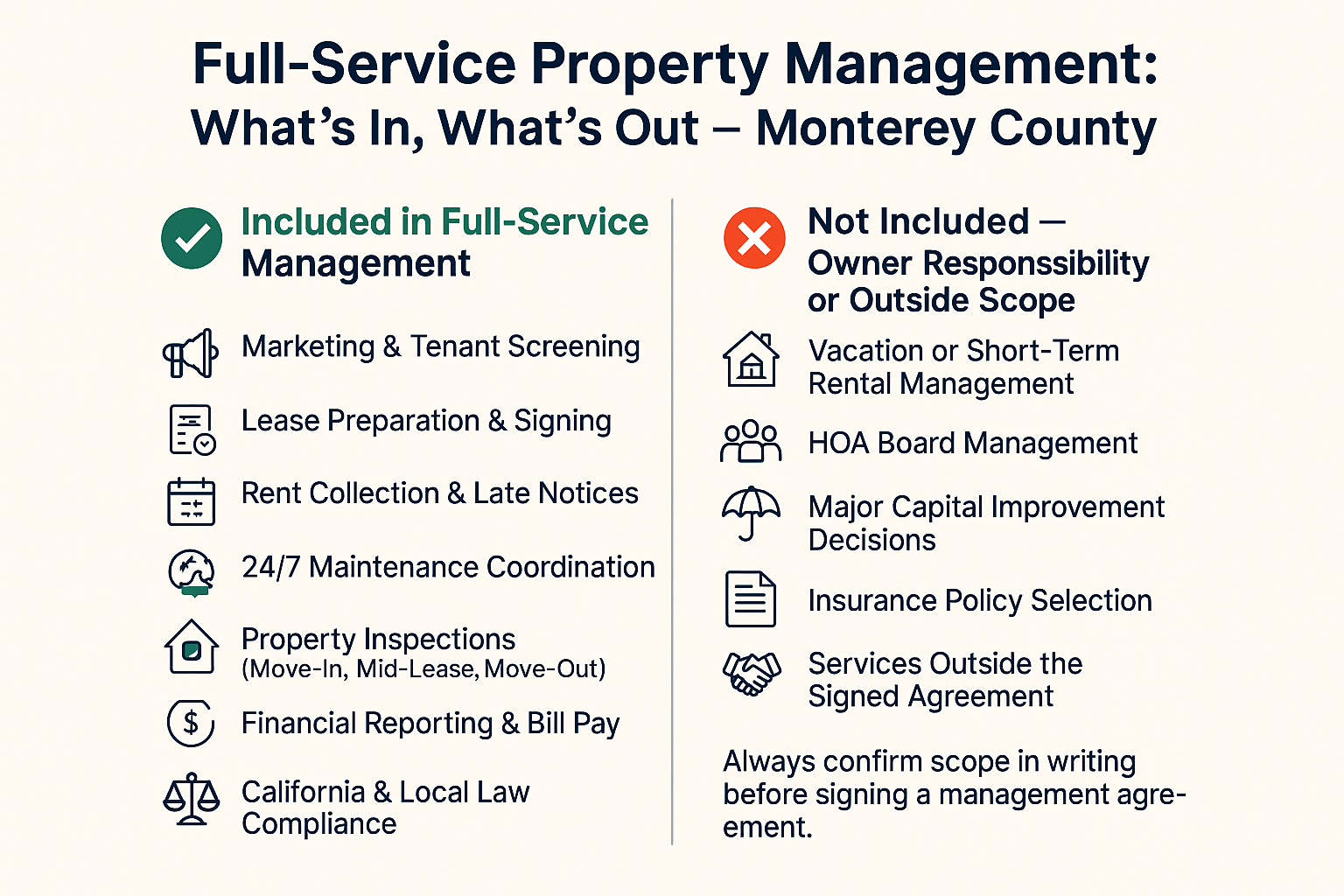
What Full-Service Property Management Does Not Cover
This is where assumptions get expensive. Owners sometimes expect their property manager to handle things that fall clearly outside any management agreement — or that no legitimate firm offers at all.
Short-term and vacation rental management is the most common example in this market. Given Monterey County’s short-term rental ordinance that took effect in October 2024, platforms like Airbnb require a separate licensing and operational framework that residential property managers don’t provide. If you want to run a vacation rental in Carmel-by-the-Sea or Pacific Grove, that’s a different business model entirely — and a different type of operator.
HOA board management is another common misconception. A property manager handles the relationship between owner and tenant. Managing the rules, finances, and governance of a homeowners association is a separate specialty. These are distinct services, even when they share similar terminology.
Major capital decisions — whether to re-roof, replace an HVAC system, or renovate a kitchen — remain with the owner. A good property manager surfaces the need, provides vendor quotes, and advises based on market knowledge. But the decision and the funding are yours.
And anything not written into your management agreement simply isn’t covered. Before signing, it’s worth reading what the contract actually says — not what the conversation implied. Choosing the right property management company starts with understanding exactly what you’re buying.
Full-Service Property Management: Covered vs. Not Covered
Use this as a quick reference when evaluating what a management firm in Monterey County should be handling for you.
| Service Area | Typically Covered | Notes |
|---|---|---|
| Tenant Marketing & Screening | Yes | Credit, background, income, and rental history checks |
| Lease Preparation | Yes | Must use California-compliant documents |
| Rent Collection | Yes | Includes late notices per CA law — 3-day grace period |
| Maintenance Coordination | Yes | Vendor dispatch, follow-up, and documentation |
| 24/7 Emergency Response | Yes | Should be available nights and weekends |
| Property Inspections | Yes | Move-in, mid-lease, and move-out |
| Financial Reporting & Bill Pay | Yes | Monthly statements, year-end summaries, utility/HOA payments |
| California Compliance (AB 1482, Ord. 2663) | Yes | Requires locally knowledgeable firm |
| Short-Term / Vacation Rental Management | No | Separate specialty — not residential property management |
| HOA Board Governance | No | Different service category entirely |
| Capital Improvement Decisions | No | Owner decides; manager advises and sources bids |
| Insurance Policy Selection | No | Owner responsibility; manager may flag coverage gaps |
Why the Scope of Services Matters More Than the Label
Two firms can both call themselves “full-service” and offer dramatically different things. One might handle maintenance coordination but not bill payment. Another might process rent but skip mid-lease inspections — which is a risk most owners don’t realize until a tenant dispute arrives. When a single missed inspection becomes a six-figure problem isn’t hypothetical in this market.
The right question isn’t “do you offer full-service management?” It’s a longer conversation about what specific tasks are performed, how often, by whom, and what happens when something goes wrong at 11 p.m. on a Saturday.
In a market as specific as Monterey County — with distinct neighborhoods from the Salinas Valley ag corridor to the Carmel Highlands — the depth of local knowledge behind those services matters just as much as the list of services itself. A firm that knows your neighborhood handles a maintenance issue in a Pebble Beach property differently than one in a Salinas multi-unit, because the tenant base, vendor relationships, and exposure levels are different.
Frequently Asked Questions About Full-Service Property Management
Does full-service management include paying my mortgage or HOA fees from rent?
It can — but only if it’s written into your agreement. A true full-service firm should offer bill payment as part of the financial management function, which means they can pay your mortgage, HOA dues, and utilities directly from collected rent before disbursing your net proceeds. Confirm this is explicitly listed in the contract before assuming it’s included.
Is tenant eviction included in a full-service agreement?
Serving legal notices — like a 3-Day Notice to Pay or Quit — is typically part of rent collection management. But the formal eviction (unlawful detainer) process in California courts usually involves additional legal fees and is handled by an attorney, not the property manager directly. Your manager should coordinate and guide the process, but legal costs are generally billed separately.
What’s the difference between residential and commercial full-service management?
Residential management is built around tenant relationships, habitability, and California landlord-tenant law. Commercial management adds lease compliance oversight, insurance coordination, and sometimes more complex vendor relationships. The financial reporting functions overlap, but the regulatory environment and day-to-day demands are different enough that not every firm handles both well.
Does full-service management include short-term or vacation rentals?
No. Short-term rental management is a separate business model with its own licensing requirements, operational demands, and regulatory framework — especially following Monterey County’s short-term rental ordinance that took effect in October 2024. Residential property managers handle long-term leases only.
How do I know if a firm is actually delivering full-service or just billing for it?
Ask for documentation. A legitimate full-service firm should be able to show you inspection reports, maintenance logs, financial statements, and a copy of your lease with all required California disclosures in place. Access to an owner portal where you can review activity in real time is also a strong indicator that they’re actually doing the work — not just claiming to.
Want to Know Exactly What’s Covered Before You Sign?
Coast & Valley Properties manages residential and commercial rentals across Monterey County — from Salinas and Seaside to Carmel and Pacific Grove — with a clearly defined scope of services and a team that stays current on California’s regulatory requirements. If you want a straight answer about what full-service management looks like for your specific property, call us at (831) 757-1270 or reach out through the contact form at coastandvalleypm.com.