
How Well Does Your Property Manager Actually Know Your Neighborhood?
Direct Answer: A property manager who truly knows your neighborhood sets smarter rents, screens tenants against local patterns, and spots compliance issues before they become expensive problems.
Most property owners evaluate a management company on price, responsiveness, and reviews. Those things matter. But there’s a question that gets skipped more often than it should: does this company actually know the block my property sits on?
In Monterey County, that question carries real weight. A rental home in Salinas’s Alisal neighborhood operates in a completely different regulatory and market environment than a property in Pacific Grove or Carmel. The rent ceilings differ. The tenant pool differs. The inspection requirements and local ordinances differ. A manager who can’t tell you why those differences matter probably isn’t tracking them closely enough to protect you.
This article breaks down what genuine local knowledge looks like in practice — and what it costs you when your property manager is working from generic templates instead of real street-level familiarity.
What ‘Local Knowledge’ Actually Means for a Rental Property
It’s easy for any management company to say they know the area. The question is whether that knowledge shows up in the decisions they make on your behalf.
Real local knowledge has three practical dimensions:
- Rental pricing accuracy — knowing what a three-bedroom on Natividad Road actually rents for right now, not what an algorithm estimates based on zip code data
- Tenant pool awareness — understanding the seasonal employment patterns in Salinas’s agricultural economy, or the military rotation cycles tied to the Presidio of Monterey, and how those affect tenant stability and turnover timing
- Regulatory specificity — tracking city-level rules like the City of Salinas Residential Rental Registration Ordinance (City Ord. 2663, enacted 2024), which requires landlords to register rental units and meet ongoing inspection standards, separate from state-level obligations
A manager working remotely from a dashboard in another city doesn’t have this. They have data. There’s a meaningful difference between the two.
Pricing is where the gap shows up fastest. Set the rent $150 too high and the unit sits vacant for six weeks — that’s more than most owners would save in a year of management fees. Set it $150 too low and you’ve left money on the table for 12 months. Both mistakes come from not knowing the neighborhood well enough. You can read more about what separates a local property manager from a national firm and why it matters in this specific market.

The Compliance Problem That Out-of-Area Managers Miss Most Often
California landlord-tenant law is complicated on its own. Layer in Monterey County’s local rules and the compliance surface area gets significantly larger.
AB 1482, the Tenant Protection Act, caps annual rent increases for qualifying properties at 5% plus local CPI, or 10% — whichever is lower. But whether your property is even subject to AB 1482 depends on factors like the age of the structure and ownership type. A manager who doesn’t understand those exemptions may either over-restrict your rent increases or expose you to a wrongful increase claim.
Then there’s the Salinas rental registration requirement. As of 2024, rental properties in the City of Salinas must be registered under City Ordinance 2663, and owners face penalties for non-compliance. A property manager unfamiliar with this ordinance may not have flagged it during onboarding — which means you could be out of compliance without knowing it.
Inspections are where these gaps compound. A missed inspection isn’t just an administrative inconvenience. As we’ve covered before, a single missed inspection can become a six-figure problem when deferred maintenance meets tenant habitability claims. A locally grounded manager knows which city programs trigger mandatory inspections and schedules proactively — not reactively.
For owners with multiple units, the compliance picture gets more complex still. How multi-unit owners in Monterey County stay legally compliant is a question worth understanding before a problem surfaces, not after.
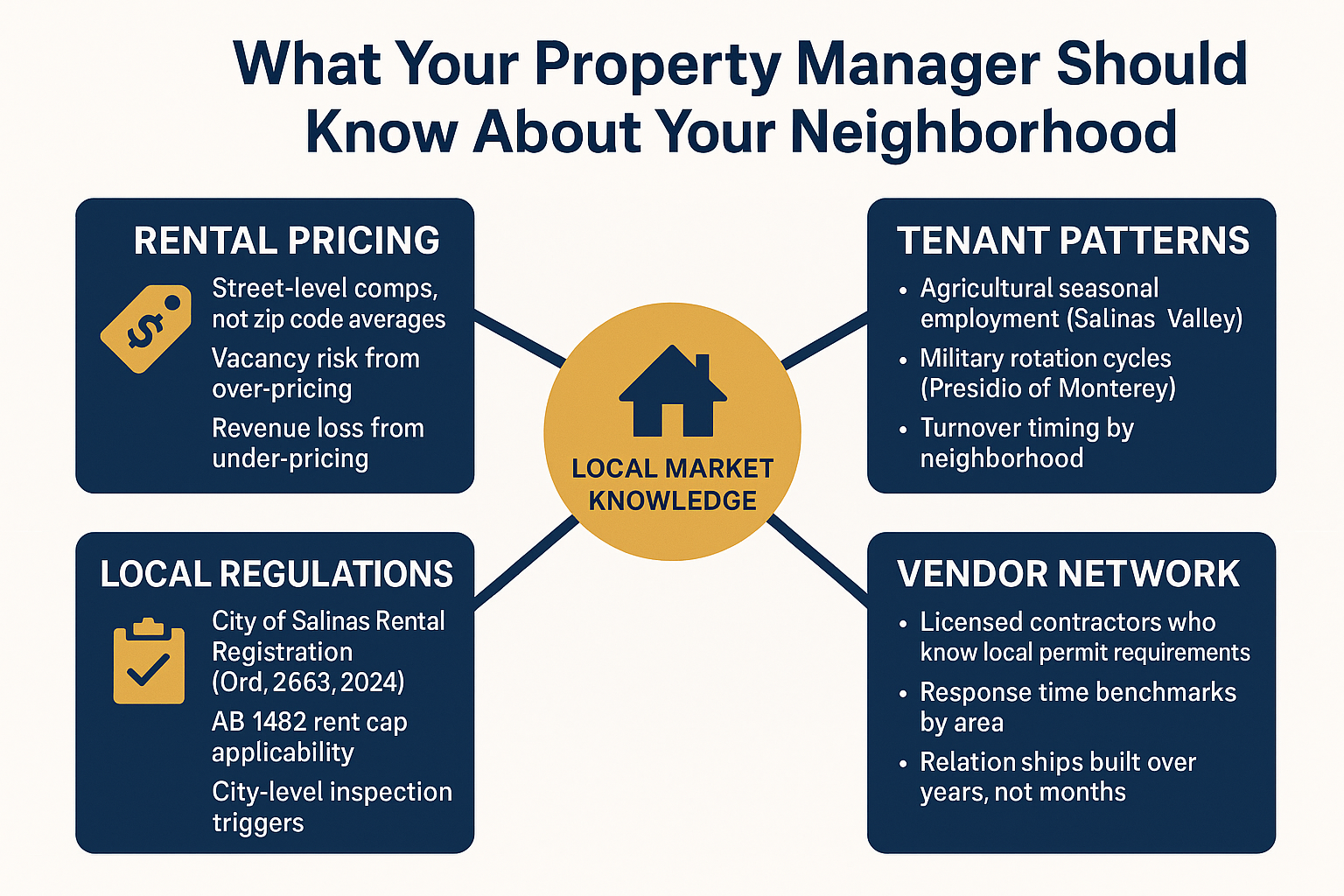
What Local Market Knowledge Actually Covers
This infographic breaks down the four areas where genuine neighborhood knowledge directly affects your rental property’s performance and legal standing.
The Vendor Network Problem Nobody Talks About
When something breaks at your rental — a water heater fails on a Saturday night in Monterey, or an HVAC unit goes down during a Salinas heat spell — your property manager’s local vendor relationships are the only thing standing between a quick fix and a week of tenant complaints.
A manager with deep local roots has spent years building relationships with licensed plumbers, electricians, roofers, and HVAC technicians who know Monterey County’s permit requirements and show up when called. Those relationships matter because good contractors in this market are busy. They prioritize clients whose management companies send them consistent work and pay invoices on time.
A national firm or a manager who handles properties across multiple counties doesn’t have those relationships in your specific area. They’re pulling from a general vendor list and hoping for the best. That’s fine until it isn’t — and when it isn’t, it’s usually your tenant calling you directly because nobody showed up.
Responsive maintenance also affects tenant retention more than most owners expect. A tenant who sees fast, professional repairs stays longer. One who waits two weeks for a plumber starts shopping for a new place. The hidden workload behind managing a single rental home includes exactly this kind of coordination — and it only works smoothly when the manager has the right people on speed dial.
Local Knowledge vs. Generic Management: What Changes in Practice
These aren’t abstract differences. Each row reflects a real decision that gets made differently depending on whether your property manager actually knows your market.
| Decision Point | Generic/Remote Manager | Locally Grounded Manager |
|---|---|---|
| Rental pricing | Relies on algorithm or regional averages | Sets rent based on current comps within the same neighborhood |
| AB 1482 compliance | Applies standard increase across all units | Evaluates each property’s exemption status individually |
| Salinas rental registration | May not track city-level ordinances | Flags Ord. 2663 at onboarding and handles registration |
| Maintenance response | Dispatches from a general vendor list | Calls established local contractors with priority relationships |
| Tenant screening | Runs standard national background check | Screens against local employment patterns and references |
| Inspection scheduling | Follows a generic annual schedule | Schedules around city program triggers and property age |
How to Actually Test a Property Manager’s Neighborhood Knowledge
Before signing a management agreement, ask specific questions. The answers — or the lack of them — tell you everything.
A few questions worth asking:
- “What did comparable properties in this neighborhood rent for in the last 90 days?” — A manager who knows your market can answer this without checking a website.
- “Is this property subject to AB 1482?” — They should be able to explain why or why not based on the year the structure was built and how it’s owned.
- “Does this city require rental registration, and are we currently compliant?” — If they don’t know about Salinas Ord. 2663 or Monterey County’s local requirements, that’s a gap worth noting.
- “Who are your go-to plumbing and HVAC contractors in this area, and how long have you worked with them?” — Specific names and multi-year relationships are a good sign. A vague answer is not.
These aren’t trick questions. A locally experienced manager answers them easily because the information is part of how they already think about their work. Choosing the right property management company comes down to exactly this kind of due diligence — not just checking whether they’re licensed, but whether they’re genuinely embedded in the market where your property sits.
If you’re self-managing right now and considering making a change, what Salinas property owners get wrong about self-managing is worth reading before that conversation.
Frequently Asked Questions About Property Manager Local Knowledge
Does it really matter if my property manager is based locally, as long as they’re responsive?
Responsiveness matters, but it’s not a substitute for local knowledge. A manager based outside Monterey County may return your calls promptly but still price your rental based on regional averages, miss a Salinas-specific compliance requirement, or send a vendor who isn’t familiar with local permit processes. Being reachable and being knowledgeable are two different things.
How does the Salinas rental registration ordinance affect me as a property owner?
Under City Ordinance 2663, enacted in 2024, residential rental properties within the City of Salinas must be registered with the city. There are ongoing compliance requirements tied to the program, including inspections. Failure to register or maintain compliance can result in penalties. Your property manager should have flagged this at onboarding and handled the registration process on your behalf.
What does AB 1482 mean for my rental property in Monterey County?
AB 1482 limits annual rent increases for covered properties to 5% plus local CPI, with a maximum of 10%. But not every property is covered. Single-family homes owned by individual landlords who provide proper notice may be exempt. Condos and multi-unit buildings generally are covered if the structure is more than 15 years old. A manager who doesn’t understand these exemptions may be leaving rent increase capacity on the table — or exposing you to a wrongful increase claim.
Can a property manager really make a difference in tenant quality?
Yes — and it starts before a single showing is scheduled. Accurate local pricing attracts more qualified applicants. Proper screening that accounts for local employment patterns filters out higher-risk candidates. A manager who understands the Salinas tenant pool, including the seasonal nature of agricultural employment or the stability patterns tied to healthcare and education sectors, makes better screening decisions. The difference between a good tenant and a great one starts before move-in — and local knowledge is a big part of how that gap gets closed.
What should I ask about vendor relationships when interviewing a property manager?
Ask for specific contractor names, how long they’ve worked together, and whether those vendors are licensed and insured in California. Ask how quickly they typically respond to emergency calls and whether they have backup vendors when a primary contractor isn’t available. Vague answers about a ‘network of trusted vendors’ are not the same as being able to name the plumber they’ve called for the last six years.
Want to Know If Your Property Is Being Managed With the Right Local Expertise?
Coast & Valley Properties has been managing residential and commercial properties throughout Monterey County since 2009 — with direct knowledge of Salinas, Monterey, Carmel, Pacific Grove, and the surrounding communities that only comes from doing this work here, every day. If you have questions about your property’s compliance status, current rental pricing, or what a locally grounded management relationship actually looks like, we’re happy to have that conversation. Reach us at (831) 757-1270 or through the contact form at coastandvalleypm.com.