
What Separates a Local Property Manager From a National Firm?
Direct Answer: A local property manager knows your specific market, your local laws, and your neighborhood. A national firm applies the same system to every property in every state — and that gap shows up in your bottom line.
Most property owners in Monterey County start their search the same way — they Google a few names, get some calls back, and assume the big national brand is the safer choice. After all, a company with offices in 30 states must know what they’re doing, right?
But California rental law is not like rental law anywhere else. The City of Salinas has its own registration ordinance. AB 1482 caps rent increases on a long list of properties here that wouldn’t qualify in other states. What a regional call center in Phoenix doesn’t know can cost you thousands of dollars in fines, legal fees, or lost rent.
This article breaks down the two or three things that actually separate a local property manager from a national firm — not in theory, but in the decisions that get made on your property every week.
What a National Firm Actually Looks Like From the Owner’s Side
National property management companies are not bad at what they do. They’ve built systems that work across markets at scale — standardized lease templates, automated rent collection, 1-800 maintenance lines. For a basic rental in a low-regulation state, that’s probably fine.
But when you hand a Carmel-area duplex or a Salinas fourplex to a firm running hundreds of properties through a centralized system, a few things tend to happen:
- Your property gets assigned to a local franchise owner or regional manager who may or may not have deep California experience
- Lease terms get generated from a national template that may miss California-specific disclosures like lead paint, mold, or AB 1482 exemption notices
- Maintenance decisions get routed through a vendor network that doesn’t know local contractors — meaning slower response times and higher costs on repairs
- Owner communication happens through a portal, not a person, and escalations can take days
For a straightforward rental in a simple market, that might be acceptable. But Monterey County is not a simple market. What Salinas property owners get wrong about self-managing applies equally to owners who outsource to the wrong firm — the risks don’t disappear just because someone else is handling the paperwork.

Why California Compliance Is a Local Knowledge Problem
California has some of the most layered landlord-tenant law in the country — and Monterey County adds its own requirements on top of that.
Take the City of Salinas Residential Rental Registration Ordinance (Ordinance 2663), which went into effect in 2024. It requires rental property owners operating within city limits to register their units, pay annual fees, and meet inspection standards. A national firm that manages properties across multiple states is unlikely to track a single city’s new ordinance proactively — and missing a registration deadline can mean fines starting at $250 per day.
Then there’s AB 1482, California’s Tenant Protection Act. It applies to most multi-family properties that are more than 15 years old and limits annual rent increases to 5% plus local CPI — a number that changes year to year. Applying the wrong increase, even accidentally, exposes you to wrongful eviction claims.
A local manager who works exclusively in Monterey County follows these changes the same way a local tax attorney follows IRS updates — because their clients’ exposure is directly tied to staying current. How multi-unit owners in Monterey County stay legally compliant goes deeper on exactly what that compliance picture looks like for portfolio owners here.
This is not something you can replicate with a checklist from a national compliance team. Local law changes fast, and the people who catch it first are the ones with relationships inside the market.
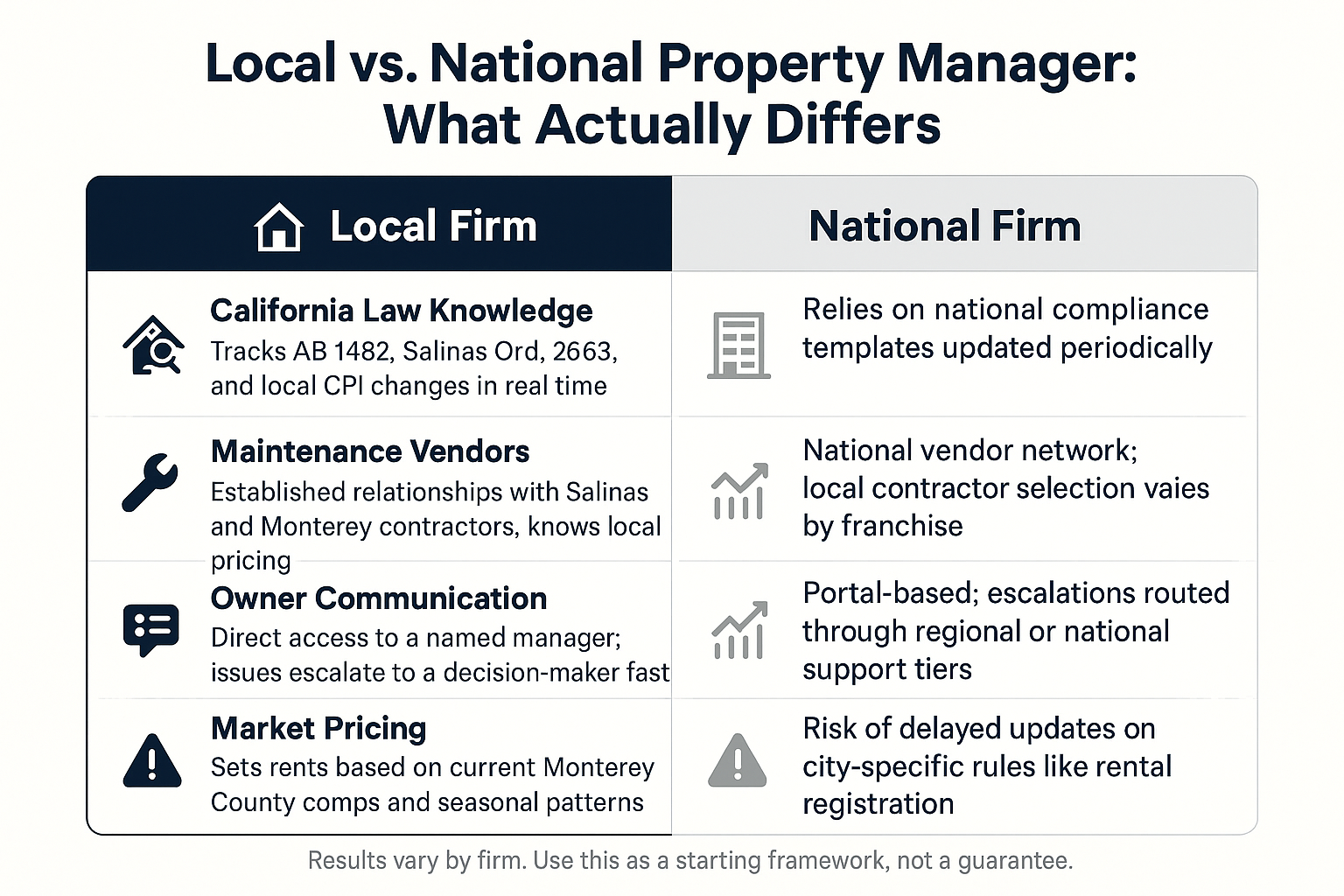
Local vs. National Property Manager: Side-by-Side
This comparison shows how local and national property management firms typically differ across the decisions that matter most to Monterey County property owners.
The Vendor Network Problem (and Why It Costs You Money)
One of the least-discussed differences between local and national property management is who actually shows up to fix things at your property.
A national firm typically uses a managed vendor network — a list of contractors who’ve agreed to standardized pricing in exchange for volume work. On paper, that sounds efficient. In practice, it often means slower response times, contractors who are stretched thin across a wide area, and pricing that doesn’t reflect local market rates.
In the Salinas and Monterey market, a skilled licensed plumber typically runs $125–$175 per hour for service calls. A property manager with long-standing local relationships can often get priority scheduling and fair pricing because they’re sending repeat business. A national firm’s vendor portal doesn’t build that kind of relationship.
The stakes are highest in emergencies. A burst pipe in a Pacific Grove rental at 9pm on a Friday needs someone who knows the market — not a dispatch center trying to find an available contractor in a zip code they service once a month. When a single missed inspection becomes a six-figure problem illustrates exactly how maintenance gaps escalate when the right people aren’t watching.
Local managers also tend to have better instincts about when to repair vs. replace, because they’ve seen what holds up in the coastal climate here — salt air, fog moisture, and temperature swings that affect materials differently than they would in Sacramento or San Diego.
How Key Decisions Typically Differ by Firm Type
This table summarizes how local and national firms tend to handle the decisions property owners care most about — based on how these firms generally operate, not a guaranteed outcome.
| Decision Area | Local Property Manager | National Property Manager |
|---|---|---|
| Lease compliance (CA-specific) | Drafted with current state and local law in mind | Template-based; may require owner review for local gaps |
| Rent pricing | Set using current Monterey County comps | Often set using automated valuation tools |
| Maintenance response | Local contractors, established relationships | National vendor network, variable local coverage |
| Regulatory updates | Tracked and applied as local law changes | Updates may lag by weeks or months |
| Owner communication | Direct line to a named manager | Portal-based with tiered support structure |
| Tenant screening | Familiar with local rental market and applicant norms | Standardized national criteria applied uniformly |
What ‘Local Knowledge’ Actually Means for Your Rental Income
Setting the right rent is not a math problem. It’s a judgment call that requires knowing what’s happening in Salinas right now — not what Zillow’s algorithm thinks based on data that’s 60 to 90 days stale.
Monterey County has distinct micro-markets. A three-bedroom house near Natividad Medical Center in Salinas rents for a different price than a comparable home near Hartnell College — and both of those are different from a unit in Pacific Grove or a commercial space on Alvarado Street in Monterey. Getting the price wrong by even $75–$100 per month adds up to $900–$1,200 in missed revenue over the course of a year.
Beyond pricing, a local manager understands the seasonal patterns that affect the Monterey Bay rental market — the way inventory tightens in late summer as families want to be settled before the school year, or the slower absorption rate for higher-end rentals in December and January. That timing affects when you list, how you price, and how much vacancy you absorb.
Tenant selection is part of this too. The difference between a good tenant and a great one starts before move-in — and local experience shapes how you read an application, not just which boxes get checked on a screening form.
Frequently Asked Questions About Local vs. National Property Management
Are national property management companies less expensive than local ones?
Sometimes the advertised management fee is lower, but the total cost often isn’t. National firms frequently charge separately for lease renewals, maintenance coordination markups, vacancy fees, and advertising. A local firm with a slightly higher base fee may cost less overall because the ancillary charges are fewer. Always compare the full fee structure, not just the monthly percentage.
What happens if my national property management company doesn’t know about the Salinas rental registration ordinance?
You’re still liable. City of Salinas Ordinance 2663 holds the property owner responsible for compliance — not the management company. If your manager misses the registration deadline, the fines come to you. This is one of the clearest arguments for working with a firm that operates specifically in this market and tracks local ordinances as part of their regular workflow.
Can a local property manager really compete with the technology a national firm offers?
Yes. Most reputable local property management firms today use the same professional software platforms — AppFolio, Buildium, Propertyware — that national chains use. Owner and tenant portal access is standard. The technology gap that existed ten years ago largely doesn’t exist anymore. What local firms offer that software can’t replicate is judgment — and that’s what you’re actually paying for.
Is a local property manager the right choice for a small portfolio — say, one or two rentals?
A boutique local firm is often the best fit for owners with one to five properties, because your portfolio gets real attention rather than being a small account inside a large system. National firms build their margins on volume; a single Carmel rental isn’t going to be anyone’s priority. A local firm that specializes in Monterey County treats every property as a meaningful part of their business.
How do I evaluate whether a local property management company actually knows California law?
Ask them directly. A firm with real California compliance knowledge should be able to explain AB 1482 coverage thresholds, what properties are exempt, and how they handle mid-lease law changes. Ask how they handled the rollout of the Salinas rental registration ordinance in 2024. If they can answer those questions in plain language without hesitating, they’re operating at the right level. What happens to your rental when California law changes mid-lease is a good reference point for what that knowledge should actually look like in practice.
Ready to Work With a Team That Knows Monterey County?
Coast & Valley Properties has managed rental properties across Salinas, Monterey, Carmel, Pacific Grove, and the broader Monterey County area since 2009 — and that depth of local experience is something no national franchise can replicate. If you’d like to talk through your property and what full-service local management would look like, you can reach our team directly at (831) 757-1270 or through the contact form at coastandvalleypm.com.