Naval Officers, Relocating Families, Retirees: Who Leases Your Monterey Home
Direct Answer: The Monterey Peninsula rental tenant pool is driven by local institutions: military schools, the hospital system, and the hospitality economy. The pool is small but stable, with relocating applicants who hold steady orders or employment.
Owners ask me this one quietly, usually about forty minutes into a walkthrough, after we have covered the roof and the water heater. Who out here can actually pay what a home like this needs?
It is a fair question. A home in Pacific Grove, Carmel, or the hills above Monterey is worth seven figures, and the rent it commands is not a number most households carry casually.
But the Peninsula does not run on general population growth the way inland markets do. It runs on institutions, and those institutions keep producing qualified long-term renters whether the broader housing market is hot or quiet. Here is who they are, when they show up, and what makes them choose one house over another.
The Monterey Peninsula Rental Tenant Pool Is Built by Employers, Not Population
Most of the serious applications I see trace back to a handful of local institutions. That is the single most useful thing an owner can understand before listing.
The military schools are the anchor. The Naval Postgraduate School reports roughly 1,616 resident students, drawn from all five U.S. uniformed services plus officers from dozens of partner countries. The Defense Language Institute adds faculty, staff, and visiting personnel on top of that.
Then there is the rest of the Peninsula economy:
- Hospital and clinic staff, including physicians and specialists recruited from out of the area
- Hospitality and resort management, which hires at the professional level year-round
- University and research staff tied to the Peninsula’s academic and marine science presence
- Professionals relocating from the Bay Area who kept the job and changed the zip code
None of these groups is large. Added together they are still smaller than the renter base in Salinas or Gonzales. But a smaller pool is not a weaker pool. An officer arriving on orders has documented, predictable income and a reason to stay put for the length of a program. A hospital hire has a contract. That applicant profile is why Monterey city runs heavily renter occupied even at rent levels that would stall a valley property.

Why a Quiet Week on a Peninsula Listing Is Not a Price Problem
An owner calls me on day ten of a vacancy and says some version of the same thing. No applications yet, so the rent must be wrong.
Usually it is not. Peninsula leasing follows rotation and reporting cycles, not the general calendar. Military and academic moves land in clusters. Hospital hiring happens when a position opens, not when it is convenient.
An applicant relocating under orders typically starts looking 30 to 60 days ahead of a report date. They are searching from Virginia, Texas, or overseas. Our inbound calls are full of out-of-area numbers, Bay Area and out-of-state, which tells you how much of this market moves in rather than moves across town.
That changes two things for an owner:
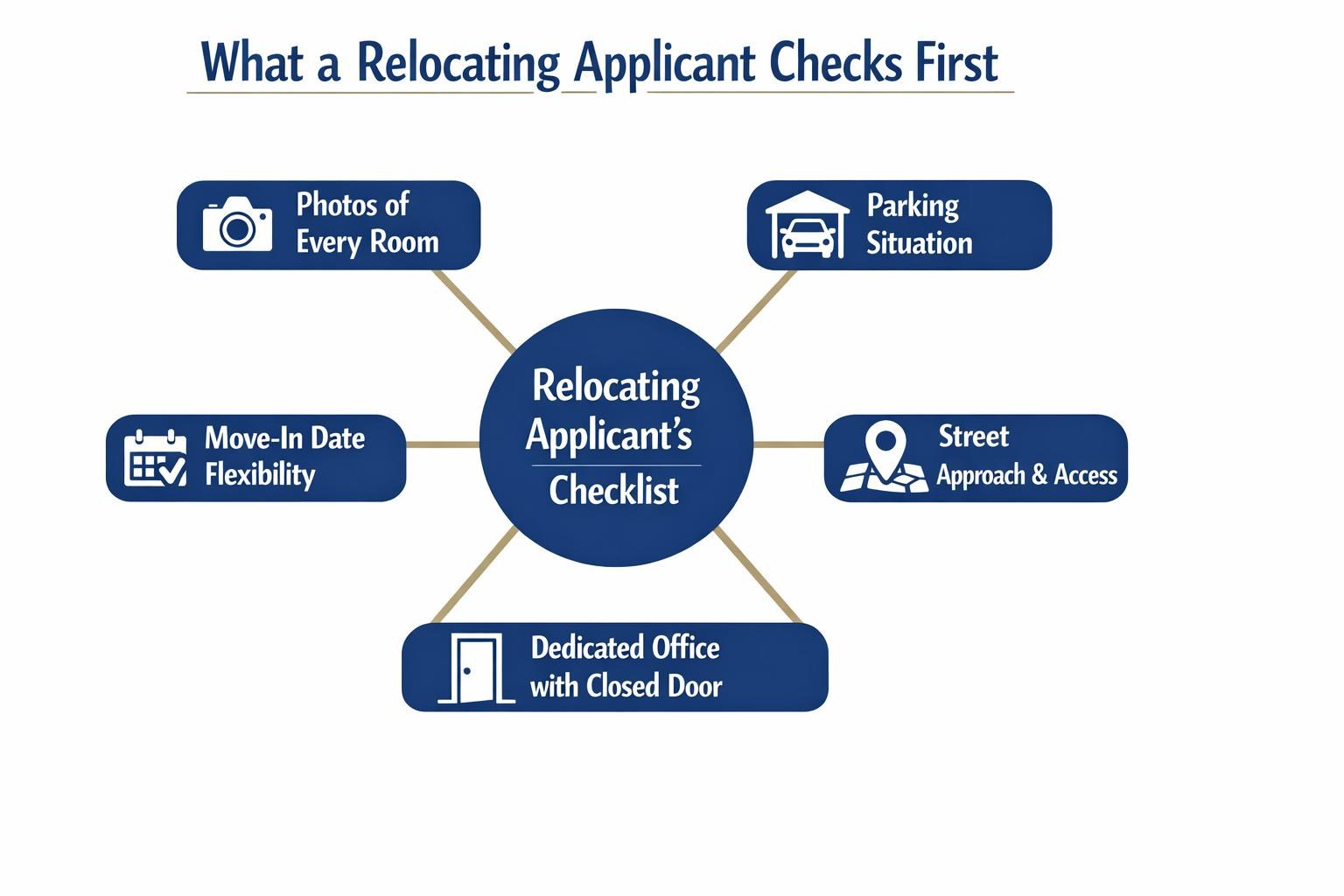
- The listing has to do the walkthrough. Many of these applicants will sign without ever standing in the house. Photos of every room, the parking situation, and the actual street approach matter more than clever copy.
- Decisions come fast once the right person appears. A week of silence followed by a complete, well-documented application in a single afternoon is a normal pattern here, not luck.
If a listing truly is mispriced, there are ways to tell, and how rent gets set on a Monterey County rental walks through why online estimates miss on Peninsula homes in particular.
Where Long-Term Peninsula Applicants Come From and How They Move
These are general patterns I see across Monterey Peninsula listings, not guarantees. Timing shifts year to year.
| Applicant source | Typical timing pattern | What tends to follow |
|---|---|---|
| Naval Postgraduate School students and officers | Clustered around reporting cycles, searching 30 to 60 days out | Orders-backed income, lease length often tracks a program |
| Defense Language Institute faculty and staff | Steadier across the year, tied to teaching assignments | Longer tenancies and strong renewal rates |
| Hospital and clinic hires | Driven by a start date, sometimes short notice | Move-in date matters more to them than shaving the rent |
| Hospitality and resort management | Seasonal hiring plus internal promotions | Mixed lease lengths, more local moves within the Peninsula |
| Relocating Bay Area professionals | Follows a job change or a lifestyle move | Frequently leases sight unseen from out of the area |
What a Relocating Applicant Actually Checks First
When someone is choosing a home from two states away, a short list of features decides which listing they apply to.
The House Filters the Pool Before Any Applicant Does
Peninsula housing stock filters hard, and not always in the ways owners expect.
Carmel has no street addresses, which sounds charming until an applicant two time zones away is trying to figure out where the house sits relative to the beach and the village. Pacific Grove’s Victorian-era grid is largely built out, so lot sizes, parking, and bathroom counts are what they are.
Older coastal homes here commonly lack:
- A garage or any off-street parking
- A true second bathroom
- A room that can honestly function as an office with a closed door
That last one has become the strongest filter on the Peninsula right now. Remote and hybrid work means a spare room with a door beats an extra hundred square feet of living room almost every time.
The marine layer is its own conversation. Surface condensation and a little mildew on a north-facing wall is a normal climate effect here, not proof the house is failing, but an applicant who sees it in a photo reads it as neglect. We cover that distinction in mildew on a Carmel rental wall.
None of these shortcomings automatically means a lower rent. They mean a narrower pool, which is a different problem with different fixes. What makes the Peninsula different goes deeper on the housing stock itself.
Absentee Owners and Relocating Applicants Rarely Overlap
Here is the part that trips up self-managing owners more than anything else on this list.
The applicant is in another state, working a report date. The owner is also somewhere else. One owner reached out and wrote, “I would like to meet with you, at my home in Carmel by the Sea to discuss property management/monthly rental of home,” offering two narrow windows during a short visit. That is a completely normal Peninsula owner situation, and I see versions of it constantly.
Someone has to physically stand in that house for both of them. For the applicant, that means a live walkthrough on video, an honest read on noise and light and the parking, and keys handed over on a day that works. For the owner, it means eyes on the property between tenancies and a person who can answer a 4 p.m. Tuesday question without a flight.
If you still use the home part of the year, the coordination gets tighter. Renting out a Carmel home you still use part of the year covers how owners structure that.
At the Top of the Market, Fewer Applications Is the Normal Outcome
Owners often arrive with a rent number already in mind, usually from an online estimate, and ask what we would project before anything else.
I understand the instinct. But the honest answer on a high-end Peninsula home is that time to lease and rent level move against each other. Push the rent toward the top of what the house can draw and you will see fewer applications and a longer vacancy. Price for speed and you lease faster and give something up monthly.
Neither is wrong. They are different decisions for different owners.
What I will say is that high-end Peninsula homes tend to see fewer applications and longer tenancies than a comparable valley property. A family settling in for a multi-year assignment is not shopping again next spring. Fewer applicants with a four-year horizon can be a better outcome than a stack of applicants with a one-year one.
An actual number for an actual address comes from a walkthrough and a conversation, never a web form. And before anyone signs, the owner should be the one reviewing the file, which is the point of what a Peninsula owner gets to approve.
Frequently Asked Questions About the Monterey Peninsula Renter Pool
Is there really a long-term tenant pool for a home at this price point?
Yes, but it is institutional rather than broad. Officers and students at the military schools, hospital and clinic hires, and relocating professionals make up most of it. The pool is small and stable, not large and casual.
How long should I expect a high-end Peninsula home to sit before leasing?
It varies with the season, the rent level, and the house itself, so I will not throw out a number that may not apply to your address. What I can tell you is that a quiet first week or two on an upper-end listing is common and usually has nothing to do with price.
Will someone really lease a million-dollar home without seeing it in person?
It happens regularly here. An applicant relocating under orders from overseas or across the country often cannot visit first. That is why thorough photos, a live video walkthrough, and clear detail about parking and street access matter so much on a Peninsula listing.
Does my older home without a garage or second bathroom hurt the rent?
Not necessarily the rent. It narrows the pool. Fewer applicants will consider it, which can stretch the vacancy, but the ones who do apply are often fine with the tradeoff because they want the location. A dedicated office space tends to matter more to Peninsula applicants right now than a garage does.
What do you charge to manage a Peninsula home?
We do not publish pricing, because the scope genuinely differs from one property to the next. A licensed agent walks the property in person, usually for about 45 minutes to an hour, and gives you a specific range along with a read on the market and any upgrades worth making first.
Thinking Through Who Would Lease Your Peninsula Home?
We have worked both sides of Monterey County since 2009, from Pebble Beach and Carmel to the Salinas Valley, and the firm is led by a licensed California broker. Every application gets reviewed with the owner rather than approved behind the scenes, which matters most when the applicant is relocating from out of the area and you are not here to read the room. If you would like to talk through what your property would draw, Coast & Valley Properties can be reached at (831) 757-1270 or through the contact form at coastandvalleypm.com.