Before Your Tenant Signs: What a Monterey Peninsula Owner Gets to Approve
Direct Answer: You approve the asking rent, lease term, pet policy, move-in date, and which qualified applicant gets the home. Your manager signs as your agent only if you granted that authority in writing.
A message came to our office a while back from someone writing on behalf of two property owners. The tenants were set to move in within two days, and the owners had still not seen the lease. That is a terrible feeling for anyone who owns the house in question.
If you have been quietly wondering whether it is pushy to ask for a copy of the lease before it is signed, it is not. It is one of the most normal requests an owner can make, and a good manager expects it.
So here is a plain map of the leasing window on the Monterey Peninsula. Which calls are yours, which ones your manager makes for you, and what should land in your hands when the ink is dry.
The Decisions That Stay With You During Tenant Placement
Leasing is not one big yes. It is a short series of small decisions, and almost all of the ones that shape your return and your risk belong to you.
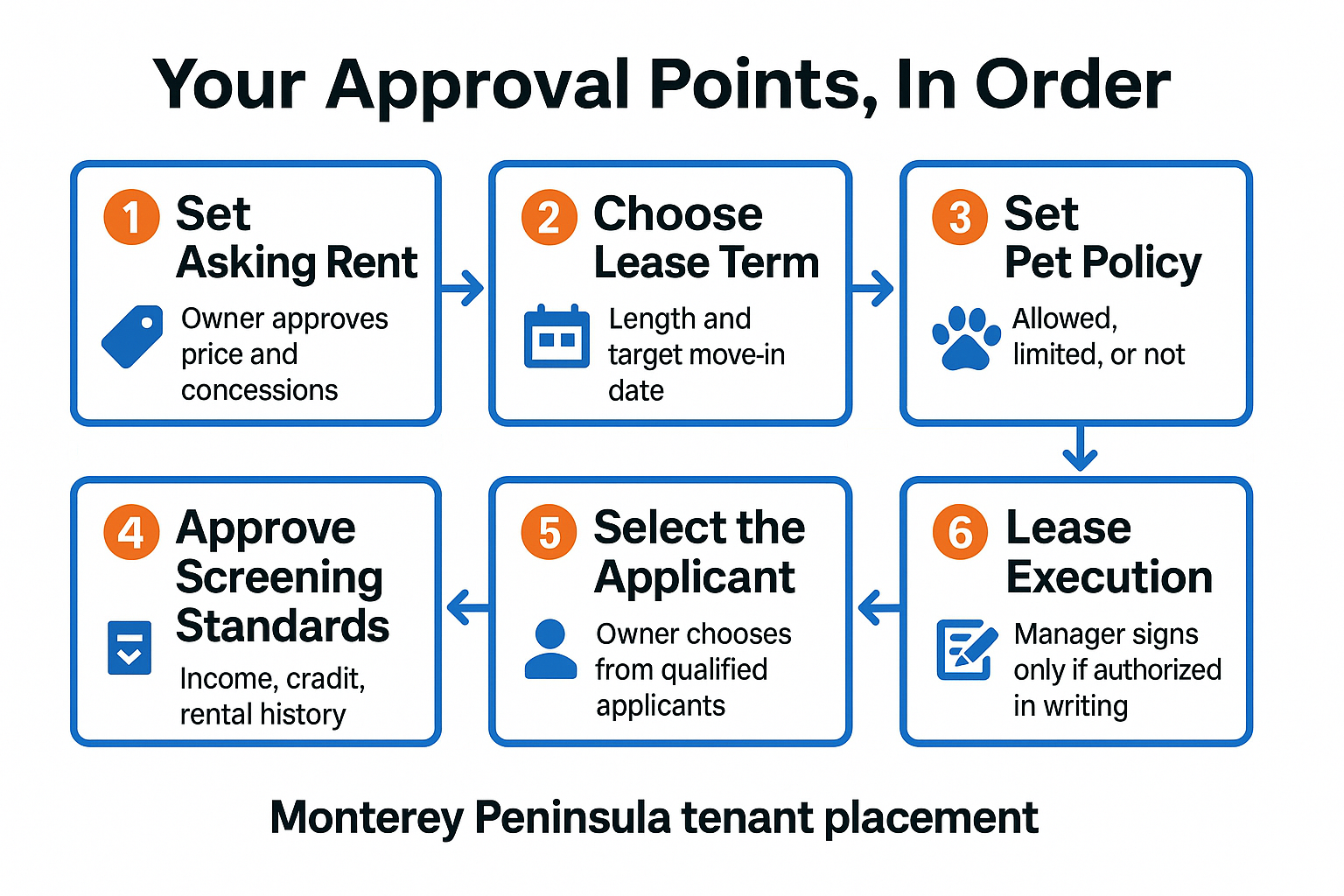
Here is the order they usually arrive in on a Pacific Grove, Carmel, or Monterey home:
- Asking rent, plus any concession like a partial first month or included utilities
- Lease term, whether that is twelve months, something longer, or a shorter window you have a reason for
- Pet policy, including whether you allow them at all and under what conditions
- Target move-in date, which matters more than owners expect when a home needs work first
- Which qualified applicant gets the keys
Our leasing work starts with a licensed agent walking the property in person, usually a 45 minute to one hour visit. That meeting covers a walkthrough, market trends for your block, upgrades or repairs worth doing first, and a suggested listing price.
On pricing, general market trackers in 2026 have put average Monterey apartment rents somewhere in the high $2,000s, with three bedroom homes across Monterey County often well above $4,000. Treat those as background noise, not a quote. A Pebble Beach estate and a Greenfield duplex live in different worlds, and how rent actually gets set on a local rental depends on condition, parking, view, and what else is sitting vacant that month.

Who Actually Signs the Lease, and Who Is Bound by It
This is the point most owners have never thought about until the lease is in front of them.
Your property manager can sign a lease on your behalf, but only when you have granted that authority in writing in the management agreement. That written grant is the whole foundation. Without it, the signature has no footing.
Two things surprise people here:
- The lease binds you, the owner. The manager signs as your agent, not as the landlord.
- In California, this leasing work sits with a licensed real estate broker or someone working under one. You can confirm any broker’s license status through the California Department of Real Estate.
So the question to settle before marketing starts is simple. Do you want to review and approve the lease before execution every time, or do you want your manager to sign once the terms you already approved are in place?
Both are workable. What causes trouble is leaving it unsaid, then discovering on move-in week that nobody sent you the document. If you are weighing how much involvement you want overall, our breakdown of tenant placement versus full management walks through where each one ends.
Who Decides What During Leasing
Here is the split as it usually works on a Peninsula property, assuming the management agreement is already signed.
| Decision | Who makes the call | When it comes up |
|---|---|---|
| Listing price and concessions | Owner, with market analysis from the agent | Before the listing goes live |
| Lease term and start date | Owner | Before the listing goes live |
| Pet policy | Owner | Before the listing goes live |
| Showing schedule and marketing | Manager | Throughout the vacancy |
| Screening standards | Agreed in advance, applied by the manager | Before applications open |
| Which approved applicant is selected | Owner, from applicants who met the standards | After screening is complete |
| Lease execution | Manager as the owner’s agent, if authorized in writing | After applicant selection |
| Move-in walkthrough and photos | Manager | Day of or just before move-in |
Why You Choose From Written Standards Instead of a Gut Feeling
You still pick the tenant. But the picking happens inside a set of standards you agreed to before any application came in.
That usually means written minimums for income, credit, rental history, and employment verification, applied the same way to every applicant. We screen in house and then send you a detailed application review so you can make the call yourself.
If a manager pushes back on a choice made purely on instinct, it is not stubbornness. It is because the owner carries the exposure when a rejected applicant decides the decision was unfair.
You do not have to take my word for the risk. Read public reviews of management firms anywhere in Monterey County and you will find denied applicants posting about it, insisting they met the income and credit standards and never got a real explanation. A selection decision becomes a public dispute fast.
Consistent criteria are what let you answer that calmly, with the same yardstick applied to everyone. For the mechanics of the screening itself, including where owners commonly slip, see how tenant screening works in California. High value Peninsula homes add their own wrinkle, since plenty of strong applicants are retired or self employed, which is its own exercise in verifying income when there is no pay stub.
Your Approval Points, In Order
Six moments where the decision comes back to you, from listing to keys.
The Paperwork That Should Land in Your Hands After Signing
Approvals are promises. Documents are proof. Once a lease is executed, a short, specific set of items should come back to you.
- The executed lease, signed by all parties
- The move-in evaluation with photos, documenting the condition of the home on day one
- Written confirmation that the security deposit and first month’s rent were collected
- The original document package, including applications, disclosures, and addenda
The timing matters less than the location. These should sit in your owner portal, not buried in an email thread you have to dig through next spring.
I say that because of who actually owns property here. One Carmel homeowner wrote to us saying she would be back in town only briefly and wanted to meet at the house. Another was relocating out of state before renting his home out. For an owner who spends part of the year somewhere else, being able to open the executed lease at 11 p.m. in another time zone is the entire point of having a portal.
That same habit carries through the tenancy. Photo confirmation that work was finished, monthly statements, inspection notes. If you want a sense of the normal rhythm after move-in, we covered how much you should hear from your manager in a typical month and who approves repairs once a tenant is in place.
Frequently Asked Questions About Owner Approval and Lease Signing
Can I ask to read the lease before it gets signed?
Yes, and you should. Reviewing the lease before execution is a normal owner request, not a sign that you are difficult to work with. Just say so at the start of the engagement so it is built into the process rather than added at the last minute.
Can a property manager sign a lease for me?
Only if you granted that authority in writing in the management agreement. The manager signs as your agent, and the tenant’s contract is with you, the owner. Settle this question before marketing begins, not during move-in week.
Do I get to pick the tenant, or does the manager?
You pick. The manager screens every applicant against the standards you approved in advance, then sends you a detailed review of the ones who qualified. Keeping the standards consistent is what protects you if a rejected applicant complains later.
What if I disagree with the suggested rent?
Then we talk it through. The asking price is your decision, and the market analysis exists to inform it, not override it. Pricing above the market usually shows up as a longer vacancy, which is a real cost worth weighing against the higher monthly figure.
How long does the leasing window usually take?
It varies a lot by city, season, and condition. A well prepared Pacific Grove or Monterey home in a strong month moves faster than an inland unit needing work. Anyone who quotes you a firm number without seeing the property is guessing.
Questions About How Approvals Would Work on Your Property?
Every approval point in this article is handled by a broker owner led team that has worked Monterey County since 2009, with a licensed California broker reviewing the file rather than a regional call center, and with executed leases and financial documents sitting in an owner portal you can open any time. If you want to talk through how this would look on your own home on the Peninsula, our office is reachable at (831) 757-1270 or through the contact form at coastandvalleypm.com.