Tenant Placement vs. Full Management: Which One Fits Where You Are
Direct Answer: Tenant placement finds and screens a tenant, then hands control back to you. Full management keeps handling rent, repairs, inspections, and California compliance for the life of the tenancy.
Most owners who reach out to us are not asking which company to hire. They are asking a simpler question: how much of this do I actually want to hand off?
One homeowner in Salinas told us they were moving out of state in a few months and wanted a rent estimate. Another owner with a condo in Soledad just wanted to know “how to go about it.” Those two people need very different arrangements, even though they filled out the same form.
So let me lay out the real difference between a tenant placement only service vs full management in California, what each one leaves on your plate, and how Monterey County’s local rules push that decision one way or the other.
What tenant placement only actually covers
Tenant placement, sometimes called leasing-only service, is front-loaded work. A manager markets the home, shows it, screens applicants, negotiates and signs the lease, then hands the property back to you.
Here is what that typically includes on our side:
- Consultation and a rent recommendation based on current local comps
- Marketing and advertising the listing
- Unlimited showings
- In-house screening: credit, rental history, employment verification
- Owner review of applications before any decision is made
- Lease execution and negotiation
- Move-in evaluation with photos
- Collection of the security deposit and first month’s rent
- The original document package handed over to you
After that, you own the day-to-day. Rent collection, the 11 p.m. water heater call, annual inspections, notices, rent increase math, deposit accounting at move-out. All of it.
Placement works well for a specific kind of owner. You live nearby, you have time during business hours, and you already know how California’s tenant screening rules and habitability standards work in practice.
One thing owners often miss: the legal obligations do not soften just because a professional wrote the lease. Just cause eviction protections, habitability duties, and notice requirements apply to you as the landlord from day one forward.

What full management picks up that placement does not
Full management includes everything in placement, then keeps going for as long as you own the property. That ongoing piece is where the real workload lives.
On our full management side, that means:
- Monthly rent collection and all resident communication
- Maintenance coordination and supervision of the work
- 24/7 emergency availability
- Annual property inspections and an annual market analysis
- Financial reporting through a secure owner portal
- Bill payment, including mortgage, utilities, insurance, and property taxes
- Compliance monitoring as California rules change
That last item is the one owners underestimate most. Our region has layers of rules that a self-managing owner has to track alone.
AB 1482, the Tenant Protection Act, caps annual rent increases for covered properties and requires just cause for most terminations. You can read the full bill text on the California Legislature’s site, though applying it correctly to a specific property is the harder part.
The City of Salinas Residential Rental Registration Ordinance (City Ord. 2663, adopted 2024) adds a registration obligation on top of state law. Miss a deadline while you are living in Boise, and you may not find out until it becomes a problem.
Our first year is an annual contract, then it moves to month-to-month. We also cover what full-service management includes and what it does not in more detail elsewhere, because the term gets used loosely across the industry.
Side by side: placement versus full management
This is the clearest way I can show where the work sits after the lease is signed.
| Responsibility | Tenant Placement Only | Full Management |
|---|---|---|
| Marketing and showings | Manager | Manager |
| Credit and background screening | Manager | Manager |
| Lease negotiation and signing | Manager | Manager |
| Move-in evaluation with photos | Manager | Manager |
| Monthly rent collection | Owner | Manager |
| Maintenance calls and vendor coordination | Owner | Manager |
| After-hours emergencies | Owner | Manager (24/7) |
| Annual inspections | Owner | Manager |
| Rent increase notices and AB 1482 caps | Owner | Manager |
| Salinas rental registration tracking | Owner | Manager |
| Financial reporting and 1099 records | Owner | Manager |
| Bill payment (mortgage, utilities, taxes) | Owner | Available |
A quick way to sort yourself into the right service
Four questions get most owners to an answer in about a minute.
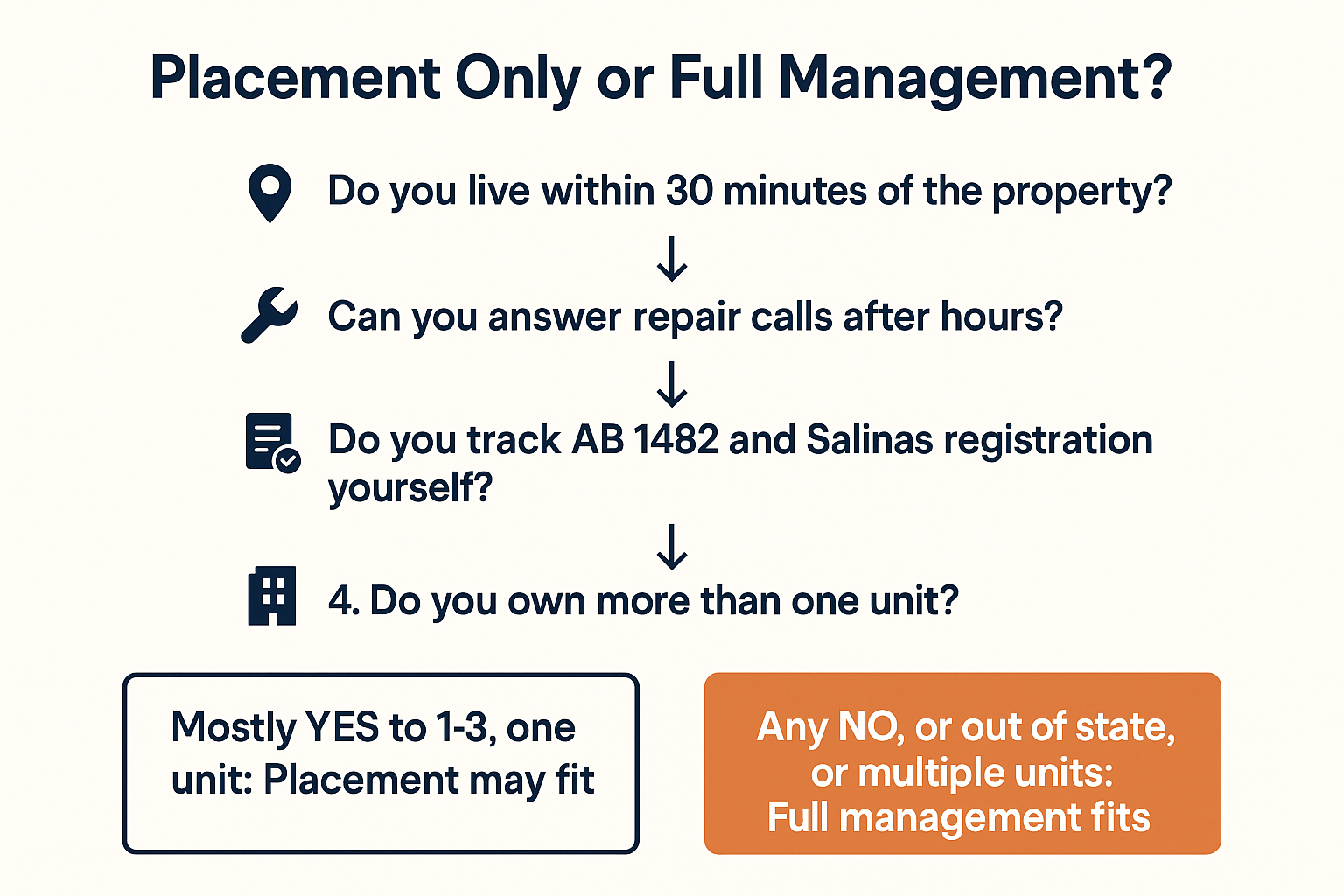
The two situations that decide it for most owners
In practice, two facts settle this more than anything else: where you live and how many doors you own.
An owner leaving California is almost always a full management situation. Distance turns small problems into expensive ones. A slow leak that a local owner catches on a Saturday drive-by becomes a subfloor replacement when nobody looks at the property for eight months.
Multiple units push the same direction. We hear from owners across Salinas who tell us that as their portfolio grew, handling everything themselves became too demanding. Four units means four lease dates, four rent increase calculations, four sets of inspection notices.
Small multi-unit buildings carry their own layer of rules too. I wrote separately about where compliance gets complicated on small Salinas apartment buildings, and that piece exists because the questions kept repeating.
Placement makes real sense in narrower cases. A retiree in Pacific Grove renting out a single home three blocks away, who is comfortable with notices and has a plumber they trust, may only need help finding the right resident.
On pricing, I will be straight with you: we do not publish fee amounts, because the right structure depends on property type, unit count, and which services you actually need. Placement is generally structured differently from ongoing monthly management. A conversation and a walkthrough get you a real number instead of a guess.
The hybrid question nobody asks until month six
Here is the scenario I see repeat. An owner uses placement, feels good about it, and then six months later the maintenance calls and the rent follow-ups wear them down.
They want to switch to full management. Whether that is simple depends entirely on the agreement they signed.
Ask before you sign:
- Can placement convert to full management mid-tenancy?
- Does converting require a brand new contract or an addendum?
- Is any portion of the placement fee credited?
- Who holds the security deposit after the switch?
- Does the manager inherit the existing lease as written?
With us, an owner can add residential management after a placement. Some firms require you to start over from scratch, which is worth knowing on day one rather than month six.
This is also why I tell owners to actually read what a management agreement says before signing anything. Termination terms, maintenance approval limits, and conversion language matter more than the headline fee.
Frequently Asked Questions About Placement vs. Full Management
If I use tenant placement only, am I still on the hook for California compliance?
Yes. You are the landlord. Habitability duties, just cause requirements under AB 1482 where it applies, lead paint disclosure on pre-1978 homes, and Salinas rental registration all remain your responsibility once the manager hands the property back.
I’m moving out of state in a few months. Is placement ever enough?
Rarely, in my experience. Someone local needs the authority to approve a repair, meet a vendor, and respond at 2 a.m. Distance is the single strongest argument for full management.
Do you manage short-term or vacation rentals?
No. We handle long-term residential and commercial management only. Monterey County’s Short-Term Rental Ordinance took effect in October 2024, and short-term operation sits outside what we do.
How much rent should I expect for my property?
That comes from a walkthrough, not a formula. A licensed agent visits the property for a 45 minute to one hour meeting, walks it, reviews condition and amenities, and gives you a rent range plus any upgrades worth making first.
Does placement include a guarantee if the tenant does not work out?
Screening reduces risk, it does not remove it. What matters more is the depth of the screening itself, credit, rental history, and employment verification, plus a documented move-in evaluation with photos so there is a clear record from day one.
Still deciding which structure fits your property?
If you own a rental in Salinas, Monterey, Carmel, Pacific Grove, or anywhere across Monterey County, the honest answer usually comes out of a walkthrough and a conversation about your situation. Coast & Valley Properties handles both leasing-only placements and ongoing residential and commercial management, and we are happy to talk through which one matches where you are right now. You can reach our office at (831) 757-1270 or through the contact form at coastandvalleypm.com.