What a Property Management Agreement Actually Says, and What to Look For
Direct Answer: A property management agreement is the legal contract between a property owner and a management firm that defines what services are included, how the manager is paid, what authority they have, and how either party can end the relationship.
A surprising number of property owners in Monterey County reach out to us already knowing the question they want answered. It isn’t about vacancy rates or maintenance vendors. It’s this: what exactly am I signing? Several owners who’ve contacted us recently asked specifically about fee structure and management agreement terms before they were willing to move forward, and I think that’s exactly the right instinct.
A property management agreement is the legal contract that governs everything between you and the firm you hire. It defines what services you’re actually getting, how compensation is calculated, how much authority the manager has to spend your money, and what happens if you need to walk away. Most owners sign it once and assume it’s standard. But the details inside vary enormously between firms, and the gaps almost always surface at the worst possible moment.
This article breaks down the three sections of a management agreement that matter most to owners in Salinas, Monterey, Carmel, and the surrounding communities. I’m not going to cover every clause. I’m going to focus on the parts that actually determine whether your experience with a manager will be what you expected, or a frustrating surprise.
The Services Section: Where Most Agreements Fall Short
The services section is where a management agreement either earns your confidence or quietly sets you up for disappointment. And it’s the section that varies the most between firms.
A vague services clause, something like “full-service residential management” without defining what that means, sounds complete. But I’ve seen owners discover real gaps when an emergency comes up and the agreement doesn’t actually require the manager to handle it. The question worth asking is: what, exactly, is included?
A well-written agreement should spell out each of the following as included services, not optional add-ons:
- Tenant marketing and listing across major rental platforms
- Tenant screening, including credit, background, and rental history checks
- Lease negotiation and execution
- Rent collection and owner disbursements
- Maintenance coordination with licensed vendors
- Routine property inspections on a defined schedule
- 24/7 emergency response for tenant issues
- Financial reporting, including monthly statements and year-end summaries
- Bill payment, including mortgage, HOA fees, and utilities if applicable
If any of those are listed as optional or priced separately, that changes the real cost picture. The article on what full-service property management actually covers goes deeper on this, and it’s worth reading before you sign anything.
One specific thing I look for: does the agreement describe the inspection schedule explicitly? A missed inspection can create liability that far outweighs the cost of managing the property in the first place. When a single missed inspection becomes a six-figure problem explains exactly why that matters.
Compensation Terms: The Headline Rate Isn’t the Whole Story
Most owners compare firms by their management percentage. That number matters, but it is rarely the full picture of what you’ll actually pay.
Residential property management fees in California commonly run as a percentage of collected rent, typically somewhere in the 8-12% range depending on the firm, property type, and scope of services. Some firms use a flat monthly fee instead, and others use a hybrid of the two. What varies most, and where the real differences show up, are the additional fees layered on top.
Here are the compensation items most agreements include beyond the base rate:
- Leasing fee: charged when a new tenant is placed, often equivalent to one month’s rent or a partial month. This is a real cost, and it compounds if tenant turnover is frequent.
- Lease renewal fee: some firms charge a flat fee each time an existing tenant’s lease is renewed. Others don’t. Worth asking.
- Maintenance markup: some agreements allow the manager to mark up the cost of vendor invoices by a percentage. It may be 10%, it may be more. The agreement should state this clearly.
- Vacancy fee: some agreements require a minimum monthly fee even when the unit sits empty. Others charge nothing during a vacancy. This is a meaningful distinction for owners of single-family homes.
When you’re comparing two firms, don’t compare the management percentage alone. Add up the realistic total over 12 months, including a leasing fee if you’re starting with a vacant unit. That gives you a real cost comparison. The California Department of Real Estate requires that all management fees be disclosed in writing, so if a firm is vague about any of these in the agreement, that’s a signal worth taking seriously. You can review the DRE’s guidance on property management disclosures directly if you want to understand what the law requires.
For owners evaluating a multi-unit property, the fee structure question gets more layered. Managing a multi-unit property in Salinas walks through how the economics shift as the property grows.
Common Management Agreement Fee Types at a Glance
Different management agreements bundle these fees differently. Use this as a checklist when reviewing any agreement.
| Fee Type | What It Covers | What to Clarify |
|---|---|---|
| Base management fee | Monthly oversight of the property | Is it % of collected rent or flat? What if the unit is vacant? |
| Leasing fee | Finding and placing a new tenant | Is it a full month’s rent, partial, or flat fee? |
| Lease renewal fee | Processing a lease renewal for an existing tenant | Charged every renewal or only year one? |
| Maintenance markup | Surcharge on vendor invoices | What percentage? Is it disclosed per invoice? |
| Early termination fee | Penalty for ending the agreement before term | How much? Does it apply mid-tenancy? |
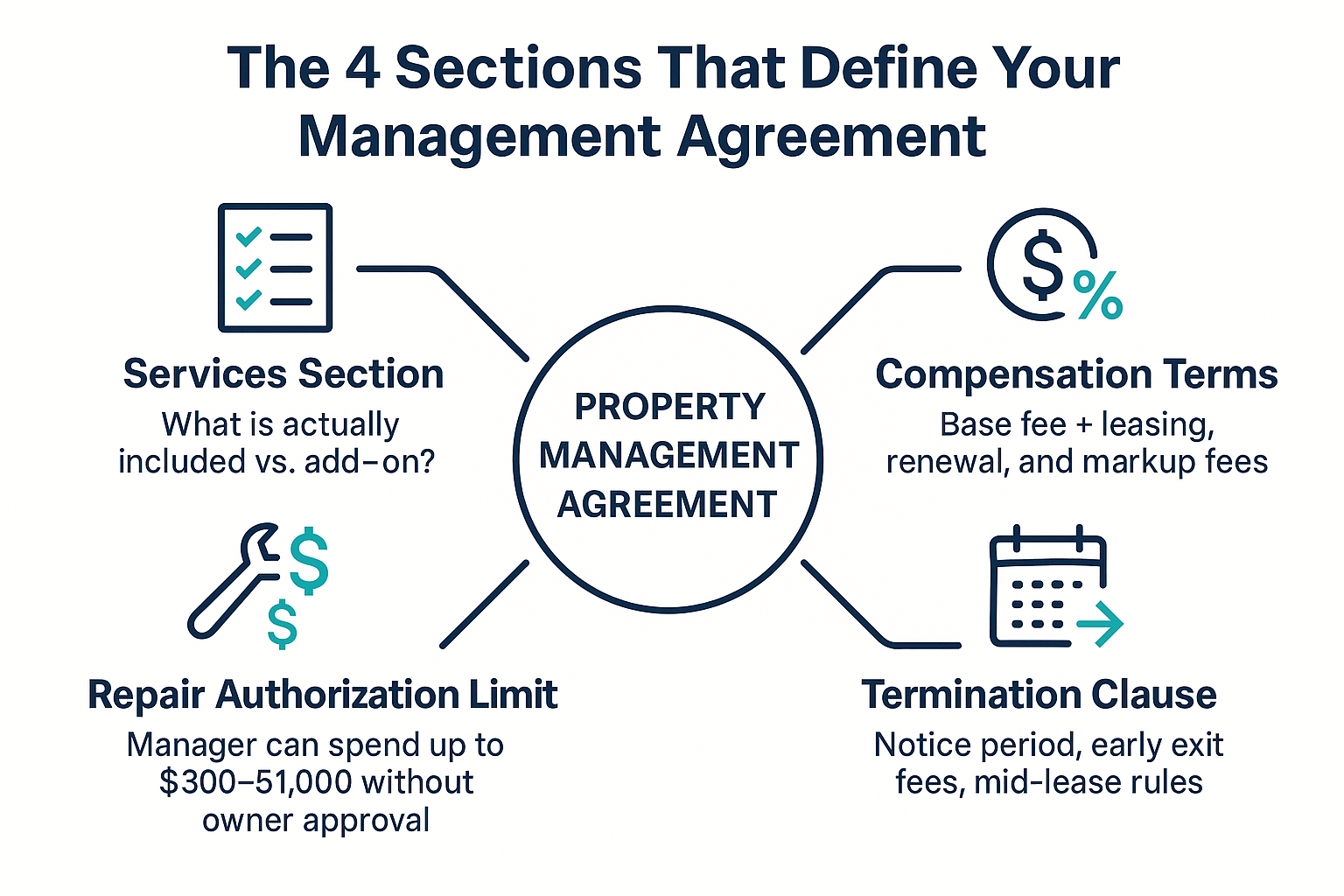
How the Four Key Sections of a Management Agreement Work Together
This overview shows what each major section of a property management agreement actually controls, and what questions to ask before you sign.
Repair Authorization and Termination: The Two Clauses Owners Overlook
These two sections sit near the back of most agreements. Most owners skim them. I’d argue they deserve more attention than the fee schedule.
Repair authorization defines how much money a manager can spend on maintenance without calling you first. This threshold is commonly somewhere between $300 and $1,000 depending on the firm and property type. For a hands-off owner who doesn’t want to field calls about a broken faucet, a higher threshold with good documentation requirements is reasonable. For an owner who wants to approve every expenditure above a modest amount, negotiating a lower limit upfront is worth doing.
What matters as much as the dollar amount is what the agreement says about documentation. Does the manager have to provide invoices for every repair? Are you notified after the fact when something is handled under the threshold? An agreement that allows discretionary spending without requiring any written record is a gap worth closing before you sign.
Termination clauses are the section I see owners most surprised by, usually when their situation has changed and they want to end the relationship. Some agreements require 30 to 60 days’ written notice with no penalty. Others include fees for ending mid-lease or during an active tenancy. A few lock owners into the full initial term regardless.
I’ve also spoken with owners who wanted a placement-only arrangement, meaning they want a manager to find and screen a tenant, handle the lease, and then step back from ongoing management. Some agreements accommodate this as a defined service scope. Others don’t offer it at all. If that’s what you need, confirm it is written into the agreement explicitly, not just promised verbally.
If you’re thinking about switching firms mid-stream, or coming from self-management for the first time, switching to a property manager in Salinas explains what that transition actually looks like in practice.
How California Law Shapes What a Management Agreement Must Include
A management agreement in Monterey County doesn’t exist in a vacuum. California law creates specific obligations that affect what any firm managing property here is required to do, and what must be reflected in writing.
Under California’s Business and Professions Code, a property manager acting on behalf of an owner must be a licensed real estate broker or operate under one. The agreement itself is a brokerage contract, which means certain disclosures and fiduciary duties apply. If you’re evaluating a firm, confirm that the broker of record is identified in the agreement by name and license number.
The agreement also needs to align with California’s AB 1482 Tenant Protection Act if your property qualifies. AB 1482 caps annual rent increases and restricts the reasons an owner can terminate a tenancy for properties that fall under its scope. If your manager doesn’t account for that in how they draft leases and notices, that’s a compliance risk that lands on you, not them. What new California landlord laws mean for Monterey County owners in 2026 covers the current landscape clearly.
The City of Salinas also enacted its Residential Rental Registration Ordinance (City Ord. 2663) in 2024, which adds a registration requirement for rental properties within city limits. A management agreement with a firm that operates primarily in Salinas should either include compliance tracking for this registration or clearly state that it’s the owner’s responsibility.
Frequently Asked Questions About Property Management Agreements
Can I negotiate the terms of a management agreement, or is it take-it-or-leave-it?
Most agreements have negotiable elements, particularly the repair authorization threshold, the notice period for termination, and sometimes the leasing fee structure. A firm that refuses to discuss any terms at all is worth a second look. That said, core fee structures are usually fixed, what you’re more likely to negotiate is the scope of services and the conditions around exiting the agreement.
What happens to my management agreement if I decide to sell the property?
Most agreements include a clause that addresses this. Some terminate automatically upon a sale closing. Others require written notice to the manager within a defined window before closing. A few include a fee if the manager helped the property reach the market condition that made a sale possible. Read this clause before you list, not after.
Is the management fee charged even when my unit is vacant?
It depends entirely on the agreement. Some firms charge a reduced fee or no fee during a vacancy. Others charge a minimum monthly fee regardless. This is one of the most important questions to ask before you sign, especially if you own a single-family home where a vacancy of even one month represents meaningful lost income.
What is a leasing fee and how is it different from the monthly management fee?
The monthly management fee covers ongoing oversight of the property while a tenant is in place. The leasing fee is a separate, one-time charge triggered when a new tenant is placed. It typically covers marketing, showings, screening, and lease execution. It is commonly priced at one month’s rent or a percentage of it, and it applies each time a new tenant moves in, so tenant turnover directly affects how often you pay it.
Do I need a lawyer to review a property management agreement before signing?
You don’t legally have to, but for a high-value property or a multi-unit portfolio, having a California real estate attorney review the termination clause and compensation schedule is a reasonable step. At minimum, read every section yourself before signing, especially anything related to fees, repair authorization, and the conditions for ending the relationship.
What should I do if a management agreement lists services that don’t match what was promised verbally?
Ask for it in writing before signing. Verbal commitments that contradict the written agreement are almost impossible to enforce in California. If a firm promises 24/7 emergency response, quarterly inspections, or a specific fee cap, and none of that appears in the contract, request an addendum. If they decline, that tells you something important.
Ready to Review What a Management Agreement Should Look Like?
If you’re evaluating property management options in Monterey County and want to understand exactly what you’d be signing before you commit, we’re glad to walk through it with you. Coast & Valley Properties serves property owners across Salinas, Monterey, Carmel, Pacific Grove, and South County communities, and we’re happy to answer specific questions about how our agreements are structured. Reach us by phone at (831) 757-1270 or through the contact form at coastandvalleypm.com.