Switching to a Property Manager in Salinas: What the Process Actually Looks Like
Direct Answer: Switching to a property manager in Salinas starts with a property assessment, followed by listing preparation, tenant screening, lease signing, and ongoing management — typically taking two to four weeks from first conversation to a placed tenant.
We get messages from Salinas property owners fairly regularly that say something close to this: ‘I need help, but I don’t really understand how the process works.’ That’s not a knock on anyone — it’s just an honest gap. Most owners know they need professional support before they actually know what that support looks like in practice.
Some of the owners who reach out are managing several units and have hit the wall. The coordination — maintenance calls, rent tracking, compliance paperwork — has become more than a side task alongside a full professional life. Others own a single home they’ve inherited or plan to rent for the first time and want to start right. Either way, the question is the same: what actually happens, step by step, when I hand this property over?
This article walks through the real process as we carry it out — not a marketing overview, but the actual sequence of decisions and actions from the first conversation through ongoing day-to-day management. If you’ve been putting off the transition because the process felt opaque, this should clear that up.
Step One: The Property Assessment
The process begins with a walkthrough. Before anything else happens — before photos, before pricing, before a listing goes live — someone needs to see the property in person.
That walkthrough covers a few different things at once:
- Current physical condition — what’s functional, what’s deferred, what needs attention before a tenant moves in
- Compliance status — including whether the property is registered under the City of Salinas Residential Rental Registration Ordinance, which took effect in 2024
- Realistic rental rate — based on comparable recent leases in the same neighborhood, not a zip code average
On that last point: Salinas rents in 2025 have generally ranged somewhere around $2,000 to $2,700 per month depending on unit type, size, and location — but those are broad market figures. The number that matters is what a well-prepared unit in your specific neighborhood and condition will actually attract right now. Owners who price based on what they need to cover the mortgage, rather than what the market supports, tend to sit vacant longer than they expect.
The assessment isn’t a formality. It’s the foundation for every decision that follows.
Step Two: Getting the Property Ready to List
After the walkthrough, the focus shifts to preparing the unit for the market. This is where we coordinate any deferred maintenance items, arrange professional photography, and write the listing itself.
Owners frequently underestimate how much the quality of a listing affects the quality of applicants. A poorly photographed unit — dark photos, odd angles, clutter visible in the background — draws fewer inquiries from qualified renters. In a competitive market like Salinas, that matters. Fewer qualified inquiries means more pressure to accept the first person who applies rather than the best-qualified person.
A listing also needs to be accurate. California law is specific about what can and cannot be represented in a rental advertisement, including lead paint disclosure requirements for older properties. Getting the listing right from the start protects the owner legally and attracts tenants who are a genuine match for the unit.
Once the listing is ready, it goes out across multiple rental platforms simultaneously. The goal is maximum qualified exposure in the shortest window — because every additional day of vacancy is a day of lost rent.

Step Three: Tenant Screening — The Decision That Shapes Everything Else
If there is one step in this entire process that determines whether the next twelve months go smoothly or become a serious problem, it’s tenant screening. And it’s also the step where self-managing owners most often get into legal trouble without realizing it.
Lawful screening in California involves a defined process:
- Income verification — typically looking for gross income of roughly three times the monthly rent
- Credit review — payment history, outstanding debt, prior evictions
- Rental history — past landlord references, patterns of tenancy
- Consistent criteria — the same standards applied to every applicant in the same order
That last point is not optional. California’s Fair Employment and Housing Act requires that screening criteria be applied consistently. Owners who make ad hoc decisions — accepting one applicant over another based on intuition rather than documented criteria — expose themselves to discrimination claims.
Starting January 1, 2026, AB 1414 adds another layer: landlords who use third-party tenant screening services now have specific obligations around how applicant data is collected, stored, and protected. What new California landlord laws mean for Monterey County owners in 2026 covers this in more depth, but the short version is that compliance requirements around screening are increasing, not decreasing.
A well-qualified tenant placed in a Salinas rental through a thorough, lawful screening process is genuinely the difference between a smooth tenancy and a situation that ends in a legal dispute. As one article we’ve published on the topic puts it, the difference between a good tenant and a great one starts before move-in.
The Onboarding Process at a Glance
Here’s how the process typically unfolds from first contact to active management — and roughly how long each phase takes.
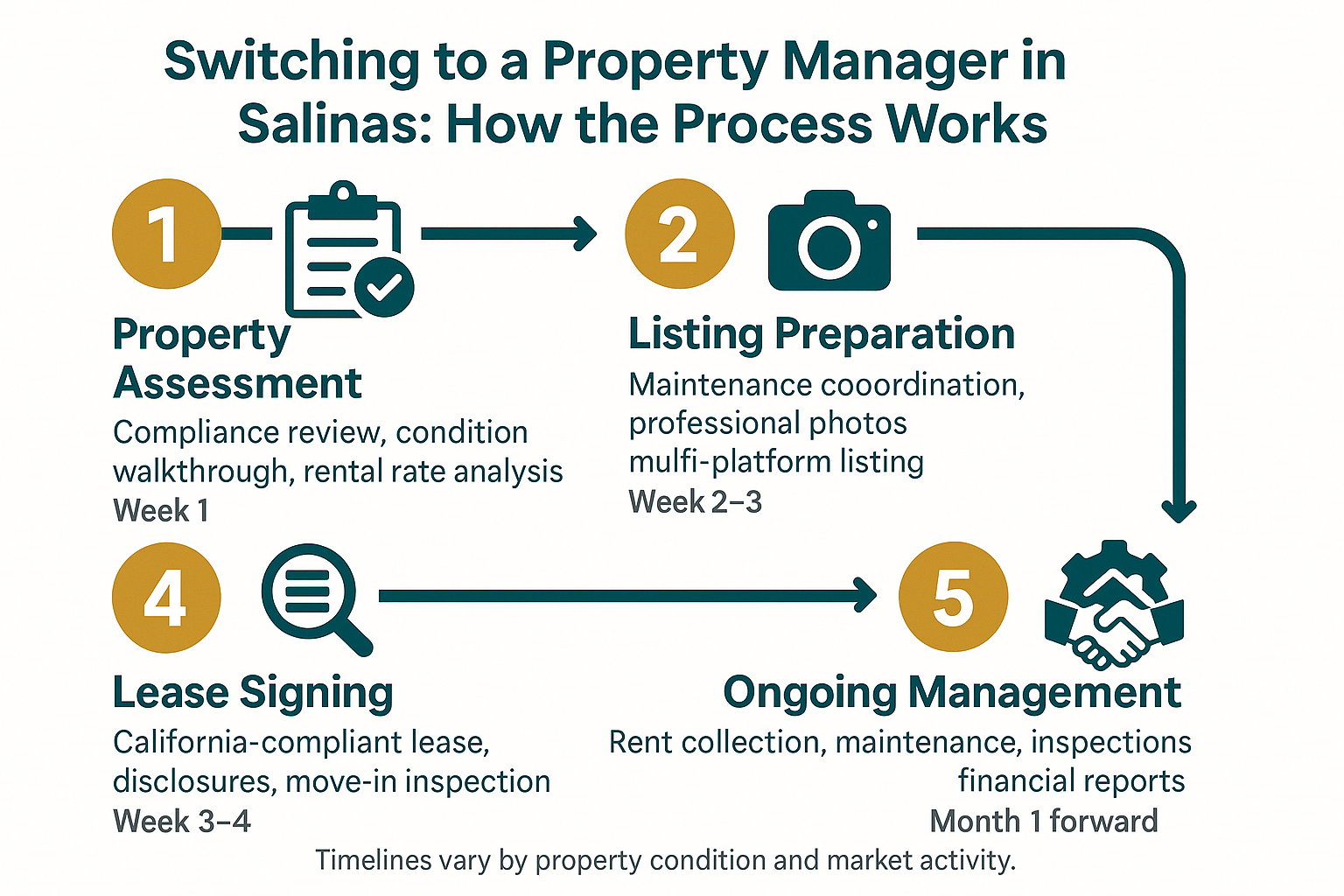
What Happens After the Lease Is Signed
This is where first-time managed-property owners are often most surprised. The lease signing feels like the finish line. It’s actually the starting point.
Ongoing management is not a passive role. Every month involves:
- Rent collection and follow-up when payment is late
- Maintenance coordination — fielding requests, dispatching vendors, tracking completion
- Scheduled property inspections to catch issues before they become expensive
- Bill payment including mortgage, HOA fees, and utilities where applicable
- Monthly financial statements delivered through the owner portal
- 24/7 emergency response for situations that can’t wait until Monday morning
Several owners who have contacted us after attempting to self-manage described reaching a point where the volume of coordination had become unmanageable alongside a full professional or personal life. One property owner with multiple units in Salinas described it as reaching ‘the point where I need dedicated support’ — not because anything had gone wrong, but because the sheer number of moving parts had outgrown what one person could reasonably track.
That’s a normal inflection point. And it’s exactly what full-service property management is designed to absorb.
California’s warranty of habitability also means that maintenance isn’t discretionary — owners have a legal obligation to maintain livable conditions, and a professional manager’s documentation and vendor relationships are a direct line of defense against habitability claims.
Self-Managing vs. Professional Management: What Changes
This isn’t a complete side-by-side of every task — it’s the specific areas where owners most often feel the difference after making the switch.
| Task | Self-Managing Owner | Professional Manager |
|---|---|---|
| Rental pricing | Based on mortgage needs or guesswork | Based on current comparable leases in the neighborhood |
| Listing quality | Often phone photos, single platform | Professional photos, multiple rental platforms |
| Tenant screening | Informal or inconsistently applied | Documented criteria, legally compliant process |
| Maintenance coordination | Owner fields every call directly | Manager coordinates vendors, tracks completion |
| Legal compliance | Owner researches changes independently | Manager monitors CA law updates and city ordinances |
| Financial reporting | Manual spreadsheets or no tracking | Monthly statements via owner portal |
| Emergency response | Owner’s personal phone, any hour | Dedicated 24/7 response line |
The Compliance Layer Most Owners Don’t Think About Until It’s a Problem
Salinas is not a simple regulatory environment. The City of Salinas Residential Rental Registration Ordinance (City Ord. 2663) requires landlords to register rental properties annually — a requirement that caught a number of owners off guard when it rolled out in 2024. That registration is separate from California state law requirements, which include AB 1482 rent increase limits for covered properties, habitability standards, and disclosure obligations.
For properties in Monterey County more broadly, the California Department of Consumer Affairs publishes the state’s landlord-tenant handbook, which outlines baseline legal obligations — but local ordinances layer on top of that, and they change. An owner managing their own property has to track those changes independently. A professional manager does it as part of the job.
This is one of the less visible benefits of professional management, but it’s one of the more consequential ones. A missed registration, an improper rent increase, or a failed disclosure can create liability that far exceeds the cost of management fees. When a single missed inspection becomes a six-figure problem explores how quickly those gaps compound.
Frequently Asked Questions About Switching to a Property Manager in Salinas
How long does it take from first contact to having a tenant in place?
It depends on the condition of the property and current market activity, but owners should generally plan for two to four weeks from the initial walkthrough to a signed lease. A unit that needs deferred maintenance addressed before listing will take longer. A well-prepared unit in a high-demand Salinas neighborhood can move faster.
What happens to my existing tenant if I bring on a property manager mid-lease?
The existing lease stays in place — a change in management doesn’t void a valid tenancy. The manager introduces themselves to the tenant, establishes new payment and maintenance communication channels, and takes over from there. The transition is typically straightforward as long as the lease documentation is in order.
Do I need to be registered with the City of Salinas before a manager can list my property?
Yes. The City of Salinas Residential Rental Registration Ordinance (City Ord. 2663) requires landlords to register rental properties. That registration needs to be in place — or initiated — before a unit is listed. Part of the initial property assessment is identifying any compliance gaps, including registration status.
Can I stay involved in decisions about my property after handing it over?
Absolutely. Most owners want to be informed without being the ones fielding every maintenance call or applicant question. A professional manager handles the day-to-day coordination and brings the owner in for decisions that warrant it — major repairs, lease renewals, significant tenant issues. The owner portal gives you real-time visibility into financials and reports at any time, without requiring you to be in the middle of every transaction.
What does tenant screening actually look like legally in California right now?
A lawful screening process in California involves documented, consistently applied criteria — income verification, credit review, and rental history — applied the same way to every applicant. Starting January 1, 2026, AB 1414 adds new obligations for landlords who use third-party screening services around how applicant data is handled. Self-managing owners who are unaware of these requirements and making screening decisions on instinct are taking on real legal risk.
How do I know what rent to charge?
Market averages for Salinas give you a general range, but the right number for your specific unit depends on size, condition, neighborhood, and what comparable units have actually leased for in recent months — not just what they’re listed at. Pricing based on your mortgage payment rather than market data is one of the most common reasons units sit vacant longer than necessary.
Ready to See What This Looks Like for Your Property?
If you own a rental in Salinas, Monterey, Carmel, or anywhere across Monterey County and you’ve been wondering how the handoff actually works, we’re happy to walk you through it — starting with a straightforward conversation about your property and your situation. Coast & Valley Properties can be reached by phone at (831) 757-1270 or through the contact form at coastandvalleypm.com.