Owning a Small Apartment Building in Salinas: Where the Compliance Gets Complicated
Direct Answer: Small Salinas apartment buildings face rules single-family rentals often skip: city rent stabilization on pre-1979 units, per-unit annual registration every July, and round-the-clock emergency duty across every door.
Most owners I talk with did not set out to become apartment landlords. They bought a duplex, inherited a fourplex on the east side of Salinas, or picked up a small building near Alisal because the numbers made sense at the time.
Then the rules caught up with them. A rent increase notice goes out, a tenant files a petition, and suddenly the owner is reading a city ordinance at 10pm trying to figure out whether their building was built before or after 1979.
That is the part nobody warns you about. Going from one rental house to four units does not multiply your workload by four, it changes the kind of work entirely. Below I want to walk through the three places where multi-unit compliance in Salinas actually trips owners up, and why the two-to-six-door range is where I see people hit their limit.
Why Salinas Multi-Unit Owners Hit a Wall That Single-Home Owners Do Not
Our contact form tells the same story over and over. One owner reached out about several rental units she holds across Salinas and said that as her portfolio grew, managing everything herself had become more demanding than she could keep up with. Another wrote in looking for full service management on a four-unit building with remodeled, vacant units.
Different properties, same breaking point. And it is almost always somewhere between two and six doors.
Here is why that range is the pressure point:
- One vacancy in a fourplex is a 25% income hit, not a rounding error
- Shared plumbing, shared roofs, and shared electrical mean one problem becomes three tenants’ problem
- Tenants in the same building talk to each other, compare rents, and notice inconsistent enforcement
- Compliance filings and notices multiply per unit, not per property
- Emergency calls arrive at night, on holidays, and while you are out of town
A single-family owner in Monterey or Pacific Grove can often absorb this with a good handyman and a calendar reminder. An apartment owner cannot. If you want the broader operational picture, I wrote about what changes as you add doors in more detail.
Rent Caps: Two Different Rules, and Your Building Might Be Under the Stricter One
This is the single most expensive mistake I see. Multi-unit buildings in Salinas are far more likely to fall under local rent stabilization than single-family homes are, and most owners do not realize it until a tenant challenges an increase.
As the city’s Rent Stabilization Ordinance is written, multi-unit buildings constructed before 1979 in Salinas are generally covered. Where it applies, annual increases are limited to 2.75% or 75% of CPI, whichever is lower. That is meaningfully tighter than the statewide ceiling.
Statewide, California’s AB 1482 Tenant Protection Act allows 5% plus regional CPI with a hard cap at 10% per year, and it also brings just cause eviction requirements into play. Housing built within the last 15 years is generally exempt, and single-family homes can be exempt with the right written disclosure.
So an owner with one Carmel rental and one 1962 Salinas fourplex is operating under two different rulebooks at the same time.
Where it gets genuinely complicated:
- Eligibility is unit by unit, not building by building, so a converted unit or an added ADU may sit outside the coverage the rest of the building falls under
- The calculation method matters, and CPI-based math done wrong is still done wrong
- Increases have to be noticed properly, with correct timing based on the size of the increase
- An improper increase can trigger a tenant petition and the city’s formal dispute process
I have watched owners lose a full year of increase because the notice was one step out of order. The rent was defensible. The paperwork was not.
Annual Rental Registration: One Filing Becomes Eight
The Salinas Residential Rental Registration Ordinance (City Ord. 2663, 2024) requires owners and managers of covered units to register annually. The window is narrow: July 1 through July 31.
For a single-family owner, that is one filing once a year. For the owner of an eight-unit building, it is eight separate unit registrations, each one needing accurate, current information.
That sounds like clerical work, and most of the year it is. The problem is when it surfaces later.
A compliance gap in your registration record has a way of showing up at the worst possible moment, usually in the middle of an eviction proceeding or a habitability dispute, when the last thing you want is a defect in your own file. I have seen owners who did everything right on maintenance and screening get slowed down by a registration entry that listed an old mailing address.
A few habits that keep this clean:
- Treat the July window as a fixed annual event, not a task to handle when you remember
- Update unit information when ownership entity, contact, or manager details change, not at renewal time
- Keep proof of each filing in the same place you keep leases and inspection records
- Reconcile your registration list against your actual rent roll every year
I cover the wider compliance picture for multi-unit owners across Monterey County separately, because South County and the Peninsula each add their own wrinkles.
One Rental House vs. One Fourplex: What Actually Changes
Here is the practical difference between managing a single Salinas rental and a small apartment building of the same total value.
| Compliance Area | Single-Family Rental | Pre-1979 Fourplex in Salinas |
|---|---|---|
| Annual rental registration | One unit filing each July | Four unit filings each July |
| Rent increase limit | Often AB 1482, or exempt with proper written disclosure | Generally city rent stabilization, the stricter of the two |
| Just cause eviction rules | Applies unless a valid exemption is disclosed | Applies, with local process layered on |
| Habitability exposure | One tenant, one system set | Shared plumbing and roof, one failure affects several tenants |
| Emergency response | Occasional after-hours calls | Round-the-clock duty across every unit |
| Vacancy impact | 100% of income for that property | 25% of income, visible to remaining tenants |
| Lead paint disclosure | Required for pre-1978 housing | Required for pre-1978 housing, per unit |
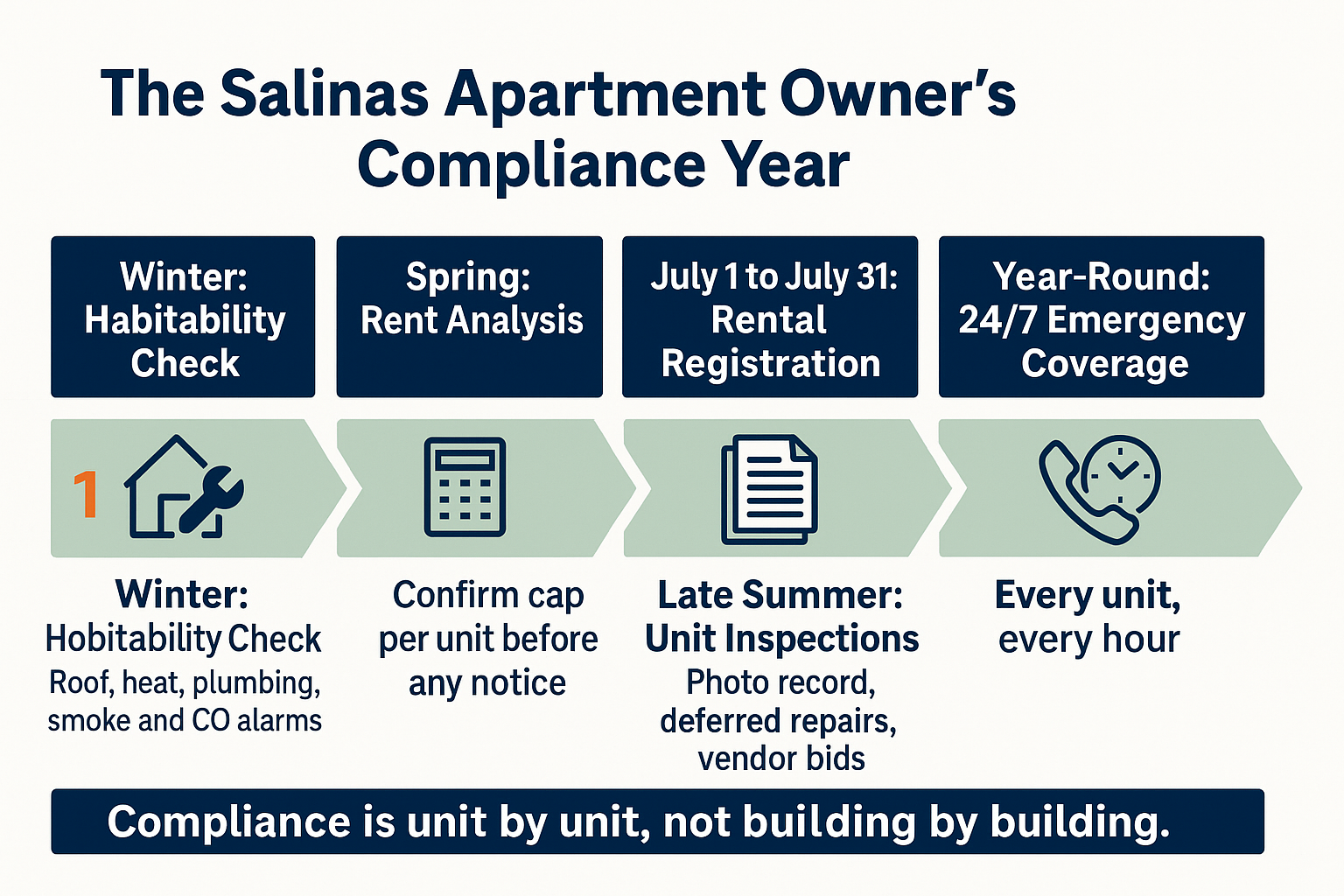
The Salinas Apartment Owner’s Compliance Year
This is the rhythm I keep in mind for a small multi-unit building in Salinas, laid out across the calendar year.
Maintenance Across Units Is a Different Job Entirely
A water heater failure in a single-family rental is inconvenient. The same failure in a fourplex can mean water in an adjacent unit, a habitability claim from a tenant who did nothing wrong, and a repair that has to be coordinated around four schedules.
California’s warranty of habitability does not care that you were on vacation. It does not care that your usual plumber was booked. And in a shared-wall building, the clock starts running on more than one tenant at once.
What I see wear owners down is not the repairs themselves. It is the 24/7 availability requirement.
Sustaining that alone gets harder with every door you add:
- Someone has to answer the phone at 2am, every night, all year
- You need vendors who will actually show up in Salinas at that hour, not just a name in your contacts
- Shared systems mean a single call may require access to multiple units
- Every interaction needs a written record, because that record is your defense later
Owners who self-manage well usually have one strong trade relationship and a lot of personal availability. That combination is fragile. When the plumber retires or the owner takes a job with real hours, the whole system falls over. It is one of the things Salinas owners most often get wrong about self-managing.
Vacancy Sequencing: The Problem Nobody Sees Coming
Here is a wrinkle that single-property owners never deal with. When one unit in your building sits vacant, your other tenants are watching.
They see the showings. They notice the listing price. If you price the vacant unit well above the rent-stabilized units next door, you have handed your existing tenants a comparison they will remember at renewal time. Price it too low and you have just set a comp against yourself.
Pricing that unit correctly takes real neighborhood knowledge. Market reporting has put average Salinas rents somewhere around $2,006 per month in early 2026, but treat that number carefully. It blends studios, older fourplex units, and newer three-bedroom homes across the whole city.
What that average will not tell you:
- What a specific floor plan leases for in a specific Salinas neighborhood
- How much a remodeled unit can command over an original one in the same building
- Whether a vacancy in your submarket fills in two weeks or six
- How your occupied, capped units constrain what you should ask for the open one
This is where a real market analysis earns its keep, and it is one reason a manager’s neighborhood-level knowledge matters more on multi-unit than on single-family. The order in which you fill units, and at what price, shapes the building’s income for years.
Frequently Asked Questions About Salinas Multi-Unit Compliance
How do I know if my Salinas apartment building is under rent stabilization?
Start with the construction date and the unit count, since multi-unit buildings built before 1979 are generally covered by the city ordinance. But do not stop there. Converted units, added units, and unusual parcel history can change the answer unit by unit, so confirm each one against city records before you send a single increase notice.
What happens if I miss the July rental registration window?
You end up with a gap in your compliance record. Most of the time nothing happens immediately, which is exactly why owners let it slide. The problem shows up later, often during an eviction or a tenant dispute, when a defect in your own filing weakens your position at the worst possible time.
Can I raise rent to market when a unit turns over in a rent-stabilized building?
Vacancy rules and unit eligibility drive that answer, and it varies. This is a question worth getting confirmed in writing before you list the unit, not after you have signed a lease at the wrong number.
Is managing a fourplex really that different from managing four separate houses?
Yes, and in some ways it is harder. Four houses give you four independent problems. A fourplex gives you shared systems, tenants who compare notes, one roof over everyone, and vacancy decisions that ripple through the whole building. The compliance layer is also denser, because local ordinances often treat multi-unit buildings more strictly.
What does professional apartment property management cost in Salinas?
Costs in this market vary quite a bit based on unit count, condition, whether you need full management or just tenant placement, and how much vendor coordination the building requires. We do not publish rates because the honest answer depends on the property, so pricing conversations happen after a walkthrough. A licensed agent visits in person, usually a 45 minute to one hour meeting, and gives you a specific range based on what the building actually needs.
Thinking Through Your Next Step on a Salinas Multi-Unit Property?
If you own a small apartment building in Salinas and the compliance side has started to feel heavier than the property itself, that is a normal place to arrive. Coast & Valley Properties has managed residential and commercial property across Monterey County since 2009, and we are glad to talk through what your building specifically requires. You can reach our office at (831) 757-1270 or through the contact form at coastandvalleypm.com.