
Who Gets Inside Your Vacant Salinas Rental Before It's Leased
When an owner calls me about renting out a house for the first time, the question underneath the question is rarely about fees or lease length. It is about who will be standing inside an empty house they own, and whether they will hear about it.
We get that question constantly from owners in Salinas, Soledad, Gonzales, and up on the Peninsula. One owner wrote in asking for help understanding the listing process from scratch. Another with a condo in South County simply asked how getting a property managed works and what is included.
So here is my position, plainly. No one should get through the door of a vacant rental without being qualified first and accompanied by someone who answers to you, and every one of those visits should double as a condition check on the building. Below is the order things actually happen in, and the decisions you get to make along the way.
What Happens Between the Listing Going Live and the Keys Changing Hands
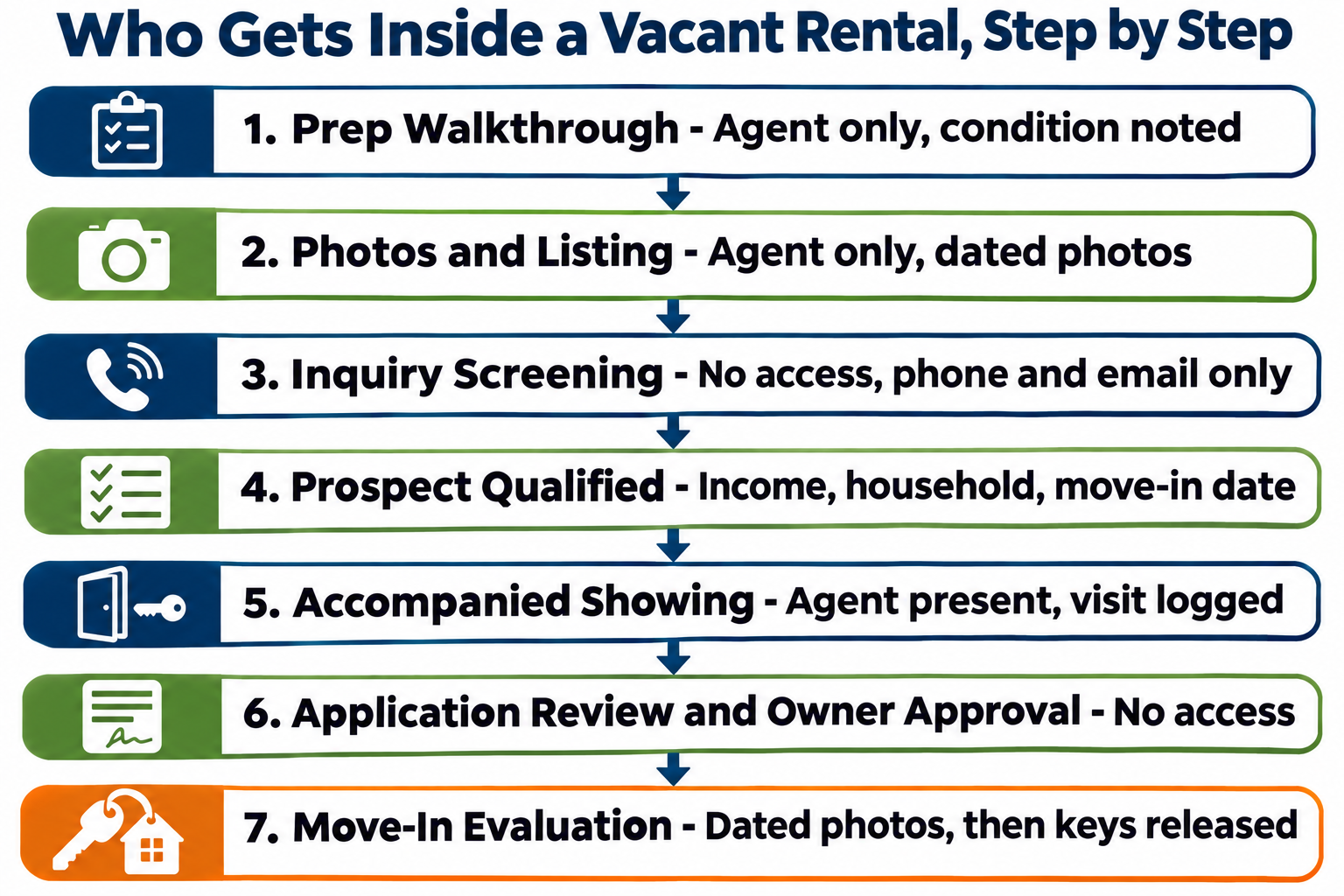
Most owners have no mental picture of this sequence, which is why the access part feels unsettling. Here is the order, start to finish:
- Pricing and prep walkthrough. Someone walks the property in person, notes condition, and sets a realistic rent range for that street and that season.
- Photos and listing. The listing goes live with accurate bedroom count, lease term, and photos that match what a prospect will actually see.
- Inquiry handling. Calls, emails, and portal messages come in. Many are tire kickers. Some are already living two hours away and want a video.
- Qualifying the prospect. Income, move-in date, household size, pets, and sometimes a completed application before a door opens.
- The showing. Accompanied, by appointment, with the agent present the whole time.
- Application review. Credit, background, rental history, and employment verification, then your approval before anyone signs.
- Lease execution.
- Move-in evaluation with dated photos, deposit and first month collected, then keys.
That whole run takes weeks, not days, and the property is empty for all of it. If your house is freshly remodeled, the prep step matters even more, because a remodel does not automatically mean rent ready.
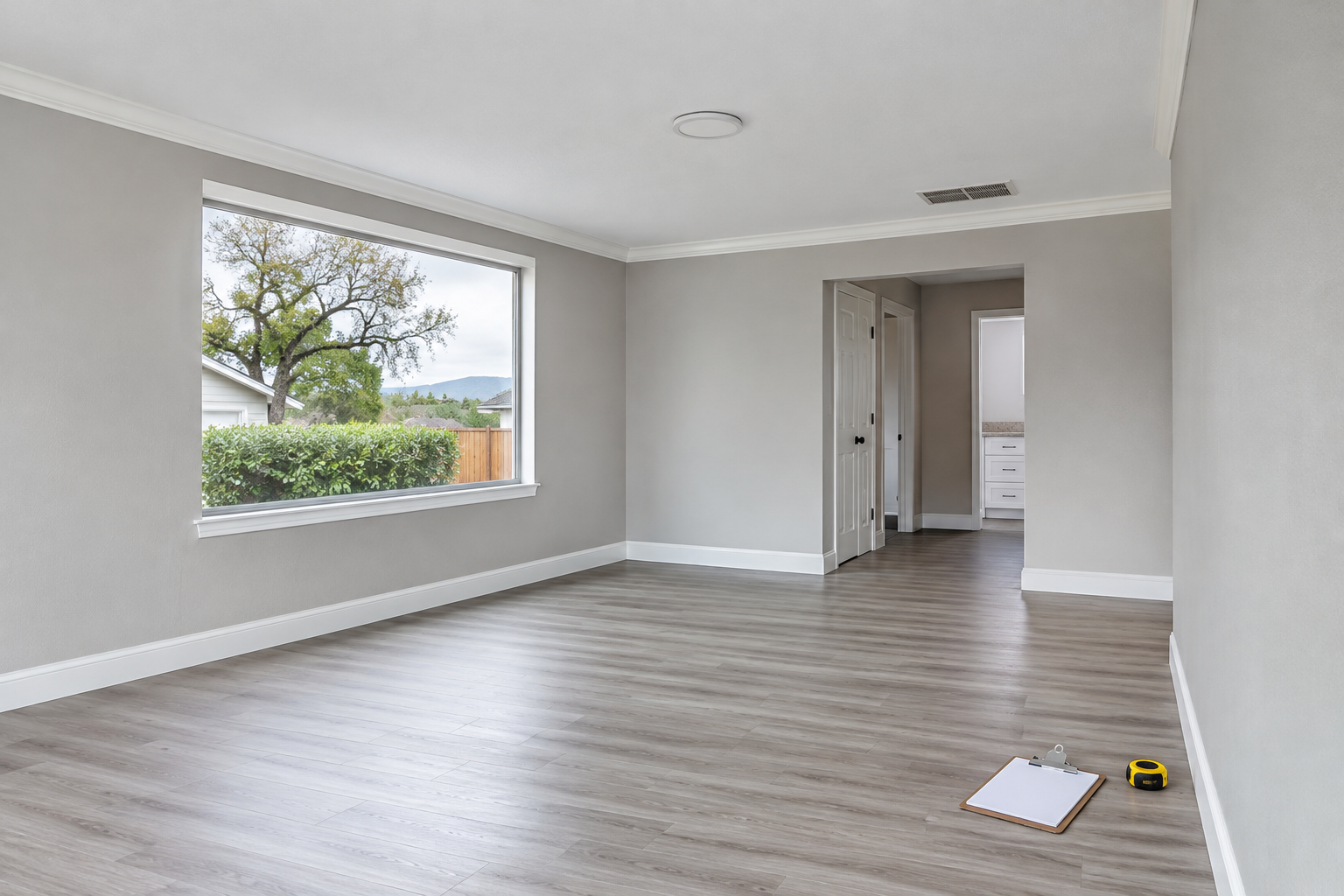
Showing Policy Is a Real Fork in the Road, and It Is Your Call
This is where owners quietly disagree with each other, and both sides have a point.
Open the door to anyone who calls and you get volume. More eyes means a faster lease, and on a vacancy you are carrying, speed has real value. But you also get no shows, unqualified traffic, and strangers wandering a house you own.
Tighten it up and you get fewer, better visits. Read the public reviews of management firms around Monterey County and you will find renters who are genuinely annoyed at being asked to apply or qualify before touring. That frustration is real, and it does shrink your applicant pool.
Now look at it from the owner side. The owners who care most about this are the ones with a remodeled fourplex sitting vacant or an estate in Pebble Beach where discretion is the whole point. They do not want their empty house treated like an open house.
My honest answer: there is no single right policy. A $2,000 unit in Greenfield and a Carmel home are not the same risk. What I will say firmly is this. Decide the policy before the listing goes live, put it in writing, and never leave a lockbox code circulating. Application fees in this market commonly land somewhere in the $40 to $60 range per adult, but ask directly rather than assuming, because that number shapes how many people will apply sight unseen.
Four Showing Approaches, and What Each One Trades
Here is how the common approaches compare on speed, control, and risk. None of them is wrong for every property.
| Approach | What you gain | What it costs you |
|---|---|---|
| Open to anyone who calls | Highest traffic, fastest lease in a slow season | Unvetted strangers inside, high no show rate, more wear on a clean unit |
| Phone prequalify, then accompanied showing | Filters out obvious mismatches, keeps volume decent | Takes staff time, some prospects drop off |
| Application first, then showing | Only serious applicants walk through, strong control | Smaller pool, public pushback from renters, slower in soft markets |
| Self access with a lockbox code | Very fast, no scheduling needed | No one watching the property, hardest to document who entered |
The Access Chain on a Vacant Rental
This is the sequence I walk first time owners through so they can picture exactly where their property sits at any point.
An Empty House in a Wet Monterey County Winter Needs Eyes on It
Here is the part owners underestimate. A vacancy that stretches from October into March is a vacancy carried through storm season.
NOAA forecasters have announced El Nino conditions and expect the pattern to strengthen through fall and winter, with strong events historically bringing heavier rain and more atmospheric river activity to the Central Coast. Salinas Valley properties sit near a river that floods. Peninsula homes fight marine layer moisture every month of the year.
An empty house has no one inside to notice problems. There is no tenant to call you about:
- A gutter running over onto the foundation
- Standing water pooling at the side of the house
- A drip under a sink that has been going for three weeks
- Mildew starting in a closed back bedroom
- A side gate blown open
This is why I argue against lockbox access so strongly in winter. Every accompanied showing is also a condition check, but only if the person opening the door knows what to look for and reports it to you the same day. If your property goes empty in December, it is worth reading up on who moves in the rain and what to walk before the first storm.
Vendors Are the Forgotten Half of the Access Question
Owners almost never ask me who lets the landscaper in. Then a tenant complains and it becomes the only thing anyone is talking about.
One tenant review in this market described a sprinkler technician walking into the backyard with no notice and taking photos while the family was home. That is a small access failure that turns into a formal complaint, a bad review, and sometimes a lost tenant.
And there are more outside hands near your property than you think. We get unsolicited pitches through our website every month from landscaping crews, flooring installers, even a security patrol company, all asking to be added to the vendor list.
The difference that matters is a vendor list versus a vendor protocol. Anyone can hire a gardener. A protocol answers four questions every time:
- Who is scheduled to be on the property, and on what date
- Was proper notice given to the tenant
- Who holds a key, and is it returned
- Did the owner get confirmation the visit actually happened
How vendors get approved in the first place is its own topic, and I covered it in who shows up to fix your rental and how they got on the list.
The Move-In Walkthrough Is Worth More Than Any Clause in the Lease
If you take one thing from this article, take this. Dated photos taken before a single box comes through the door settle every condition argument twelve months later.
Read the deposit disputes in this market and you see the same fight over and over. Paint touch ups. Weather stripping that was already torn. Cleaning standards at move out. In more than one of those disputes, the damage in question was visible in the original move-in photos, which is exactly why the photos exist.
A proper move-in evaluation should capture:
- Every room, wide shot plus close ups of existing wear
- Floors, walls, and baseboards
- Appliance condition and serial plates
- Utility meter readings on the move-in date
- Yard, fencing, and exterior condition
- A date stamp on every single image
Those files should not live on someone's phone. They belong in your owner portal where you can pull them up yourself at midnight without asking anyone. Owners ask us for this all the time, including one who wanted photo proof that a fence was finished and a front tree was trimmed before he approved the invoice. As one client put it in a review, "everything was done electronically which made it really convenient." You should never have to take anyone's word for what your property looked like on day one.
Frequently Asked Questions About Showings and Access on a Vacant Rental
Can someone tour my property before they apply?
That depends on the showing policy you and your manager agree on. Some owners want qualified-only access, which cuts foot traffic and protects a remodeled home. Others want maximum volume to fill a vacancy fast. Both are defensible, and it should be your decision, made before the listing goes live.
Who holds the keys while my house sits empty?
In our process, keys stay controlled by the office and showings are accompanied. I am not a fan of codes floating around on a vacant property, especially in winter when nobody is inside to notice a leak or an open gate.
How often is anyone at my property between showings?
It varies with how much interest the listing is getting. In a slow stretch, that can mean a week or more with nobody there, which is exactly why each visit should include a condition check and a same day note to the owner, not just an unlock and relock.
Do I get to approve the tenant before the lease is signed?
Yes. Screening results, including credit, background, rental history, and employment verification, go to you for review before any lease is executed. Screening is handled in house, not routed to a national call center.
What if a vendor needs to get in while the house is occupied?
It should be scheduled, with notice to the tenant, by a vendor who is already on an approved list, and you should get confirmation the visit happened. Unannounced entry is how a decent tenant relationship goes sideways over something small.
Questions About How Showings Work on Your Own Property?
We have been working out of a Main Street office in Salinas since 2009, broker owner led, serving owners across the Monterey Peninsula and the Salinas Valley. If you want to talk through how showings, vendor access, and move-in documentation would be handled on your specific property, the office line is (831) 757-1270 and we are glad to walk you through it.

Your Salinas Tenant's Lease Ends in January. Renew, Raise, or Re-List?
Most owners call me about a renewal and open with a number. They want to know how much they can raise the rent. But the first thing I look at is not the rent, it is the date the lease expires.
A lease that ends in January puts you in a different position than one that ends in June. December through March is our wet season on the Central Coast, and it is also the stretch when the local applicant pool thins out. If that tenant walks, you are marketing a vacant house in the rain.
So before you decide what to ask for, let me walk you through how I think about a lease renewal on a Salinas rental when the clock runs out in the middle of winter. We will cover the calendar, the honest math on a small increase, and how to judge whether the tenant you have is worth keeping.
Start With the Date on the Lease, Not the Rent Number
Every January our phone rings more than it does in any other month. Owners reach out about units that are vacant, nearly ready, or about to turn over, and they are usually a few weeks behind where I wish they were.
The pattern is consistent. Nobody wants a unit sitting empty through the rain, and that is exactly what a winter expiration date threatens.
Here is why the season matters so much in Monterey County:
- Fewer people move in winter. Families do not pull kids out of school in February. Job relocations cluster in spring and summer.
- Showings get harder. Short days, wet driveways, and a soggy yard do not help a house show well.
- Make-ready work slows down. Painters and flooring crews cannot work around our rain the way they can in July.
- You are negotiating from behind. A tenant does not need to know the market is slow to sense that you would rather not start over in January.
The National Weather Service office that covers Monterey County tracks our wet season, and the pattern is reliable enough to plan a lease around. I treat it the way a farmer treats a planting calendar.
None of this means you have to renew. It means the calendar changes the price of being wrong.

The Honest Math on a Small Increase Versus a Turnover
Most owners assume rent goes up every year because their costs went up every year. Insurance, taxes, and vendor rates all moved. That logic is fair, but the market does not care about your expenses.
Public rent trackers put the Salinas apartment average somewhere in the mid $2,000s, and several of them show close to flat movement over the past year, roughly half a percent to one percent of annual change. One major portal has described this market as cool. Those are general market snapshots, not a quote for your property.
The gap across the county is wide. Public data on three bedroom single family homes in Monterey County often lands well above $4,000, which is a different animal from a Salinas apartment. Two owners can read the same headline and both be wrong about their own house.
Here is the part that decides it. An increase only pays off if it survives everything it might trigger:
- Weeks of vacancy while you market and show
- Make-ready work, paint, cleaning, and any deferred item you have been putting off
- Leasing time, screening, and lease preparation
- The risk that the replacement tenant is not as good as the one who left
I have watched a modest number on a tenant who stays beat an ambitious number on a tenant who leaves more times than I can count. If you want to understand why the online estimate on your address is probably off, I wrote about how rent actually gets set here, and we cover what an empty unit really costs separately. For a real number, you want a walkthrough and current comparables from the same neighborhood.
Renew, Raise, or Re-List: How I Weigh the Three Options
This is the quick version of the conversation I have with owners every December and January. The right answer depends far more on the tenant and the date than on the market headline.
| Option | Best when | What it risks |
|---|---|---|
| Renew at the current rent | Strong tenant, winter expiration, property is in good shape and you want zero disruption | You fall further behind the market if this becomes a habit |
| Renew with a modest increase | Solid tenant, rent sits below comparable homes nearby, you can document why | A tenant already stretched may start shopping, so timing and delivery matter |
| Push for a larger increase | Rent is clearly under market and the tenant has strong reasons to stay | Turnover in the slowest leasing months of the year |
| Let it go and re-list | Payment problems, condition issues, or the property needs work only an empty house allows | Vacancy through the wet season plus full make-ready and leasing costs |
Judge the Tenant, Not Just the Rent
Most owners I meet know the rent arrives on time. Far fewer have seen the inside of their property in the past year. That is the gap that makes renewal decisions feel like guesswork.
When I put together a renewal recommendation, the rent history is one line in a longer picture. Annual inspections and an annual market analysis are part of full management on our side, which means the recommendation rests on a documented walkthrough rather than a hunch.
Here is the short list I weigh:
- Payment history. Not just whether it came, but whether it came on the same day every month without a reminder.
- How repair requests come in. A tenant who reports a leak the day it starts is protecting your asset. A tenant who mentions it eight months later during an inspection has cost you money.
- Condition between visits. How the place looks when nobody told them you were coming.
- The yard and exterior. Overgrown landscaping and a neglected fence line tend to show up well before interior problems do.
- Neighbor friction. Trash, parking, and noise complaints are early signals, and they are worth taking seriously before renewal.
There is a financial reason to care beyond the obvious. If you read public reviews of property managers across this county, the complaints cluster heavily around move-out charges and deposit deductions. Turnover is where the money and the goodwill both get tested, and reading those reviews correctly takes some context.
A tenant who treats your house carefully is worth real money at renewal. Price accordingly.
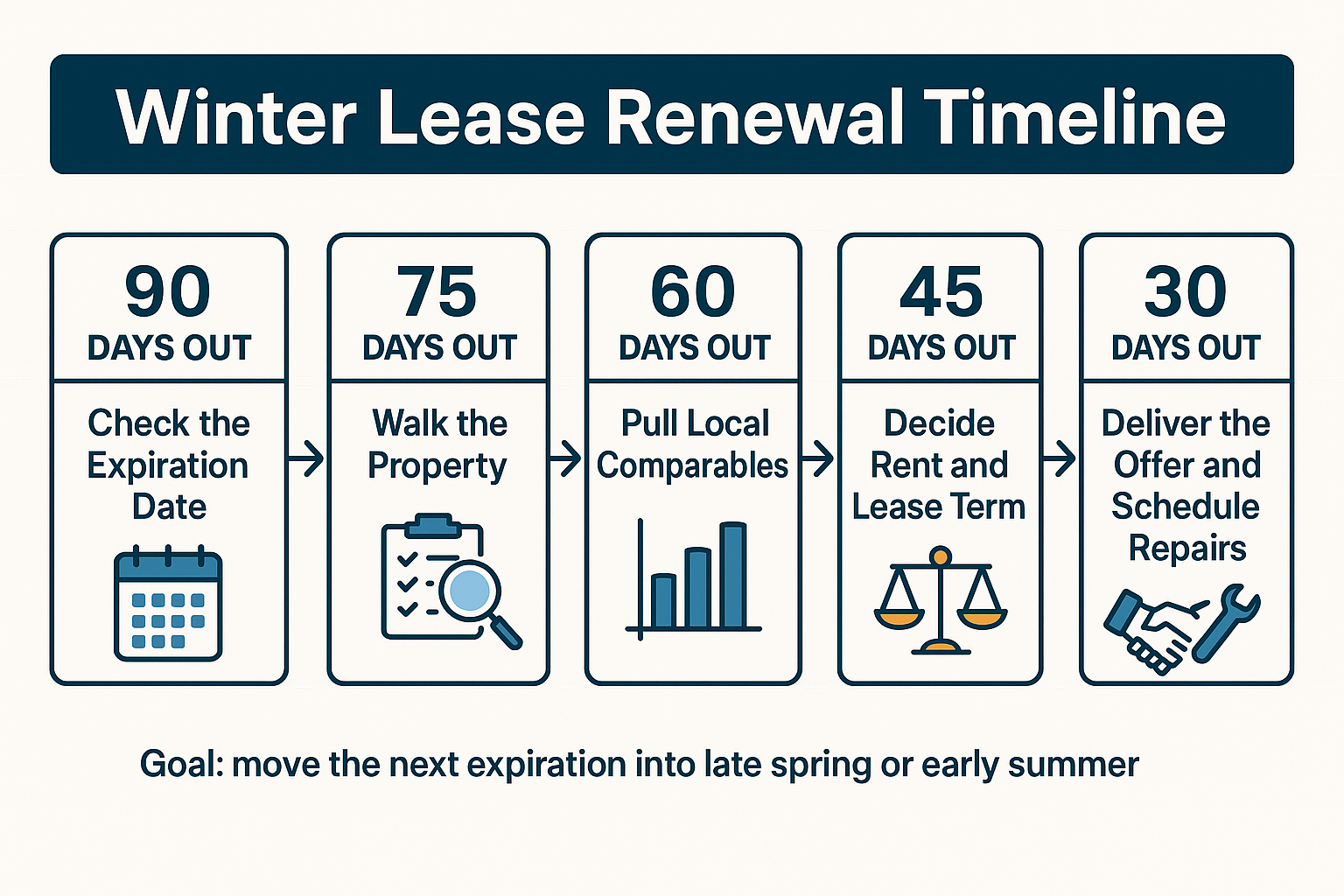
A Winter Renewal Timeline That Actually Works
This is the sequence I follow when a lease expires in the wet months. Starting late is the single most common mistake I see.
Renewal Is the Cheapest Time to Fund Winter Maintenance
A tenant who is staying is far easier to schedule work around than an empty house competing for space on a crew's calendar. That is the practical argument for pairing the renewal conversation with a short maintenance plan.
The Salinas Valley hands us a specific list. Valley fog, agricultural dust, inland temperature swings, and genuine flood exposure near the river all show up in the same places year after year.
At renewal I want to know the status of four things:
- Roof and gutter condition. Full gutters are the cheapest problem on this list to fix and the most expensive to ignore.
- Drainage away from the slab. Where does the water go when it comes off the roof.
- Tree limbs over the roofline. One Salinas owner asked us twice in a single season whether the front yard tree had been trimmed, calling it severely overgrown, and wanted photos of the finished work. That is a reasonable thing to want.
- Anything the last inspection flagged. Deferred items do not stay the same size over a winter.
On the Peninsula the list looks different. In Pacific Grove, Carmel, and Pebble Beach, marine air and salt exposure drive the conversation toward hardware, finishes, and moisture, and mildew on an interior wall is not always a maintenance failure.
If you want the full walkthrough order, we cover what to check before the first storm in its own article. And if you have ever wondered how you confirm a repair actually got done, that matters more than most owners expect.
You Can Reset a Badly Timed Lease at Renewal
This is the part almost nobody knows, and it is the most useful thing in this article. You are not stuck with the lease cycle you inherited.
Plenty of owners end up with a January expiration because of a previous owner, a mid-year move-out, or a tenant placement that happened at an awkward time. A renewal term of a few months more or less can permanently move that date into late spring or early summer, when the applicant pool here is at its deepest.
In practice that might mean a fifteen month term instead of twelve, or a nine month term if you want to get there faster. I treat it as a one-time correction, then go back to standard terms afterward.
Two cautions. Start the conversation well ahead of expiration, because marketing, showings, and screening take real time to run properly. And California's rules around increases and renewals shift often enough that the how and the when matter as much as the number, which is worth getting right rather than guessing at.
If you are curious how the fall market behaves before winter sets in, leasing after Labor Day covers that shift in detail.
Frequently Asked Questions About Winter Lease Renewals in Monterey County
How far ahead should I start the renewal conversation?
I like to be looking at it about 90 days out. That gives room to walk the property, pull comparables, decide on a term, and still deliver the offer with plenty of notice. Starting 30 days out means you are reacting instead of deciding.
Is it better to raise rent a little every year or a lot every few years?
Small and regular is almost always easier on everyone. A tenant who sees a modest adjustment each year plans for it. A tenant who gets hit with a large correction after three flat years starts looking at listings, and in a slow season that is the last thing you want.
My tenant pays on time but the yard looks rough. Should I renew?
Usually yes, with conditions. Landscaping neglect is fixable and far less expensive than a vacancy in February. I would renew, spell out the yard expectations clearly in the new term, and schedule the tree or fence work while the tenant is still in place to let the crew in.
What if I want to sell the property next year?
Then the lease term matters more than the rent. A buyer inherits whatever is in place, and so does the next owner's plan. We wrote about what comes with a tenant-occupied purchase, and the same list applies in reverse when you are the one selling.
Can I just use an online rent estimate to set the renewal number?
You can look at one, but I would not price off it. Those estimates pull from database averages and cannot see your flooring, your layout, your parking situation, or what the house two streets over actually leased for last month. A walkthrough plus current local comparables gets you a defensible number.
Thinking Through a Winter Renewal on Your Monterey County Rental?
A renewal recommendation is only as good as the information behind it, which is why ours starts with someone who has physically walked the property and priced comparable homes in the same neighborhood. We have worked Monterey County from one office since 2009, broker owner led, which is a different experience from a call center handling a portfolio across four states. Owners weighing a renewal can reach our office at (831) 757-1270 or through the contact form at coastandvalleypm.com.

Valley Fog, Farm Dust, and Inland Heat: What Salinas Weather Does to a Rental
Most of the rental maintenance advice written for this county was written for the coast. Marine layer, salt air, mildew on a north wall in Carmel. Useful if your property sits west of the hill. Not very useful if it sits on the valley floor.
I get calls from owners in Salinas, Gonzales, Greenfield, and King City who have read all of that and still feel like they are missing something a local would know. They are right. What holds up in Pacific Grove and what holds up in the middle of the valley are two different lists.
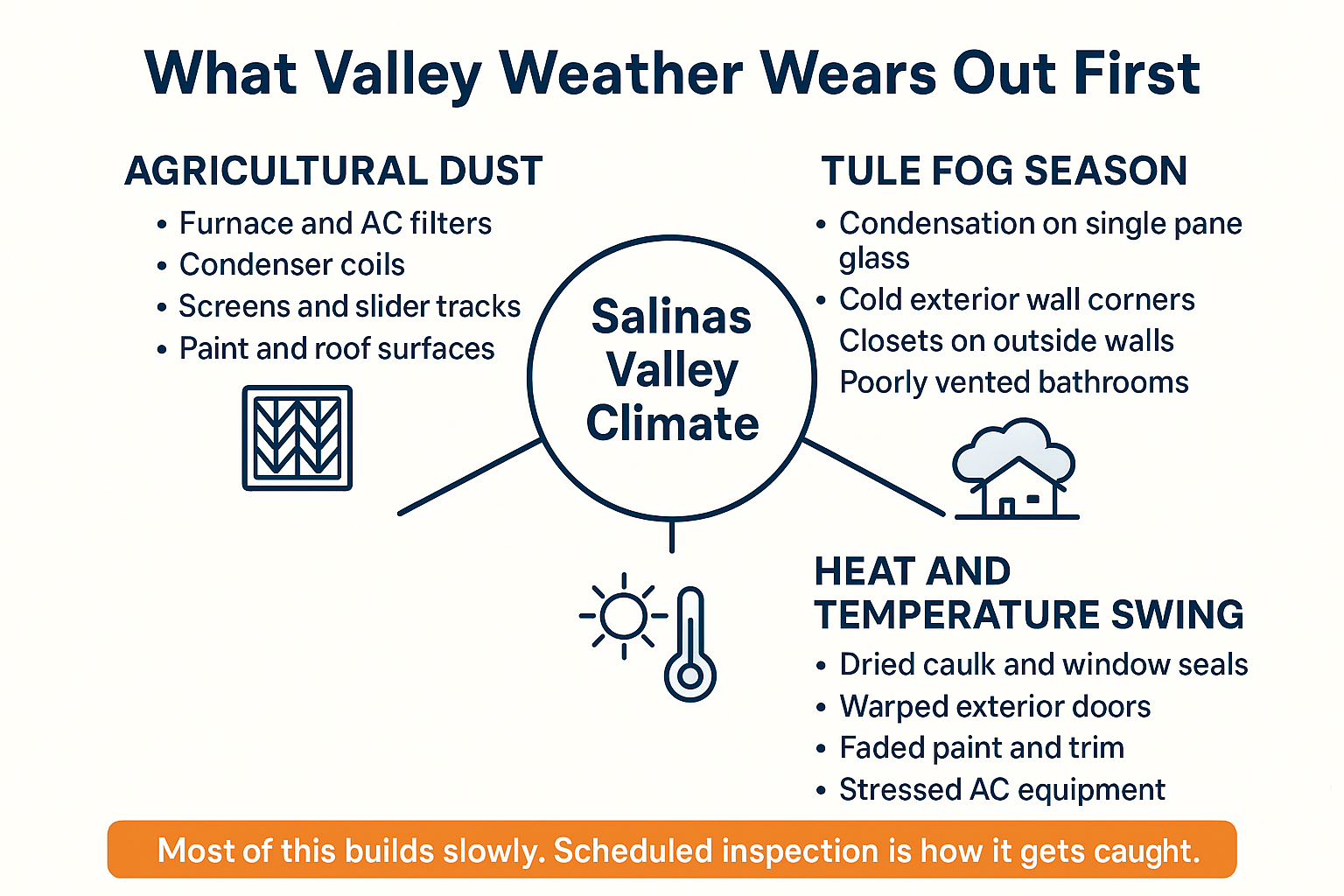
This article is the valley list. Three things drive Salinas Valley climate rental property upkeep: agricultural dust, tule fog season, and the big swing between a hot afternoon and a cold night. I will walk you through each one the way I would if we were standing in the driveway together.
Why Coastal Upkeep Advice Does Not Travel Inland
Drive Highway 68 east from Monterey and the air changes somewhere around Toro Park. The marine layer thins out, the temperature climbs, and the whole wear profile of a house changes with it.
A Peninsula property fights surface moisture as ordinary climate behavior. Condensation on glass, mildew on shaded siding, salt on hardware. That is normal coastal aging, and it gets managed on a coastal schedule.
A valley property fights a different set:
- Fine agricultural dust for much of the growing and harvest season
- Winter tule fog that can sit over the floor of the valley for days
- Day to night temperature swings that work on seals, caulk, and wood
- Real water exposure on parcels near the Salinas River and the lower drainage lines
- Dry heat and sun load that dulls paint and bakes roof surfaces
Same builder, same floor plan, two different aging curves. I have said this to owners who hold property on both sides of the hill, and it is the same point I make in why a Pebble Beach estate needs different management than a Salinas rental.
If you own in South County, the effect is stronger, not weaker. Hotter summers, dustier shoulder seasons, longer drives for vendors. I covered that market separately in owning a rental in Salinas Valley's South County.

Agricultural Dust: The Problem That Never Announces Itself
This is the wear factor almost nobody writes about for owners, and it is the one I would put at the top of the list.
When the fields around Chualar, Gonzales, and Spreckels get worked, fine dust travels. It does not stop at the property line. Over a season it settles into the places that quietly matter:
- Furnace and air filters, which load up months faster than the label assumes
- Condenser coils on the AC unit, which lose their ability to shed heat
- Window screens and slider tracks, which stop sealing and stop sliding
- Exterior paint and roof surfaces, which go chalky and dull years early
- Dryer vents and bathroom fans, which lose airflow
Nothing breaks on a Tuesday. The filter just stops doing its job over eighteen months, the blower works harder, and the repair bill arrives years before it should have.
Here is how it usually surfaces: a tenant calls in July saying the AC is not keeping up, and everyone assumes the equipment failed. Often the coil is packed and the filter is gray. A coil cleaning and a filter change cost a fraction of a compressor, but only if somebody looks before the hot stretch.
My rule for valley properties is to treat the 60 to 90 day filter guidance as the ceiling, not the target, and to put eyes on the condenser before summer. If you are an owner who visits once or twice a year, you cannot see slow accumulation between visits. Nobody can.
Three Valley Forces and Where They Show Up
A quick visual of what each part of the valley climate actually attacks on a rental home.
Trees, Ivy, and Water Paths: What Cannot Wait Until Spring
Landscaping reads as cosmetic right up until a limb comes down on a carport or a fence lets go in a wind event. Then it is a real repair and sometimes a liability conversation.
One Salinas owner wrote to us about a front yard tree and put it plainly: "It is severely overgrown." Months later, the follow up was still the same question, had the tree been trimmed and had the side fence been replaced. That gap between noticing and handling is where most of the money gets lost.
Another owner wrote in about ivy from the neighboring property swallowing the back fence and climbing onto the garage roof. Ivy on a fence looks charming. Ivy on a roof holds moisture against the surface and pries at flashing.
The water side matters just as much. Valley lots are flat, drainage is shallow, and a few seasons of leaf litter will reroute runoff straight at a foundation. I walk through the full pre-storm sequence in walking your Salinas rental before the first storm.
If you only do three things before the rains start:
- Clear gutters, downspouts, and the area drains at the low corners of the lot
- Get dead and overhanging limbs off the roof, the carport, and the power drop
- Pull vegetation off fence lines and roof edges before it has a wet season to work with
Can It Wait Until Spring? A Quick Triage
This is roughly how I sort a running list of small property items when an owner sends me photos in October.
| What You're Looking At | Wait or Handle Now | How to Tell From a Photo |
|---|---|---|
| Limb hanging over a roof, carport, or driveway | Handle now | Any branch sitting above a structure or a parked car |
| Clogged gutters or a downspout dumping at the foundation | Handle now | Standing debris, staining on the wall below, soil washed away |
| Ivy or vine onto a roof edge or into a fence | Handle now | Growth touching shingles, flashing, or a leaning fence panel |
| Dull, chalky exterior paint | Can wait | Even fading with no bare wood or peeling |
| Overgrown shrubs away from the house | Can wait | Nothing touching siding, windows, or walkways |
| Hairline cracks in a driveway or walkway | Can wait, monitor | No lift, no trip edge, no water pooling at the crack |
Interior Moisture in an Inland House: Fog Season vs. a Real Problem
You get a text from the tenant with a photo of a damp corner and no context. Most of those photos are not emergencies. A few are.
In fog season, a closed up valley house with older single pane windows will produce moisture on glass and on cold exterior walls. Tenants heat in the evening, shut everything tight, cook, shower, and the house has nowhere to put that humidity. That is ordinary winter condensation, not a building failure.
Before I send anyone out, I ask the tenant the same questions in this order:
1. Is the moisture on the glass and the frame, or on the wall itself?
2. Does it dry out by midday or is it still wet in the afternoon?
3. Has the stain gotten bigger since last week, and do you have an earlier photo?
4. Does the bathroom fan run, and does the window get opened after showers?
5. Is anything above or behind that spot, like a shower, a roof valley, or a hose bib?
Condensation on glass that clears by noon is a ventilation habit conversation. A stain that spreads, a musty closet on an exterior wall, or a soft baseboard is a different conversation and gets a vendor.
The federal guidance on moisture and indoor mold is a reasonable plain-language reference for owners, and the EPA's brief guide to mold, moisture and your home covers the basics well. For the coastal version of this same question, we answered a Carmel owner's situation in mildew on a Carmel rental wall. The inland version is a different animal, which is the whole point of this article.
None of This Matters Unless Somebody Is Looking
Every item above is invisible unless someone walks the property on a schedule and takes pictures. The filter, the coil, the roof surface, the drainage path, the tree over the carport. None of them send you a notification.
A lot of the owners I work with are not driving by. One relocated out of state before renting out a Salinas house. Another wrote in from outside the county about a newly built property. The common thread is distance, and the common request is the same: send me photos showing the work got done.
That is a fair ask, and it is the standard I think owners should hold anyone to. You should be able to see what was found, what was recommended, and what got done, without chasing anybody. Annual inspections documented with photos, maintenance records in an owner portal, and a clear approval trail before money gets spent.
If you want the mechanics of that approval trail, I laid it out in who approves a repair at your Salinas rental, and how you know it got done. Proof beats assurances every time someone is managing an asset from three hundred miles away.
Frequently Asked Questions About Valley Climate and Rental Upkeep
How often should filters really be changed in a Salinas Valley rental?
The common 60 to 90 day guidance assumes a typical suburban house. On the valley floor, especially near active fields, I treat 90 days as the outside limit and plan closer to 60 during the dusty stretch of the year. It is one of the least expensive things you can do for an HVAC system here.
My tenant sent a photo of water on the windows. Is that an emergency?
Almost never. Fog season condensation on single pane glass is normal in a closed up valley house. Ask whether it dries by midday, whether the stain is spreading, and whether the wall itself feels damp. Spreading stains and soft baseboards get a vendor.
Does the maintenance advice I read for my Pacific Grove property apply to my Greenfield rental?
Partly, but the priorities flip. The coast is a moisture and salt story. The valley is a dust, heat, and drainage story. Same house, different list.
What does dust actually cost me if I ignore it?
It rarely shows up as one bill. It shows up as shortened equipment life, an earlier roof or paint cycle, and service calls during the hottest week of the year when vendors are busiest. Costs vary by property and equipment, so the honest answer is that a quick look before summer is worth far more than a guess.
I live out of state. How do I know inspection work is actually happening?
Ask for dated photos and a written summary of findings and recommendations, delivered through an owner portal you can check yourself. If you have to call and ask whether something was done, the reporting is not working.
Thinking through what your valley property needs this season?
We have managed properties on both sides of the hill since 2009, on the Monterey Peninsula and across the Salinas Valley into South County, which is why we can tell an owner that the same house ages differently in Pacific Grove than it does on the valley floor. If you want to talk through a specific property and what its climate is doing to it, our team at Coast & Valley Properties is reachable at (831) 757-1270.
Who Shows Up to Fix Your Salinas Rental, and How They Got on the List
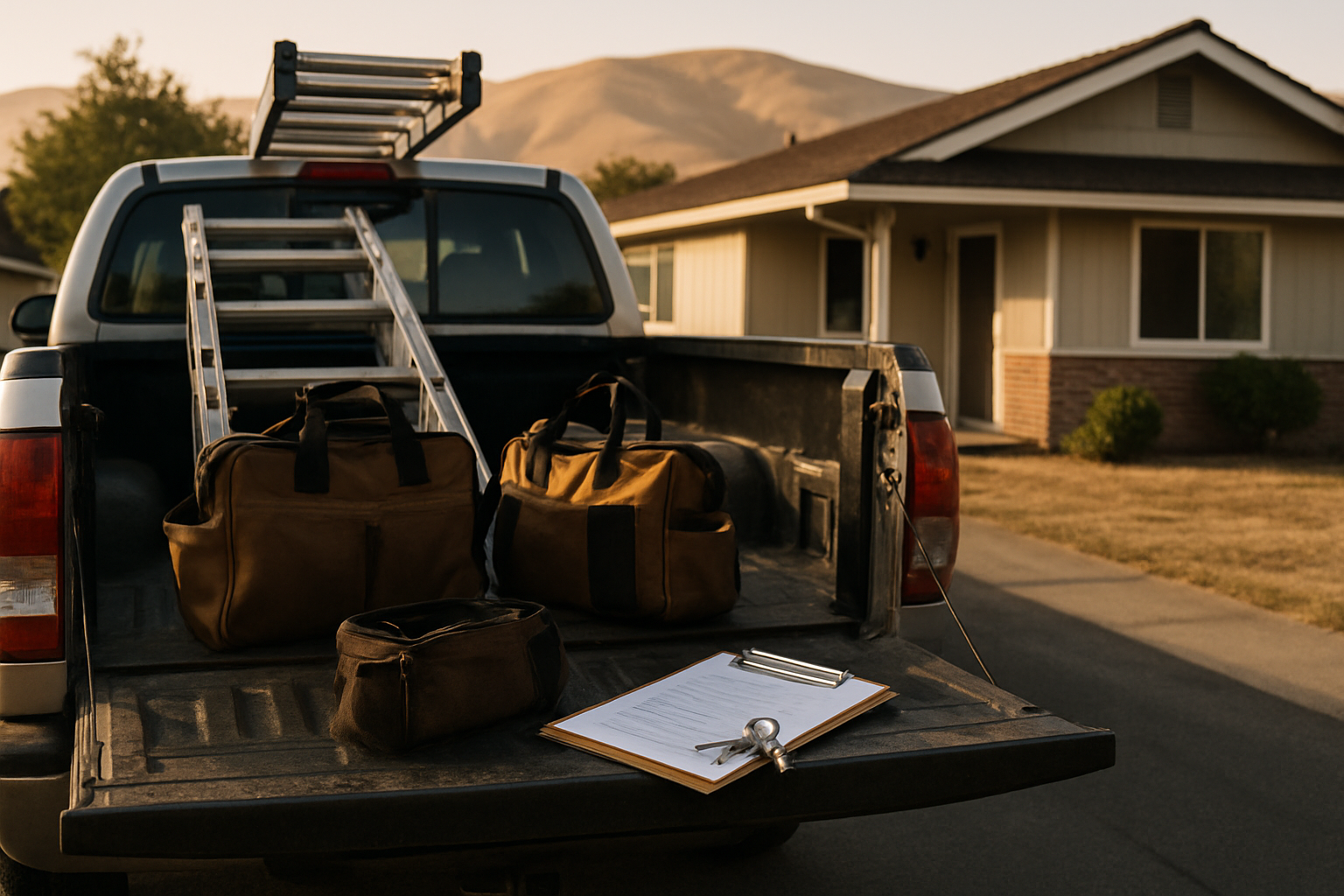
There is a moment most owners never really think about until it happens. A repair gets approved, a date gets set, and then a stranger is standing in your kitchen at 8 a.m. with a key to your property. You did not meet him. You did not check anything about him.
What you did not see is the stream of pitches behind that moment. In a single recent stretch, a Monterey County landscaping company asked to be added to our vendor list and offered to send over its company information, insurance, and W-9. A Salinas flooring contractor who does carpet and luxury vinyl plank stopped by one of our managed properties to introduce himself. A security patrol firm offered free walkthroughs.
Owners never see that traffic. But the filter that decides which of those companies gets your address is one of the most underrated parts of property management. That filter is what this article is about.
What a vendor has to clear before anyone gets a key
Getting on a vendor bench is not a handshake. Before a company works on a property we manage, we want a paper trail that holds up if something goes sideways.
Here is what that screen looks like in practice:
- Active license verification for any trade that requires one in California, checked at the state level, not taken on faith from a business card
- General liability coverage with a current certificate, because an expired policy on file is the same as no policy at all
- Workers compensation for anyone sending a crew, not just a solo operator
- A signed W-9 so payments are reported correctly at year end
- A written scope before work starts, so there is no argument later about what was agreed to
This protects you more than it protects us. When an uninsured worker falls off a ladder at your rental, or when work gets done wrong and has to be torn out and redone, the exposure tends to land on the person who owns the building.
California is not a forgiving place for loose paperwork. The liability environment here rewards owners and managers who keep clean files and punishes the ones who do not. A vendor who hesitates to send a certificate of insurance has told you something useful about how the rest of the job will go.

Your vendor list is not one list. It is several.
This is the part nobody local writes about, and it matters more here than in most markets.
A handyman who happily takes a call in north Salinas may turn down the same job in Greenfield or King City. Drive time eats the margin on a small repair. So an owner with a property in South County is often choosing from a much shorter bench than an owner a few blocks off Main Street, and that shows up as slower response, not higher prices. Anyone owning a rental in South County learns this fast.
On the Peninsula the problem flips. Distance is short, but the specialty requirement is real:
- Salt air and marine layer chew through exterior finishes and hardware faster than inland properties
- Wood windows and older housing stock in Pacific Grove and Carmel need finish carpenters and painters who understand coastal exposure
- Moisture management matters year round, which is why mildew on a Carmel rental wall is not always a simple cleaning job
Valley properties need a completely different skill set. Irrigation, well pumps, ag dust loading up HVAC filters, and inland temperature swings that run far hotter and colder than anything on the coast.
So the practical takeaway for an owner is this: a real vendor bench is organized two ways at once, by trade and by drive time. A single all-purpose list is a sign the list has not been used much.
What the Bench Looks Like by Area
The same repair request pulls from different people depending on where your property sits. Here is the rough shape of it.
| Area | What the housing stock demands | Where the bench gets thin |
|---|---|---|
| Pacific Grove, Carmel, Monterey | Finish carpentry, painting rated for coastal exposure, wood window repair, moisture control | Trades willing to work carefully on older homes without rushing |
| Pebble Beach estates | Discretion, scheduling around owners, specialists for high-end finishes and systems | Vetted specialists who handle access and privacy correctly |
| Salinas and north valley | General repair, plumbing, roofing, HVAC with heavy dust loads | Storm season, when everyone is booked at once |
| Soledad, Gonzales, Greenfield, King City | Irrigation, well pumps, septic, wide temperature swings | Drive time. Many Salinas vendors decline these calls outright |
The Five Checks Before a Vendor Gets Your Address
This is the sequence a company goes through before we will send them to a managed property.

Storm season is when the bench proves itself
Forecasters have put the odds of a very strong El Nino this fall and winter above 90 percent, with California leaning toward above-normal winter rain. That does not mean one bad night. It means the chance of repeated atmospheric rivers stacked back to back.
We watched how that plays out in the winter of 2023. Monterey County took nine atmospheric rivers in a row. The Salinas River topped flood stage at Salinas, Spreckels, and Bradley, and roads including River Road, Blanco, and Reservation went underwater. The county's own record of major flood hazards shows this is a recurring pattern along the Salinas, Carmel, and Arroyo Seco rivers, not a freak event.
Here is what that does to repair logistics. Roofers, tree crews, and water mitigation companies triage by relationship and repeat volume. They answer the people who feed them work all year first.
So on day three of steady rain, the owner calling a stranger off a search result is at the back of a long line. The owner whose manager has used that same roofer eleven times since spring is not. That gap is the entire value of a bench, and it only exists if someone built it before the rain started. It also pairs with walking the property before the first storm, which is the cheaper half of the equation.
How you know the chosen vendor is the one who did the work
Approving a repair is a separate conversation. This one is narrower: how do you confirm the work actually happened, and happened right?
One Salinas owner we heard from had asked twice across several months whether the fence along the side of her rental had been replaced and whether an overgrown tree out front had been trimmed. She wanted photos of the finished work. That is a completely reasonable ask, and the fact that she had to ask twice is the problem.
A documented close-out should include:
- Before and after photos of the specific area, not a wide shot of the yard
- An itemized invoice that matches the approved scope line for line
- An inspection by someone on the management side before the vendor gets paid
- A record in the owner portal so you can pull it up months later without emailing anyone
That last step is the one that gets skipped most often. Paying first and checking later removes the only real leverage you have with a vendor. For more on how the approval side works, see who approves a repair at your Salinas rental.
What drives the cost, honestly
I am not going to quote numbers, because the real answer depends on trade, property, access, and season here on the Central Coast. But the mechanics are worth understanding.
- Competing estimates get pulled on larger jobs. For a small repair, three bids cost more in delay than they save in dollars. For a roof or a repipe, they are standard.
- Steady monthly volume changes the conversation. A vendor who gets regular work tends to offer better scheduling and sharper pricing than they would on a one-off homeowner call.
- After hours and storm work price differently than a Tuesday morning repair. That is true everywhere, and it is especially true when half the county is calling the same roofer.
If you want a figure for your specific property, that is a conversation, not an article. A walkthrough and a look at your actual systems will get you a far more useful number than any range I could print here.
Frequently Asked Questions About Vendor Vetting in Monterey County
Can I keep using my own handyman?
Often yes, as long as they clear the same screen everyone else does. Active license where the trade requires one, current liability coverage, workers comp if they bring a crew, and a W-9. Plenty of longtime owner contacts clear it without trouble. The ones who cannot usually turn out to have let insurance lapse.
What happens if a worker gets hurt at my rental?
This is the exact reason the paperwork matters. If the vendor carries proper coverage, their policy handles it. If they do not, the claim tends to find its way toward the property owner, which is a bad surprise to discover after the fact.
Do you get multiple bids on every repair?
No, and you would not want us to. Chasing three estimates for a leaking faucet costs you days of tenant frustration to save very little. On bigger work, competing proposals are standard practice.
Is the vendor list different for a Pebble Beach property than a Greenfield one?
Completely different. Coastal properties need people who understand salt air, older housing stock, and discretion on site. South County properties need irrigation and well pump knowledge, and a much shorter list of vendors who will even make the drive.
How do I see what was done without calling the office?
Through the owner portal. Invoices, financials, and reports sit there so you can pull up a completed job months later on your own schedule.
Want to Talk Through Who Is Working on Your Property?
We have been placing vendors in Salinas Valley and Monterey Peninsula properties since 2009, broker-owner led the whole way, and we sort through vendor solicitations constantly so owners do not have to. That means checking license and insurance status, sourcing competing proposals on larger jobs, and inspecting work before anyone gets paid. If you would like to talk through how your own bench is holding up, Coast & Valley Properties is available at (831) 757-1270 or through the contact form at coastandvalleypm.com.

Trash, Trees, and Parking: When Neighbors Complain About Your Monterey Area Rental
The complaint almost never comes from your tenant. It comes from the person next door, and it usually lands somewhere other than your inbox first.
They look up who manages the property, or they track down an owner's phone number, and they write. Not angry, most of the time. Just expecting somebody to do something, soon.
After years of fielding these across Monterey County, I can tell you they sort into three buckets almost every time: trash, vegetation, and parking. Below is what each one really is underneath, who usually pays to fix it, and the order I work through a complaint so it ends instead of escalating.
The Trash Complaint Comes In Friendly and Still Needs a Fast Answer
Here is the tone these arrive in. A neighbor of one Salinas property we manage wrote in to say the tenants were "leaving garbage outside of their receptacle" and that "the animals are getting into it." Then they added that the tenants were "in general nice people but not sure about some of their choices."
That is the typical temperature. Polite, a little apologetic, and fully expecting action.
What I have learned is that an overflowing bin is often not a tenant attitude problem at all. Before anyone gets a notice, I want to know:
- How many cans are on the account versus how many people actually live there
- Whether the service day lines up with when the household generates the most waste
- Whether a recent move-in or move-out dumped a one-time pile at the curb
- Whether the bin area has a gate, a latch, or any defense against raccoons and crows
At a lot of older properties the answer is simply that one can was sized for a different household. Adding service is a small monthly cost and it solves the complaint permanently. Writing a tenant up for a problem the property created just buys you a resentful resident and the same bin on its side next week.

Ivy and Tree Limbs: A Maintenance Bill Wearing a Neighbor Dispute Costume
The second recurring type is vegetation. One adjacent owner wrote to us about ivy from a managed property that had swallowed the shared back fence and was working its way toward her garage roof and into her yard.
She framed it as a favor. Handle it now, she said, and avoid a roof problem later. She was right.
This is the part owners get wrong most often: vegetation is almost always the owner's cost, not the tenant's. Mowing and weeding are housekeeping. Ivy eating a fence, a limb hanging over a neighbor's garage, roots lifting a shared walkway, those are structural upkeep on your asset.
And the clock on these is seasonal. Once the Central Coast wet season starts, a limb that was merely annoying in October becomes a saturated, wind loaded liability in January. In years when forecasters point toward a wetter than normal winter, the gap between a scheduled trim and an emergency call gets expensive fast.
So when a neighbor flags a limb in the fall, they have done you a genuine favor. An owner living three hours away would not have seen it until something came down. This is exactly the kind of thing we look for when walking a property before the first storm.
Parking Causes More Neighbor Friction Than Anything Else at Small Multi-Units
At four to twelve unit properties around Salinas, parking generates more complaints than trash and trees combined. One public review of a property we manage put it plainly: neighbors with "like 3 cars for one apartment" or "blocking you from getting out."
The same handful of patterns repeat:
- One unit with three or four vehicles quietly absorbing the lot
- Residents blocked in by a car parked across a shared driveway
- A tenant or guest told verbally they could park somewhere, then finding the car towed
- Enforcement that lands on one vehicle and skips another, which residents notice immediately
The practical fix is unglamorous. Assigned spaces written into the lease, one rule applied identically to every resident, and a documented warning step before anything is touched.
Towing ends a parking problem and starts a much longer one. It generates a furious resident, a furious guest, and a public review that prospective tenants will read for years. I have seen a single tow cost an owner more in vacancy and reputation than a decade of parking stickers would have. If you are adding units, this is one of the things that changes as you add doors.
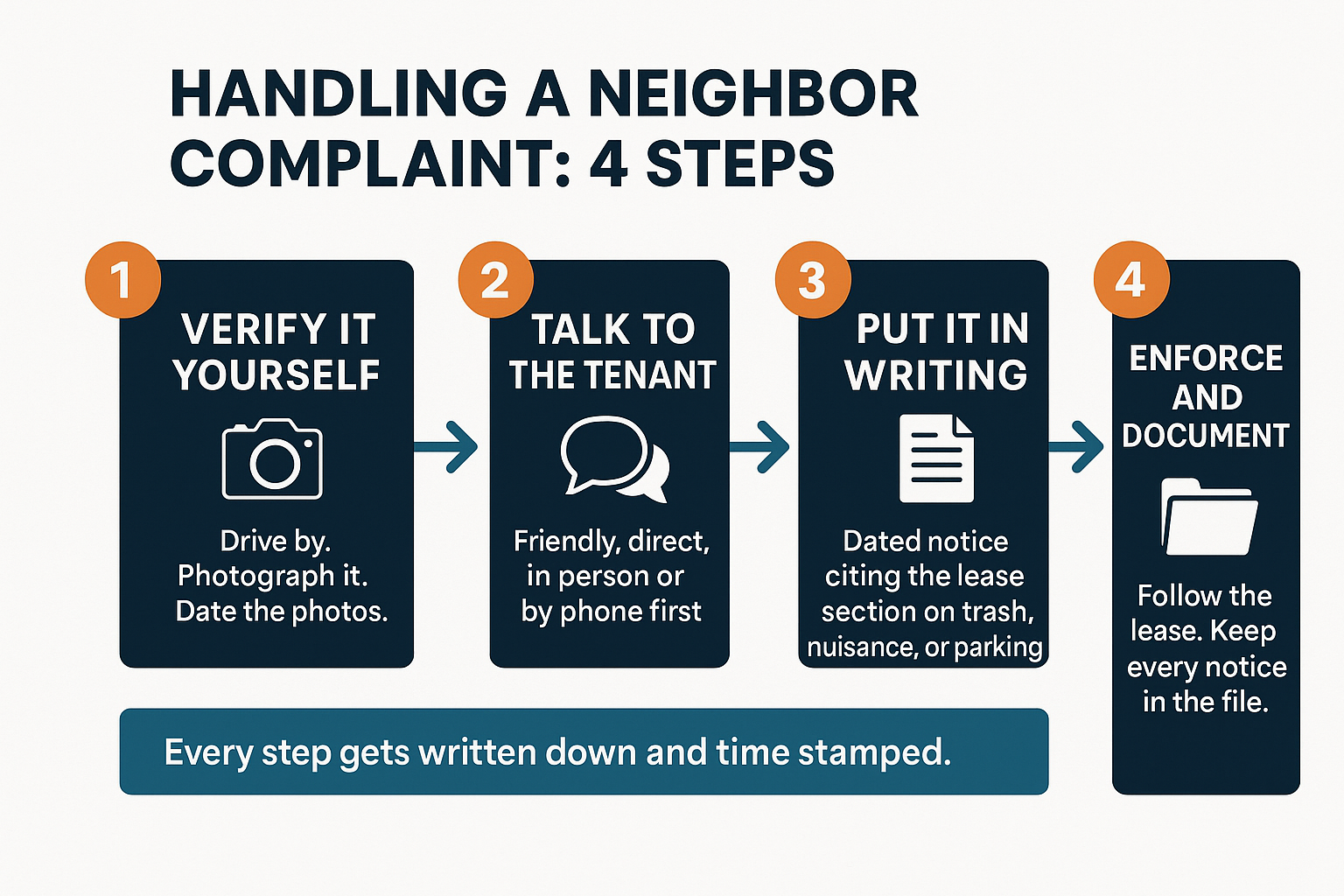
The Four Step Ladder I Use on Every Complaint
Most owners either overreact or freeze. This is the sequence that keeps a complaint from turning into a dispute you cannot document later.
Why Documentation Is the Whole Point
Every step on that ladder gets written down with a date on it. That is not bureaucracy for its own sake.
A single complaint proves nothing. A pattern of dated, written notices is what separates a defensible position from a he said, she said conversation at the end of a tenancy.
I also verify independently before anything else happens. One neighbor's word is a starting point, not a finding. I have driven out to confirm a "constant" trash problem and found one bag from a move-out, and I have driven out expecting nothing and found a situation worse than described.
The friendly direct contact in step two resolves more than people expect. Most tenants had no idea the bin was feeding the neighborhood wildlife, or that the space they have used for eight months belongs to unit three.
Who Usually Pays, and What I Check First
A quick reference for the complaints that come in most often around Monterey County.
| Complaint | Usually whose cost | What I check first |
|---|---|---|
| Trash outside the bin | Tenant behavior, unless the service is undersized | Can count versus household size, pickup day, photos of the bin area |
| Ivy, hedges, overhanging limbs | Owner, as structural upkeep | Where growth crosses the line, contact with fence or roof |
| Blocked driveway, extra vehicles | Tenant behavior, a lease issue | Assigned spaces in writing, vehicles per unit |
| Noise or late night activity | Tenant behavior | Dates and times, whether more than one neighbor reports it |
| Leaning or failing fence | Often shared, frequently the owner | Photos from both sides, whether it is now a safety problem |
Calling the Neighbor Back Yourself Usually Makes It Worse
I understand the instinct. It is your property and somebody just told you your tenants are behaving badly on it.
But owners are emotionally invested in a way a third party is not. Neighbors also escalate differently when they sense they are dealing with an individual rather than a process, because an individual can be pressured and a process cannot.
The bigger risk is the off the cuff promise. You tell the neighbor you will have the ivy gone by the weekend, or that the car will be moved today, and now you have created an obligation your tenant never agreed to.
A third party absorbs the complaint, verifies it, applies the same standard to every resident, and keeps you out of a dispute between two people who still have to live next to each other.
This matters most for owners who inherited a property or moved away. They often learn about a problem only when a neighbor finally tracks down their phone number, and by then it has been building for months. If that sounds familiar, it may be a sign that self-managing has stopped making sense.
The Same Complaint Sounds Different Depending on the Street
Geography changes the tone, not the remedy.
In older Salinas neighborhoods with street parking, shared driveways, and alley collection, the flashpoints are cans left out past pickup and vehicles blocking access. Neighbors there tend to give you a little room, because everybody's bins and cars are in everybody's way sometimes.
On the Peninsula and in Carmel, lots are tighter and streets are narrower. A single overgrown hedge changes a neighbor's view or pushes water somewhere it was not going before.
The same complaint arrives with a very different tone and a much lower tolerance for delay. The fix is identical. The expected response time is not, and knowing which street you are standing on is part of knowing a neighborhood well enough to manage in it.
Frequently Asked Questions About Neighbor Complaints
Can I charge the tenant for trimming the ivy or the tree?
Generally no. Vegetation that threatens a fence, roof, or property line is structural upkeep, which sits with the owner. Routine mowing and weeding can sit with the tenant if the lease says so clearly.
A neighbor keeps calling about my tenant's cars. Can I just have them towed?
You can, and it is usually the wrong first move. Towing ends one problem and starts a longer one that often includes a public review future applicants will read. Assigned spaces in writing and a documented warning step solve far more parking problems than a tow truck does.
What if the neighbor is exaggerating or has a grudge?
That happens, which is exactly why verification is step one. I would rather drive by and find nothing than send a tenant a notice based on a single phone call. If photos and a site visit do not support the complaint, nothing goes in the tenant's file.
How quickly should a complaint get a response?
Acknowledge it the same day, verify within a day or two, and have a plan the neighbor can hear. Most people calm down the moment they learn a real person looked at it.
Does one neighbor complaint hurt my property value or future rent?
One does not. A pattern does. Neighborhoods talk, applicants ask about the street, and a property known for overflowing bins and blocked driveways shows up in how long it sits vacant.
Questions about a complaint at your Monterey County rental?
Complaints about the properties we manage come to a local office on Main Street in Salinas, staffed by people who can drive out the same afternoon and see whether the trash is really out, the ivy is really over the fence, or the car is really in the wrong space. Annual inspections and an established local vendor network mean the tree trim or fence repair that resolves a neighbor issue gets scheduled rather than debated. We have been doing this in Monterey County since 2009, and owners who want to talk through a specific situation are welcome to reach us at (831) 757-1270.
Measure H: Salinas Voters Decide Rent Stabilization on November 3
If you own rental property inside Salinas city limits, November 3, 2026 is the date to circle. That is when voters decide Measure H, and the outcome touches your rent increase ceiling, your eviction obligations, and your annual registration paperwork.
I hear this question almost weekly from owners who hold a duplex in Salinas and a second home over the hill in Pacific Grove or Carmel. They want to know which rules apply where, and whether they should sit still until the votes are counted.
Below I walk through what Measure H actually asks, what changes with a yes versus a no, and what I tell owners to do between now and election day. No guessing about the result, just the parts you can control.
What Measure H Actually Asks Salinas Voters
The ballot question is short. It asks whether Ordinance No. 2687, which repeals four rental ordinances, should be adopted.
The four ordinances on the line are:
- The Residential Rental Registration Ordinance
- The Rent Stabilization Ordinance
- The Tenant Protection and Just Cause Eviction Ordinance
- The Tenant Anti-Harassment Ordinance
A yes vote removes the four tenant-related ordinances and lets stand a repeal action by the Salinas City Council that was never enacted because of a successful referendum campaign. A no vote keeps all four in place. The measure needs a majority of voters to pass.
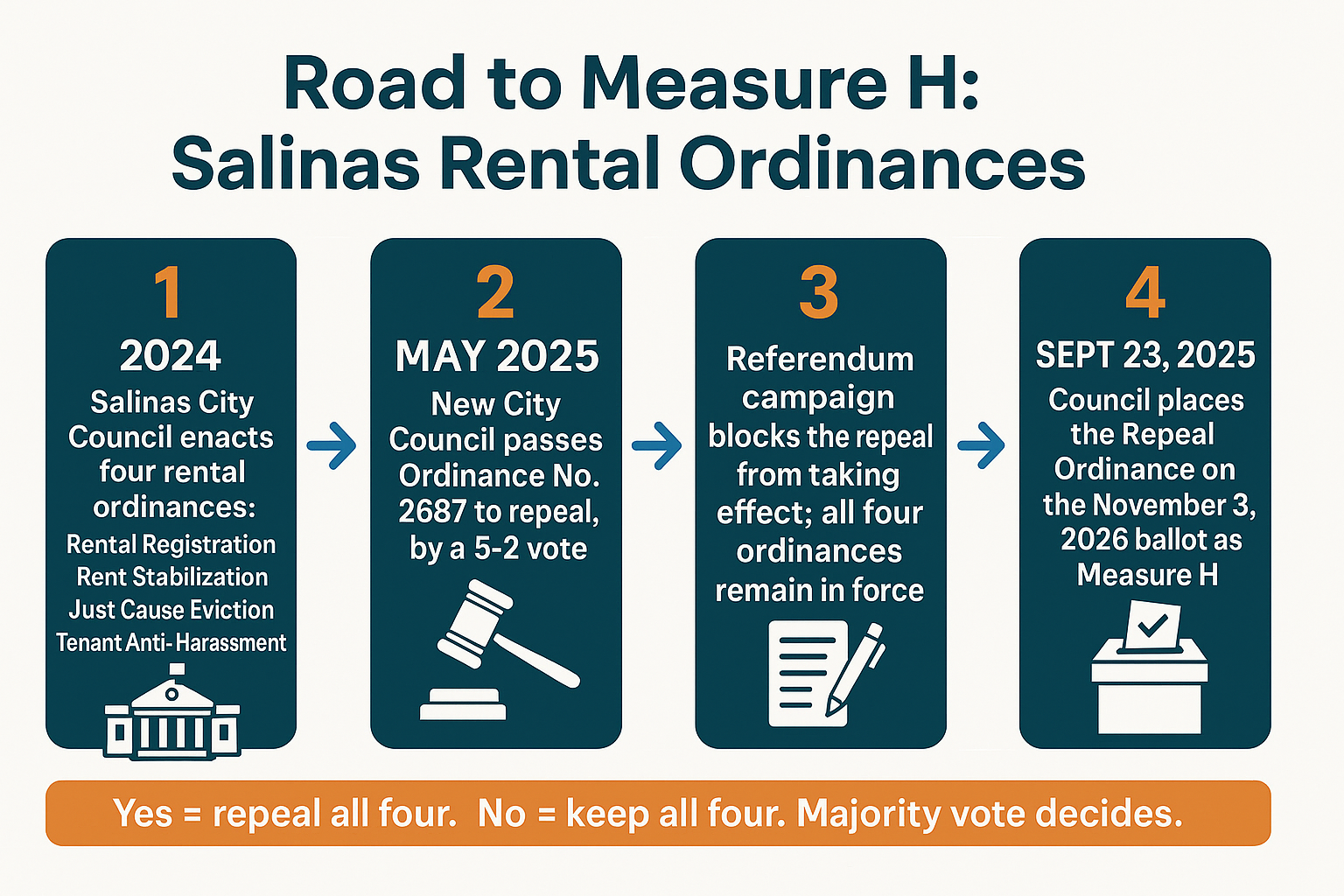
Here is how it got here. The Salinas City Council enacted the four ordinances in 2024. A new City Council passed the repeal, Ordinance No. 2687, in May 2025 by a 5-2 vote, per reporting from Monterey County Weekly. The referendum campaign blocked it from taking effect.
Then on September 23, 2025, the City Council voted to place the Repeal Ordinance on the November 3, 2026 General Election ballot. The City's own Rental Registration and Rent Stabilization page states the four ordinances remain in effect until voters decide. Salinas Californian reporting confirmed in August 2026 that the measure now carries the name Measure H.

Everything Stays in Effect Until the Vote
This is the part owners get wrong most often. Because the repeal was passed by the Council, some owners assume the rules already went away. They did not.
All four ordinances are live right now and stay live through election day. That means:
- Annual rent increases in Salinas remain capped at 2.75 percent or 75 percent of the consumer price index, whichever is lower
- Rental units must be listed in the city's rental registry
- Just cause eviction rules apply, including three months' relocation assistance in covered evictions
- The tenant anti-harassment rules apply to how you communicate and act
Registration is billed per unit each year. Published figures have been reported around $29 or $112 per unit depending on the property, but the City sets and updates those amounts, so confirm the current figure directly with the City rather than working from an old invoice.
And the exposure for getting a rent increase wrong is not small. Reporting on the ordinances describes damages of up to three times the amount of an overcharge. An increase you issue in September does not become retroactively fine because of how the vote lands in November.
Yes Vote vs No Vote: What Each Outcome Does
Here is the side-by-side I sketch out for owners when they call. This covers the mechanics of the measure only, not any prediction about the result.
| What is at stake | If Measure H passes (Yes) | If Measure H fails (No) |
|---|---|---|
| Rent increase cap | Rent Stabilization Ordinance is repealed | Cap of 2.75% or 75% of CPI, whichever is lower, stays |
| Rental registry | Residential Rental Registration Ordinance is repealed | Registry and annual per-unit fees continue |
| Just cause eviction | Tenant Protection and Just Cause Eviction Ordinance is repealed | Just cause rules and three months' relocation assistance stay |
| Tenant anti-harassment | Tenant Anti-Harassment Ordinance is repealed | Ordinance stays in force |
| Rules before November 3, 2026 | All four still apply up to the vote | All four still apply up to the vote |
| Where it applies | Rental property inside Salinas city limits | Rental property inside Salinas city limits |
How Measure H Got on the Ballot
A quick timeline of the four Salinas rental ordinances and the repeal effort that became Measure H.
Peninsula Owners: Measure H Is a Salinas City Question
Measure H is a City of Salinas ballot measure. It governs rental property inside Salinas city limits.
If your rental sits in Pacific Grove, Monterey, Pebble Beach, or Carmel, your vote on Measure H does not change the rules on that home. California's rental laws still apply everywhere, and those shift on their own schedule regardless of what happens on November 3.
Where this gets messy is for owners holding both. I work with plenty of families who inherited a Salinas fourplex and later bought on the Peninsula, or who kept a Salinas rental after moving to Carmel. Two properties, two different sets of local obligations, one owner trying to track both.
A few things I watch for with those owners:
- Using the same rent increase notice template on both properties, which is how a Salinas overcharge happens
- Applying a Salinas relocation assistance assumption to a Peninsula tenancy, or the reverse
- Missing a registry renewal on the Salinas unit while focused on the higher-value coastal home
The Peninsula has its own pressures on pricing and turnover, which I cover in what makes renting out a Pacific Grove home different. Setting rent well is a separate exercise from setting it legally, and both matter. How rent actually gets set on a Monterey County rental walks through why online estimates miss.
What I Tell Owners to Do Between Now and November 3
Nobody should build a plan around a result that has not happened. But there is a difference between waiting and drifting.
Here is the short list I give owners with Salinas units:
- Verify your registration is current. Confirm the fee and the status with the City, not from memory.
- Recalculate any pending rent increase against the current cap before the notice goes out. A wrong number now can follow you for years.
- Document everything. Dated inspection photos, written maintenance requests, repair invoices, and copies of every notice served. Records are what protect you if a tenancy goes sideways.
- Do not rush a turnover hoping to get ahead of a vote. Decisions made on speculation tend to cost more than they save.
- Read the actual ballot text when your ballot arrives, rather than a summary from a neighbor.
If you want more background on the vote itself, we have covered it from a few angles, including what changes either way on the Salinas rent stabilization repeal and what owners need to know before the November vote.
One more thing. Several owners who call us are not struggling with the law at all. They are struggling with the hours. One owner with multiple Salinas units told us that managing everything alone had simply become more than the schedule allowed. A ballot measure does not change that math either way.
Frequently Asked Questions About Measure H
Do I vote yes or no if I want the rent cap gone?
A yes vote on Measure H adopts Ordinance No. 2687, which repeals all four ordinances, including rent stabilization. A no vote keeps all four in place. The measure passes on a simple majority.
Can I raise rent above the cap now, since the Council already voted to repeal?
No. The City has stated the four ordinances remain in effect until voters decide on November 3, 2026. The Council's 2025 repeal never took effect because of the referendum. Reported exposure for an overcharge runs up to three times the amount, so an early increase is a real risk.
Does Measure H apply to my Carmel or Pebble Beach rental?
It does not. Measure H is a City of Salinas measure and governs rentals inside Salinas city limits. California rental law still applies to your Peninsula property regardless of the outcome.
What happens to the registry if Measure H passes?
The Residential Rental Registration Ordinance is one of the four ordinances the repeal would remove. How and when the City would wind that down is up to the City, so watch its announcements rather than assuming an immediate stop.
Should I hold off on placing a tenant until after the vote?
I would not. A vacant unit costs you every month it sits, and the rules that apply to a tenancy are the rules in effect when you act. Screen well, document the move-in condition, and get the unit earning.
Sorting out what Measure H means for your property?
We have managed rentals across Salinas and the Monterey Peninsula since 2009, and we track local rule changes closely because our owners' properties depend on it. If you have a Salinas unit and questions about where things stand before November 3, we are happy to talk it through at (831) 757-1270 or through the contact form at coastandvalleypm.com. No pressure either way.

Your Salinas Rental Is Remodeled and Empty. Is It Ready to List?
The trades finish. The unit is empty, the paint is fresh, the floors are new, and it feels like the hard part is behind you. That is usually the moment an owner calls us.
One owner with a four unit building in Salinas told us the units were remodeled and sitting vacant. Another, part way through a rehab on a house in Gonzales, asked if somebody could come out and take a look before he did anything else. Same question underneath both: is this thing actually ready to rent?
Here is the gap that costs people money. New paint and new floors say nothing about whether the systems behind the walls will hold up under a tenant. Below is what I check before a property in Monterey County goes live, and why the order you do things in matters more than most owners expect.
Finished Construction and Rent Ready Are Two Different Things
A remodel makes a property look good in photos. Being rent ready means it can carry a family for twelve to twenty four months without a string of complaints.
Those are not the same test. A contractor's job ends when the work is signed off. A tenant's experience starts the first night they run the shower, the dryer, and the sprinklers all in the same week.
What I look for in a just finished property is different from what a buyer's inspector looks for:
- Did anything get disconnected during the work and never reconnected? Vents, valves, and drain lines get moved constantly during a rehab.
- Did the vacancy itself cause a problem? Water sitting in unused lines, a pilot light out, a slab drain that dried and now smells.
- Is there anything a tenant will call about in week one? Sticking windows, a slow drain, a garage door that needs a shoulder into it.
None of that shows up in listing photos. All of it shows up in your inbox later.
What a Pre-Listing Walkthrough Actually Covers
A real pre-listing walkthrough is not a drive by. Ours run 45 minutes to an hour on site with a licensed agent, and they cover three separate things at the same time.
- Physical condition. Room by room, plus the exterior, the roofline, the crawl space access, and the mechanical equipment.
- What it realistically rents for in its current condition. Not what a national estimate tool guesses. Owners ask us constantly what a property would bring, and the honest answer depends on the block, the unit count, the parking, and whether the yard is something a tenant can keep up.
- Which upgrades pay for themselves. Some pay back in rent. Some pay back in fewer maintenance calls. Some pay back in neither and should be skipped.
That last part is where owners usually want the most help. I split the list into two piles.
Cosmetic items change the listing photos and your showing traffic. Paint color, light fixtures, cabinet hardware, landscaping cleanup.
Mechanical items change the next three years of your life as an owner. A water heater with six years left on it, a drain that backs up under load, a vent that was never hooked up right. Fixing those before a tenant moves in is cheap compared to fixing them at 9 p.m. on a Sunday with somebody living there.
If you want the longer version of the rent question, we broke down how rent gets set on a Monterey County rental and why the online numbers miss.

The Systems That Fail Quietly After a Property Sits Empty
This is where owners in Monterey County get hurt, and it is almost always the same short list. Irrigation, drainage, water heaters, and vent runs all sit idle during a rehab, and none of them announce a problem until somebody is living in the house.
Read the rental review pages across the Central Coast and you will see how this ends. Tenants describing water bills of roughly $300 a month from a sprinkler line leaking underground that nobody caught before move in. Arguments over dryer venting that had never been checked. Those are not tenant problems. They are pre-listing problems that got skipped.
What I want tested with water and power actually running, before anyone gets keys:
- Every irrigation zone, valve by valve, watching for soft ground, pooling, and a meter that keeps spinning after the system shuts off.
- The water heater, including the temperature setting, the relief valve, the drain pan, and the vent.
- Every dryer and bath vent run, confirmed to terminate outside the building and nowhere else.
- All drains under load, meaning tubs and showers filled and released, not just a trickle down the sink.
- Exterior grade and downspout discharge, so water leaves the foundation instead of collecting against it.
The math here is simple. A leak found in the week before you list is a repair. The same leak found in month two is a bill, an argument, and a public one star review that sits on your listing history for years.
Cosmetic Fixes vs. Mechanical Fixes: Where the Money Goes
Not every item on a punch list deserves the same priority. This is roughly how I sort them during a walkthrough.
| Type of Item | Examples | What It Actually Buys You |
|---|---|---|
| Cosmetic, high impact | Interior paint, light fixtures, yard cleanup, cabinet hardware | Better photos, more showings, faster lease up |
| Cosmetic, low impact | Trendy accent walls, high end finishes in a standard unit | Little to no rent change, often skippable |
| Mechanical, urgent | Irrigation leaks, vent runs, drainage, water heater age | Fewer emergency calls and fewer deposit disputes |
| Mechanical, planned | Roof at end of life, older HVAC, aging water lines | Budget it now so it is a project, not a crisis |
| Documentation | Room by room move-in photos, condition report | Protects your deposit position at move out |
The Order That Keeps You Out of Trouble
Almost nobody gets the sequence right, and both common mistakes cost real money.
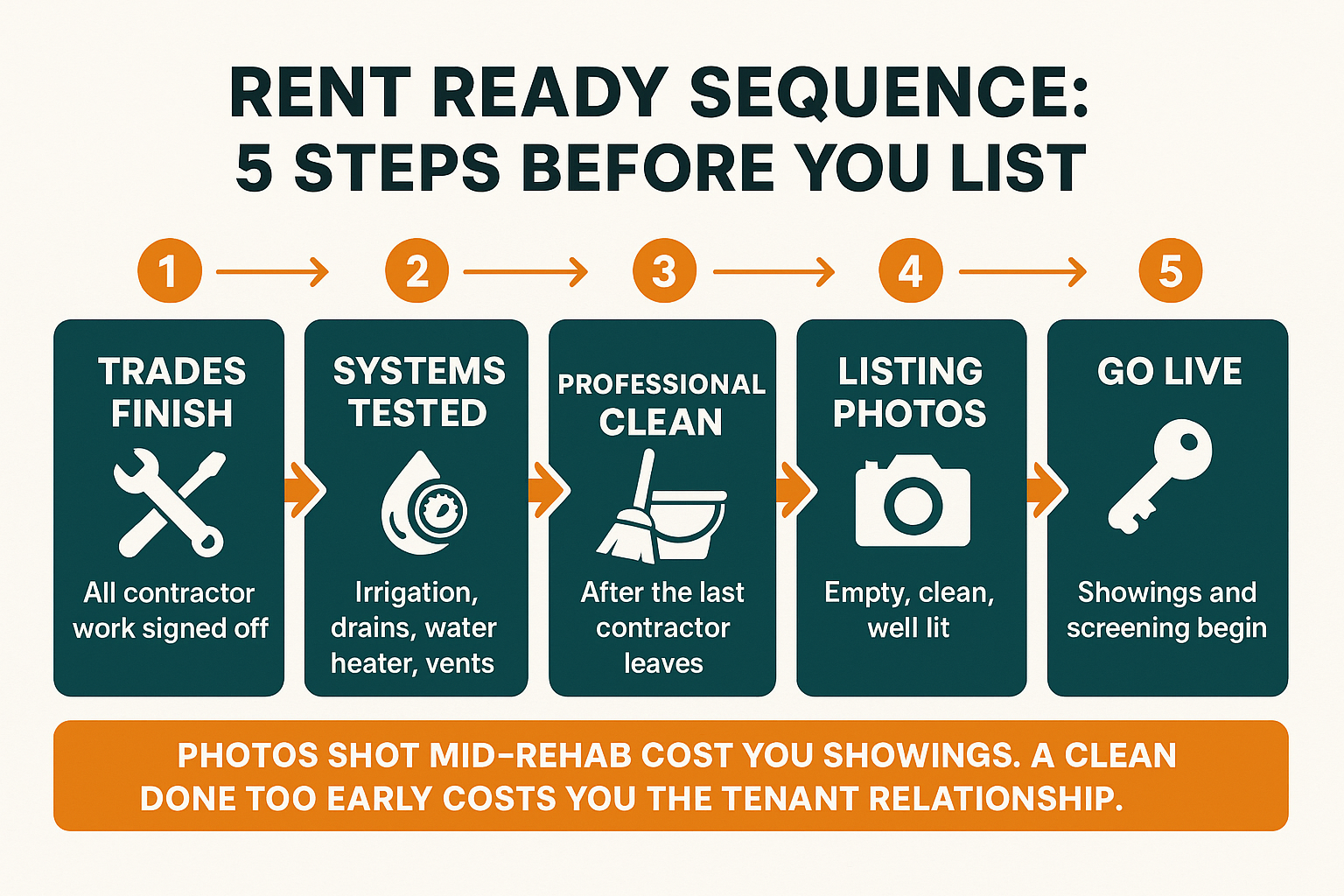
Sequence Matters, and Almost Nobody Gets It Right
The order is short: trades finish, systems get tested, the professional clean happens, photos get shot, and then the property goes live. Move any of those and you pay for it.
Owners who photograph a unit mid rehab pay in weak showing traffic. Drop cloths, bare bulbs, and a half tiled bathroom in the second photo will cut your inquiries in half, and every extra week the unit sits is rent you do not get back. We wrote about what vacancy actually costs a Monterey County owner if you want the numbers behind that.
Owners who clean before the last contractor walks through pay a different way. Tenant reviews in this market repeatedly describe arriving at a home that had not been cleaned the way they were told it had been. That is a relationship starting in a hole, and it rarely recovers. The first week sets whether you have a tenant who reports a small leak or one who stops calling you at all.
Move-In Documentation Is Part of Being Rent Ready
Most owners treat the move-in photo record as paperwork that happens later. I treat it as the last step of getting rent ready, and I do it before the keys leave my hand.
Here is why. A room by room photo record is the thing that settles a disagreement twelve or eighteen months on. Review pages for property managers up and down the Central Coast are full of deposit fights over paint touch ups and worn weather stripping, and in plenty of those cases the wear was visible in the original inspection photos all along. Nobody looked, because nobody took good ones.
What a usable record looks like:
- Every room, wide shot plus close ups of any existing scuff, chip, or stain.
- Appliances, including the serial plates and the current filter.
- Floors and baseboards, since this is where most move out arguments live.
- Exterior and yard condition on the day of move in, with the irrigation timer setting noted.
- Meter readings, so utility transfer questions have an anchor point.
It costs about an hour before the keys go out. It saves a season of back and forth after. Owners who self manage almost never build this record thoroughly enough, which is one of the things Salinas owners get wrong about self-managing.
If You Are Listing Between October and March, Add a Layer
Timing changes the checklist. Forecasters have been pointing toward a wet California winter, and NOAA's Climate Prediction Center has reported on a strengthening El Nino pattern heading into the cool season.
A vacant property with nobody inside to notice a slow roof leak is the worst possible setup going into heavy rain. So before a tenant takes possession, not during the first serious storm, I want eyes on:
- Roof condition, including flashing and any patch work done during the remodel.
- Gutter runs, cleared of construction debris, which collects there constantly.
- Downspout discharge, aimed away from the building.
- Grade around the foundation, especially where landscaping was reworked.
In the Salinas Valley this also means looking honestly at how the lot drains, because flat lots and heavy soil hold water in places that look fine in September. On the Peninsula, in Pacific Grove or Carmel, it means accepting that coastal moisture will find any gap you left unsealed around windows, trim, and vents. Our storm walkthrough order of operations goes step by step if you want to do a pass yourself.
Frequently Asked Questions About Getting a Rental Rent Ready
My remodel is done. How long before I can list?
Often within a week, if the systems check out and the clean is scheduled. What stretches it is finding something during the walkthrough that needs a vendor, like an irrigation leak or a vent run that has to be redone. Better to lose five days now than to lease a problem.
Will a remodel let me charge more rent?
Sometimes, and not always as much as owners hope. Kitchens, flooring, and a clean yard move the number. Higher end finishes in a standard unit usually do not move it much at all. That is exactly what a market read during the walkthrough is for.
What does a pre-listing consultation cost?
We do these in person and we talk through pricing during that visit rather than posting numbers on a page, because the scope depends on the property, the unit count, and what you want handled. You can ask about it directly at (831) 757-1270.
I only want help finding a tenant. Can I still get a walkthrough?
Yes. Some owners want a quality tenant placed and then plan to handle the property themselves afterward. The condition review and market read happen either way, since you cannot price a unit you have not walked.
Do I need to test the sprinklers if the yard looks fine?
Run them. Underground leaks show up as a spinning meter and a soft spot long before they show up as a dead lawn, and a tenant stuck with a high water bill in month one is a dispute you will not win cleanly.
Wondering What Your Finished Remodel Is Actually Ready For?
We have been doing in person pre-listing consultations across Salinas, the Salinas Valley, and the Monterey Peninsula since 2009. Those visits include the walkthrough, a read on current market rent, and notes on what to address first, and any pricing questions get answered in that conversation rather than on a web page. Coast & Valley Properties can be reached at (831) 757-1270 or through the contact form at coastandvalleypm.com.

How Rent Money Moves From Your Salinas Tenant to Your Bank Account
Not long ago an owner in the Salinas area filled out our contact form with a question I wish more people asked out loud. She said she did not really understand how the process works and asked us to walk her through it.
That question is not about services. It is about mechanics. Rent gets collected somewhere, and the owner sits there guessing when it becomes money in the bank and what paperwork arrives with it.
So here is the walkthrough. One normal month from the tenant's due date to your account, why the first payout almost never matches the rest, and what the monthly statement is actually telling you.
How Property Managers Pay Owners Rent: One Month, Start to Finish
Every firm runs its own calendar, but the shape of the month is usually the same. Here is the order things happen in.
- Rent comes due on the date written in the lease, most often the first.
- A short grace window follows. When rent has not landed by the end of it, a late notice goes out and the tenant starts owing a late fee.
- Collected money has to clear. Online tenant payments and checks both need a few business days before the funds can safely be moved out again.
- Approved expenses and any reserve come off the top.
- The balance goes out as an owner disbursement, by check or direct deposit, along with that month's statement.
Most owners I talk to assume the deposit should hit the same day the tenant pays. It cannot. Moving money that has not cleared is how a manager ends up clawing back a payout, and nobody wants that phone call.
What I would push any owner in Monterey County to do is get the dates in writing before signing anything. Ask what day disbursements run, how the timing shifts when that day falls on a weekend, and what happens when rent arrives on the 20th instead of the 1st. Those three answers tell you a lot about how organized an office really is.

Why Your First Deposit Looks Nothing Like the Rest
This one causes more confusion than anything else in owner accounting. The first payout on a newly leased home is almost always smaller than the steady monthly amount, and that is normal.
Three things usually explain it:
- Prorated rent. A tenant who moves in mid month pays for part of a month, not all of it.
- The security deposit is held, not paid out. It stays in trust because it is the tenant's money until move out is settled. Owners often expect to see it land and get uneasy when it does not.
- Leasing costs hit in month one. Marketing, screening, and lease execution work happens before a single rent payment exists, so those charges tend to show up against the first collection.
By month two or three you should see a predictable number. If you want a fuller picture of which charges belong where, this breakdown of what property management fees actually cover, and what they don't is a good companion read.
And the dollars here are not small. General market figures put average apartment rent in Salinas somewhere in the low $2,300s and Monterey closer to $2,800, with three-bedroom houses county wide often averaging well above $4,000 a month. One unexplained line item on a Carmel or Pacific Grove single-family rental is real money.
First Payout vs. a Steady Month
Here is the same rental, two different months, so you can see why the numbers move. Figures are illustrative only and will vary by property and by firm.
| Line item | First month after lease-up | Typical later month |
|---|---|---|
| Rent collected | Prorated, partial month | Full monthly rent |
| Security deposit | Collected and held in trust, not disbursed | Not applicable |
| Leasing and lease-up charges | Usually appear this month | None |
| Management fee | Applied to rent collected | Applied to rent collected |
| Maintenance or repair costs | Possible make-ready items | Only if work was done |
| Reserve held | Often funded this month | Replenished as needed |
| What reaches your account | Noticeably lower than expected | Predictable month to month |
Reading the Monthly Statement Without Guessing
Most owner frustration I see is not about the amount. It is about not being able to tell why the amount is what it is.
A well-run owner file should give you access to all of this:
- A monthly income and expense statement showing rent in and costs out
- A general ledger so you can trace every entry
- Accounts payable detail for anything owed to a vendor
- Copies of repair invoices, not just a dollar figure with a label
The deposit that reaches you is what remains after those expenses, plus any maintenance reserve your manager holds. That reserve exists so a broken garbage disposal on a Friday night can be handled without calling you for a check.
Here is the scenario that surprises people most. A month with a water heater replacement or a tree removal in the backyard produces a much thinner deposit, sometimes close to nothing on a single-family home. The statement is the place that shows exactly why, line by line, and if it does not, that is the problem to raise. Knowing who approves a repair at your rental and how you know it got done keeps those months from feeling like a surprise.
The Monthly Rent Cycle at a Glance
This is the same sequence laid out visually, from the tenant's due date to your disbursement.
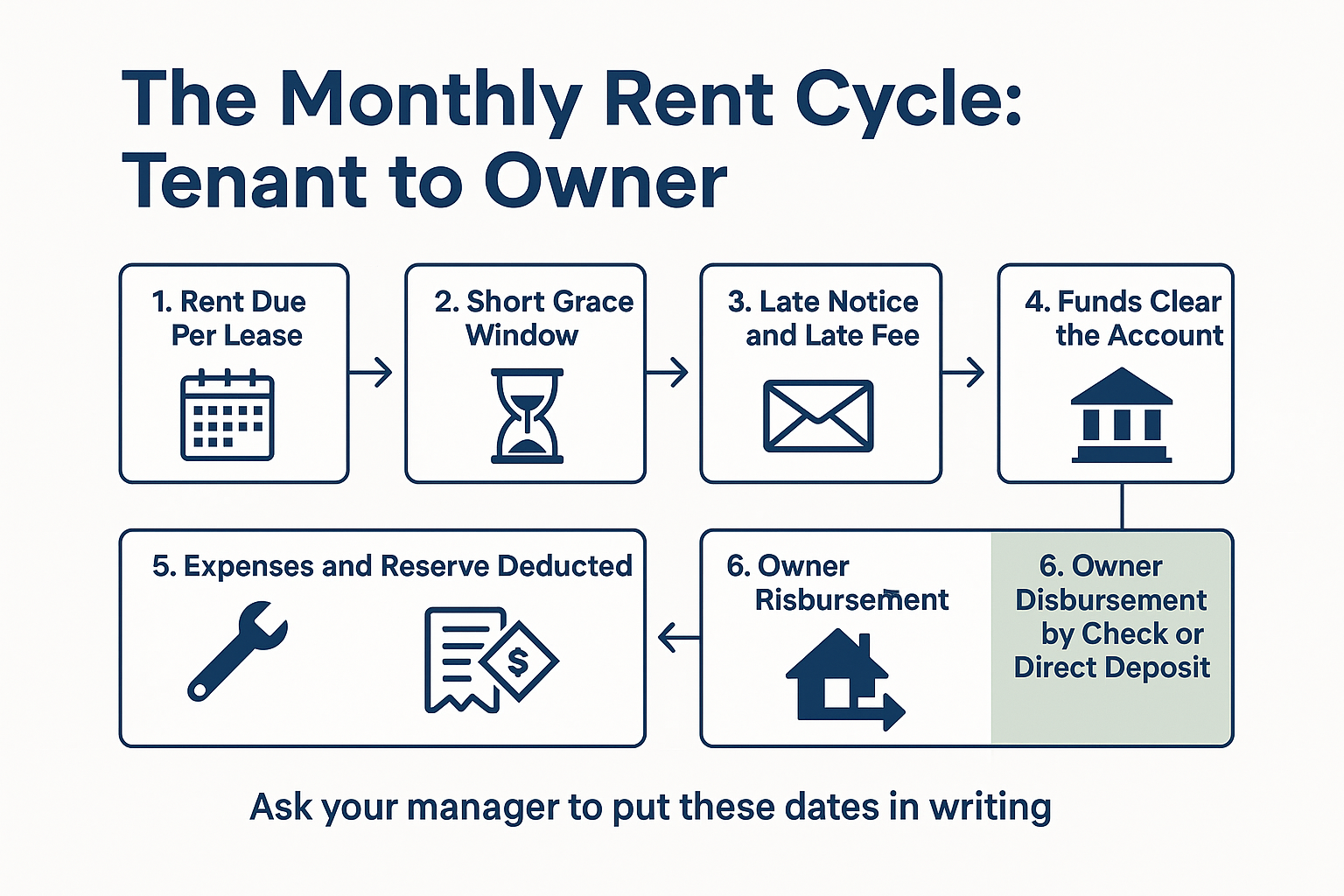
When Your Manager Also Pays the Bills, the Math Changes
A lot of owners do not realize bill payment can be part of full management. When it is, the deposit reaching you is a net number, not a rent number.
Out of collected rent, a manager may be paying:
- The mortgage
- HOA dues
- Utilities the owner carries
- Insurance premiums
- Property taxes
That is a real convenience, especially for owners living out of the area. It also means you need to understand the order things get paid in and what happens in a month when rent arrives late but the mortgage is still due.
Questions worth asking directly:
- What reserve level do you hold on my property, and how is it funded?
- Which obligations get paid first if collected rent does not cover everything?
- Will you tell me the same week if a shortfall is coming, or do I find out on the statement?
- Do I need to send funds in, and how fast?
A late tenant should never turn into a late mortgage. That only happens when nobody defined the priority ahead of time. If you are weighing whether to hand this off at all, the honest accounting of what Salinas property owners get wrong about self-managing covers the time cost people underestimate.
Portal Access, and the February Phone Call From Your Accountant
The practical failure point in all of this is not the money. It is access to the records.
An owner with a rental in Gonzales once wrote in unsure whether a portal account had ever been set up, and the password reset email would not arrive. That is a five minute fix, but only if you catch it early instead of the night before a tax deadline.
In the first week of any management relationship, do these four things:
- Log in to the owner portal yourself and confirm it works
- Confirm how statements get delivered, portal only or email too
- Download one document and one statement to be sure you can
- Find out which person at the office to call when the technology breaks
I also tell owners to keep local PDF copies of every monthly statement. Portals are convenient, but your own folder on your own computer is what saves you later.
Then carry it to year end. Expect 1099 preparation and a year-end summary, and expect your accountant to ask for statements, repair invoices, and expense detail around February. The IRS outlines what counts as rental income and deductible expenses if you want to see the categories yourself. Owners who try to reconstruct a year of rental income in March always find gaps, and those gaps usually cost them a deduction they had every right to take.
Frequently Asked Questions About Owner Disbursements
When do I actually get paid if my tenant pays late?
Your disbursement follows the money, not the calendar. If rent clears after the monthly payout has already run, the funds usually go out on the next cycle, which can mean waiting until the following month. Ask your manager whether they run off-cycle disbursements for late payments, because policies differ.
Does the security deposit ever get sent to me?
No, not during the tenancy. It is held in trust because it still belongs to the tenant until move out and final accounting are settled. Seeing it sit there is correct, not an error.
Why was my deposit so much smaller this month?
Almost always a repair, a bill payment, or a reserve replenishment. A single water heater, sewer line call, or tree removal can swallow most of a month's rent on a single-family home. The income and expense statement plus the repair invoice should show you the exact figures, and if it does not, ask for the invoice copy.
Check or direct deposit, and can I switch?
Both are common and most offices will let you change. Direct deposit is faster and far easier to reconcile, which matters if you own more than one property.
What should I hand over before my first payout?
Expect to provide a signed management agreement, a completed tax form for 1099 reporting, banking details for direct deposit, and any loan, insurance, or utility account information if bill payment is part of your service. Missing paperwork is the most common reason a first disbursement gets delayed.
Want the Payout Calendar in Writing?
We have been handling owner accounting from our Main Street office in Salinas since 2009, with a broker-owner reviewing the work, owner portal access to financials and reports, and bill payment available for owners who want the mortgage, taxes, insurance, and utilities handled alongside rent collection. If you have questions about how a disbursement schedule or a monthly statement would look for your Monterey County property, or about pricing, that is a conversation rather than a web page. You can reach Coast & Valley Properties at (831) 757-1270 or through the contact form at coastandvalleypm.com.

Who Approves a Repair at Your Salinas Rental, and How You Know It Got Done
The message we get most often from owners is not about money. It is some version of "did that ever get fixed?"
One Salinas owner followed up twice over roughly three months about the same two items, a tree and a side fence, and finally asked for photos of the finished work. The first note was simple: "I asked if we could get a quote to trim the tree in the front yard. It is severely overgrown." Nothing about that request was complicated. The problem was the silence after it.
That gap between approved and verified complete is where owner trust breaks down. This article stays in one lane: who decides on a repair, at what dollar amount, who picks the vendor, and how you confirm the work happened and was billed correctly. It is not a general maintenance overview, and it is not the separate question of what counts as an emergency at 2 a.m. versus a Monday morning item.
Approved Is Not the Same as Done
Most repair breakdowns are not refusals. Somebody said yes, a vendor got called, and then the thread went quiet.
Here is the usual chain of small failures I see in Monterey County:
- A tenant reports an issue by phone instead of in writing, so nothing gets logged
- A quote is requested from a vendor who is busy and never sends it
- The owner approves by email, but no work order is opened against the approval
- The vendor finishes, invoices, gets paid, and nobody takes a single photo
- The owner sees a line item on a statement two months later and cannot tie it to anything
Every one of those is fixable with a paper trail. When an owner asks for pictures, they are not questioning your honesty. They are asking for the record that should have existed from the start.
So before you evaluate any manager on price or personality, ask them to walk you through one real repair from request to closeout. The answer to "show me the trail" tells you more than any brochure.
The Approval Threshold Nobody Asks About Until It Surprises Them
Every management agreement sets a dollar threshold. Below it, your manager can act without calling you. Above it, you sign off first.
Most owners skim right past that number and only notice it when a repair lands on the wrong side of the line. Then it becomes an argument.
I will not quote a figure here, because there is no standard one and yours should be set on your property, not a template. What I can tell you is what moves the line:
- Where you live. Out of area owners in the Bay Area or out of state usually set it higher, because a 6 hour approval delay on a leak is expensive
- How much reserve the manager holds. A thin reserve caps what can be handled without a call regardless of the written limit
- The age of the systems. A 1950s Alisal Street rental with original galvanized plumbing generates more small calls than a rebuilt house in Pacific Grove
- How involved you want to be. Some owners want to hear about every water heater. Others want to hear about nothing under a certain size
- Tenant impact. Anything touching heat, water, or safety usually gets a higher standing limit than cosmetic work
Settle this in writing before the first repair, not after. And ask the manager directly what threshold they propose and why they propose that number for your specific property.
What Pushes Your Approval Limit Up or Down
Use this as a conversation guide when you are negotiating the agreement.
| Factor | Points Toward a Higher Limit | Points Toward a Lower Limit |
|---|---|---|
| Owner location | Out of county, out of state, travels often | Lives in Salinas or on the Peninsula and wants a say |
| Property age and systems | Older plumbing, older roof, frequent small calls | Recently renovated, systems under warranty |
| Reserve held by manager | Healthy reserve that refills monthly | Minimal reserve on file |
| Owner involvement style | Wants a hands-off ownership experience | Wants to review and approve most spending |
| Number of doors | Small portfolio where calls stack up | Single home with predictable maintenance |

The Verification Trail You Should Be Able to Pull Up Yourself
When an owner asks for pictures, what they actually want is proof they can check without asking anyone. That is a reasonable standard, and it is not hard to meet.
A closed repair should leave behind five things:
- Before and after photos attached to a dated work order, not floating in someone's text messages
- The vendor's own invoice, not a summary line typed by the office
- A note on who authorized the spend, and whether it fell under the standing limit or got owner approval
- The completion date, which matters if the same issue comes back
- A record you can open months later from an owner portal without emailing a request
That last one is the piece most local management sites barely mention. An owner portal is not a nice extra. It is where financials, statements, and work history sit so you can answer your own question at 9 p.m. on a Sunday.
If you are comparing firms, ask to see a sample portal view of a completed work order. A manager who has this running will show you in about a minute. This is also part of what full-service management actually covers, and it is worth confirming rather than assuming.
How a Repair Should Move From Request to Closed
Here is the trail a single repair should leave behind, step by step.
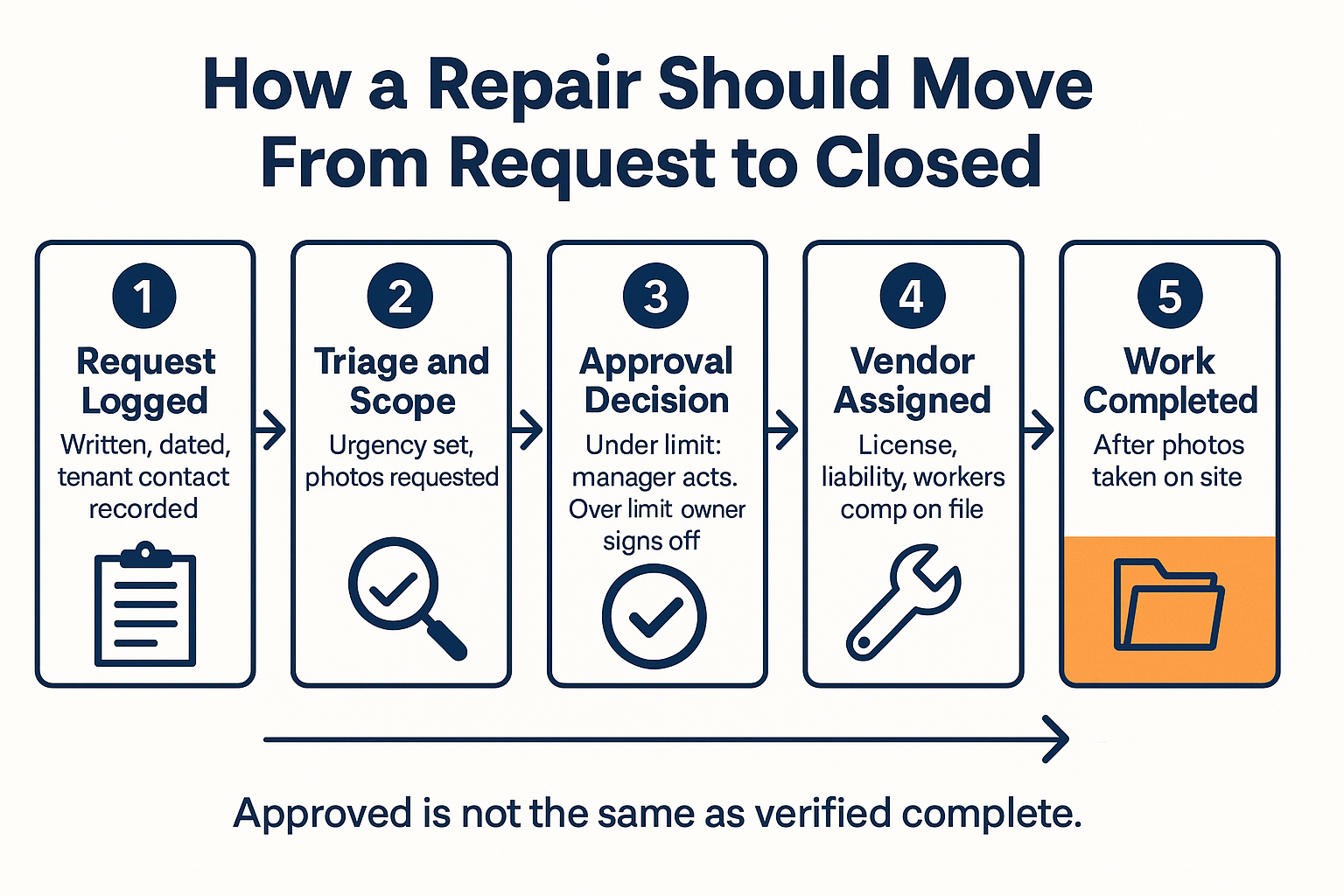
The Small Repairs Are the Expensive Ones
Owners who set a low approval limit to stay in control often end up paying more, because the delay costs more than the repair.
The pattern shows up in tenant complaints across this market. Renters here have described sprinkler and plumbing leaks that pushed their monthly water bills toward $300, went unresolved for the length of the tenancy, and then turned into a move-out deposit argument. By then the owner has a water bill dispute, a vacancy, and a public review that reads badly to the next applicant.
Water is the worst version of this. Nationally, household water damage claims commonly land in the five figures once you get past the surface, and water and freezing losses are consistently among the most frequent and costly homeowners insurance claims. A leak ignored for a season is not a small line item.
The math for an owner is simple:
- Week one: a plumbing call and a short invoice
- Month ten: a claim, a deposit fight, a turnover, and a review that lives online
That is the real argument for a workable approval limit. You are not giving up control. You are buying speed on the repairs where speed is the whole game. Owners who reach this conclusion are often the same ones asking when self-managing a Salinas rental stops making sense.
Who Picks the Vendor, and What Should Be Verified First
Owners assume vendor vetting happens. Almost nobody asks how.
A management office in Monterey County fields a steady stream of pitches. Landscapers, flooring installers, and security patrol companies write in asking to be added to the vendor list, and the good ones volunteer their license, insurance certificate, and W-9 up front. That is a decent signal, but it is the floor, not the finish line.
Before a vendor touches your property, someone should confirm:
- An active state license for the trade and scope of work
- General liability coverage, current, with the management company or owner listed appropriately
- Workers compensation, so an injury on your rental does not become your problem
- A documented response window, in writing, not a verbal promise
- A history on similar properties, ideally in the same corridor of the county
Here is the local wrinkle. During peak Salinas Valley harvest months and Peninsula event season in August, the good contractors are booked solid. Roofers, plumbers, and tree crews all get squeezed at once.
In those stretches, an established relationship beats the lowest bid every time. A manager who has sent that vendor steady work for years gets on the schedule. A cold call with a cheaper quote waits three weeks.
What a Scheduled Inspection Should Catch Before a Tenant Reports It
Maintenance timing on the Central Coast is not generic, and the calendar here is predictable enough to plan around.
After a dry summer, the first real rain of the fall exposes roof, gutter, and drainage problems all at once. Every roofer from Pacific Grove to King City gets the same call in the same week, which means your position in that queue was decided in September, not November.
A few patterns worth knowing:
- Salt air on the Peninsula chews through exterior paint, hinges, and hardware faster than inland Salinas
- Hard water in the Salinas Valley shortens water heater life and quietly kills fixtures
- Clogged gutters and blocked yard drains cause more first-storm damage here than roof failure does
These are the items an annual scheduled inspection should catch on purpose. Not because a tenant called, but because someone walked the property in daylight with a list. That is also why walking the rental before the first storm is a different activity than responding to a work order.
Complaint-driven maintenance always costs more. It arrives at the worst time of year, in the busiest week, at the highest rate.
Frequently Asked Questions About Rental Property Repair Approvals in Monterey County
What dollar amount should my approval limit be set at?
There is no standard number, and any manager who quotes one before seeing your property is guessing. The right limit depends on where you live, the age of your systems, how much reserve is held, and how involved you want to be. Ask the manager what they propose for your specific property and get it in writing before the first repair.
Can I require approval on every single repair, no matter how small?
You can, and some owners do. Just understand the trade. Every approval adds hours or days, and on water intrusion or a failed water heater that delay is where the real cost shows up.
How do I know the vendor invoice I am being shown is the real one?
Ask for the vendor's own invoice document, not a retyped summary line on a statement. It should show the vendor name, license, work performed, and date. If that document is not available to you in a portal, that is the question to raise.
Should I expect before and after photos on every repair?
On anything beyond a filter swap, yes. Photos tied to a dated work order are the cheapest form of protection you have, and they settle move-out disputes later far better than memory does.
What if a repair was approved months ago and I still cannot tell whether it happened?
Pull the work order by date and look for a completion entry, after photos, and a matching invoice. If any of those three are missing, the repair is not documented as done, whatever anyone remembers. That is exactly the gap worth closing before it becomes a pattern.
Questions About Approval Limits and Reporting?
We have been broker-owned and working Monterey County since 2009, with annual scheduled inspections rather than complaint-driven visits, and an owner portal where financials and work history sit waiting whenever an owner wants to look. One review put it plainly: "They are very efficient when requesting maintenance." If you are weighing how repair authority and reporting should work on your own property, that is a conversation worth having directly with Coast & Valley Properties at (831) 757-1270.

Walking Your Salinas Rental Before the First Storm: What to Check, in Order
Every winter I get the same call in the same week. The first real storm rolls through, and an owner who felt fine in September is suddenly asking why there is water in the garage and why no one can get a plumber out for six days.
Almost every time, the cause was visible in October. A drain packed with agricultural dust. A downspout dumping two feet from the slab. A limb that had been dead since spring.
Forecasters are pointing toward a wet El Nino winter for California, with the heaviest window generally running December through March and the storm track sitting far enough south to line up repeat systems over the Central Coast. That does not promise anything. It just loads the dice, which is reason enough to walk your property now rather than react later.
Why This Super El Nino Storm Preparedness Checklist Belongs in October
The value of a pre-storm walkthrough is not the list. It is the timing and the order.
In Monterey County, our dry season runs long. From roughly May to October, dust off the fields, oak leaf drop, and fine grit blow into every horizontal opening on a property and sit there. By the time the first atmospheric river arrives, your drainage system may already be sealed shut.
Here is what an October walk buys you that a December walk does not:
- Vendor availability. Roofers, gutter crews, and tree services book out fast once the rain starts.
- Scheduled instead of emergency work, which is a different conversation about cost entirely.
- Time to get tenant access sorted for interior items like crawl space vents and dryer venting.
- Daylight and dry ground, which matters more than people expect when you are trying to see where water actually goes.
I treat early November as the hard stop. After that, you are joining a queue behind everyone who waited, and the weather decides your schedule instead of you.
Step 1: Start at the Ground, Not the Roof
Owners almost always look up first. I understand the instinct, but a worn roof fails at about the same rate it always did. A blocked drain turns an ordinary Tuesday storm into water inside the unit.
So I start low and work a full loop around the building. What I am looking at:
- Where every downspout discharges. If it dumps within a couple feet of the foundation, that water is going under the slab. Extensions are cheap and boring and they work.
- Which way the lot grades. Walk the perimeter and look for ground that slopes back toward the house. Salinas Valley lots are flat, and flat holds water.
- Area drains and yard basins. Pull the grate. If you find packed dust, leaf mat, and gravel, that drain is decorative right now.
- Crawl space vents. Same problem, plus rodent screen that has been collecting debris since spring.
- Last winter's high water line. A stain band on a fence board, a discolored ring on a garage slab, or a silt line along a walkway tells you exactly where water pooled before.
That stain line is the single most useful thing on the property. It is real evidence from a real storm, and it beats any guess I could make standing there in dry weather. If you own in the valley, this ground-level pass matters even more than it does on the Peninsula, and that is worth understanding if you also own a rental in South County.

Step 2: Now Go Up, and Look at Seams Before Shingles
Once the ground is handled, I move to the roof. I am not looking for a new roof. I am looking for the specific spots where water gets in first.
From the ground with binoculars, or from a ladder if it is safe:
- Gutter seams and end caps, which separate slowly and leak in exactly the spot you least want water.
- Flashing around chimneys, skylights, and vent stacks. These are the classic entry points.
- Missing or slipped tiles, common on older Salinas and Monterey homes after a windy summer.
- Anything a previous repair touched. Old patch jobs and re-sealed penetrations deserve a hard look. A repair that held through a dry year is not a repair that held.
While you are up there, clear the gutters. In the valley, gutter debris is not just leaves. It is fine field dust that turns into a dense mud layer once it gets wet, and that layer holds water against the fascia all winter.
One more item people skip: check that gutters actually drain somewhere useful. I have seen clean gutters feed a downspout that empties directly onto a walkway that slopes back toward the front door.
The Walkthrough, in Order
This is the sequence I follow on every property, and the order is the point. Ground first, roof second, trees third.
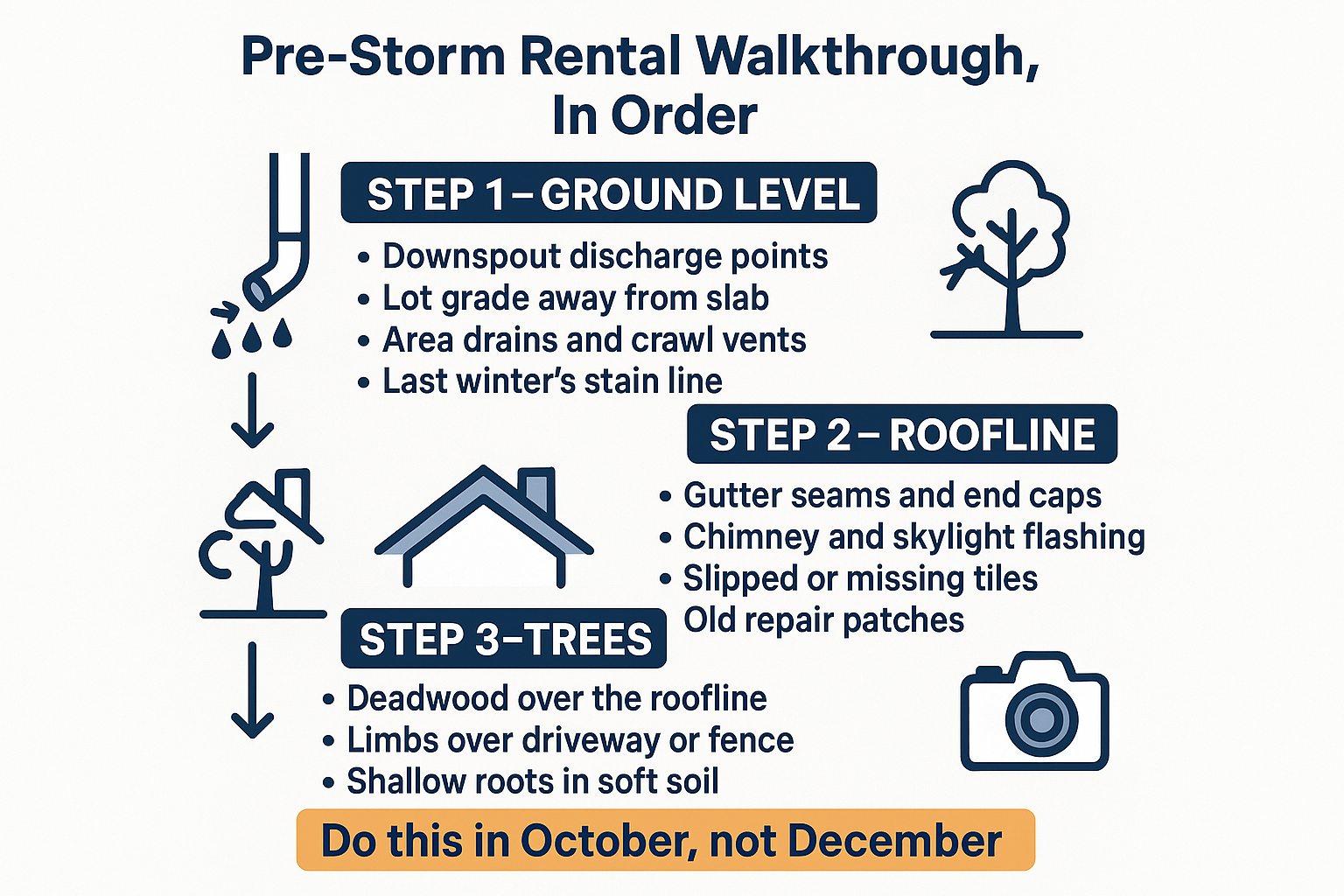
Step 3: The Tree You Have Been Putting Off
Trees are the item owners defer longest and the one most likely to produce a wind claim. I see it in our inbox every year.
One Salinas owner reached out asking for a quote to trim a front yard tree, describing it as severely overgrown. Months later, the same owner followed up to ask whether the trimming and a fence repair had been finished, and asked for photos of the completed work. That second message is the part I want owners to notice.
What to look for on your walk:
- Deadwood hanging over the roofline. Dead limbs come down first and they come down hard.
- Limbs over a driveway, a parked car, or a neighbor's fence. That is where a nuisance becomes a liability conversation.
- Shallow-rooted species in soft ground. Saturated valley soil plus a top-heavy canopy plus wind is the whole story of most winter tree failures I have seen here.
And then close it out properly. A verbal yes from a vendor is not proof. I want a written scope, a dated set of before and after photos, and a record in the file. If a limb comes down later anyway, that documentation is the difference between a clean claim and an argument.
Two Climates, One County: Valley vs Peninsula
Monterey County is really two weather systems sharing one rental market. The properties I manage in Salinas fail in completely different ways than the ones in Pacific Grove or Carmel.
| What You Are Fighting | Salinas Valley | Monterey Peninsula |
|---|---|---|
| Primary storm risk | Standing water on flat lots, river floodplain exposure, slow-draining soil | Wind-driven rain forced into seams, siding, and window frames |
| What clogs things up | Agricultural dust and grit packed into gutters and area drains | Pine needles, fog drip, and salt residue on exterior finishes |
| The recurring complaint | Water under the slab, garage flooding, crawl space moisture | Surface mildew on walls and window sills from marine layer condensation |
| What owners misread | Assuming a dry summer means drains are clear | Reading normal coastal surface mildew as structural failure |
| Where to focus in October | Drainage, grading, downspout discharge | Sealing, flashing, exterior finish condition, ventilation |
The July Complaint That Becomes a January Emergency
Here is a pattern I would bet money on. The maintenance item a tenant mentions casually in summer is the one that pages us at 11pm during a storm.
The recurring ones in this market:
- Irrigation and sprinkler leaks. These usually show up first as a water bill spike, not a puddle. A tenant in one of our reviews described being stuck with roughly $300 water bills because of a sprinkler leak, and that kind of complaint deserves a same-week response, not a same-season one.
- Slow drains. A drain that gurgles in July backs up under storm load in January.
- Dryer venting that was never run correctly, including vents that terminate into a crawl space instead of outside.
- Plumbing that struggles when everything runs at once, which is your early warning on a main line.
Every one of those is a scheduled repair in October and an emergency call in January. That difference in timing is one of the biggest levers an owner has over what winter costs them, and it is a real part of the hidden workload behind a single rental home.
Vendor Timing, Road Access, and Watching Conditions
Two logistics items that owners outside the area consistently underestimate.
First, vendor supply. Once the rain starts, roofers, gutter crews, and tree services in Monterey County are triaging. Scheduled work in October is a normal appointment. The same work after the first storm is a waiting list.
Second, access. In past wet years, storm-related closures on roads like Davis Road, Alisal Road, and stretches of Highway 68 have cut the Peninsula and the valley off from each other. If the person responding to your property is not already on the same side of the water, they are not responding.
During the season itself, stop guessing about conditions near a valley property. The county maintains a real-time river and rainfall gauge network through its flood warning system, and watching actual gauge data near your property beats reading a regional forecast and hoping.
What Actually Moves a Storm Repair Bill
I will not put numbers on this, because the range is wide and the honest answer depends on your property. But I can tell you what drives it.
The factors that matter most:
- Emergency versus scheduled work. After-hours and storm-week pricing is a different market than a booked October appointment.
- Whether water reached finished materials. Clearing a drain is one job. Drying a unit, replacing drywall, and pulling flooring is another job entirely.
- How long the water sat. Response time changes the scope more than almost anything else.
- Whether the unit stays occupied during the repair, and what that does to the timeline.
Meanwhile, the cost of simply holding a rental in California has climbed sharply, insurance in particular. That changes the math on what an owner can afford to get wrong in a wet winter. Preventive drainage work is a known number on a calendar. Water intrusion is not.
If you want a real figure for your property, that is a conversation with a licensed local vendor or with us directly, not something anyone should quote you from a blog post.
Frequently Asked Questions About Pre-Storm Rental Walkthroughs
When is the actual deadline to get this done?
I aim for October through early November. That is before the heavy window and before vendors get booked. If you are reading this in December, do the ground-level drainage pass anyway. It is the highest-value hour you will spend.
My tenant says there is mildew on the walls in Pacific Grove. Is the house failing?
Usually not. Surface mildew from marine layer condensation is a normal effect of living that close to the water, and it is a ventilation and cleaning issue more often than a structural one. It still needs to be addressed, but it is a different problem than water coming through a wall in Salinas.
Can I do this walkthrough myself if I self-manage?
Yes, and you should. The order in this article is the whole method. Where owners run into trouble is the follow-through: coordinating tenant access, getting vendors scheduled during their busiest season, and documenting that the work actually closed out.
How do I prove a pre-storm repair was completed?
Get a written scope before the work and dated photos after. I keep both in the property file. Owners regularly ask us for photos of completed work months later, and having them ready is the point of doing it that way.
Does a wet winter forecast mean my property will flood?
No. A wet pattern raises the odds of repeat systems over the Central Coast, but it does not predict what happens at your address. That is exactly why the walkthrough is worth more than the forecast.
Questions About Your Own Property Before the Rain?
We have managed properties on both sides of this county since 2009, which means we know the Salinas Valley drainage problems and the Peninsula wind and salt problems are not the same job. We keep 24/7 emergency availability and a vetted local vendor bench for exactly the weeks when everyone else is booked. Owners with questions about a specific property in Monterey County are welcome to reach us at (831) 757-1270 or through the contact form at coastandvalleypm.com.