
Moving Out of State and Renting Out Your Salinas House: What to Line Up First
Most of the owner inquiries I get about this start the same way. Someone writes to say they are moving out of Salinas to another state in late June and want to rent out the house, or that they are leaving in the next six months and are not sure where to begin.
The move date is usually set. The house is not ready, the paperwork is not sorted, and the owner is about to be 1,500 miles away when the first maintenance call comes in.
So here is how I walk owners through it, laid out as a timeline: what to handle at 90 days, at 60 days, at 30 days, and in your final week in the house. Do these in order and the move gets a lot quieter.
Step 1: Time Your Listing Against the Local Leasing Calendar (90 Days Out)
Rental demand in Monterey County is not flat across the year. Applicant volume concentrates from late spring through summer, pushed along by the school calendar in the Salinas Union High School District and by summer job relocations across the valley and the Peninsula.
It thins out sharply from late November into the holidays. Fewer people move in December, and the ones who do are usually moving because they have to.
That means your departure date changes the plan:
- A June or July departure: you are listing into the busiest stretch of the year. You can expect a deeper applicant pool and a shorter marketing window, so the house needs to be genuinely ready, not almost ready.
- A November or December departure: plan for more days on market and a slower trickle of showings. Some owners in this spot choose a shorter first lease so the next turnover lands in summer instead of midwinter.
- A move that lands in February or March: demand is building but has not peaked. Pricing tends to matter more here than it does in July.
If you have any flexibility at all on your move date, this is the one variable worth bending. Two weeks of timing can be worth more than any single repair on your list.

Step 2: Separate What You Tolerated From What a Rental Has to Be (90 Days Out)
This is the step owners skip, and it causes more trouble than anything else on this list. The things you quietly lived with for ten years become disputes the moment someone else is paying rent.
I have seen local tenant accounts of Salinas houses where an unfound irrigation leak turned into months of arguing over water bills that ran into the hundreds. Nobody caught it before move in, so it became a fight instead of a repair.
Walk the house like a stranger and look hard at:
- Irrigation and hose bibs. A leaking valve or a cracked lateral line shows up as a spiking water bill, and in Salinas water is billed separately from rent in most single family homes. Run every zone and watch the ground.
- The dryer vent. A dryer that vents into a crawl space instead of outside is a lint and fire problem, not a quirk. Confirm where it actually terminates.
- The water heater. If it is near the end of its service life, replace it now on your schedule, not at 11pm in February on somebody else's.
- Locks. Rekey everything. Assume there are keys out there you forgot about.
- Windows and slider hardware. Sticky latches and broken window locks are habitability and safety items, not cosmetic ones.
- Smoke and carbon monoxide alarms. California requires working alarms in rentals, and this is an easy one to get wrong.
California's warranty of habitability sets a floor, and it does not care that you lived with the problem happily for years. Fixing these in April is a scheduled expense. Fixing them in August is an emergency call plus an unhappy tenant.
The 90 Day Timeline at a Glance
Here is the sequence I give owners who are leaving Monterey County. The order matters more than the exact dates.
| Timeframe | What to Handle | Why It Matters |
|---|---|---|
| 90 days out | Set your listing window, run a full condition walkthrough, get repair bids | Vendor scheduling in the Salinas Valley takes weeks in busy season |
| 60 days out | Bank account, insurance change, utility decisions, rental registration | Almost all of this is easier with a local address and in person ID |
| 30 days out | Decide placement only versus ongoing management, set rent range, prep marketing | Showings and screening have to start before you leave, not after |
| Final week | Photo and video record, serial numbers, keys, signed condition report | This file settles the deposit conversation two or three years later |
Step 3: Build the Money and Paperwork Trail While You Still Live Here (60 Days Out)
A lot of this is far simpler to do in person with a California ID and a local address. Once you are out of state, the same tasks turn into notarized forms and hold music.
Get these sorted before you go:
- A dedicated bank account for rent deposits and property expenses. Mixing rental money into your household checking makes your tax return miserable.
- A written decision on utilities. Who pays water, sewer and trash, in writing, in the lease. In Salinas these are separate bills from separate providers, and vague language here is how disputes start.
- Insurance. Call your carrier and switch from a homeowner policy to a landlord policy. A standard homeowner policy is not written for a tenant occupied house, and finding that out after a claim is a bad day. Costs vary by carrier and coverage, so ask for the specific quote rather than assuming it is a wash.
- Mail forwarding through USPS, plus a plan for anything that still gets delivered to the house.
- Property tax records, permits, warranties and receipts collected into one file, digital if possible.
- Keys. Decide now who physically holds spares once you are gone. Not a neighbor who might move. Someone with a documented reason to have them.
One more Salinas specific item: the city adopted a Residential Rental Registration Ordinance (City Ord. 2663, 2024), so registration is part of the picture for rental housing inside city limits. Rules around rent and just cause under AB 1482 may also apply to your property, and Salinas rent ordinances have been heading to voters, which is worth tracking before you set a lease term.
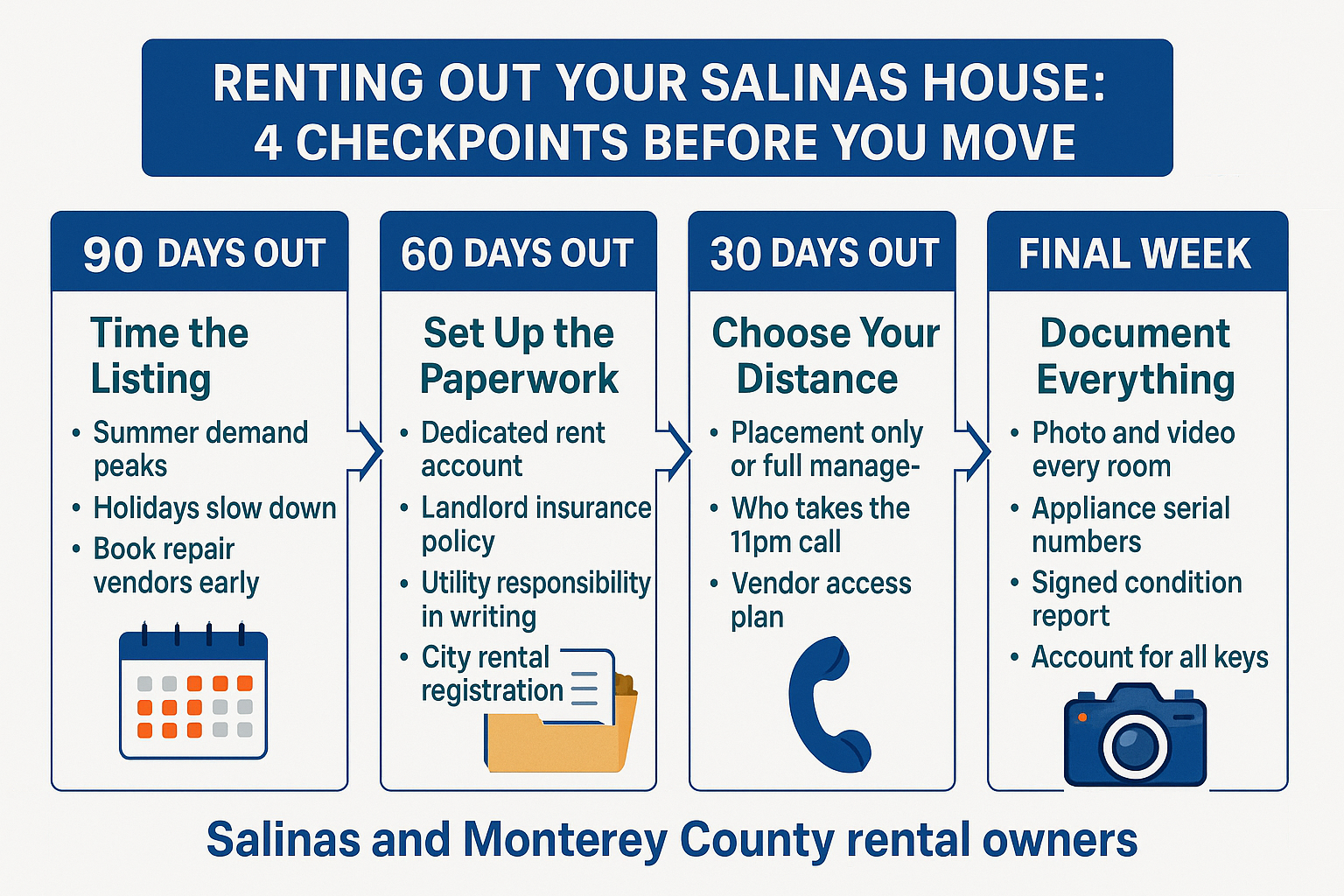
The Four Checkpoints Before You Leave
This is the same timeline in visual form, useful if you are juggling a move date and a listing date at the same time.
Step 4: Decide How Much Distance You Can Actually Absorb (30 Days Out)
There are two real choices here, and owners tend to pick one based on the task list when they should be picking based on the time zone.
The first option is placement only. Someone markets the house, runs showings, screens applicants through credit, background, rental history and employment verification, negotiates the lease, does the move in evaluation with photos, and collects the deposit and first month's rent. Then the keys and the responsibility come back to you.
The second is ongoing management, where the same team stays on for rent collection, maintenance coordination, inspections, emergency response and financial reporting.
Placement only works fine for some owners. It gets hard when you are three time zones away and:
- The water heater fails on a Saturday night and someone has to authorize a vendor before the floor is ruined.
- A plumber needs access at 9am Tuesday and you are in a meeting in Charlotte.
- A mid lease inspection is due and there is nobody to walk the property.
- The tenant gives notice and showings have to start within days.
- Something goes wrong at 11pm and yours is the only phone number the tenant has.
I have watched owners handle the task list fine and get worn down by the clock. A 10pm call in Salinas is 1am on the East Coast. Do that four times in a year and the calculation changes. If you are weighing it, the real workload behind a single rental home and how placement only compares to full management are both worth reading before you commit.
Step 5: Document the House on Your Last Day (Final Week)
Your last day in the house is the single most valuable hour of this entire process. Once the rooms are empty and clean, record everything.
Build one file that contains:
- Photo and video of every room, plus closets, the garage, the yard, fences, the roofline and the driveway. Date stamped.
- Appliance model and serial numbers, photographed straight off the labels.
- Warranty paperwork for the roof, HVAC, water heater and any recent appliance.
- Paint colors and finishes, brand and code, not "the beige from the hardware store."
- A key inventory: how many exist, who has them, which doors they open, plus garage remotes and mailbox keys.
- A signed condition report completed with the tenant at move in.
This file is what settles a deposit conversation two or three years from now, when nobody remembers what the baseboards looked like. California limits what a landlord can deduct from a security deposit and requires an itemized statement, and the California Courts self help guide on security deposits is a straightforward read on how that works.
Owners who skip this step almost always lose the argument later. Not because they are wrong, but because they cannot prove they are right.
Frequently Asked Questions About Renting Out a Salinas Home From Out of State
How far ahead should I start if I am moving in six months?
Six months is comfortable. Use the first couple of months for repairs and vendor scheduling, since good trades in the Salinas Valley book out weeks ahead in busy season, then move into paperwork at the 60 day mark. Starting late is what forces owners to list a house that is not ready.
Can I manage the property myself from another state?
You can, and some owners do it well, usually because they still have family locally and a plumber they trust. The two things that break it are after hours emergencies and vendor access. If you have no one who can meet a contractor at the door on a weekday, self managing from a distance gets expensive fast.
What rent can I expect for my Salinas house?
It depends on the neighborhood, the bedroom count, condition, parking, yard and whether utilities are included, and the number moves with the season. A rent range should come from a walkthrough and current comparable listings, not from an online estimate. That is a conversation worth having in person before you leave.
Do I need to register my rental with the City of Salinas?
The city adopted a Residential Rental Registration Ordinance (City Ord. 2663, 2024) covering rental housing inside city limits. Requirements and deadlines change, so confirm your specific property's status with the city rather than assuming.
Should I just sell instead?
That is a fair question and it deserves real math, not a gut call. Holding costs, your tax basis, the condition of the house and how long you plan to be gone all factor in. We wrote a separate piece on how to think it through.
Planning a Move Out of Monterey County?
One thing that helps before a move is having someone walk the property with you while you are still standing in it. A licensed local agent can meet you at the house, give you a rent range and a rent ready punch list in a single visit, and answer the utility and registration questions specific to your address. After you are out of state, emergencies and financial reporting run through an owner portal you can check from anywhere. If that would be useful as you plan your timeline, Coast & Valley Properties is at (831) 757-1270 or coastandvalleypm.com.

6 Things You Inherit When You Buy a Tenant-Occupied Salinas Rental
The best call I get from a buyer comes while the deal is still in escrow. One prospective owner reached out to us before closing on a Monterey County investment property just to get a manager lined up first, and that instinct is right. Almost everything on this list is easier to fix before the deed records than after.
When you buy a vacant house, you get a house. When you buy a tenant-occupied duplex on the east side of Salinas or a fourplex near Oldtown, you get a running business with existing obligations, existing wear, and existing people who did not choose you.
Here are the six things that come with the building, and what I would ask the seller for on each one during your due diligence window.
1. The Existing Leases, Including the Deals Nobody Wrote Down
Leases run with the property, not the owner. Whatever the seller agreed to, you agreed to, and that includes the handshake stuff that never made it into the file.
The rent roll spreadsheet is a summary, not a document. I have seen rent rolls that were quietly wrong about half the units in a small building.
During escrow, ask for the signed lease and every addendum for each unit, then confirm the terms in writing with each tenant. You are checking:
- Rent amount and the next renewal or expiration date
- Pet allowances, including the pet nobody put on paper
- Assigned parking, extra spaces, and storage
- Who pays water, sewer, trash, and gas
- Verbal side arrangements, like a rent break for yard work or a promise that a family member can stay
Rent history matters too. Under AB 1482, past increases affect what you can do next, and the clock does not reset because the building sold. That is one of several ways state rules can shift the ground under an existing lease.
2. The Security Deposits and the Condition Records Behind Them
This is the item buyers shortchange most often. Deposits should transfer to you at closing with a per tenant breakdown, not a single lump sum on a settlement statement.
Under California Civil Code 1950.5, the deposit obligation follows the property. When that tenant moves out three years from now, you are the one who has to account for every dollar, even the dollars the seller collected in 2019.
The money is only half of it. Ask for:
- Move-in photos for every occupied unit
- Signed move-in condition reports or inspection checklists
- Any written record of damage charges already assessed
- Documentation of pet deposits or additional deposits
Without that paper trail, every scuffed wall, stained carpet, and cracked outlet cover becomes yours to prove. Move-out disputes are the number one source of tenant complaints in this market, and you cannot win one with photos you never received.

3. The Deferred Maintenance That Comes With the Keys
Sellers show you the vacant unit. Walk the occupied ones.
Tenant accounts of rentals around Salinas describe the same pattern over and over: an irrigation leak that pushed a water bill toward $300 a month, an appliance that sat broken for weeks, a dryer venting into a crawl space instead of outside. Those were somebody else's problems last month. They are yours the day you close.
Ask for the full maintenance request history, not a summary. A list of work orders with dates tells you what actually happens in that building.
What I look at hardest in older Salinas housing stock:
- Irrigation and sprinkler zones, since a hidden leak shows up on a bill, not on a wall
- Water heaters, furnaces, and carbon monoxide and smoke alarms
- Sewer laterals and repeat drain backups
- Dryer venting, bathroom fans, and anything that was clearly done without a permit
California's warranty of habitability does not care who owned the building when the problem started. Neither does a tenant who has been waiting since spring.
4. The Shared Systems in a Small Multifamily Building
Apartment property management in Salinas gets complicated fast once units start sharing things. Older downtown and east side fourplexes often have one water service, one trash enclosure, a shared laundry room, and a gate or intercom nobody has serviced in years.
Shared infrastructure changes three practical decisions:
- Utility billing. One meter for four units means you either absorb the cost or set up a fair allocation method, and you need to know which before you underwrite the deal.
- Vendor needs. Shared landscaping, a common area light, and a laundry machine contract all require someone to schedule and inspect the work.
- Neighbor conflict. Overflowing trash, a blocked driveway, or a car taking two spaces turns into a complaint about you within a week.
A broken gate is the one I would fix first. When access hardware fails at a Salinas complex and stays broken, safety complaints follow, and they escalate quickly.
This is the part of ownership that scales in a way people do not expect, which I get into more in what changes as you add doors.
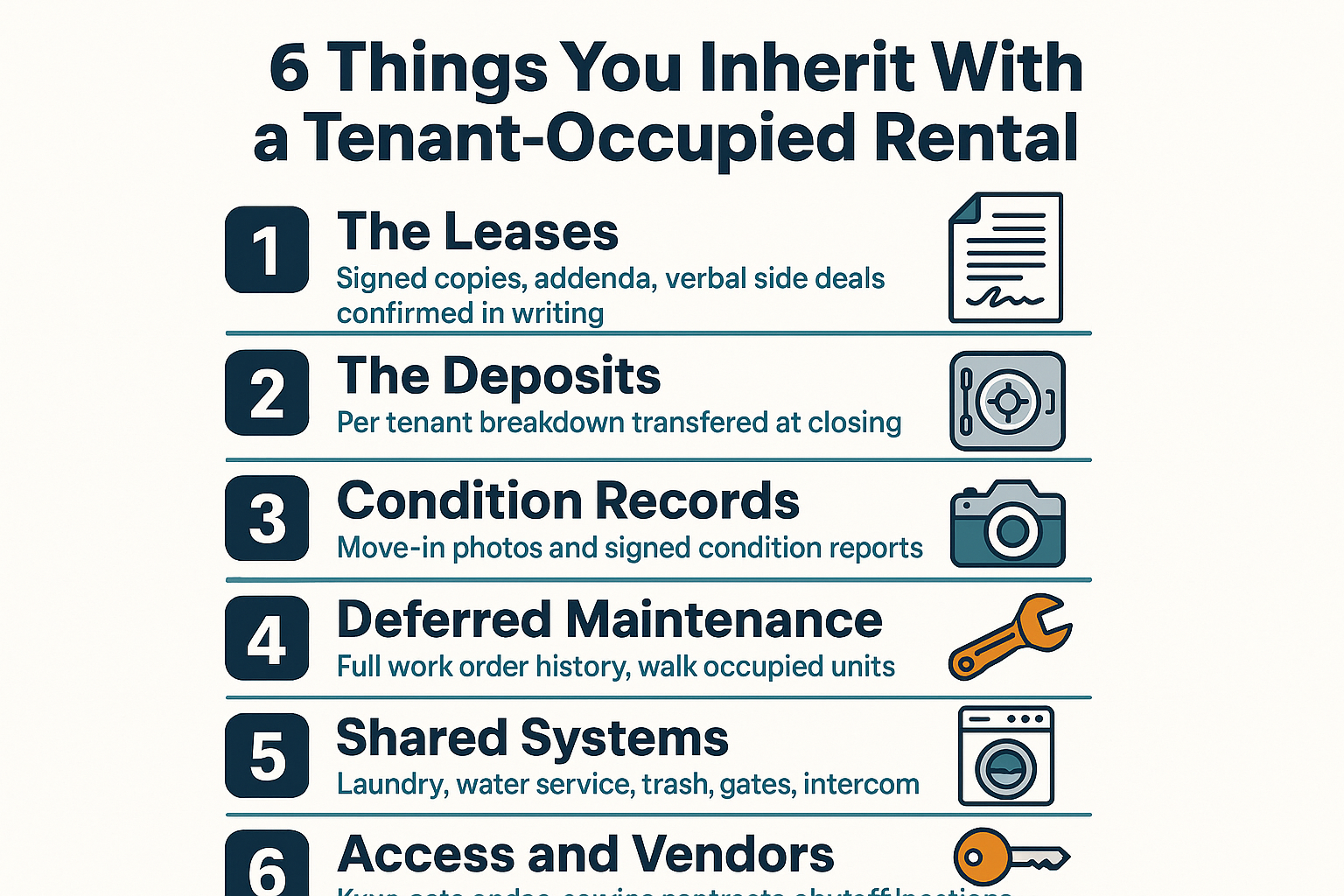
Your Escrow Due Diligence at a Glance
Here is the short version of what to collect before the deed records, grouped by the six things that transfer with the building.
5. Keys, Codes, Contracts, and Whoever Has Been Letting the Plumber In
This is the boring one that ruins your first month. The seller knows which key opens the laundry room. Once they hand you the deed and fly back to wherever they live now, that knowledge leaves with them.
Build the access list before closing:
- Keys for every unit, plus mailbox, laundry, storage, and gate keys
- Gate codes, intercom codes, and any lockbox combinations
- Landscape, pest, pool, and laundry equipment contracts with renewal dates
- Appliance warranties and the age of each unit's water heater and furnace
- Locations of the main water shutoff, gas shutoff, and electrical panels
- Who has been meeting vendors on site, and whether any tenant holds a spare key
Without that list, your first after hours call turns into a locksmith call at Salinas emergency rates. With it, a plumber gets in the door in twenty minutes.
I also ask for the seller's vendor contacts. A plumber who already knows a 1960s fourplex on the east side is worth more than a cheaper bid from someone seeing it for the first time.
6. Tenants Who Are Already Bracing for New Ownership
Tenants read a sale as a coming change in policy, and they are usually right. Reviews of Central Coast complexes that changed hands follow a familiar arc: residents who felt fine under the old owner, then resentful within a month of the new one.
The trigger is rarely the rent. It is finding out about a new fee, a new rule, and a new payment system all in the same letter.
What works in the first two weeks:
- A short written introduction with your management contact and hours
- Portal setup for rent payments and maintenance requests
- One clear channel for repairs, so nothing gets lost in a text thread
- No fee changes or rule changes announced alongside the introduction
Save policy changes for later, and give them their own notice with proper timing. You also need to handle the administrative side, including the City of Salinas residential rental registration ordinance adopted in 2024, which puts current owner and contact information on record.
How you open that conversation sets the tone for years. I have written more about what good owner and tenant communication looks like.
What to Request Before the Deed Records
Print this and hand it to your agent. Every item is easier to get while the seller still needs your signature.
| What to Request | Who Has It | Why It Matters Later |
|---|---|---|
| Signed leases and all addenda | Seller or current manager | You are bound by terms you never negotiated |
| Written confirmation of terms from each tenant | The tenants | Catches verbal deals the rent roll missed |
| Per tenant deposit breakdown | Seller and escrow | You must account for every dollar at move-out |
| Move-in photos and condition reports | Seller or current manager | Without them, old damage becomes your damage |
| Full maintenance request history | Seller or current manager | Shows repeat problems and ignored requests |
| Utility bills for the last 12 months | Seller | Reveals leaks and shared meter surprises |
| Keys, codes, and access list | Seller | Prevents a locksmith call on your first emergency |
| Active vendor and service contracts | Seller | Tells you what auto-renews and what you inherit |
Frequently Asked Questions About Buying an Occupied Rental in Monterey County
Can I raise the rent right after I buy the building?
Not automatically. Existing leases stay in force until they expire, and if the property falls under AB 1482, the rent cap and just cause rules apply based on the unit's history, not your purchase date. Some properties are exempt and some are not, so this is worth confirming during escrow rather than after.
What happens if the seller cannot produce move-in photos?
You do the next best thing. Document current condition yourself before or right at closing, unit by unit, with dated photos, and put a note in the file that the record starts there. It is not as strong as a signed move-in report, but it beats arguing from memory two years later.
Do I have to keep the seller's property manager?
No. Management agreements are between the seller and the manager, and they do not transfer to you the way leases do. Read the existing agreement anyway, because it tells you how the building has been run, what the tenants are used to, and whether any notice period applies before that manager stops.
Should I meet the tenants before closing?
Usually yes, if the seller allows it and the timing is handled respectfully. A short conversation confirms lease terms, surfaces open repair issues, and tells you a great deal about how the building has been maintained. Just be careful not to promise anything about rent or rules before you own it.
Is a small fourplex really different from managing a single rental house?
Yes, and it surprises people. Shared water, shared laundry, shared parking, and a shared trash enclosure mean tenant behavior in one unit becomes an owner problem across four. The bookkeeping, vendor coordination, and complaint volume all step up at the same time.
Thinking Through a Purchase in Monterey County?
If you are in escrow on an occupied property anywhere from Salinas to Pacific Grove and want a second set of eyes on the leases, deposits, and maintenance history, our team at Coast & Valley Properties is available to talk it through. You can reach the office at (831) 757-1270 or through the contact form at coastandvalleypm.com. Even if you plan to manage it yourself, walking the building with someone who has seen a hundred of them is worth an hour.

Reading Property Management Reviews When Most Reviewers Are Tenants
Almost every owner I speak with has already looked us up before the phone rings. They type a company name plus "reviews", read the first page of results, and treat it like a report card on how that firm treats property owners.
That page is measuring something else entirely. In this business, public reviews are written overwhelmingly by tenants and rental applicants, so an owner making a six-figure decision is reading a tenant satisfaction survey.
I am not going to tell you to ignore reviews. I am going to show you how to read them the way I would if I were handing over a house in Carmel or a fourplex off Alisal Street, and what to ask for once the stars run out of useful information.
Who Is Actually Writing Property Management Reviews in Salinas
Look at the math behind any local management firm. A company with a few hundred doors under management is serving maybe 50 to 100 owners and interacting with hundreds of residents and applicants every single month.
The contact volume is not close. A tenant deals with a management office through applications, showings, rent portals, maintenance calls, rule notices, and a move-out inspection. An owner usually sees a monthly statement and a couple of phone calls a year.
Reviews also get written at moments of friction, not moments of routine. The people most motivated to post publicly are the ones who just got:
- A rental application denied or delayed
- A deposit statement with deductions on it
- A notice about trash, parking, or pets
- A rent increase, even a legal one under AB 1482
Owners, meanwhile, almost never post. A quiet property with rent hitting the bank on the same day each month does not create the urge to write a paragraph on Google. So the visible record skews toward the group with the most contact and the most friction, and the owner reading it has to translate.

Sort Enforcement Complaints From Responsiveness Complaints
Read enough reviews of Monterey County management firms and the same four complaints show up over and over. Three of them describe a policy that exists to protect the owner. One of them is a genuine warning sign.
Deposit deductions at move-out. California requires an itemized written statement within 21 days of move-out under California Civil Code 1950.5. A firm that documents damage in writing and charges for it is doing the thing you would want done with your own hardwood floors. A firm that returns everything without a walkthrough is spending your money.
Application fees. Screening costs real money. Application fees in this market commonly land somewhere in the $40 to $60 range depending on the credit and background provider, and policies about when they get collected vary widely from office to office. Ask about the policy directly instead of guessing from a one-star post.
Parking, trash, and rule enforcement. Nobody enjoys getting a notice. But rule enforcement is exactly what keeps a multi-unit property in Salinas from turning into a turnover machine.
Slow maintenance response. Pay close attention here. Delayed repairs feed straight into California's warranty of habitability, and unrepaired leaks, plumbing, and safety items are how a manageable $400 repair becomes a $6,000 problem plus a vacancy. Complaints about calls not returned and repairs left open are the ones that predict how a firm will treat your property. Read them closely, and read the firm's replies for whether the specifics are addressed or dodged. How a company communicates with owners and tenants is one of the few things a review set genuinely reveals.
What Each Complaint Category Actually Tells an Owner
This is the sorting I do in my head when I read a competitor's review page or my own. Not every one-star review points at a problem you would care about.
| Complaint in the review | What it usually reflects | What it means for an owner |
|---|---|---|
| Deposit deductions itemized at move-out | Documented condition report and legal 21-day statement | Generally a good sign, the asset is being protected |
| Application fee charged before a tour | Screening cost and showing policy | Neutral, ask about the policy directly |
| Parking, trash, or yard rule notices | Lease enforcement on a shared property | Generally a good sign, protects value and neighbors |
| Repairs left open, calls not returned | Weak maintenance coordination or staffing | Real red flag, habitability and turnover risk |
| Application sat for weeks with no update | Slow processing or thin communication | Real concern, slow leasing means longer vacancy |
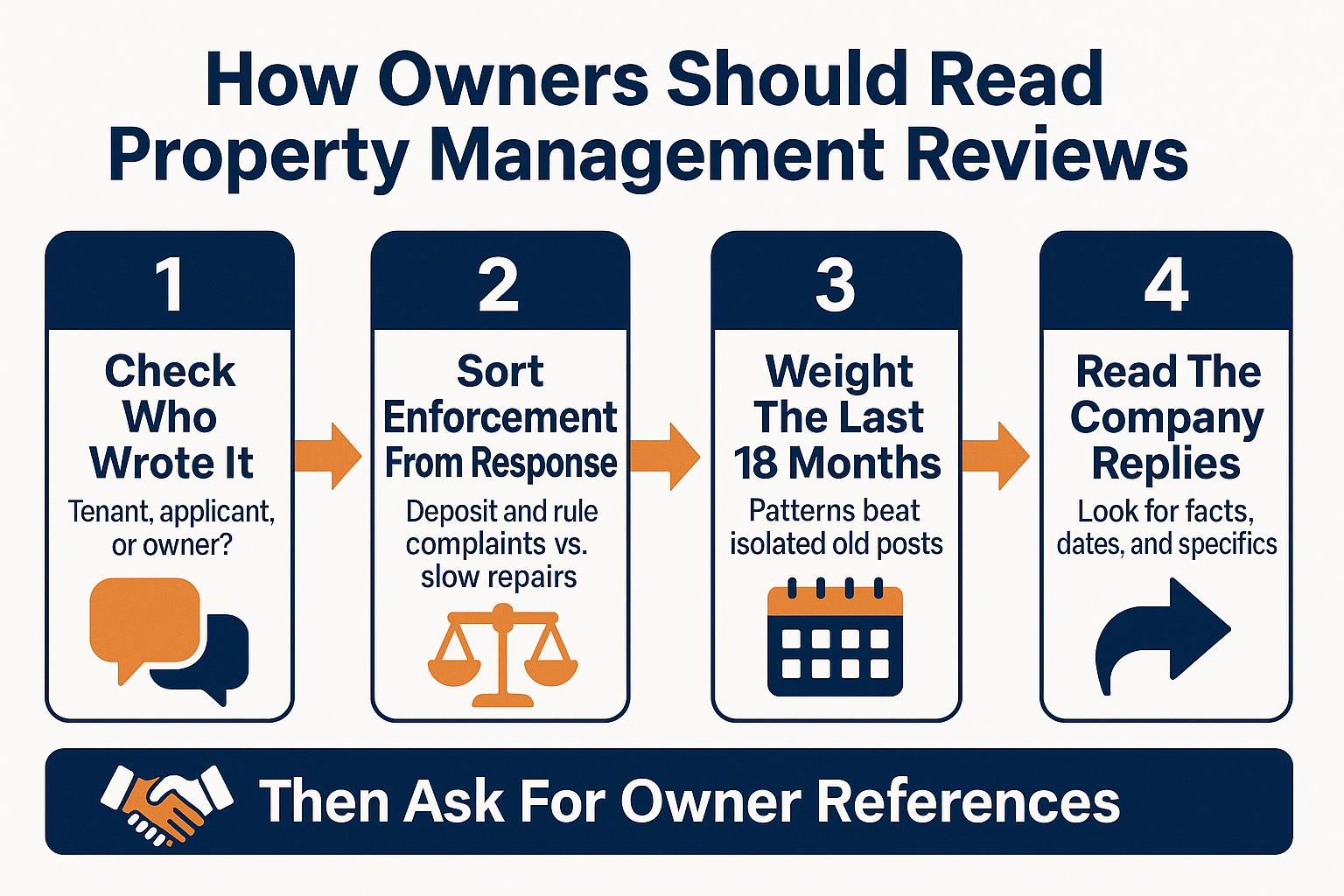
A Four-Step Filter for Reading a Review Page
Here is the sequence I would use before letting a star average influence a decision about a property worth several hundred thousand dollars or more.
Volume and Recency Matter More Than the Star Average
Here is the part most owners miss. Plenty of management firms on the Central Coast carry fewer than three dozen reviews spread across ten years or more.
At that sample size, the average is fragile. Three unhappy move-outs in a single summer can drag a visible rating down by more than a full star, and it will sit there for years even if the office fixed the underlying issue in month two.
So read chronologically instead of by rating:
- Sort by newest and read everything from the last 12 to 18 months first
- Ask whether the recent complaints are the same complaint or five different ones
- Treat a cluster of similar recent posts as a real pattern
- Treat an isolated complaint from 2019 as history, not a forecast
- Notice whether the company replies at all, and whether replies cite dates, lease terms, or documented facts
A reply that stays factual and specific tells you the office keeps records. A reply that argues in generalities tells you something too. Both are more informative than the number at the top of the page.
The Reviews That Actually Carry Owner Information
Some tenant reviews are gold for an owner, because they describe the exact operational machine you would be handing your property to. I read closely whenever a review mentions:
- How fast the phone gets answered and whether questions get real answers
- Leasing speed, how quickly a unit went from listing to signed lease
- Electronic paperwork, portals, online applications, and online rent payment
- Inspection quality, move-in and move-out walkthroughs with photos
- Staff by role, office staff, maintenance coordination, or the broker
One local review put it simply: "These ladies are really efficient, friendly and very knowledgeable" (Mauricio M.). Another said the office staff answer any question quickly. Neither reviewer was an owner, and neither meant to write anything about asset management. But efficiency and quick answers at the front desk are the same qualities that get your vacancy filled in Pacific Grove in three weeks instead of nine, and that keep a repair from sitting unaddressed.
That is the translation exercise. A tenant describing a well-run office is describing your future experience, just from the other side of the counter. This is also why understanding what full-service management actually covers matters more than the rating on any single platform.
Four Things to Ask For Instead of Reading Stars
Owners fall back on star ratings for a reason. Most property management websites on the Central Coast publish a bullet list of services and nothing else. No process detail, no sample reporting, no explanation of how maintenance approval works or when funds get disbursed.
That vacuum is the real problem. Fill it with direct questions instead:
- Ask for owner references specifically. Not tenant references, not a general testimonial page. Two or three current owners with properties like yours.
- Ask how long the average owner has stayed under management. Long owner tenure is the closest thing this industry has to an honest review score.
- Ask to see a sample monthly statement. You want to see how income, expenses, and reserves are laid out before you agree to anything.
- Ask for a live walkthrough of the owner portal. Have them log in and show you where the statements, invoices, and inspection reports live.
Then ask two Monterey County questions. How does the firm handle AB 1482 rent cap and just cause requirements, and how are they tracking the City of Salinas Residential Rental Registration Ordinance adopted in 2024? A firm that answers both without hesitating knows this market. It also helps to understand what a management agreement actually says before you sign, and how property management fees are structured in California.
Frequently Asked Questions About Property Management Reviews in Salinas
Why do property management companies have such low star ratings compared to other local businesses?
Because the reviewers are mostly tenants and applicants, and the review-writing moments are usually friction moments like a denied application, a deposit deduction, or a rule notice. A restaurant gets reviewed by happy customers. A management office gets reviewed by the person who just got a move-out statement. Owners, who are the actual clients, rarely post at all.
Should I be worried if I see complaints about deposit deductions?
Usually the opposite. California requires an itemized statement within 21 days of move-out, and deductions for real damage are how your property gets restored without you paying for it. What I would look at is whether the deductions sound documented, and whether the firm mentions move-in photos and a written condition report.
How many reviews are enough to trust a rating?
There is no magic number, but be cautious with anything under about 40 reviews spread over many years. At that sample size a couple of bad months can move the average more than a full star. Read the newest 15 posts instead and look for repeated themes.
Are there review sites that show owner feedback specifically?
Not reliably. Google, Yelp, and similar platforms do not separate owners from tenants, and most owner feedback in this industry happens privately or through referrals from other property owners, attorneys, and real estate brokers. That is exactly why asking for owner references beats scrolling further.
What is the single biggest red flag in a review set?
Repeated, recent complaints about unreturned calls and repairs left open. Enforcement complaints tell you the firm has standards. Responsiveness complaints tell you your emergency call at 11pm may not get picked up, and that is the one that costs owners money in Monterey County.
Want the Owner Side of the Story?
If you are evaluating management for a property in Salinas, Monterey, Carmel, or anywhere across Monterey County, the questions above are the ones worth asking of anyone you interview. We are always willing to walk an owner through a sample statement, a portal login, and how we handle AB 1482 and Salinas rental registration. Coast & Valley Properties can be reached at (831) 757-1270 or through the contact form at coastandvalleypm.com.
Owning a Small Apartment Building in Salinas: Where the Compliance Gets Complicated
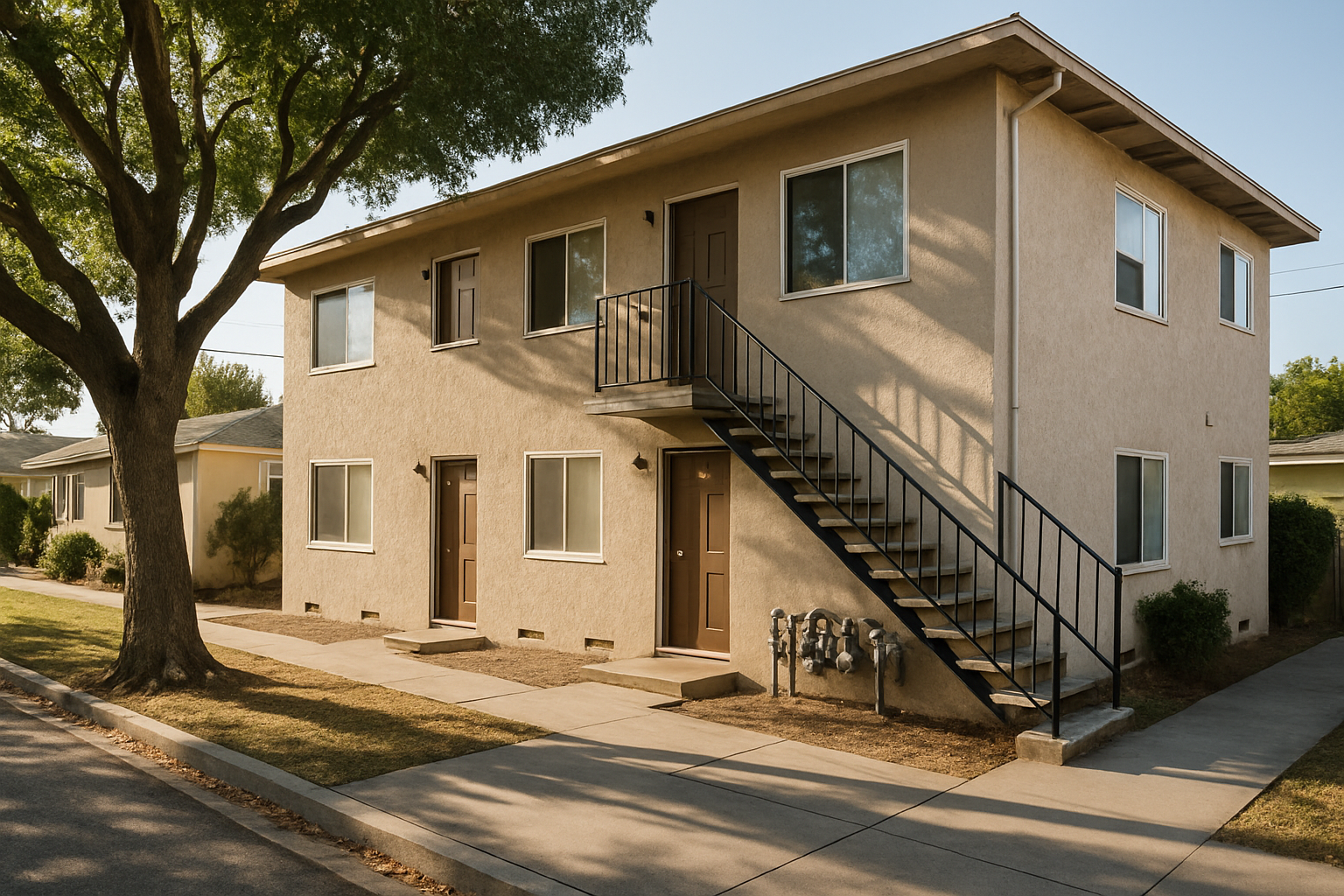
Most owners I talk with did not set out to become apartment landlords. They bought a duplex, inherited a fourplex on the east side of Salinas, or picked up a small building near Alisal because the numbers made sense at the time.
Then the rules caught up with them. A rent increase notice goes out, a tenant files a petition, and suddenly the owner is reading a city ordinance at 10pm trying to figure out whether their building was built before or after 1979.
That is the part nobody warns you about. Going from one rental house to four units does not multiply your workload by four, it changes the kind of work entirely. Below I want to walk through the three places where multi-unit compliance in Salinas actually trips owners up, and why the two-to-six-door range is where I see people hit their limit.
Why Salinas Multi-Unit Owners Hit a Wall That Single-Home Owners Do Not
Our contact form tells the same story over and over. One owner reached out about several rental units she holds across Salinas and said that as her portfolio grew, managing everything herself had become more demanding than she could keep up with. Another wrote in looking for full service management on a four-unit building with remodeled, vacant units.
Different properties, same breaking point. And it is almost always somewhere between two and six doors.
Here is why that range is the pressure point:
- One vacancy in a fourplex is a 25% income hit, not a rounding error
- Shared plumbing, shared roofs, and shared electrical mean one problem becomes three tenants' problem
- Tenants in the same building talk to each other, compare rents, and notice inconsistent enforcement
- Compliance filings and notices multiply per unit, not per property
- Emergency calls arrive at night, on holidays, and while you are out of town
A single-family owner in Monterey or Pacific Grove can often absorb this with a good handyman and a calendar reminder. An apartment owner cannot. If you want the broader operational picture, I wrote about what changes as you add doors in more detail.
Rent Caps: Two Different Rules, and Your Building Might Be Under the Stricter One
This is the single most expensive mistake I see. Multi-unit buildings in Salinas are far more likely to fall under local rent stabilization than single-family homes are, and most owners do not realize it until a tenant challenges an increase.
As the city's Rent Stabilization Ordinance is written, multi-unit buildings constructed before 1979 in Salinas are generally covered. Where it applies, annual increases are limited to 2.75% or 75% of CPI, whichever is lower. That is meaningfully tighter than the statewide ceiling.
Statewide, California's AB 1482 Tenant Protection Act allows 5% plus regional CPI with a hard cap at 10% per year, and it also brings just cause eviction requirements into play. Housing built within the last 15 years is generally exempt, and single-family homes can be exempt with the right written disclosure.
So an owner with one Carmel rental and one 1962 Salinas fourplex is operating under two different rulebooks at the same time.
Where it gets genuinely complicated:
- Eligibility is unit by unit, not building by building, so a converted unit or an added ADU may sit outside the coverage the rest of the building falls under
- The calculation method matters, and CPI-based math done wrong is still done wrong
- Increases have to be noticed properly, with correct timing based on the size of the increase
- An improper increase can trigger a tenant petition and the city's formal dispute process
I have watched owners lose a full year of increase because the notice was one step out of order. The rent was defensible. The paperwork was not.

Annual Rental Registration: One Filing Becomes Eight
The Salinas Residential Rental Registration Ordinance (City Ord. 2663, 2024) requires owners and managers of covered units to register annually. The window is narrow: July 1 through July 31.
For a single-family owner, that is one filing once a year. For the owner of an eight-unit building, it is eight separate unit registrations, each one needing accurate, current information.
That sounds like clerical work, and most of the year it is. The problem is when it surfaces later.
A compliance gap in your registration record has a way of showing up at the worst possible moment, usually in the middle of an eviction proceeding or a habitability dispute, when the last thing you want is a defect in your own file. I have seen owners who did everything right on maintenance and screening get slowed down by a registration entry that listed an old mailing address.
A few habits that keep this clean:
- Treat the July window as a fixed annual event, not a task to handle when you remember
- Update unit information when ownership entity, contact, or manager details change, not at renewal time
- Keep proof of each filing in the same place you keep leases and inspection records
- Reconcile your registration list against your actual rent roll every year
I cover the wider compliance picture for multi-unit owners across Monterey County separately, because South County and the Peninsula each add their own wrinkles.
One Rental House vs. One Fourplex: What Actually Changes
Here is the practical difference between managing a single Salinas rental and a small apartment building of the same total value.
| Compliance Area | Single-Family Rental | Pre-1979 Fourplex in Salinas |
|---|---|---|
| Annual rental registration | One unit filing each July | Four unit filings each July |
| Rent increase limit | Often AB 1482, or exempt with proper written disclosure | Generally city rent stabilization, the stricter of the two |
| Just cause eviction rules | Applies unless a valid exemption is disclosed | Applies, with local process layered on |
| Habitability exposure | One tenant, one system set | Shared plumbing and roof, one failure affects several tenants |
| Emergency response | Occasional after-hours calls | Round-the-clock duty across every unit |
| Vacancy impact | 100% of income for that property | 25% of income, visible to remaining tenants |
| Lead paint disclosure | Required for pre-1978 housing | Required for pre-1978 housing, per unit |
The Salinas Apartment Owner's Compliance Year
This is the rhythm I keep in mind for a small multi-unit building in Salinas, laid out across the calendar year.
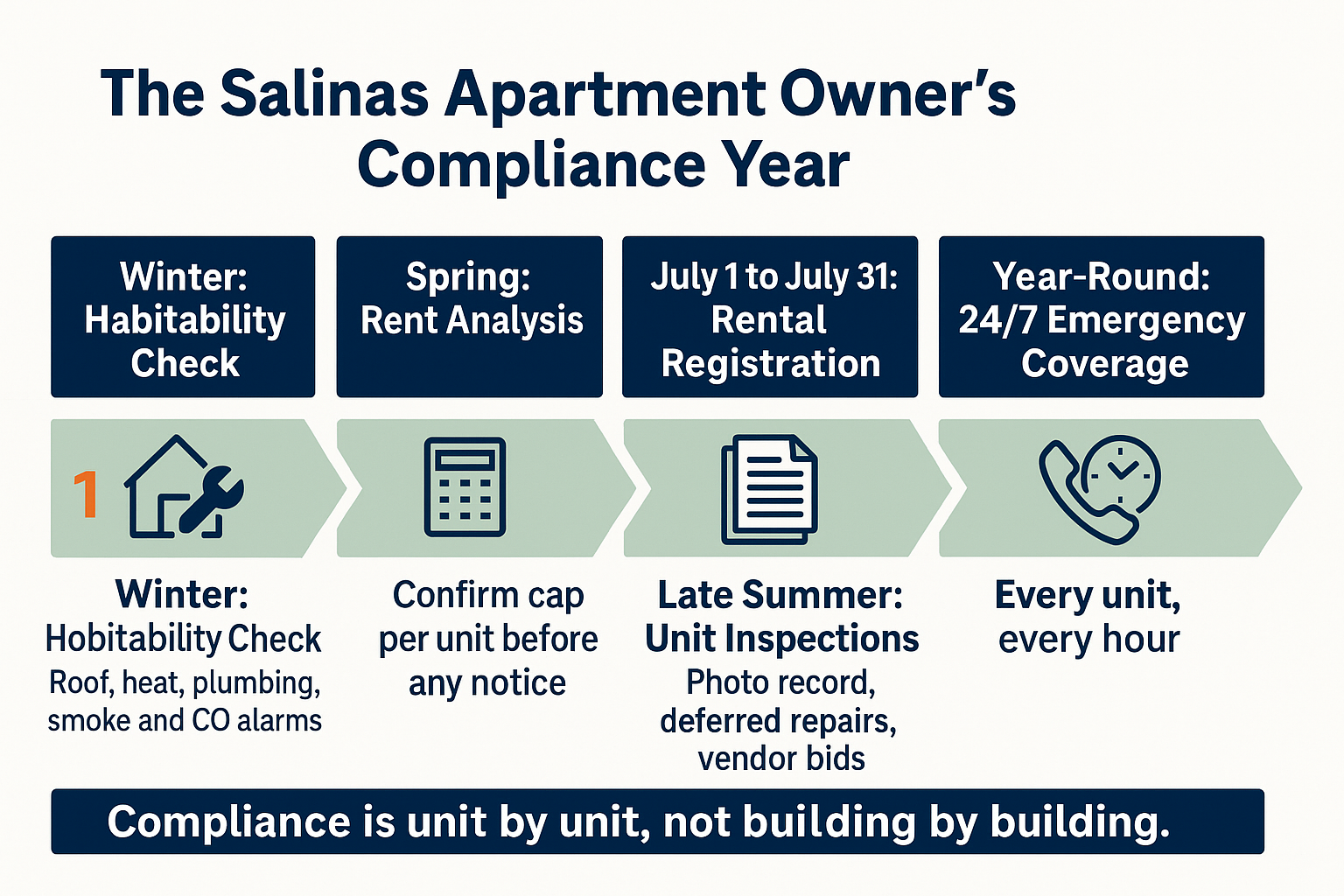
Maintenance Across Units Is a Different Job Entirely
A water heater failure in a single-family rental is inconvenient. The same failure in a fourplex can mean water in an adjacent unit, a habitability claim from a tenant who did nothing wrong, and a repair that has to be coordinated around four schedules.
California's warranty of habitability does not care that you were on vacation. It does not care that your usual plumber was booked. And in a shared-wall building, the clock starts running on more than one tenant at once.
What I see wear owners down is not the repairs themselves. It is the 24/7 availability requirement.
Sustaining that alone gets harder with every door you add:
- Someone has to answer the phone at 2am, every night, all year
- You need vendors who will actually show up in Salinas at that hour, not just a name in your contacts
- Shared systems mean a single call may require access to multiple units
- Every interaction needs a written record, because that record is your defense later
Owners who self-manage well usually have one strong trade relationship and a lot of personal availability. That combination is fragile. When the plumber retires or the owner takes a job with real hours, the whole system falls over. It is one of the things Salinas owners most often get wrong about self-managing.
Vacancy Sequencing: The Problem Nobody Sees Coming
Here is a wrinkle that single-property owners never deal with. When one unit in your building sits vacant, your other tenants are watching.
They see the showings. They notice the listing price. If you price the vacant unit well above the rent-stabilized units next door, you have handed your existing tenants a comparison they will remember at renewal time. Price it too low and you have just set a comp against yourself.
Pricing that unit correctly takes real neighborhood knowledge. Market reporting has put average Salinas rents somewhere around $2,006 per month in early 2026, but treat that number carefully. It blends studios, older fourplex units, and newer three-bedroom homes across the whole city.
What that average will not tell you:
- What a specific floor plan leases for in a specific Salinas neighborhood
- How much a remodeled unit can command over an original one in the same building
- Whether a vacancy in your submarket fills in two weeks or six
- How your occupied, capped units constrain what you should ask for the open one
This is where a real market analysis earns its keep, and it is one reason a manager's neighborhood-level knowledge matters more on multi-unit than on single-family. The order in which you fill units, and at what price, shapes the building's income for years.
Frequently Asked Questions About Salinas Multi-Unit Compliance
How do I know if my Salinas apartment building is under rent stabilization?
Start with the construction date and the unit count, since multi-unit buildings built before 1979 are generally covered by the city ordinance. But do not stop there. Converted units, added units, and unusual parcel history can change the answer unit by unit, so confirm each one against city records before you send a single increase notice.
What happens if I miss the July rental registration window?
You end up with a gap in your compliance record. Most of the time nothing happens immediately, which is exactly why owners let it slide. The problem shows up later, often during an eviction or a tenant dispute, when a defect in your own filing weakens your position at the worst possible time.
Can I raise rent to market when a unit turns over in a rent-stabilized building?
Vacancy rules and unit eligibility drive that answer, and it varies. This is a question worth getting confirmed in writing before you list the unit, not after you have signed a lease at the wrong number.
Is managing a fourplex really that different from managing four separate houses?
Yes, and in some ways it is harder. Four houses give you four independent problems. A fourplex gives you shared systems, tenants who compare notes, one roof over everyone, and vacancy decisions that ripple through the whole building. The compliance layer is also denser, because local ordinances often treat multi-unit buildings more strictly.
What does professional apartment property management cost in Salinas?
Costs in this market vary quite a bit based on unit count, condition, whether you need full management or just tenant placement, and how much vendor coordination the building requires. We do not publish rates because the honest answer depends on the property, so pricing conversations happen after a walkthrough. A licensed agent visits in person, usually a 45 minute to one hour meeting, and gives you a specific range based on what the building actually needs.
Thinking Through Your Next Step on a Salinas Multi-Unit Property?
If you own a small apartment building in Salinas and the compliance side has started to feel heavier than the property itself, that is a normal place to arrive. Coast & Valley Properties has managed residential and commercial property across Monterey County since 2009, and we are glad to talk through what your building specifically requires. You can reach our office at (831) 757-1270 or through the contact form at coastandvalleypm.com.
Salinas Rent Stabilization Is on the November Ballot. What Changes Either Way.
On September 23, 2025, the Salinas City Council voted to place a repeal of the city's four rental ordinances on the November 3, 2026 general election ballot. Those ordinances, covering rental registration, rent stabilization, just cause eviction, and tenant anti-harassment, remain fully in force until voters decide. I've already had owners ask me whether they can ease up on compliance while they wait for the results. The honest answer is no, and I want to explain exactly why.
This is a different article from what we've published about the political timeline and what owners need to know before the vote. That post covers the background. This one focuses on what actually changes operationally under each outcome, and what you need to have in order regardless of which way November goes.
If you own a covered rental unit in Salinas right now, both possible outcomes require the same near-term preparation. Getting that preparation right is what this article is about.
The Rent Cap That Catches Owners Off Guard
Most owners who follow California landlord law know about AB 1482, the statewide Tenant Protection Act. It caps annual rent increases at 5% plus the local CPI, up to a maximum of 10%. That feels like a meaningful ceiling to many people.
But Salinas runs a tighter rule for covered units. The city's rent stabilization ordinance caps annual increases at 2.75% or 75% of the most recent 12-month CPI increase, whichever is less. In practice, that is substantially lower than what AB 1482 would allow, and the gap matters when you're calculating a lease renewal.
I've seen owners make this math error in good faith. They know the state rule, they apply it, and they don't realize the city ordinance sets a lower ceiling for their specific unit. The result can be a tenant petition challenging the increase as unlawful, and the burden of proof falls on the owner to show the calculation was correct.
Before you issue any rent increase notice, confirm two things:
- Whether your unit is covered by the Salinas ordinance (not all unit types are)
- Which figure is actually lower: 2.75% or 75% of the current CPI reading for the Salinas area
The California Department of Industrial Relations publishes CPI data by region. That number changes, so check it fresh each time you calculate an increase, not once a year.
What Compliance Looks Like Right Now, Before November
The worst mistake I see owners make is treating a pending repeal vote as a reason to slow down on paperwork. It isn't. The ordinances are active law today, and enforcement doesn't pause for an election cycle.
Here's what owners with covered Salinas units need to have documented right now:
- A complete rent increase history going back to at least December 31, 2023, including the date of every notice, the amount, and the percentage calculated
- Current registration under City Ordinance 2663, which opened its annual window from July 1 to July 31 each year, gaps in registration are their own compliance problem, separate from the stabilization rules
- Signed lease documentation that reflects current terms, including any addenda related to just cause eviction provisions
- Records of any tenant communications about rent changes, including written notices and any responses received
If you've been sloppy about any of these, the time to correct it is before November, not after. A gap in your records becomes harder to explain if a tenant files a petition while the ordinance is still in effect.
We've written before about when self-managing a Salinas rental stops making sense, and this kind of layered compliance tracking is exactly the point where many owners realize they're in over their heads.
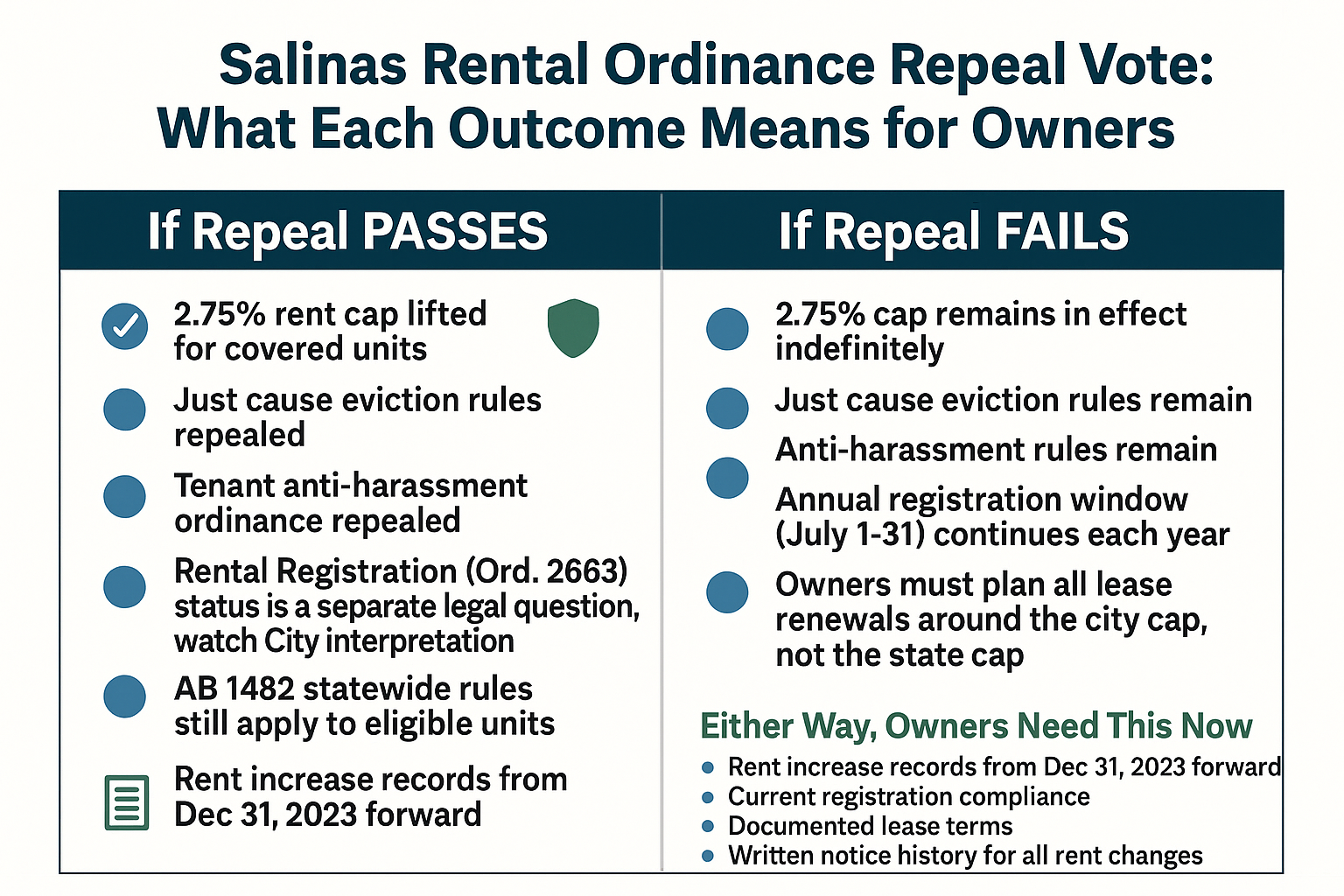
Two Outcomes, One Set of Near-Term Requirements
This comparison shows what owners should expect operationally under each election outcome, and what stays the same either way.
Salinas vs. California: How the Rent Caps Compare
This table shows the key difference between the city ordinance cap and the statewide AB 1482 cap, the gap that trips up owners who only track one rule.
| Rule | Who It Covers | Annual Increase Cap |
|---|---|---|
| Salinas Rent Stabilization Ordinance | Covered units in Salinas (check unit type) | 2.75% or 75% of local CPI, whichever is less |
| AB 1482 (Tenant Protection Act) | Most CA rentals 15+ years old, not single-family or condo exempt | 5% plus local CPI, max 10% |
| Either Way: Registration (Ord. 2663) | All Salinas rental units subject to ordinance | Annual registration required July 1-31 |
If the Repeal Passes: What Does Not Automatically Go Away
I want to be specific here, because I've heard owners assume a repeal vote clears the board entirely. It doesn't, and the rental registration requirement is the clearest example.
City Ordinance 2663, which created the Salinas Residential Rental Registration requirement, was adopted in 2023 as a standalone measure. It is a distinct legal instrument from the rent stabilization and just cause ordinances. Whether a repeal vote covers it depends on how the ballot measure is written and how the City interprets the outcome.
Owners who have registered annually since 2023 will need to watch closely for guidance from the City of Salinas after the vote. Assuming registration quietly disappears could leave you out of compliance with an ordinance that may still be standing.
The statewide AB 1482 rules also don't disappear. If your unit qualifies under the state law, which applies to most rental housing built more than 15 years ago that isn't exempt as a single-family home or condo with proper notice, those protections for tenants stay in place regardless of what Salinas voters decide in November.
Owners with properties in South County who may have assumed these rules don't reach them should review our guide to owning a rental in Salinas Valley's South County for a clearer picture of how local and state rules overlap across the region.
If the Repeal Fails: Planning Lease Renewals Around 2.75%
If the ordinance stands, owners with covered units will be operating under the 2.75% cap indefinitely. That changes how you plan lease renewals, especially on longer-held units where market rents have moved significantly above current rent rolls.
A few things worth thinking through now:
- Rent increases must be planned annually and documented correctly, missing a year doesn't let you bank that percentage and apply it the next year
- Lease renewal timing matters, if you're approaching a renewal window, make sure your notice period and timing comply with California's requirements for written rent increase notices
- Maintenance and habitability standards still apply regardless of the cap, and owners cannot reduce services in response to a frozen rent situation without creating separate legal exposure
One pattern I've seen in multi-unit portfolios is that owners who weren't tracking each unit's rent history individually end up unable to calculate the correct allowable increase because they don't know what the base rent actually was. That's the kind of gap that needs to be fixed now.
If you're managing more than a few doors, the complexity compounds quickly. Our article on managing a multi-unit property in Salinas covers how that operational picture shifts as a portfolio grows.
Frequently Asked Questions About the Salinas Rent Ordinance Repeal Vote
Can I stop registering my rental unit now that the repeal is on the ballot?
No. The ordinances remain fully in effect until voters decide in November 2026. Stopping registration before the vote puts you out of compliance with an active law. The annual registration window runs July 1 to July 31 each year, and missing it creates its own problems regardless of how the election goes.
Does the statewide AB 1482 cap replace the Salinas ordinance if the repeal passes?
For units that qualify under AB 1482, yes, the state's 5% plus CPI cap would apply in the absence of a stricter local rule. But not all units are covered by AB 1482. Single-family homes and condos with proper tenant notice, newer construction, and certain other categories are exempt. You'd need to verify your specific unit type under state law.
If I made a rent increase that was within AB 1482 but above the Salinas cap, am I exposed?
Potentially, yes. The Salinas ordinance applies a tighter ceiling to covered units, and applying the state cap instead of the city cap is still an overcharge under local law while the ordinance is active. A tenant can file a petition challenging an increase that exceeds the city's allowable amount. Document everything and talk to a qualified attorney if you're unsure about a past increase.
What happens to the rental registration requirement if the repeal passes?
That is genuinely uncertain right now. City Ordinance 2663, which created the registration program, was adopted separately in 2023. Whether a repeal ballot measure covers it depends on how the measure is drafted. Owners should watch for official guidance from the City of Salinas following the vote before assuming registration goes away.
How far back do my rent increase records need to go?
At minimum, you need documentation from December 31, 2023 forward, the point when the current ordinances took effect. That means the date of every notice, the previous rent amount, the new amount, and the percentage you calculated. If you're missing any of that, work on reconstructing it now.
Questions About Where Your Property Stands Before the Vote?
We work with rental owners across Monterey County who are trying to stay ahead of exactly this kind of regulatory uncertainty. If you want to talk through your specific units, your registration status, or what your rent increase history looks like on paper, we're available by phone at (831) 757-1270 or through the contact form at coastandvalleypm.com.
When Self-Managing a Salinas Rental Stops Making Sense
I hear the same story a lot. An owner starts with one rental, handles it themselves, and it mostly works. Then a second property comes along, or they move out of the area, or a long-term tenant leaves and suddenly the whole operation feels a lot heavier than it did before. That is usually when the phone rings here.
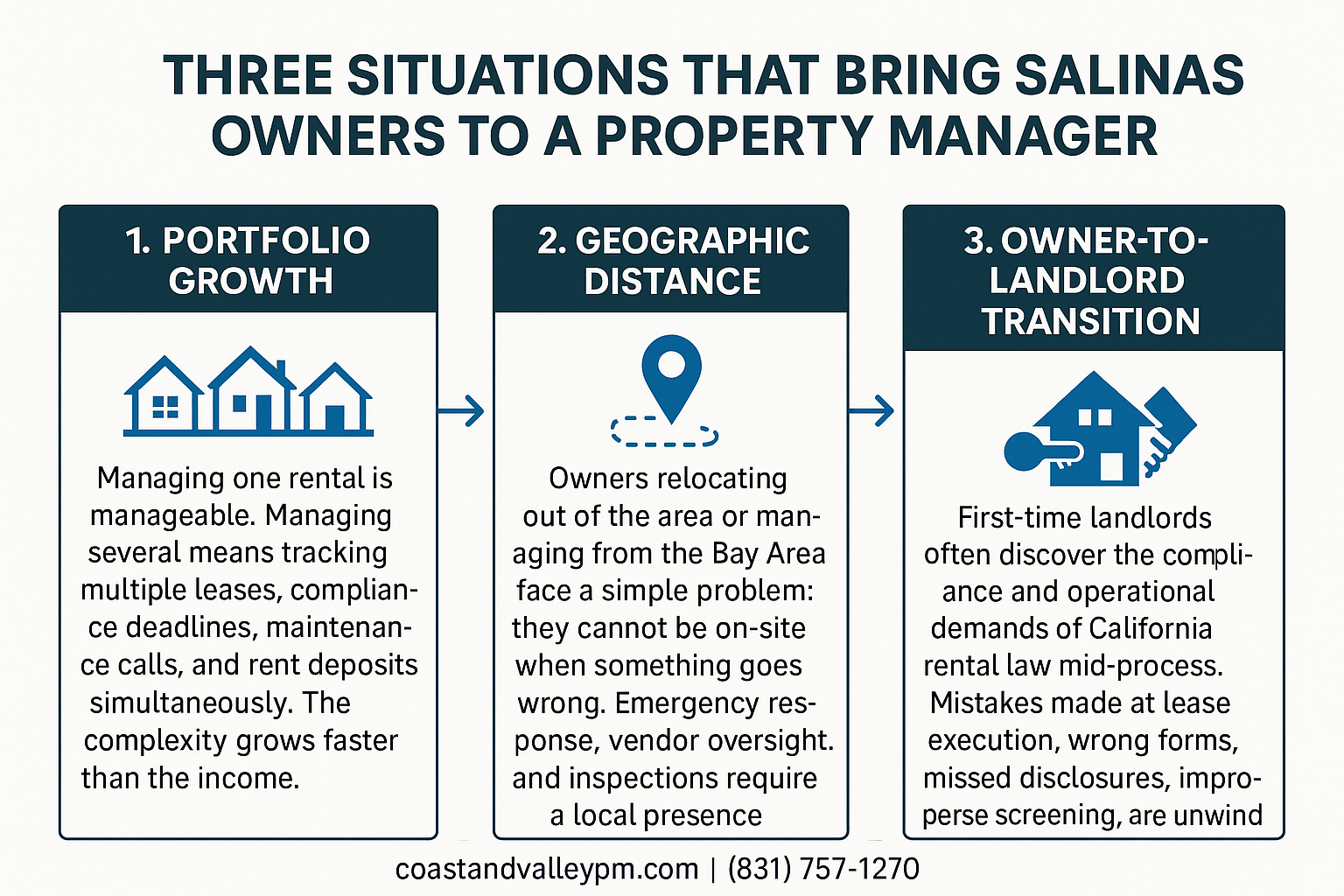
What I have seen over the past several years working with property owners across Monterey County is that the transition from self-management to professional management is rarely planned. It is almost always triggered. And the three triggers that come up most consistently are portfolio growth, geographic distance, and the jump from owner-occupant to full landlord. If any of those describes where you are right now, this article is worth reading through.
Salinas is not a forgiving market for owners who are learning as they go. The local compliance environment is specific, the penalties for getting it wrong are real, and the operational demands of even a single rental add up faster than most people expect.
The Compliance Layer Salinas Adds on Top of California Law
California landlord law is already one of the most layered regulatory environments in the country. Salinas adds its own requirements on top of that, and I find that a lot of owners, especially those who inherited a property or recently moved into the landlord role, are not fully aware of what those requirements involve.
Owners of covered multi-family properties built before February 1, 1995 are operating under an active Rent Stabilization Ordinance. Annual increases are capped at 2.75 percent or 75 percent of CPI, whichever is less. Every covered unit requires annual registration with the city, and the registration fee runs $170 per year per stabilized unit. That is a hard deadline, not a suggestion.
The penalty for getting this wrong is not a warning letter. Violations can expose an owner to damages of up to three times the amount of any overcharged rent, plus potential misdemeanor exposure. An owner managing remotely, or managing several properties at once, is carrying real risk if they are not actively tracking these requirements. The city's Salinas Residential Rental Registration Ordinance (City Ord. 2663) has added another compliance layer that is still catching some owners off guard.
And California AB 1482 sits underneath all of this. If your property qualifies as exempt, you still need documentation to prove it. If it does not qualify, you need a system for tracking allowable increases and just-cause eviction requirements. These are not things you want to figure out for the first time when a tenant disputes a rent increase. For a deeper look at what is coming on this front, the piece on Salinas rent control going to voters in November is worth reading before that ballot hits.
What Self-Management Actually Looks Like From the Start
One thing I hear regularly from owners who reach out is some version of: "I didn't understand the process and I just wanted to know how it works before I committed to anything." That honesty is telling. The process of leasing a property in California is genuinely not intuitive, and mistakes made at the beginning are expensive to fix later.
Here is what managing a Salinas rental from scratch actually involves before the first month's rent arrives:
- Marketing the vacancy with photos, descriptions, and syndication across rental platforms
- Fielding inquiries and scheduling showings
- Screening applicants in compliance with California AB 2493, which governs how applications must be processed and in what order
- Executing a lease that reflects current state law, local ordinances, and any applicable rent control provisions
- Completing a move-in property condition report with photos, which is required and forms the legal basis for any deposit deduction later
- Collecting the security deposit and first month's rent in compliance with California's deposit rules
And that is just the front end. Once a tenant moves in, the maintenance coordination begins. Fielding calls, vetting vendors, getting bids, authorizing work, following up to confirm the job is done correctly. That is a recurring job, not a one-time task.
For owners in South County cities like Gonzales or Soledad, vendor access is an added challenge. Quality tradespeople familiar with those markets are harder to find without established relationships. One owner in Gonzales who reached out recently was nearly finished rehabbing a property and specifically wanted someone with local knowledge to walk through it before it hit the market. That kind of assessment requires context that a Bay Area-based owner or a national platform simply does not carry. If you want to understand the hidden workload behind managing a single rental home, that article breaks it down honestly.
Three Situations That Bring Salinas Owners to a Property Manager
These three scenarios account for the majority of owners who reach out to us. If your situation fits one of them, it is worth understanding what the shift to professional management actually resolves.
Self-Management vs. Professional Management: Where the Work Actually Falls
This is not an exhaustive list, but it covers the tasks that consume the most time and carry the most legal exposure for self-managing owners in Salinas.
| Task | Self-Managed Owner | Professional Manager |
|---|---|---|
| Rent Stabilization Compliance | Owner tracks manually, files annually | Handled as part of ongoing management |
| AB 2493 Screening Process | Owner must sequence applications correctly | Documented, compliant process every time |
| Maintenance Coordination | Owner fields calls, vets vendors, follows up | Established vendor network, owner notified of outcomes |
| Move-In Condition Report | Often incomplete or informal | Photographed, documented before keys are handed over |
| Financial Reporting | Receipts, bank statements, spreadsheets | Monthly owner portal reports, organized year-round |
| Emergency Response | Owner's personal phone, any hour | 24/7 coverage handled by the management team |
| Lease Execution | Owner sources forms, may miss local requirements | Current California and Salinas-specific lease documents |
What the Transition to Professional Management Actually Resolves
When owners describe what they want to stop dealing with, they are rarely vague. The phone calls at odd hours. Not knowing if a vendor actually finished the job. Wondering whether a rent increase is legally defensible. Those are the specific things that wear people down.
Here is what changes when professional management takes over:
- The tenant calls stop coming to the owner's personal number. All communication routes through the management team. That alone is worth the conversation for most owners we talk with.
- Compliance deadlines get handled. Registration renewals, required notices, legally compliant rent increase letters, and inspection schedules are tracked as part of the service, not left to the owner to calendar.
- Maintenance has a documented chain. Vendors are vetted, bids are collected, work is inspected before payment is released, and the owner gets a record of everything.
- Financial reporting is organized. Instead of a folder of receipts at tax time, there is a monthly statement waiting in an owner portal that covers rent collected, expenses paid, and current balances.
Several owners who have reached out specifically mentioned wanting to review a management agreement before deciding to move forward. That is a reasonable ask. We operate under a formal written agreement that outlines exactly what is covered, how maintenance authorizations work, how funds are handled, and what either party's obligations are. If you want to understand what a property management agreement actually says and what to look for, that article walks through the key provisions in plain language.
For owners managing multiple units, the complexity multiplies with each door added. The article on managing a multi-unit property in Salinas is a useful read for anyone approaching that inflection point. And if you are already leaning toward making a change, the piece on switching to a property manager in Salinas explains what that transition actually looks like step by step.
The Time Cost Is Real, and It Compounds
I want to be direct about something that does not always show up in conversations about property management: the time cost of self-management is not static. It compounds as the property ages, as the tenant population turns over, and as California law continues to evolve.
A 2024 study from the National Association of Residential Property Managers found that property management is among the most regulated business activities in most states, with California consistently ranked among the most complex jurisdictions for rental compliance. That complexity does not decrease year over year.
For an owner who has been managing the same tenant and the same property for several years, the workload can feel manageable. But the moment a vacancy opens, a maintenance issue escalates, or a new ordinance takes effect, the full weight of self-management shows up quickly. Owners who have been through a difficult tenant situation or a costly compliance mistake almost universally describe the experience the same way: they did not realize how much they were carrying until something went wrong.
Frequently Asked Questions About Property Management in Salinas, CA
How do I know if my Salinas property is covered by rent stabilization?
Generally, multi-family properties with two or more units built before February 1, 1995 are covered under Salinas's Rent Stabilization Ordinance. Single-family homes and condos are typically exempt, but there are nuances. If you are unsure whether your property qualifies, the safest move is to confirm directly with the City of Salinas or with a licensed property manager who knows the ordinance well before you set any rent or send any increase notice.
What happens if I miss the annual rental registration deadline in Salinas?
Missing the registration deadline for a covered unit creates real legal exposure. Penalties can include fines, and if an overcharge of rent is later discovered, California law allows tenants to seek damages of up to three times the overcharged amount. Staying current with registration is not optional for covered properties.
Can I manage my Salinas rental from out of state?
Technically yes, but practically it is very difficult. California law requires timely responses to maintenance requests, 24-hour emergency availability, and in-person inspections at various points in the tenancy. Without a local representative who can be on-site when needed, an owner managing from a distance is almost always one incident away from a compliance problem or a tenant dispute they cannot resolve quickly.
What does a property management agreement typically cover?
A management agreement generally outlines the scope of services, how maintenance authorizations work, the fee structure, how funds are collected and disbursed, the duration of the contract, and termination provisions. It should also specify who handles legal matters and at whose expense. If you want a detailed breakdown of what to look for, the article on what a property management agreement actually says covers this in depth.
Is professional property management in Salinas worth the cost?
That depends on what self-management is actually costing you in time, stress, and risk. Owners often undercount the hours spent on maintenance coordination, compliance tracking, and tenant communication. When you add in the potential cost of a single compliance mistake or a contested deposit, the math on professional management often looks different than it did at the start. Fees vary based on the scope of services and the property type, so the only way to get an accurate number for your specific situation is to have a direct conversation.
Ready to See What Professional Management Would Actually Look Like for Your Property?
We have worked with property owners across Salinas and Monterey County since 2009, and we are happy to walk through your specific situation before you make any decisions. If you would like to review a management agreement, get a sense of what your property might rent for in the current market, or simply understand the process, reach out to Coast & Valley Properties directly at (831) 757-1270 or through the contact form at coastandvalleypm.com.

Maximizing Your Monterey County Investment: 9 Property Management Best Practices for High-Value Properties
Owning high-end rental property in Monterey County, from the agricultural heart of Salinas to the coastal estates of Pebble Beach, is a significant investment that demands more than just rent collection. It requires a sophisticated, proactive strategy to preserve asset value, maximize your Return on Investment (ROI), and ensure peace of mind. For discerning owners and busy professionals, standard management is not enough; you need concierge-level oversight that anticipates needs and mitigates risks before they arise.
This guide moves beyond generic advice to outline the essential property management best practices that separate adequate service from exceptional stewardship. We will explore nine critical pillars, providing actionable insights specifically tailored for the unique market dynamics of Salinas, Monterey, and the surrounding South County communities like King City and Gonzales. These are the proven methodologies Coast & Valley Properties employs to protect and grow our clients' portfolios, championed by our deep local roots and the leadership of Amy Salmina.
By implementing these advanced strategies, you can transform your property from a passive asset into a high-performing investment, secure in the knowledge that every detail is managed with professionalism and trust. To further streamline your operations and ensure comprehensive coverage of best practices, consider reviewing a detailed guide on crucial Top 8 Property Management Checklist Items to complement the strategies discussed here. You will learn to navigate complex California laws, leverage technology for efficiency, and build tenant relationships that drive long-term value, ensuring your Monterey County portfolio thrives.
1. Concierge-Level Tenant Screening: Securing Your High-Value Asset
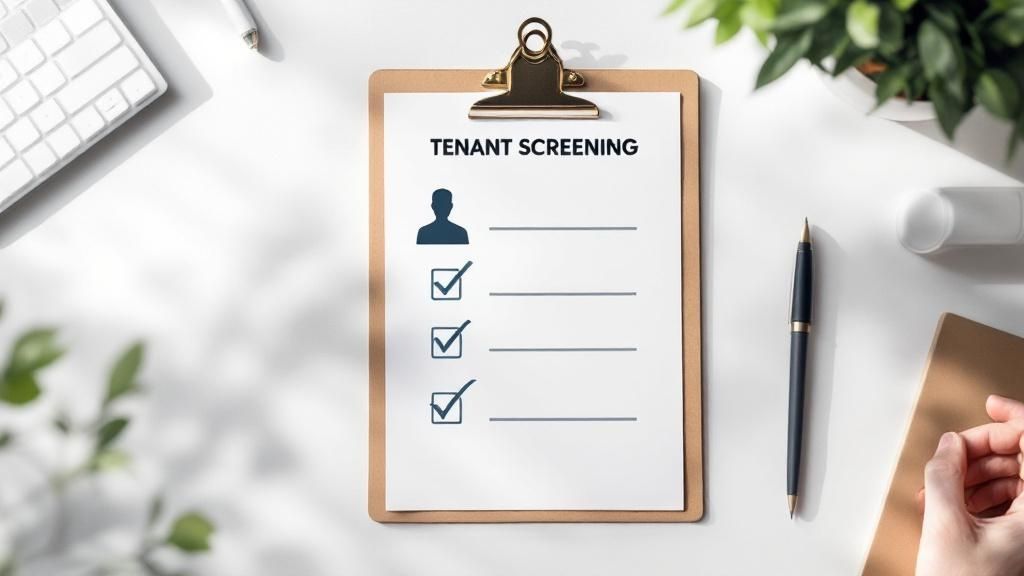
For a luxury property in Carmel or a prime single-family home in Salinas, the tenant is the most critical variable affecting your investment's health. This best practice transcends basic background checks. It’s a comprehensive, white-glove evaluation process designed to secure reliable, responsible residents who will not only pay rent punctually but also respect and preserve the quality of your property. This meticulous, fair, and legally compliant approach is one of the most vital property management best practices for protecting your asset and maximizing ROI from day one.
In Monterey County's competitive market, a sophisticated screening process attracts a higher caliber of applicant. It involves a deep dive into an applicant's financial stability, rental history, and overall reliability to ensure they are an ideal fit. For a luxury Pebble Beach home, for example, a concierge-level process may involve verifying international employment and assets to secure a high-quality corporate tenant. In contrast, for a multi-family unit in Salinas, it could identify a subtle pattern of late payments in an applicant's history, preventing a potential collections issue down the line. Utilizing advanced, secure platforms like AppFolio further streamlines this for applicants while ensuring data security and accelerating verification.
Actionable Tips for Implementation
- Establish Uniform Criteria: Create a written checklist of screening standards and apply them consistently to every applicant. This ensures you comply with the Fair Housing Act and maintain a professional, unbiased process. Your criteria should include income-to-rent ratio, credit score minimums, and rental history requirements.
- Verify Income at the Source: Always confirm an applicant's stated income by requesting recent pay stubs, bank statements, or official offer letters. A common practice is requiring gross income to be at least 3x the monthly rent. Never take income claims at face value.
- Conduct Thorough Landlord Interviews: Contact at least two previous landlords. Ask specific, actionable questions: "Did the tenant pay rent on time every month?" "Was the full security deposit returned?" "Would you rent to them again?" This provides invaluable insight into their behavior as a tenant.
- Leverage Professional Services: Use a professional, FCRA-compliant screening service that provides comprehensive credit, criminal, and eviction reports. This is a non-negotiable step for any serious investor. For additional insights, you can find more strategies for prospect screening to help secure ideal tenants.
2. Preventive Maintenance Programs: Protecting Your Investment's Future
Reactive maintenance—only fixing things as they break—is one of the quickest ways to erode a property's value and tenant goodwill. A systematic, proactive approach is one of the most critical property management best practices. This involves scheduled inspections, routine service, and proactive repairs to prevent catastrophic failures, extend the lifespan of key systems like HVAC and plumbing, and ultimately protect your bottom line by controlling costs. This strategy shifts the focus from costly emergency calls to predictable, budgeted upkeep, ensuring your property remains a top-tier asset.

For a multi-family property in Salinas or a luxury vacation home in Monterey, a well-executed preventive maintenance program is invaluable. It transforms property upkeep from a liability into a strategic advantage, preserving your asset's value. In the Monterey Bay Area, this means semi-annual gutter cleaning before the winter rains, checking for salt air corrosion on coastal properties in Pacific Grove, and servicing HVAC systems before the summer heat hits inland communities like King City. This not only keeps tenants happy but also provides a documented history of care, which is vital for warranty claims and insurance purposes.
Actionable Tips for Implementation
- Create Seasonal Checklists: Develop detailed, seasonal maintenance checklists tailored to your property. For the Monterey Bay Area, this includes checking for roof leaks before the rainy season, servicing HVAC systems, inspecting for pests, and ensuring proper drainage away from foundations.
- Leverage Technology for Scheduling: Use property management software to automate maintenance scheduling, reminders, and work order tracking. This ensures no task is overlooked and creates a clear, accessible record of all activities, giving you full transparency.
- Build a Network of Vetted Local Contractors: Cultivate strong relationships with reliable, licensed, and insured local contractors in Salinas and Monterey. Having trusted professionals on call is essential for both scheduled tasks and unexpected repairs, ensuring quality work and fair pricing.
- Document Everything Meticulously: Keep detailed records of all maintenance work, including dates, vendor details, costs, and photos. This documentation is crucial for budgeting, demonstrating due diligence, and supporting potential insurance claims. Explore our guide to see how a structured approach to rental property maintenance in Salinas can maximize your ROI.
3. Clear Lease Agreements and Documentation
The lease agreement is the legal backbone of any tenancy, a foundational document that prevents disputes and protects all parties. This property management best practice involves creating comprehensive, legally sound lease agreements that clearly outline the rights, responsibilities, and rules for both landlord and tenant. A meticulously drafted lease serves as the ultimate reference point for every aspect of the rental relationship, from rent collection to property maintenance, ensuring there is no room for ambiguity or misinterpretation.

For a high-end property owner in Monterey County, a generic, one-size-fits-all lease is a significant liability. A custom-tailored agreement protects your specific asset, whether it's a luxury home in Carmel with complex landscaping requirements or a multi-unit building in Salinas with shared amenities. For example, a lease for a Pebble Beach property might include specific clauses about event hosting or vehicle restrictions, while a lease in Gonzales might have addendums related to water usage. Ensuring full compliance with California’s intricate landlord-tenant laws is paramount. A clear, enforceable lease is your first and best line of defense.
Actionable Tips for Implementation
- Secure an Annual Legal Review: Your lease agreement is a legal document that must evolve with changing laws. Have a qualified California real estate attorney review and update your lease templates annually to ensure they remain compliant and enforceable.
- Use Plain Language for Clarity: While maintaining legal precision, write the lease in clear, understandable language. This minimizes tenant confusion and fosters a more transparent relationship from the start. A confused tenant is more likely to violate terms unintentionally.
- Incorporate Local and State Addendums: California has numerous required disclosures, such as those for lead-based paint, Megan’s Law, and pest control history. Ensure all mandatory state and local addendums for Monterey County are included to maintain full compliance.
- Provide a Lease Summary or FAQ: Offer tenants a one-page summary or a frequently asked questions document that highlights key terms like rent due dates, maintenance request procedures, and emergency contacts. This practical tool enhances comprehension and compliance. You can learn more about crafting essential lease clauses from reliable resources like the California Apartment Association, which provides guidance for landlords.
4. Effective Communication Systems: Building Trust and Efficiency
In the high-stakes world of property management, from a luxury estate in Carmel to a multi-family complex in Salinas, communication is the foundation of every successful relationship. An effective communication system is more than just answering the phone; it's a multi-channel strategy designed to ensure every interaction with owners, tenants, and vendors is timely, professional, and transparent. This commitment to clear and accessible dialogue is one of the most critical property management best practices, preventing misunderstandings, resolving issues swiftly, and building the trust necessary for long-term partnerships.

A robust communication framework provides a dedicated channel for every need. For an absentee owner of a Monterey vacation home, this means a secure online portal with 24/7 access to financial statements and maintenance updates. For a tenant in a South County property, it could be a simple text message system for routine maintenance requests. At Coast & Valley, we utilize integrated platforms like AppFolio to centralize these interactions, ensuring a single source of truth and a documented record of all communication. This technology-driven approach delivers the concierge-level service that discerning Monterey Bay clients expect, saving you time and providing complete transparency.
Actionable Tips for Implementation
- Establish Response Time Standards: Define and communicate clear service level agreements (SLAs) for different communication types. For example, commit to acknowledging emergency maintenance calls within 15 minutes and responding to routine owner emails within one business day. This sets professional expectations.
- Utilize a Centralized Platform: Implement a property management software with an integrated owner and tenant portal. This allows for secure document sharing, online rent payments, maintenance tracking, and a centralized hub for all important notices, enhancing owner convenience.
- Provide Multiple Contact Options: Offer various communication channels to suit different needs and preferences, such as a dedicated phone line for emergencies, an email address for general inquiries, and a portal or app for routine requests and announcements.
- Document All Critical Conversations: Maintain a meticulous record of important decisions, approvals, and agreements in your management software. This creates a clear audit trail that protects both the owner and the management company from future disputes and demonstrates professionalism.
5. Financial Management and Budgeting
Effective property management is fundamentally about protecting and maximizing the return on your investment. At its core, this requires rigorous financial oversight, strategic budgeting, and absolute transparency. For owners of valuable properties in Monterey County, from commercial spaces in Salinas to luxury homes in Carmel, this practice ensures every dollar is accounted for, expenses are controlled, and profitability is systematically enhanced. This is a cornerstone of professional property management best practices, transforming a real estate asset into a predictable, high-performing financial instrument.
This level of financial stewardship goes far beyond simple rent collection. It involves creating detailed annual budgets that anticipate everything from routine maintenance to seasonal utility spikes and potential vacancy periods. For example, a multi-unit property in Salinas requires careful cash flow management to cover landscaping in the spring and higher utility costs in the winter, all while building a capital reserve for future roof repairs or parking lot resurfacing. Elite management provides owners with clear, monthly statements that offer a real-time view of their asset's performance, fostering trust and enabling informed decision-making. For maximizing ROI through transparent financial management, consider adopting specialized invoice management for real estate to streamline expense tracking and vendor payments.
Actionable Tips for Implementation
- Utilize Integrated Accounting Software: Employ modern property management software like AppFolio or Buildium that has robust, built-in accounting features. This centralizes rent collection, expense tracking, and reporting, ensuring accuracy and saving you time.
- Maintain Separate Bank Accounts: Never commingle property funds with personal or other business finances. A dedicated operating account and a separate trust account for security deposits are non-negotiable for legal compliance and financial clarity in California.
- Conduct Monthly Financial Reviews: Schedule a consistent time each month to review key financial reports like the profit and loss statement, cash flow statement, and rent roll with your property manager. Understanding your financial reports for a Salinas investment property is crucial for strategic adjustments and maximizing ROI.
- Create a Proactive Annual Budget: Develop a comprehensive budget at the beginning of each year. This should include projected income, fixed costs (mortgage, insurance), variable expenses (repairs, utilities), and a contingency fund (typically 5-10% of gross rents) for unexpected issues, ensuring your investment remains financially sound.
6. Market-Competitive Pricing Strategies: Maximizing Revenue Without Sacrificing Occupancy
Setting the right rental price is a delicate balance. Price too high, and your high-end Carmel property sits vacant, costing you money every day. Price too low, and you leave significant revenue on the table, diminishing your return on investment. This is why dynamic, market-competitive pricing is one of the most crucial property management best practices. It’s an analytical approach that moves beyond guesswork, using real-time local data to set a rental rate that attracts quality tenants quickly while maximizing your income potential.
For a luxury ocean-view home in Monterey, this means analyzing comparable listings, seasonal demand, and recent rental comps to justify a premium rate. For a multi-unit property in Salinas, it involves a granular analysis of vacancy rates, local employment trends (like growth in the AgTech sector), and competitor pricing to ensure every unit is priced for optimal performance. This data-driven principle is now essential for individual investors in Monterey County to stay competitive and maximize their ROI.
Actionable Tips for Implementation
- Conduct Quarterly Market Surveys: Regularly analyze comparable properties in the immediate vicinity. Use professional tools and physically observe competing listings to understand their condition, amenities, and current asking rents. This provides a real-time pulse on the local Salinas or Monterey market.
- Factor in Total Cost of Occupancy: When setting a price, consider the value of included amenities. A property in Pebble Beach with included landscaping and pool services can command a higher rent than a similar home without these perks, as tenants value the convenience and cost savings.
- Adjust for Property Improvements: If you've recently upgraded a kitchen, installed new flooring, or added a desirable feature like an EV charging station, your rent should reflect this added value. Quantify the investment and adjust the price accordingly to capture the ROI.
- Monitor Local Economic Trends: Keep an eye on major employment shifts, like new business openings or expansions in the Salinas Valley agricultural tech sector. A growing job market increases rental demand and supports higher rental rates. This proactive awareness is a key differentiator in professional property management.
7. Legal Compliance and Risk Management
Navigating the complex web of federal, state, and local landlord-tenant laws is a non-negotiable component of professional property management. For an investor with properties across Monterey County, from a multi-unit complex in Salinas to a luxury home in Carmel, maintaining strict legal compliance is the ultimate form of risk management. This best practice involves a proactive, diligent approach to understanding and adhering to all regulations, ensuring every action, from lease signing to eviction, is handled correctly. It’s a foundational element that protects your investment from costly lawsuits, fines, and reputational damage.
Effective legal compliance is not a one-time task but an ongoing commitment to education and procedural integrity. It means staying current on rapidly changing California housing laws, such as tenant protection ordinances, safety codes, and Fair Housing regulations. For instance, a property manager must handle a security deposit for a Pacific Grove rental with the same legal precision as a tenant request for reasonable accommodation in a Soledad apartment. This diligent oversight protects your assets and reinforces the trust that is central to a successful owner-manager relationship.
Actionable Tips for Implementation
- Subscribe to Legal Updates: Actively follow publications from local real estate and apartment owner associations like the California Apartment Association. These organizations provide timely, localized information on legislative changes that directly impact your rental properties.
- Maintain Comprehensive Insurance: Secure robust landlord and liability insurance, and consider an umbrella policy for extra protection. This coverage is your financial shield against unforeseen events, accidents, or legal claims.
- Document Everything Meticulously: Keep detailed, organized records of all tenant communications, maintenance requests, property inspections with photos, and financial transactions. This documentation is invaluable evidence if a dispute arises.
- Establish a Relationship with Legal Counsel: Partner with a qualified attorney specializing in California landlord-tenant law before you need one. Having an expert on call provides peace of mind and allows for swift, accurate guidance when issues emerge. You can learn more about the intricate landscape of California landlord-tenant laws to better understand your obligations.
- Conduct Regular Staff Training: Ensure anyone interacting with tenants is regularly trained on Fair Housing laws, safety protocols, and proper tenant relations. Consistent training minimizes the risk of unintentional discrimination or procedural errors.
8. Technology Integration and Automation: Enhancing Efficiency and Service
In today’s fast-paced world, leveraging technology is no longer optional; it’s a cornerstone of elite property management best practices. This involves the strategic implementation of sophisticated property management software, smart home features, and automated workflows. The goal is to create a seamless, efficient ecosystem that benefits everyone, from the property owner in Monterey to the tenant in a Salinas multi-family complex. By automating routine tasks and providing digital convenience, we can dedicate more time to high-value activities like strategic planning and personalized client service.
Modern property management platforms, such as the powerful AppFolio system we utilize, centralize every facet of the management process. This integration transforms operations into a streamlined, data-driven engine. For instance, a maintenance request submitted by a tenant in Pacific Grove can be automatically logged, assigned to a vetted local vendor, and tracked through to completion, with all parties receiving real-time updates. Similarly, smart home technology, like smart locks or thermostats popular in luxury Pebble Beach rentals, offers enhanced security and energy efficiency, boosting a property's appeal and value while providing operational advantages.
Actionable Tips for Implementation
- Select an All-in-One Platform: Choose a comprehensive software solution that integrates accounting, leasing, maintenance, and communication. A unified system prevents data silos and provides a single source of truth for your entire portfolio, enhancing transparency and owner convenience. To understand the full impact, learn more about why professional property management software is essential.
- Prioritize Security and Data Integrity: Ensure any technology you adopt has robust security protocols, including regular data backups and encryption. Protecting owner and tenant financial information is a paramount responsibility that builds trust.
- Implement Smart Home Tech Strategically: Introduce smart home devices that offer a clear return on investment. Smart locks simplify turnovers and enhance security, while smart thermostats can reduce utility costs for vacant units and provide a desirable amenity for tenants.
- Automate Communications and Reporting: Use your software to automate rent reminders, lease renewal notices, and the generation of monthly owner statements. This ensures consistent, timely communication and frees up valuable time for more complex, high-touch interactions.
9. Tenant Retention and Relationship Building
High turnover is one of the most significant profit drains for any rental property, from a luxury home in Monterey to a multi-family building in Soledad. This best practice moves beyond transactional interactions and focuses on proactively building positive, long-term relationships with tenants. By fostering a sense of community and demonstrating genuine care, you transform a temporary resident into a loyal, long-term steward of your property, significantly reducing costly vacancies and marketing efforts. This focus on tenant satisfaction is a cornerstone of advanced property management best practices, ensuring stable occupancy and predictable cash flow.
A positive landlord-tenant relationship is invaluable. It encourages tenants to report maintenance issues early, take better care of the property, and be more understanding during necessary property improvements or repairs. In our experience managing properties throughout Monterey County, a responsive and respectful approach is the single most effective tool for retention. The goal is to create an environment where tenants feel valued and heard, making them far more likely to renew their lease year after year and protect your asset as if it were their own.
Actionable Tips for Implementation
- Be Responsive and Proactive: Address maintenance requests promptly and professionally. Use a digital portal to track requests and provide tenants with status updates, showing that their concerns are a top priority. A 24-hour response to non-emergency requests is a good benchmark.
- Offer Meaningful Renewal Incentives: Don't wait until the last minute. Begin the renewal conversation 60-90 days before the lease expires, offering a tangible incentive like a small rent credit, a professional carpet cleaning, or a smart-home gadget upgrade. This shows you value their tenancy.
- Personalize Communication: Make an effort to remember tenants' names and occasional personal details. A simple holiday card or a quick, friendly check-in can build significant goodwill and make residents feel like more than just a rent check.
- Foster a Sense of Community: For multi-family properties, consider organizing occasional, low-cost community events like a summer BBQ or a holiday decorating contest. Creating spaces where tenants can interact positively strengthens their connection to the property. You can find more strategies and learn more about how to earn a lease renewal from tenants on coastandvalleypm.com.
Best Practices Comparison Matrix for Property Management
| Item | Implementation Complexity 🔄 | Resource Requirements ⚡ | Expected Outcomes 📊 | Ideal Use Cases 💡 | Key Advantages ⭐ |
|---|---|---|---|---|---|
| Tenant Screening and Selection | Medium - involves multiple checks | Moderate - background, credit services | Reliable tenants, reduced risk, safer units | Leasing new tenants, risk mitigation | Reduces non-payment & damage risk, protects investment |
| Preventive Maintenance Programs | High - scheduled, ongoing | High - skilled staff, contractors, tools | Lower emergency costs, longer asset lifespan | Properties needing proactive upkeep, cost control | Cuts emergency repairs, extends property life |
| Clear Lease Agreements & Documentation | Medium - legal review required | Moderate - legal consultation, documentation | Fewer disputes, legal protection | All rental relationships, legal compliance | Reduces conflicts, ensures legal clarity |
| Effective Communication Systems | Medium - multi-platform setup | Moderate - tech investment, staff training | Faster issue resolution, higher tenant satisfaction | Tenant/vendor communication, operational efficiency | Enhances satisfaction, reduces conflicts |
| Financial Management & Budgeting | High - requires accounting skill | High - professional accounting tools | Maximized ROI, informed financial decisions | Property profitability oversight | Improves transparency, cost control |
| Market-Competitive Pricing Strategies | Medium - ongoing analysis | Moderate - market research tools | Optimized rental income, reduced vacancy | Competitive markets, revenue maximization | Increases income, adapts to market changes |
| Legal Compliance & Risk Management | High - continuous updates | High - legal training, consultations | Reduced legal risks, tenant safety | Regulatory-heavy environments, risk mitigation | Prevents costly lawsuits, maintains reputation |
| Technology Integration & Automation | High - technical setup & training | High - software, hardware, training | Increased efficiency, tenant convenience | Large portfolios, tech-forward operations | Streamlines operations, remote management |
| Tenant Retention & Relationship Building | Medium - ongoing commitment | Moderate - programs, events, staff time | Lower turnover, improved tenant loyalty | Long-term tenancy focus, community building | Reduces vacancy, boosts property value |
Partner with the Leader in Monterey County Property Management
Navigating the complexities of high-end property ownership in Monterey County requires more than just a checklist; it demands a strategic, integrated approach. Throughout this guide, we've detailed the essential pillars of elite property management, providing a blueprint for excellence. From implementing rigorous tenant screening to deploying proactive, seasonal maintenance programs designed for the unique coastal climate of the Monterey Bay Area, each practice is a critical component of a larger strategy. These aren't just suggestions; they are the fundamental property management best practices that distinguish a thriving, high-return investment from a time-consuming liability.
Mastering these domains—from crafting ironclad, California-compliant lease agreements to fostering tenant relationships that encourage long-term occupancy—is a full-time commitment. It requires deep local knowledge, sophisticated technological infrastructure, and an unwavering dedication to detail. For discerning owners in communities from Salinas to Pacific Grove, the true value lies not just in executing these tasks, but in orchestrating them seamlessly to preserve asset value and maximize your return on investment.
From Theory to Action: The Coast & Valley Advantage
Implementing these best practices independently can be a monumental task for a busy professional or investor. It involves sourcing and vetting reliable vendors, staying current on ever-changing rental laws, managing complex financial reporting, and being on call 24/7. The alternative is to partner with a team that has already built these elite standards into its DNA. This is where Coast & Valley Properties elevates the ownership experience. We transform these best practices from a demanding to-do list into a fully managed, turnkey solution that saves you time and protects your asset.
Our approach is built on a foundation of local expertise and a concierge-level commitment to service. Consider these key differentiators:
- Proactive, Not Reactive: Our maintenance programs are designed around the specific needs of Monterey County properties, addressing issues like coastal humidity in Carmel or seasonal agricultural demands in the Salinas Valley before they become costly problems.
- Technology with a Human Touch: We utilize advanced property management software for transparent financial reporting and instant communication, but we never lose the personal connection. You have direct access to a team that knows you and your property intimately.
- Unmatched Local Insight: Led by fourth-generation Salinas native Amy Salmina, our understanding of the local market is unparalleled. We leverage this insight to set competitive rental rates, attract high-caliber tenants, and navigate the nuances of local regulations with confidence.
Secure Your Investment, Reclaim Your Time
Ultimately, superior property management is about achieving peace of mind. It’s the confidence that comes from knowing your valuable asset is not only protected but is also performing at its peak potential. By embracing these property management best practices, you are making a strategic decision to enhance your property’s longevity, profitability, and reputation. The most efficient path to achieving this is by entrusting your portfolio to specialists who live and breathe this work every day. Your investment deserves more than basic oversight; it deserves strategic, professional stewardship. When you partner with a leader in the field, you are not just hiring a manager; you are investing in a system designed for success, freeing you to focus on what matters most to you.
Ready to see how these principles translate into superior results for your property? Contact Coast and Valley Properties to experience a management service that combines deep local roots with best-in-class operational excellence. Let us show you how our strategic approach can protect your investment and maximize your returns.

Maximize Deductions with 7 Tax-Saving Strategies for Commercial Property Owners

Being a commercial property owner comes with its own set of financial responsibilities, including taxes. However, with a strategic approach and the right knowledge, you can maximize deductions and save on your tax bill. In this article, we will explore seven effective tax-saving strategies specifically tailored for owners of commercial properties.
Understanding the Basics of Commercial Property Tax
Before diving into the tax-saving strategies, it's important to have a good grasp of the basics of commercial property tax. Commercial property tax is a levy imposed by local governments on owners of commercial properties based on the assessed value of the property. Understanding how this tax works is crucial for implementing effective tax-saving strategies.
Commercial property tax is a significant expense for property owners, and having a solid understanding of how it is calculated can help you make informed financial decisions. The assessed value of a commercial property is determined by local assessors who evaluate the property's market value, taking into account factors such as location, size, and condition. This assessed value is then multiplied by the mill rate, which is the rate used to calculate the property tax owed.
The Importance of Tax Planning for Commercial Property Owners
Effective planning is essential for commercial property owners when it comes to taxes. By carefully reviewing your financial situation, property assessment, and applicable tax laws, you can identify opportunities to minimize your tax liability and maximize your deductions. Engaging the services of a qualified tax professional can greatly help in devising a tax plan tailored to your specific circumstances.
Tax planning is not a one-time task but an ongoing process that should be revisited regularly to ensure that you are taking advantage of all available tax-saving opportunities. Changes in tax laws, property values, and your financial situation can all impact the effectiveness of your tax plan, making regular reviews crucial for optimizing your tax strategy.
Key Terms in Commercial Property Taxation
Before exploring the tax-saving strategies in detail, it's important to familiarize yourself with key terms related to commercial property taxation. Some of these terms include assessed value, mill rate, tax exemptions, and abatement. Understanding these terms will help you navigate the tax landscape better and make informed decisions.
Assessed value is the value assigned to a property for tax purposes and is used as the basis for calculating property taxes. The mill rate, on the other hand, is the rate per thousand dollars of assessed value that is used to calculate the property tax due. Tax exemptions and abatements are incentives provided by local governments to reduce the tax burden on certain properties, such as historic buildings or properties used for charitable purposes.
The Role of Depreciation in Tax Savings
Depreciation is an essential concept that commercial property owners should be well-versed in, as it plays a crucial role in tax savings. Depreciation allows you to deduct the costs of acquiring and improving your property over time, rather than all at once. This can significantly reduce your taxable income and increase your deductions, resulting in substantial tax savings.
Understanding the nuances of depreciation can empower property owners to make informed financial decisions and optimize their tax liabilities. By leveraging depreciation strategies effectively, property owners can not only save on taxes but also enhance their overall financial position.
How Depreciation Works in Commercial Real Estate
In commercial real estate, depreciation is typically calculated over a 39-year period for non-residential properties and 27.5 years for residential rental properties. The depreciation deduction is spread out evenly over this period, allowing you to deduct a portion of the property's value each year. This systematic approach to depreciation provides a steady stream of tax savings over the long term.
Depreciation can also reflect the actual wear and tear of a property over time, aligning tax deductions with the property's decreasing value. This not only benefits property owners from a tax perspective but also ensures a fair representation of the property's economic reality.
Maximize Deductions through Accelerated Depreciation
Accelerated depreciation is a strategy that allows you to front-load your depreciation deductions, thereby maximizing your tax savings in the earlier years of property ownership. By using methods such as bonus depreciation and Section 179 expensing, you can deduct a significant portion of the property's value in the first year. This can provide immediate tax benefits and help free up cash flow for further property investments.
Property owners can strategically utilize accelerated depreciation to optimize their tax planning, improve cash flow, and reinvest in their properties for long-term growth. By understanding the benefits of accelerated depreciation, owners can take advantage of valuable tax incentives and enhance their property investment strategies.
Exploring Cost Segregation Studies
Cost segregation studies are a valuable tool for commercial property owners looking to maximize their deductions. These studies involve the identification and reclassification of certain building components into shorter recovery periods, such as five, seven, or fifteen years, rather than the standard 27.5 or 39 years for depreciation purposes. This allows for accelerated deductions and significant tax savings.
When delving into the world of cost segregation studies, it's essential to understand the intricate details involved in the process. Each component of a commercial property is carefully evaluated to determine its proper classification for depreciation purposes. This meticulous examination can uncover hidden opportunities for tax savings that may have been previously overlooked. By conducting a thorough cost segregation study, property owners can unlock the full potential of their tax benefits.
The Benefits of Cost Segregation
Cost segregation offers numerous benefits beyond accelerated deductions. By segregating the costs of different components of your commercial property, you gain a better understanding of the building's true value. This information can be used for insurance purposes, financial reporting, and even potential future sales. Cost segregation studies can result in increased cash flow, as tax savings can be reinvested into your property or other ventures.
The insights gained from a comprehensive cost segregation study can provide strategic advantages for property owners. Understanding the specific depreciation timelines of various building components can inform decisions regarding maintenance, renovations, and overall asset management. This knowledge empowers property owners to make informed choices that optimize their financial position and long-term investment strategies.
Implementing Cost Segregation in Your Tax Strategy
To implement cost segregation effectively, it is crucial to engage the services of a qualified professional with expertise in this area. They will conduct a detailed study of your property and identify components that can be reclassified for accelerated depreciation. This not only ensures compliance with applicable tax laws but also maximizes your tax savings while minimizing potential audit risks.
Working hand in hand with a knowledgeable specialist in cost segregation can streamline the process and provide peace of mind for property owners. Their expertise and experience in navigating the complexities of tax regulations ensure that every opportunity for savings is leveraged to its fullest extent. By incorporating cost segregation into your overall tax strategy, you can position yourself for long-term financial success and enhanced profitability in the realm of commercial property ownership.
Utilizing the 1031 Exchange for Tax Deferral
The 1031 exchange, also known as a like-kind exchange, is a powerful tax-deferral strategy available to commercial property owners. By selling a property and reinvesting the proceeds into a similar property, you can defer capital gains taxes. This allows you to keep more of your investment capital working for you and potentially grow your wealth further.
The Basics of a 1031 Exchange
A 1031 exchange involves the sale of a commercial property and the subsequent purchase of another property that is of "like-kind." The term "like-kind" is broad and encompasses a variety of property types, as long as they are held for productive use in a trade or business or for investment purposes. When executed correctly, a 1031 exchange can provide substantial tax deferral benefits.
Strategic Use of 1031 Exchanges in Commercial Real Estate
Commercial property owners can strategically use 1031 exchanges to their advantage. By continually reinvesting in like-kind properties, you can defer taxes indefinitely, potentially accumulating a substantial real estate portfolio while deferring capital gains obligations. It's important to work with a qualified intermediary to ensure compliance with IRS regulations and maximize the benefits of this tax-saving strategy.
Capitalizing on Opportunity Zone Investments
Opportunity zones are designated areas that provide tax benefits to investors who choose to invest in economically distressed communities. Commercial property owners can utilize this tax-saving strategy to not only reduce their tax bill but also make a positive impact on communities in need of revitalization.
Understanding Opportunity Zones
Opportunity zones were established as part of the Tax Cuts and Jobs Act of 2017 to encourage investment in underserved areas. These zones offer attractive tax incentives, including the deferral of capital gains, partial reduction of capital gains taxes, and potential tax-free growth on qualified investments. Understanding the intricacies of opportunity zones can help you make informed investment decisions.
Tax Advantages of Investing in Opportunity Zones
Investing in opportunity zones can provide significant tax advantages. By investing capital gains into a qualified opportunity zone fund, you can defer taxes on those gains until 2026 or until you sell your investment, whichever comes first. Additionally, if you hold the investment for at least ten years, any future appreciation on that investment will be tax-free. This can be a powerful tool for growing your wealth while minimizing your tax liability.
Implementing these seven tax-saving strategies can provide commercial property owners with substantial savings and increased cash flow. By understanding the basics of commercial property tax, depreciating assets effectively, utilizing cost segregation studies, strategically executing 1031 exchanges, and capitalizing on opportunity zone investments, you can maximize deductions and optimize your tax position. Remember, it's always wise to consult with a qualified tax professional to ensure compliance and take full advantage of the available tax benefits.

7 Tenant Services That Will Elevate Your Salinas, CA Rental Property
If you own a rental property in Salinas, CA, you know how important it is to provide excellent tenant services. These services not only enhance the overall tenant experience but also have a significant impact on your property's value. In this article, we will explore the importance of tenant services, the top seven services you should offer, how to implement them in your property, and ways to evaluate their effectiveness.
Understanding the Importance of Tenant Services
Tenant services play a crucial role in rental properties. By offering services that cater to your tenants' needs, you create a positive living environment and build strong tenant relationships. When tenants feel well taken care of, they are more likely to stay longer, take better care of the property, and refer others to your rental units. This ultimately leads to higher tenant satisfaction and improved property value.
The Role of Tenant Services in Rental Properties
Tenant services go beyond simply collecting rent. They involve providing support and assistance to tenants throughout their lease term. Whether it's addressing maintenance issues promptly or offering online rent payment options, these services contribute to the overall well-being of your tenants and foster a sense of community within your property.
One important aspect of tenant services is maintenance support. When tenants encounter issues with their rental units, such as plumbing problems or electrical malfunctions, it is essential to address these concerns promptly. By having a dedicated team of maintenance professionals available, you can ensure that repairs are carried out efficiently and effectively, minimizing any inconvenience to your tenants. This proactive approach to maintenance not only enhances the living experience for your tenants but also helps to preserve the condition of your property.
In addition to maintenance support, tenant services can also include amenities that enhance the quality of life for your tenants. For example, you may consider providing access to a fitness center, a communal lounge area, or a swimming pool. These amenities not only attract potential tenants but also contribute to a sense of community within your property. By fostering a welcoming and inclusive environment, you can create a place where tenants feel connected and supported.
How Tenant Services Impact Your Property's Value
When you invest in tenant services, you are investing in the long-term success of your rental property. By offering comprehensive services, you create a competitive advantage, attracting quality tenants who are willing to pay a premium for the added value. Additionally, satisfied tenants are more likely to renew their leases, reducing turnover costs and increasing cash flow.
Furthermore, tenant services can have a positive impact on the overall property value. When tenants are happy and satisfied with the services they receive, they are more likely to take better care of the property. This means fewer instances of damage or neglect, resulting in lower maintenance and repair costs for you as the landlord. Additionally, well-maintained properties are more attractive to potential buyers or investors, increasing the market value of your rental units.
Moreover, tenant services can also contribute to the reputation of your rental property. Positive word-of-mouth referrals from satisfied tenants can attract a larger pool of prospective tenants, allowing you to be more selective in choosing reliable and responsible individuals to occupy your units. This, in turn, reduces the risk of problematic tenants and potential issues that may arise from their tenancy.
In conclusion, tenant services are essential for creating a positive living environment, building strong tenant relationships, and enhancing the value of your rental property. By investing in comprehensive services and amenities, you can attract quality tenants, reduce turnover costs, and increase the overall satisfaction of your tenants. Ultimately, this leads to improved property value and long-term success in the rental market.
The Top 7 Tenant Services for Your Salinas Rental Property
Now that you understand the importance of tenant services, let's delve into the top seven services that will elevate your Salinas rental property:
Comprehensive Maintenance and Repair Services
Efficient and reliable maintenance and repair services are essential for any rental property. Timely response to repairs and well-maintained units contribute to tenant satisfaction and minimize potential property damage.
When it comes to comprehensive maintenance and repair services, it's important to have a team of skilled professionals who can address any issues that may arise. From plumbing and electrical repairs to fixing appliances and handling general wear and tear, having a reliable maintenance crew ensures that your tenants' needs are met promptly and effectively.
Additionally, implementing a preventive maintenance plan can help identify potential problems before they escalate. Regular inspections and scheduled maintenance tasks, such as HVAC servicing and gutter cleaning, can go a long way in preserving the condition of your property and preventing costly repairs down the line.
24/7 Customer Service and Support
Providing round-the-clock customer service and support is crucial for tenant convenience and peace of mind. Quick responses to inquiries or emergencies create a sense of reliability and trust between you and your tenants.
Having a dedicated customer service team available 24/7 ensures that your tenants can reach out for assistance whenever they need it. Whether it's a maintenance request, a question about their lease agreement, or a concern about their neighbors, being accessible and responsive demonstrates your commitment to providing a positive living experience.
Investing in technology that allows tenants to easily submit requests or reach out for support can streamline the process and enhance tenant satisfaction. Online portals, chatbots, and automated systems can all contribute to a seamless communication experience for both you and your tenants.
Online Rent Payment and Tenant Portal
Offering an online rent payment option and tenant portal simplifies the rent collection process and provides tenants with easy access to important documents and information. This modern approach also improves efficiency and reduces administrative overhead.
Gone are the days of collecting rent checks and manually updating spreadsheets. By implementing an online rent payment system, tenants can conveniently pay their rent from anywhere, at any time. This not only saves them the hassle of writing and mailing checks but also ensures that you receive payments promptly.
A tenant portal goes hand in hand with online rent payment. It serves as a centralized hub where tenants can access lease agreements, submit maintenance requests, view payment history, and communicate with you. This self-service option empowers tenants and reduces the need for constant back-and-forth communication.
Regular Property Inspections
Regular property inspections help identify maintenance issues early on, ensuring that your property remains in excellent condition. These inspections also provide opportunities for open communication with tenants and address any concerns they may have.
Conducting routine inspections allows you to proactively identify and address any maintenance or safety issues. By inspecting the property on a regular basis, you can catch problems before they become major headaches for both you and your tenants. This not only helps maintain the value of your property but also shows your commitment to providing a safe and comfortable living environment.
During inspections, take the time to engage with your tenants. Ask them if they have any concerns or suggestions for improvements. This open dialogue fosters a positive landlord-tenant relationship and shows that you value their input.
Efficient Handling of Tenant Complaints
Creating a system that addresses tenant complaints promptly and effectively is crucial for tenant satisfaction. By actively listening to your tenants' concerns and taking appropriate action, you demonstrate your commitment to providing a comfortable living environment.
No matter how well-maintained your property is, issues may still arise that require your attention. It's important to have a clear process in place for handling tenant complaints. This includes establishing multiple channels of communication, such as phone, email, or an online portal, to ensure that tenants can easily report their concerns.
When a complaint is received, respond promptly and acknowledge the issue. Investigate the matter thoroughly and take appropriate action to resolve it. Keeping tenants informed throughout the process shows that you take their concerns seriously and are committed to maintaining a high standard of living in your property.
Tenant Screening and Selection Services
Thorough tenant screening and selection services play a key role in maintaining a high-quality tenant base. By carefully evaluating potential tenants' backgrounds, credit histories, and rental references, you can minimize the risk of problematic tenants and ensure a harmonious community.
When it comes to tenant screening, it's important to have a standardized process in place. Conducting background checks, verifying employment and income, and contacting previous landlords can provide valuable insights into a potential tenant's reliability and suitability for your property.
While it may be tempting to fill vacancies quickly, taking the time to thoroughly screen applicants can save you from potential headaches down the line. A thorough screening process helps ensure that you select tenants who will pay rent on time, take care of the property, and abide by the terms of the lease agreement.
Lease Renewal and Rent Increase Management
Managing lease renewals and rent increases efficiently is important for maintaining a stable cash flow and establishing clear expectations with your tenants. By providing transparent communication and fair rent adjustments, you can maintain positive landlord-tenant relationships.
As leases approach their expiration dates, it's important to initiate conversations with your tenants regarding their intentions to renew or move out. Providing clear and timely communication about lease renewal options and any potential rent adjustments allows both parties to plan ahead.
When considering rent increases, it's essential to conduct market research to ensure that your proposed adjustments are fair and in line with the current rental market. Communicate the reasons for the increase to your tenants and be open to discussing any concerns they may have. A transparent and respectful approach to rent adjustments helps maintain trust and fosters a positive landlord-tenant relationship.
By implementing these top seven tenant services, you can elevate your Salinas rental property and provide an exceptional living experience for your tenants. Remember, happy tenants are more likely to stay long-term, take care of the property, and recommend it to others. Investing in tenant services is not only beneficial for your tenants but also for your overall success as a landlord.
Implementing Tenant Services in Your Rental Property
Now that you are aware of the top tenant services, let's discuss how to implement them in your Salinas rental property:
Steps to Introduce New Services
When introducing new services, outline a clear plan for implementation. This may involve researching service providers, setting up systems and processes, and training your staff to ensure a smooth transition.
Communicating Changes to Your Tenants
Effective communication is key when implementing new services. Inform your tenants well in advance about the changes, highlighting the benefits they will receive. Be open to feedback and address any concerns to ensure a positive reception.
Evaluating the Effectiveness of Your Tenant Services
Once you have implemented tenant services, it's important to evaluate their effectiveness regularly. Here are a few ways to assess the impact of these services:
Tenant Satisfaction Surveys
Conduct regular tenant satisfaction surveys to gauge overall tenant happiness and identify areas for improvement. Use the feedback received to fine-tune your services and cater to your tenants' needs better.
Tracking Rent Collection Efficiency
Monitor your rent collection efficiency to ensure that your online payment system is functioning well and is widely adopted. Efficient rent collection processes reduce administrative burden and contribute to improved cash flow management.
Monitoring Tenant Retention Rates
Track tenant retention rates over time to assess the success of your tenant services. A high retention rate indicates that your services are meeting tenant expectations and creating a positive living experience.
By offering comprehensive tenant services, you can elevate your Salinas rental property to new heights. Invest in these services, implement them effectively, and regularly evaluate their effectiveness. Your tenants will appreciate the care and attention you provide, leading to a successful and thriving rental property.

Maximize Rental Income in 2024 with These 4 Powerful Strategies for Salinas Property Owners
Renting out property in Salinas can be a lucrative investment, especially if you employ the right strategies. With the new year just around the corner, it's essential for Salinas property owners to be prepared and maximize their rental income in 2024. In this article, we will explore five powerful strategies that will help you achieve this goal.
Understanding the Salinas Rental Market
Before implementing any strategies, it's important to have a solid understanding of the Salinas rental market. This includes analyzing key factors that influence rental prices and predicting trends for the upcoming year.
The Salinas rental market is a dynamic and ever-changing landscape, influenced by various factors that shape the pricing and demand for rental properties. By delving deeper into these factors, property owners can gain valuable insights and make informed decisions to maximize their rental income.
Key Factors Influencing Rental Prices
Several factors play a role in determining rental prices in Salinas. Firstly, location is a critical factor that significantly impacts rental rates. Properties situated in prime locations, such as near the beach or in desirable neighborhoods, tend to command higher rental prices due to their proximity to amenities and attractions.
Property size also plays a crucial role in rental pricing. Larger properties with more bedrooms and bathrooms generally have higher rental rates compared to smaller units. This is because larger properties offer more space and can accommodate larger families or groups, making them more desirable for tenants.
Amenities are another important consideration when it comes to rental prices. Properties with desirable amenities, such as swimming pools, fitness centers, or gated access, often command higher rental rates as they provide added convenience and luxury to tenants.
Overall market demand is a key factor that influences rental prices in Salinas. When there is high demand for rental properties and limited supply, landlords have the advantage of setting higher rental rates. Conversely, during periods of low demand or increased competition, landlords may need to adjust their prices to attract tenants.
Predicted Trends for 2024
Having insights into predicted trends can give you a significant advantage as a Salinas property owner. By staying updated on market forecasts, you can anticipate shifts in demand and make proactive decisions to stay ahead of the competition.
One predicted trend for 2024 is the continued growth of the local economy in Salinas. With new businesses and industries moving into the area, there will likely be an increased demand for rental properties as more people seek housing options near their workplaces.
Another trend to watch out for is the development of the rental landscape in Salinas. As the city continues to grow, there may be new rental developments and complexes being built, which could impact the overall supply and demand dynamics. Keeping an eye on these developments can help property owners adjust their rental pricing and marketing strategies accordingly.
Additionally, changes in the local economy can also influence rental prices. Factors such as job growth, wage increases, and changes in the cost of living can all impact the affordability and demand for rental properties. Staying informed about these economic indicators can help property owners make educated decisions about their rental pricing.
In conclusion, understanding the Salinas rental market is crucial for property owners looking to maximize their rental income. By analyzing key factors that influence rental prices and staying updated on predicted trends, property owners can make informed decisions and stay ahead in this competitive market.
Strategy 1: Optimal Pricing
One of the most critical strategies for maximizing rental income is setting optimal pricing for your property. Competitive pricing attracts tenants and ensures you're generating consistent income.
When it comes to setting the right price for your rental property, it's important to consider various factors. These factors include the location, size, amenities, and condition of your property. Additionally, you should also take into account tenant-landlord laws, as well as current demand and market trends in the area.
Importance of Competitive Pricing
Competitive pricing is important because it directly affects your property's desirability and occupancy rate. Price your rental too high, and potential tenants will look elsewhere; price it too low, and you may be leaving money on the table.
By setting a competitive price, you are positioning your rental property as an attractive option for potential tenants. This increases the chances of attracting a larger pool of interested individuals, ultimately leading to a higher occupancy rate and maximizing your rental income.
Tools for Accurate Rental Pricing
Thankfully, there are tools available to help you accurately price your rental property. Utilize online platforms that provide rental market data and compare your property to similar listings in Salinas. This will give you a better understanding of the competitive landscape to make informed pricing decisions.
These online platforms often provide valuable insights such as average rental prices in the area, rental trends, and the demand for different types of properties. By leveraging this data, you can ensure that your rental property is priced competitively and in line with the current market conditions.
Furthermore, it's also beneficial to consult with local real estate agents or property management companies who have a deep understanding of the rental market in Salinas. Their expertise and knowledge can provide you with valuable guidance in determining the optimal pricing for your property.
Strategy 2: Property Upgrades that Maximize Rental Income
Investing in property upgrades can significantly increase your rental income. By making strategic improvements, your property becomes more attractive to potential tenants, allowing you to charge higher rental rates.
When considering property upgrades, it's important to focus on areas that have the potential for high returns. One area to consider is the kitchen. Renovating the kitchen can have a significant impact on the overall appeal of the property. Upgrading countertops, cabinets, and appliances can give the kitchen a modern and luxurious feel, making it more desirable to potential tenants.
In addition to the kitchen, another area to focus on is the bathroom. Upgrading the bathroom can make a big difference in attracting quality tenants. Consider installing new fixtures, updating the flooring, and adding a fresh coat of paint. These simple upgrades can give the bathroom a fresh and clean look, enhancing the overall appeal of the property.
While the interior upgrades are important, it's also crucial to pay attention to the exterior of the property. Enhancing curb appeal can make a lasting impression on potential tenants. Consider landscaping the front yard, adding new plants and flowers, and ensuring that the property looks well-maintained. A visually appealing exterior can make a property stand out from the competition and attract more tenants.
In addition to the physical upgrades, adding desirable amenities can also increase the rental income. Consider adding in-unit laundry facilities, as this is a highly sought-after feature for many tenants. Another amenity that can attract tenants is a gym facility. Creating a dedicated space for tenants to exercise can be a valuable selling point and justify higher rental rates.
When planning property upgrades, it's important to strike a balance between cost and value. Conduct thorough cost-benefit analyses to determine which upgrades will yield the highest return on investment. This ensures that you're making strategic choices that enhance the value of your property without overspending.
By investing in property upgrades strategically, you can not only increase your rental income but also attract more quality tenants. The key is to focus on areas that have the potential for high returns, such as the kitchen and bathroom, while also considering the overall curb appeal and adding desirable amenities. Remember to strike a balance between cost and value to maximize your investment.
Strategy 3: Effective Marketing
Effective marketing is vital for attracting the right tenants and filling vacancies quickly. By utilizing the right channels and targeting the right audience, you can maximize your rental income.
Targeting the Right Tenants
Identify your ideal tenant profile and tailor your marketing efforts accordingly. Consider factors such as demographics, lifestyle preferences, and rental history. This allows you to craft targeted messages that resonate with potential tenants, increasing the chances of attracting the right individuals.
Utilizing Digital Marketing Channels
Take advantage of various digital marketing channels to reach a wide audience. Create eye-catching listings on popular rental websites and leverage social media platforms to showcase your property's unique features. Utilize high-quality photos and engaging descriptions to make a memorable impression.
Strategy 4: Tenant Retention
It's not just about acquiring new tenants; retaining existing tenants can also help maximize rental income. Reducing turnover costs and establishing positive landlord-tenant relationships should be part of your long-term strategy.
The Cost of Tenant Turnover
Tenant turnover can be expensive and time-consuming. Vacancies result in loss of rental income and require additional resources for advertisement, screening, and lease preparation. By focusing on tenant retention, you can minimize these costs and maintain a stable income stream.
Strategies for Increasing Tenant Satisfaction
Building positive relationships with your tenants is crucial for long-term success. Ensure prompt responses to maintenance requests, conduct regular property inspections, and provide incentives for lease renewals. Happy tenants are more likely to stay longer, reducing turnover and maximizing your rental income.
Conclusion
As we approach 2024, Salinas property owners have the opportunity to maximize their rental income by implementing powerful strategies. Understanding the rental market, utilizing optimal pricing, investing in property upgrades, executing effective marketing campaigns, and focusing on tenant retention are all key elements for success. By following these strategies, you can make the most out of your rental property and achieve maximum financial returns.