When Self-Managing a Salinas Rental Stops Making Sense
Direct Answer: Self-managing a Salinas rental stops making sense when compliance demands, portfolio growth, or distance from the property creates risk you can no longer absorb on your own.
I hear the same story a lot. An owner starts with one rental, handles it themselves, and it mostly works. Then a second property comes along, or they move out of the area, or a long-term tenant leaves and suddenly the whole operation feels a lot heavier than it did before. That is usually when the phone rings here.
What I have seen over the past several years working with property owners across Monterey County is that the transition from self-management to professional management is rarely planned. It is almost always triggered. And the three triggers that come up most consistently are portfolio growth, geographic distance, and the jump from owner-occupant to full landlord. If any of those describes where you are right now, this article is worth reading through.
Salinas is not a forgiving market for owners who are learning as they go. The local compliance environment is specific, the penalties for getting it wrong are real, and the operational demands of even a single rental add up faster than most people expect.
The Compliance Layer Salinas Adds on Top of California Law
California landlord law is already one of the most layered regulatory environments in the country. Salinas adds its own requirements on top of that, and I find that a lot of owners, especially those who inherited a property or recently moved into the landlord role, are not fully aware of what those requirements involve.
Owners of covered multi-family properties built before February 1, 1995 are operating under an active Rent Stabilization Ordinance. Annual increases are capped at 2.75 percent or 75 percent of CPI, whichever is less. Every covered unit requires annual registration with the city, and the registration fee runs $170 per year per stabilized unit. That is a hard deadline, not a suggestion.
The penalty for getting this wrong is not a warning letter. Violations can expose an owner to damages of up to three times the amount of any overcharged rent, plus potential misdemeanor exposure. An owner managing remotely, or managing several properties at once, is carrying real risk if they are not actively tracking these requirements. The city’s Salinas Residential Rental Registration Ordinance (City Ord. 2663) has added another compliance layer that is still catching some owners off guard.
And California AB 1482 sits underneath all of this. If your property qualifies as exempt, you still need documentation to prove it. If it does not qualify, you need a system for tracking allowable increases and just-cause eviction requirements. These are not things you want to figure out for the first time when a tenant disputes a rent increase. For a deeper look at what is coming on this front, the piece on Salinas rent control going to voters in November is worth reading before that ballot hits.
What Self-Management Actually Looks Like From the Start
One thing I hear regularly from owners who reach out is some version of: “I didn’t understand the process and I just wanted to know how it works before I committed to anything.” That honesty is telling. The process of leasing a property in California is genuinely not intuitive, and mistakes made at the beginning are expensive to fix later.
Here is what managing a Salinas rental from scratch actually involves before the first month’s rent arrives:
- Marketing the vacancy with photos, descriptions, and syndication across rental platforms
- Fielding inquiries and scheduling showings
- Screening applicants in compliance with California AB 2493, which governs how applications must be processed and in what order
- Executing a lease that reflects current state law, local ordinances, and any applicable rent control provisions
- Completing a move-in property condition report with photos, which is required and forms the legal basis for any deposit deduction later
- Collecting the security deposit and first month’s rent in compliance with California’s deposit rules
And that is just the front end. Once a tenant moves in, the maintenance coordination begins. Fielding calls, vetting vendors, getting bids, authorizing work, following up to confirm the job is done correctly. That is a recurring job, not a one-time task.
For owners in South County cities like Gonzales or Soledad, vendor access is an added challenge. Quality tradespeople familiar with those markets are harder to find without established relationships. One owner in Gonzales who reached out recently was nearly finished rehabbing a property and specifically wanted someone with local knowledge to walk through it before it hit the market. That kind of assessment requires context that a Bay Area-based owner or a national platform simply does not carry. If you want to understand the hidden workload behind managing a single rental home, that article breaks it down honestly.
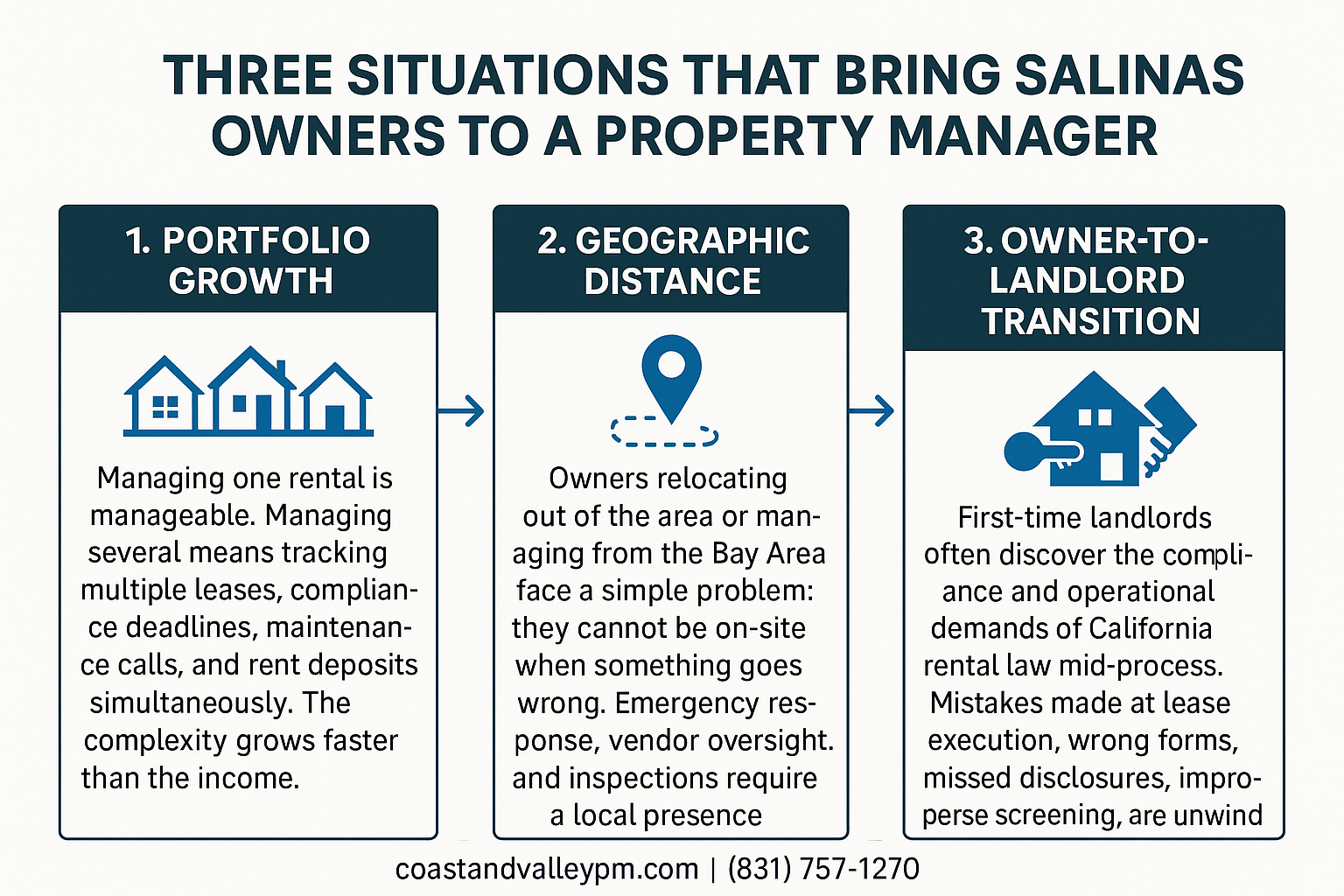
Three Situations That Bring Salinas Owners to a Property Manager
These three scenarios account for the majority of owners who reach out to us. If your situation fits one of them, it is worth understanding what the shift to professional management actually resolves.
Self-Management vs. Professional Management: Where the Work Actually Falls
This is not an exhaustive list, but it covers the tasks that consume the most time and carry the most legal exposure for self-managing owners in Salinas.
| Task | Self-Managed Owner | Professional Manager |
|---|---|---|
| Rent Stabilization Compliance | Owner tracks manually, files annually | Handled as part of ongoing management |
| AB 2493 Screening Process | Owner must sequence applications correctly | Documented, compliant process every time |
| Maintenance Coordination | Owner fields calls, vets vendors, follows up | Established vendor network, owner notified of outcomes |
| Move-In Condition Report | Often incomplete or informal | Photographed, documented before keys are handed over |
| Financial Reporting | Receipts, bank statements, spreadsheets | Monthly owner portal reports, organized year-round |
| Emergency Response | Owner’s personal phone, any hour | 24/7 coverage handled by the management team |
| Lease Execution | Owner sources forms, may miss local requirements | Current California and Salinas-specific lease documents |
What the Transition to Professional Management Actually Resolves
When owners describe what they want to stop dealing with, they are rarely vague. The phone calls at odd hours. Not knowing if a vendor actually finished the job. Wondering whether a rent increase is legally defensible. Those are the specific things that wear people down.
Here is what changes when professional management takes over:
- The tenant calls stop coming to the owner’s personal number. All communication routes through the management team. That alone is worth the conversation for most owners we talk with.
- Compliance deadlines get handled. Registration renewals, required notices, legally compliant rent increase letters, and inspection schedules are tracked as part of the service, not left to the owner to calendar.
- Maintenance has a documented chain. Vendors are vetted, bids are collected, work is inspected before payment is released, and the owner gets a record of everything.
- Financial reporting is organized. Instead of a folder of receipts at tax time, there is a monthly statement waiting in an owner portal that covers rent collected, expenses paid, and current balances.
Several owners who have reached out specifically mentioned wanting to review a management agreement before deciding to move forward. That is a reasonable ask. We operate under a formal written agreement that outlines exactly what is covered, how maintenance authorizations work, how funds are handled, and what either party’s obligations are. If you want to understand what a property management agreement actually says and what to look for, that article walks through the key provisions in plain language.
For owners managing multiple units, the complexity multiplies with each door added. The article on managing a multi-unit property in Salinas is a useful read for anyone approaching that inflection point. And if you are already leaning toward making a change, the piece on switching to a property manager in Salinas explains what that transition actually looks like step by step.
The Time Cost Is Real, and It Compounds
I want to be direct about something that does not always show up in conversations about property management: the time cost of self-management is not static. It compounds as the property ages, as the tenant population turns over, and as California law continues to evolve.
A 2024 study from the National Association of Residential Property Managers found that property management is among the most regulated business activities in most states, with California consistently ranked among the most complex jurisdictions for rental compliance. That complexity does not decrease year over year.
For an owner who has been managing the same tenant and the same property for several years, the workload can feel manageable. But the moment a vacancy opens, a maintenance issue escalates, or a new ordinance takes effect, the full weight of self-management shows up quickly. Owners who have been through a difficult tenant situation or a costly compliance mistake almost universally describe the experience the same way: they did not realize how much they were carrying until something went wrong.
Frequently Asked Questions About Property Management in Salinas, CA
How do I know if my Salinas property is covered by rent stabilization?
Generally, multi-family properties with two or more units built before February 1, 1995 are covered under Salinas’s Rent Stabilization Ordinance. Single-family homes and condos are typically exempt, but there are nuances. If you are unsure whether your property qualifies, the safest move is to confirm directly with the City of Salinas or with a licensed property manager who knows the ordinance well before you set any rent or send any increase notice.
What happens if I miss the annual rental registration deadline in Salinas?
Missing the registration deadline for a covered unit creates real legal exposure. Penalties can include fines, and if an overcharge of rent is later discovered, California law allows tenants to seek damages of up to three times the overcharged amount. Staying current with registration is not optional for covered properties.
Can I manage my Salinas rental from out of state?
Technically yes, but practically it is very difficult. California law requires timely responses to maintenance requests, 24-hour emergency availability, and in-person inspections at various points in the tenancy. Without a local representative who can be on-site when needed, an owner managing from a distance is almost always one incident away from a compliance problem or a tenant dispute they cannot resolve quickly.
What does a property management agreement typically cover?
A management agreement generally outlines the scope of services, how maintenance authorizations work, the fee structure, how funds are collected and disbursed, the duration of the contract, and termination provisions. It should also specify who handles legal matters and at whose expense. If you want a detailed breakdown of what to look for, the article on what a property management agreement actually says covers this in depth.
Is professional property management in Salinas worth the cost?
That depends on what self-management is actually costing you in time, stress, and risk. Owners often undercount the hours spent on maintenance coordination, compliance tracking, and tenant communication. When you add in the potential cost of a single compliance mistake or a contested deposit, the math on professional management often looks different than it did at the start. Fees vary based on the scope of services and the property type, so the only way to get an accurate number for your specific situation is to have a direct conversation.
Ready to See What Professional Management Would Actually Look Like for Your Property?
We have worked with property owners across Salinas and Monterey County since 2009, and we are happy to walk through your specific situation before you make any decisions. If you would like to review a management agreement, get a sense of what your property might rent for in the current market, or simply understand the process, reach out to Coast & Valley Properties directly at (831) 757-1270 or through the contact form at coastandvalleypm.com.