What Property Management Fees Actually Cover, and What They Don’t
Direct Answer: Most California property management fee structures include a monthly management fee, a leasing fee when a tenant is placed, and sometimes renewal, inspection, or maintenance coordination charges. Percentages vary by property.
Almost every owner who reaches out to us opens with the same question: what does it cost? I see it in our contact form submissions constantly. One owner with several rental units in Salinas wrote in asking about fee structure and management agreement terms before anything else, and honestly, that is a fair place to start.
But the monthly management fee percentage is rarely the whole picture. Owners who compare firms on that single number often get surprised six months later when a leasing fee or a vendor markup shows up.
This article is not a pitch. It is a breakdown of how fee structures generally work in California so that when you sit down with any firm in Monterey County, you know exactly what to ask.
The Monthly Management Fee Is Only One Line Item
The monthly fee is usually a percentage of collected rent, and in California it is typically quoted as a range rather than a flat number. What drives that range is more interesting than the number itself.
From what I see across Monterey County, the factors that move a quote up or down include:
- Property type. A single family home in Pacific Grove takes different work than a four unit building in Salinas.
- Door count. Owners with small portfolios often see different pricing than single property owners.
- Condition and age. An older home with deferred maintenance generates more service calls.
- Location. A property in King City or Greenfield involves different drive time than one on the Peninsula.
- Scope. Bill payment for mortgage, utilities, insurance, and property taxes is a different level of service than rent collection alone.
That is why we do a 45 minute to one hour walkthrough before quoting anything. A firm that gives you a number over the phone without seeing the property is guessing.
If you want the wider view of what falls inside a management scope, we covered that in what full-service property management actually covers.
The Leasing Fee Causes the Most Sticker Shock
This is the one that catches people. The leasing fee is charged when a new tenant is placed, and in California it is commonly structured as one month’s rent or a percentage of it.
Market reporting generally puts average rent in Salinas somewhere around $2,000 a month, and higher on the Peninsula. So a one month leasing fee is not a rounding error. It is a real number that hits at the start of a tenancy, which is also when your property has been vacant and producing nothing.
Here is what that fee usually pays for on the front end:
- Marketing and advertising the listing
- Unlimited showings
- Screening applications for credit, rental history, and employment
- Owner review of applications before a decision
- Lease execution and negotiation
- A documented move-in evaluation with photos
- Collection of the security deposit and first month’s rent
Ask every firm you evaluate three things: how the leasing fee is calculated, when it is charged, and whether anything similar applies at lease renewal. Some firms charge a smaller renewal fee. Some charge nothing. The agreement should say plainly which it is.
California is also tightening disclosure rules around rental fees generally, with AB 747 requiring mandatory fees to be shown upfront in rental listings. That tells you where the state’s attention is headed for the whole industry.

Common California Fee Types and What to Ask About Each
Not every firm charges all of these, and not every firm brings them up in the first conversation. Use this as a checklist when you interview anyone.
| Fee Type | What It Generally Covers | Question to Ask |
|---|---|---|
| Monthly management fee | Rent collection, tenant communication, maintenance supervision, reporting, emergency availability | Is it charged on collected rent or scheduled rent, and is it charged during vacancy? |
| Leasing fee | Marketing, showings, screening, lease execution, move-in documentation | Is it one month’s rent or a percentage, and when is it billed? |
| Lease renewal fee | Renewal paperwork, rent review, compliance updates under current law | Do you charge one at all, and how is the renewal rent set? |
| Inspection fee | Periodic or annual property inspections with documentation | Is an annual inspection included in the monthly fee or billed separately? |
| Maintenance coordination | Sourcing vendors, scheduling, verifying the work before payment | Is there a markup on vendor invoices, a flat coordination fee, or neither? |
| Legal and eviction costs | Attorney retention, filings, court appearances | Are these at my expense, and who selects counsel? |
Six Questions Every Owner Should Ask Before Signing
If you only remember one part of this article, make it this list. These six questions surface almost every fee that would otherwise show up later.
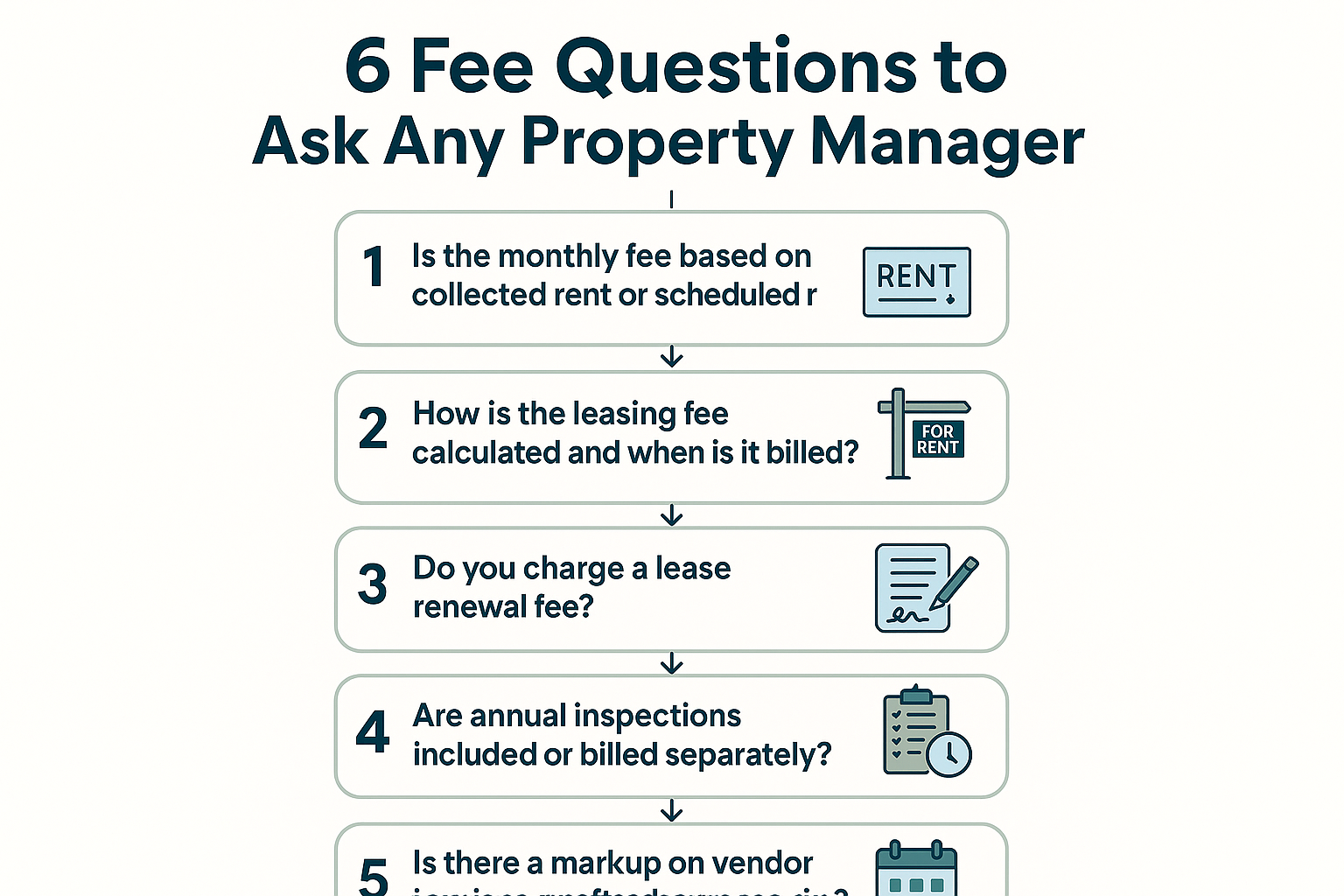
Maintenance Coordination Is Where Costs Vary Most
Two firms can quote the same monthly percentage and end up costing very different amounts over a year, and maintenance is usually the reason.
Some firms add a markup on vendor invoices. Some charge a flat coordination fee per work order. Some charge neither and simply pass the invoice through. None of those approaches is wrong on its own, but you should know which one you are agreeing to.
After hours work is the part owners underestimate. Any owner who has self-managed knows that an emergency plumber on a Saturday night can run two to three times the normal rate. If your management agreement is silent on how after-hours calls are handled and billed, get that clarified before you sign.
A few things worth confirming in writing:
- The dollar threshold above which you must approve a repair
- Whether the firm inspects completed work before releasing payment
- Whether vendors are licensed, insured, and carry a current W-9 on file
- How emergency calls are routed after business hours
We review estimates, oversee the work, and check it before payment goes out, because the alternative is paying twice for the same repair. Owners weighing this against doing it themselves may want to read what Salinas property owners get wrong about self-managing.
What Management Fees Do Not Cover
This is the half of the conversation that gets skipped. Management fees pay for management. They do not pay for the property itself.
In most California agreements, these remain owner expenses:
- Repairs and materials. The vendor invoice is yours.
- Capital improvements. Roofs, HVAC replacement, and remodels are ownership costs.
- Legal fees. Attorney retention for an eviction or dispute is typically at the owner’s expense.
- Turnover work. Paint, carpet, and deep cleaning between tenants.
- Insurance, taxes, HOA dues, and utilities. We can pay these from your funds, but the money is still yours.
One more thing owners often do not realize: managing rentals for others in California is licensed activity. Under the California Department of Real Estate, that work generally requires a real estate license, and our firm is broker-owned. If a company cannot answer who holds the license, that is a bigger issue than the fee schedule.
Before signing anything, read the agreement itself. We walked through the clauses that matter in what a property management agreement actually says, including term length and exit terms.
Frequently Asked Questions About Property Management Fees in California
Do property managers charge a fee while my unit is vacant?
It depends entirely on the agreement. Many California firms base the monthly fee on rent actually collected, which means no rent, no fee. Others charge a reduced flat amount during vacancy. Ask directly and get the answer in writing.
Why won’t you quote a price over the phone?
Because a quote without seeing the property is a guess. We do a walkthrough of 45 minutes to an hour, look at condition, amenities, and comparable rents, and then give you a specific range. For a number on your property, the office line is (831) 757-1270.
Is a lower monthly percentage always the better deal?
Not usually. A firm with a low monthly rate and a full month leasing fee, a renewal fee, an inspection fee, and a vendor markup can cost more over a two year hold than a firm with a higher percentage and nothing else. Compare the total, not the headline.
How long am I locked into a management agreement?
Terms vary by firm. Ours runs annual for the first year and then converts to month-to-month. Always ask about the exit clause and the notice period before you sign.
Do commercial properties use the same fee structure as residential?
No. Commercial management pricing is generally built around the services the property needs, since lease compliance, budget preparation, 1099 handling, and vendor contract oversight look different than residential work.
Want a straight answer on what management would cost for your property?
Every property in Monterey County prices differently, from a Carmel cottage to a four unit building off Main Street in Salinas, so we look at the property before we quote it. Coast & Valley Properties handles consultations by phone at (831) 757-1270 or through the contact form at coastandvalleypm.com, and we are happy to walk through the full fee schedule line by line so nothing surprises you later.