Moving Out of State and Renting Out Your Salinas House: What to Line Up First
Direct Answer: Start about 90 days before you move. Time the listing to the local leasing season, fix what a tenant will not tolerate, set up rent and insurance accounts locally, then document the house before you leave.
Most of the owner inquiries I get about this start the same way. Someone writes to say they are moving out of Salinas to another state in late June and want to rent out the house, or that they are leaving in the next six months and are not sure where to begin.
The move date is usually set. The house is not ready, the paperwork is not sorted, and the owner is about to be 1,500 miles away when the first maintenance call comes in.
So here is how I walk owners through it, laid out as a timeline: what to handle at 90 days, at 60 days, at 30 days, and in your final week in the house. Do these in order and the move gets a lot quieter.
Step 1: Time Your Listing Against the Local Leasing Calendar (90 Days Out)
Rental demand in Monterey County is not flat across the year. Applicant volume concentrates from late spring through summer, pushed along by the school calendar in the Salinas Union High School District and by summer job relocations across the valley and the Peninsula.
It thins out sharply from late November into the holidays. Fewer people move in December, and the ones who do are usually moving because they have to.
That means your departure date changes the plan:
- A June or July departure: you are listing into the busiest stretch of the year. You can expect a deeper applicant pool and a shorter marketing window, so the house needs to be genuinely ready, not almost ready.
- A November or December departure: plan for more days on market and a slower trickle of showings. Some owners in this spot choose a shorter first lease so the next turnover lands in summer instead of midwinter.
- A move that lands in February or March: demand is building but has not peaked. Pricing tends to matter more here than it does in July.
If you have any flexibility at all on your move date, this is the one variable worth bending. Two weeks of timing can be worth more than any single repair on your list.

Step 2: Separate What You Tolerated From What a Rental Has to Be (90 Days Out)
This is the step owners skip, and it causes more trouble than anything else on this list. The things you quietly lived with for ten years become disputes the moment someone else is paying rent.
I have seen local tenant accounts of Salinas houses where an unfound irrigation leak turned into months of arguing over water bills that ran into the hundreds. Nobody caught it before move in, so it became a fight instead of a repair.
Walk the house like a stranger and look hard at:
- Irrigation and hose bibs. A leaking valve or a cracked lateral line shows up as a spiking water bill, and in Salinas water is billed separately from rent in most single family homes. Run every zone and watch the ground.
- The dryer vent. A dryer that vents into a crawl space instead of outside is a lint and fire problem, not a quirk. Confirm where it actually terminates.
- The water heater. If it is near the end of its service life, replace it now on your schedule, not at 11pm in February on somebody else’s.
- Locks. Rekey everything. Assume there are keys out there you forgot about.
- Windows and slider hardware. Sticky latches and broken window locks are habitability and safety items, not cosmetic ones.
- Smoke and carbon monoxide alarms. California requires working alarms in rentals, and this is an easy one to get wrong.
California’s warranty of habitability sets a floor, and it does not care that you lived with the problem happily for years. Fixing these in April is a scheduled expense. Fixing them in August is an emergency call plus an unhappy tenant.
The 90 Day Timeline at a Glance
Here is the sequence I give owners who are leaving Monterey County. The order matters more than the exact dates.
| Timeframe | What to Handle | Why It Matters |
|---|---|---|
| 90 days out | Set your listing window, run a full condition walkthrough, get repair bids | Vendor scheduling in the Salinas Valley takes weeks in busy season |
| 60 days out | Bank account, insurance change, utility decisions, rental registration | Almost all of this is easier with a local address and in person ID |
| 30 days out | Decide placement only versus ongoing management, set rent range, prep marketing | Showings and screening have to start before you leave, not after |
| Final week | Photo and video record, serial numbers, keys, signed condition report | This file settles the deposit conversation two or three years later |
Step 3: Build the Money and Paperwork Trail While You Still Live Here (60 Days Out)
A lot of this is far simpler to do in person with a California ID and a local address. Once you are out of state, the same tasks turn into notarized forms and hold music.
Get these sorted before you go:
- A dedicated bank account for rent deposits and property expenses. Mixing rental money into your household checking makes your tax return miserable.
- A written decision on utilities. Who pays water, sewer and trash, in writing, in the lease. In Salinas these are separate bills from separate providers, and vague language here is how disputes start.
- Insurance. Call your carrier and switch from a homeowner policy to a landlord policy. A standard homeowner policy is not written for a tenant occupied house, and finding that out after a claim is a bad day. Costs vary by carrier and coverage, so ask for the specific quote rather than assuming it is a wash.
- Mail forwarding through USPS, plus a plan for anything that still gets delivered to the house.
- Property tax records, permits, warranties and receipts collected into one file, digital if possible.
- Keys. Decide now who physically holds spares once you are gone. Not a neighbor who might move. Someone with a documented reason to have them.
One more Salinas specific item: the city adopted a Residential Rental Registration Ordinance (City Ord. 2663, 2024), so registration is part of the picture for rental housing inside city limits. Rules around rent and just cause under AB 1482 may also apply to your property, and Salinas rent ordinances have been heading to voters, which is worth tracking before you set a lease term.
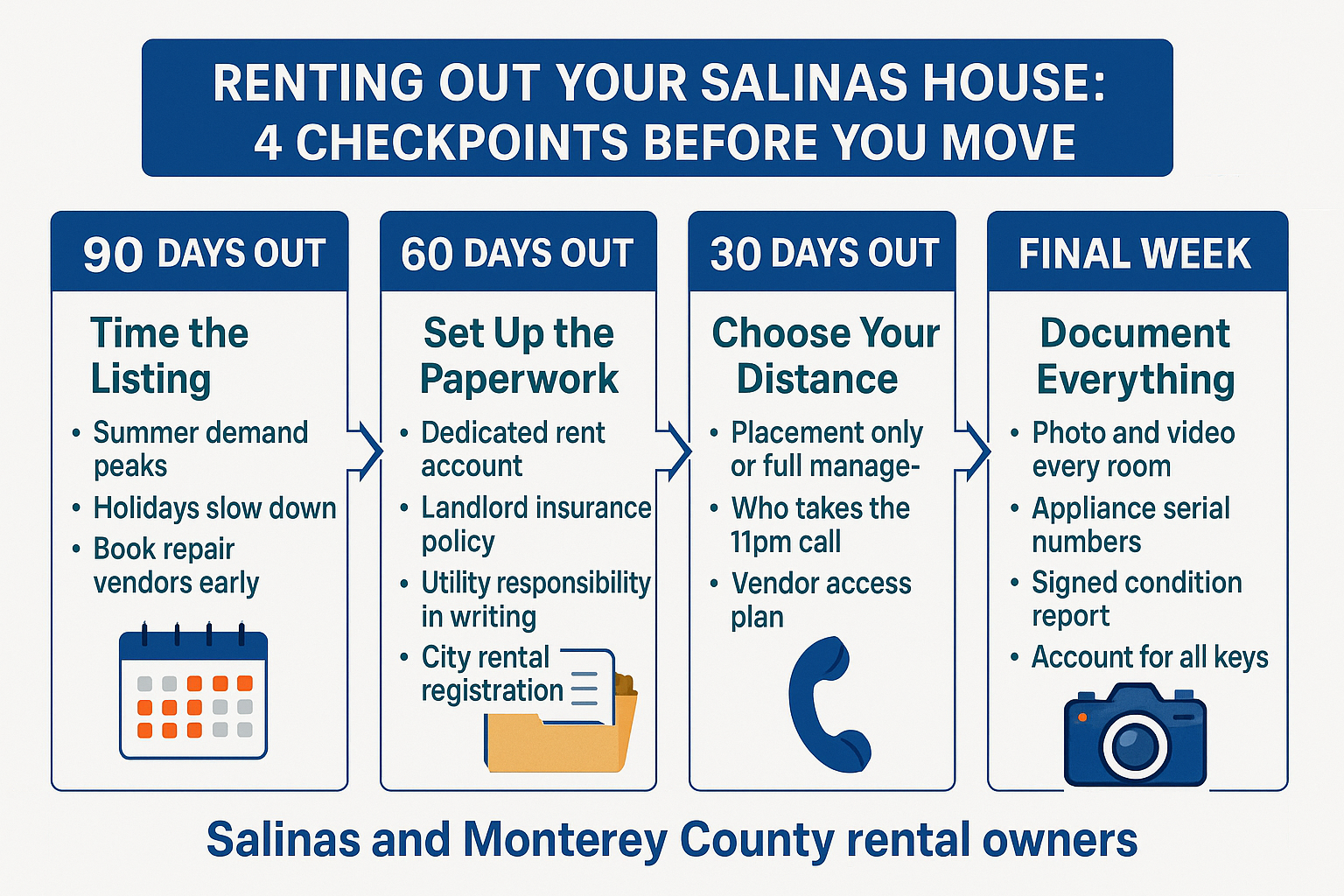
The Four Checkpoints Before You Leave
This is the same timeline in visual form, useful if you are juggling a move date and a listing date at the same time.
Step 4: Decide How Much Distance You Can Actually Absorb (30 Days Out)
There are two real choices here, and owners tend to pick one based on the task list when they should be picking based on the time zone.
The first option is placement only. Someone markets the house, runs showings, screens applicants through credit, background, rental history and employment verification, negotiates the lease, does the move in evaluation with photos, and collects the deposit and first month’s rent. Then the keys and the responsibility come back to you.
The second is ongoing management, where the same team stays on for rent collection, maintenance coordination, inspections, emergency response and financial reporting.
Placement only works fine for some owners. It gets hard when you are three time zones away and:
- The water heater fails on a Saturday night and someone has to authorize a vendor before the floor is ruined.
- A plumber needs access at 9am Tuesday and you are in a meeting in Charlotte.
- A mid lease inspection is due and there is nobody to walk the property.
- The tenant gives notice and showings have to start within days.
- Something goes wrong at 11pm and yours is the only phone number the tenant has.
I have watched owners handle the task list fine and get worn down by the clock. A 10pm call in Salinas is 1am on the East Coast. Do that four times in a year and the calculation changes. If you are weighing it, the real workload behind a single rental home and how placement only compares to full management are both worth reading before you commit.
Step 5: Document the House on Your Last Day (Final Week)
Your last day in the house is the single most valuable hour of this entire process. Once the rooms are empty and clean, record everything.
Build one file that contains:
- Photo and video of every room, plus closets, the garage, the yard, fences, the roofline and the driveway. Date stamped.
- Appliance model and serial numbers, photographed straight off the labels.
- Warranty paperwork for the roof, HVAC, water heater and any recent appliance.
- Paint colors and finishes, brand and code, not “the beige from the hardware store.”
- A key inventory: how many exist, who has them, which doors they open, plus garage remotes and mailbox keys.
- A signed condition report completed with the tenant at move in.
This file is what settles a deposit conversation two or three years from now, when nobody remembers what the baseboards looked like. California limits what a landlord can deduct from a security deposit and requires an itemized statement, and the California Courts self help guide on security deposits is a straightforward read on how that works.
Owners who skip this step almost always lose the argument later. Not because they are wrong, but because they cannot prove they are right.
Frequently Asked Questions About Renting Out a Salinas Home From Out of State
How far ahead should I start if I am moving in six months?
Six months is comfortable. Use the first couple of months for repairs and vendor scheduling, since good trades in the Salinas Valley book out weeks ahead in busy season, then move into paperwork at the 60 day mark. Starting late is what forces owners to list a house that is not ready.
Can I manage the property myself from another state?
You can, and some owners do it well, usually because they still have family locally and a plumber they trust. The two things that break it are after hours emergencies and vendor access. If you have no one who can meet a contractor at the door on a weekday, self managing from a distance gets expensive fast.
What rent can I expect for my Salinas house?
It depends on the neighborhood, the bedroom count, condition, parking, yard and whether utilities are included, and the number moves with the season. A rent range should come from a walkthrough and current comparable listings, not from an online estimate. That is a conversation worth having in person before you leave.
Do I need to register my rental with the City of Salinas?
The city adopted a Residential Rental Registration Ordinance (City Ord. 2663, 2024) covering rental housing inside city limits. Requirements and deadlines change, so confirm your specific property’s status with the city rather than assuming.
Should I just sell instead?
That is a fair question and it deserves real math, not a gut call. Holding costs, your tax basis, the condition of the house and how long you plan to be gone all factor in. We wrote a separate piece on how to think it through.
Planning a Move Out of Monterey County?
One thing that helps before a move is having someone walk the property with you while you are still standing in it. A licensed local agent can meet you at the house, give you a rent range and a rent ready punch list in a single visit, and answer the utility and registration questions specific to your address. After you are out of state, emergencies and financial reporting run through an owner portal you can check from anywhere. If that would be useful as you plan your timeline, Coast & Valley Properties is at (831) 757-1270 or coastandvalleypm.com.