Reading Property Management Reviews When Most Reviewers Are Tenants
Direct Answer: Most public property management reviews come from tenants and applicants, not owners. Read them for responsiveness and operations, not for rule enforcement complaints, and weigh the last 12 to 18 months most heavily.
Almost every owner I speak with has already looked us up before the phone rings. They type a company name plus “reviews”, read the first page of results, and treat it like a report card on how that firm treats property owners.
That page is measuring something else entirely. In this business, public reviews are written overwhelmingly by tenants and rental applicants, so an owner making a six-figure decision is reading a tenant satisfaction survey.
I am not going to tell you to ignore reviews. I am going to show you how to read them the way I would if I were handing over a house in Carmel or a fourplex off Alisal Street, and what to ask for once the stars run out of useful information.
Who Is Actually Writing Property Management Reviews in Salinas
Look at the math behind any local management firm. A company with a few hundred doors under management is serving maybe 50 to 100 owners and interacting with hundreds of residents and applicants every single month.
The contact volume is not close. A tenant deals with a management office through applications, showings, rent portals, maintenance calls, rule notices, and a move-out inspection. An owner usually sees a monthly statement and a couple of phone calls a year.
Reviews also get written at moments of friction, not moments of routine. The people most motivated to post publicly are the ones who just got:
- A rental application denied or delayed
- A deposit statement with deductions on it
- A notice about trash, parking, or pets
- A rent increase, even a legal one under AB 1482
Owners, meanwhile, almost never post. A quiet property with rent hitting the bank on the same day each month does not create the urge to write a paragraph on Google. So the visible record skews toward the group with the most contact and the most friction, and the owner reading it has to translate.

Sort Enforcement Complaints From Responsiveness Complaints
Read enough reviews of Monterey County management firms and the same four complaints show up over and over. Three of them describe a policy that exists to protect the owner. One of them is a genuine warning sign.
Deposit deductions at move-out. California requires an itemized written statement within 21 days of move-out under California Civil Code 1950.5. A firm that documents damage in writing and charges for it is doing the thing you would want done with your own hardwood floors. A firm that returns everything without a walkthrough is spending your money.
Application fees. Screening costs real money. Application fees in this market commonly land somewhere in the $40 to $60 range depending on the credit and background provider, and policies about when they get collected vary widely from office to office. Ask about the policy directly instead of guessing from a one-star post.
Parking, trash, and rule enforcement. Nobody enjoys getting a notice. But rule enforcement is exactly what keeps a multi-unit property in Salinas from turning into a turnover machine.
Slow maintenance response. Pay close attention here. Delayed repairs feed straight into California’s warranty of habitability, and unrepaired leaks, plumbing, and safety items are how a manageable $400 repair becomes a $6,000 problem plus a vacancy. Complaints about calls not returned and repairs left open are the ones that predict how a firm will treat your property. Read them closely, and read the firm’s replies for whether the specifics are addressed or dodged. How a company communicates with owners and tenants is one of the few things a review set genuinely reveals.
What Each Complaint Category Actually Tells an Owner
This is the sorting I do in my head when I read a competitor’s review page or my own. Not every one-star review points at a problem you would care about.
| Complaint in the review | What it usually reflects | What it means for an owner |
|---|---|---|
| Deposit deductions itemized at move-out | Documented condition report and legal 21-day statement | Generally a good sign, the asset is being protected |
| Application fee charged before a tour | Screening cost and showing policy | Neutral, ask about the policy directly |
| Parking, trash, or yard rule notices | Lease enforcement on a shared property | Generally a good sign, protects value and neighbors |
| Repairs left open, calls not returned | Weak maintenance coordination or staffing | Real red flag, habitability and turnover risk |
| Application sat for weeks with no update | Slow processing or thin communication | Real concern, slow leasing means longer vacancy |
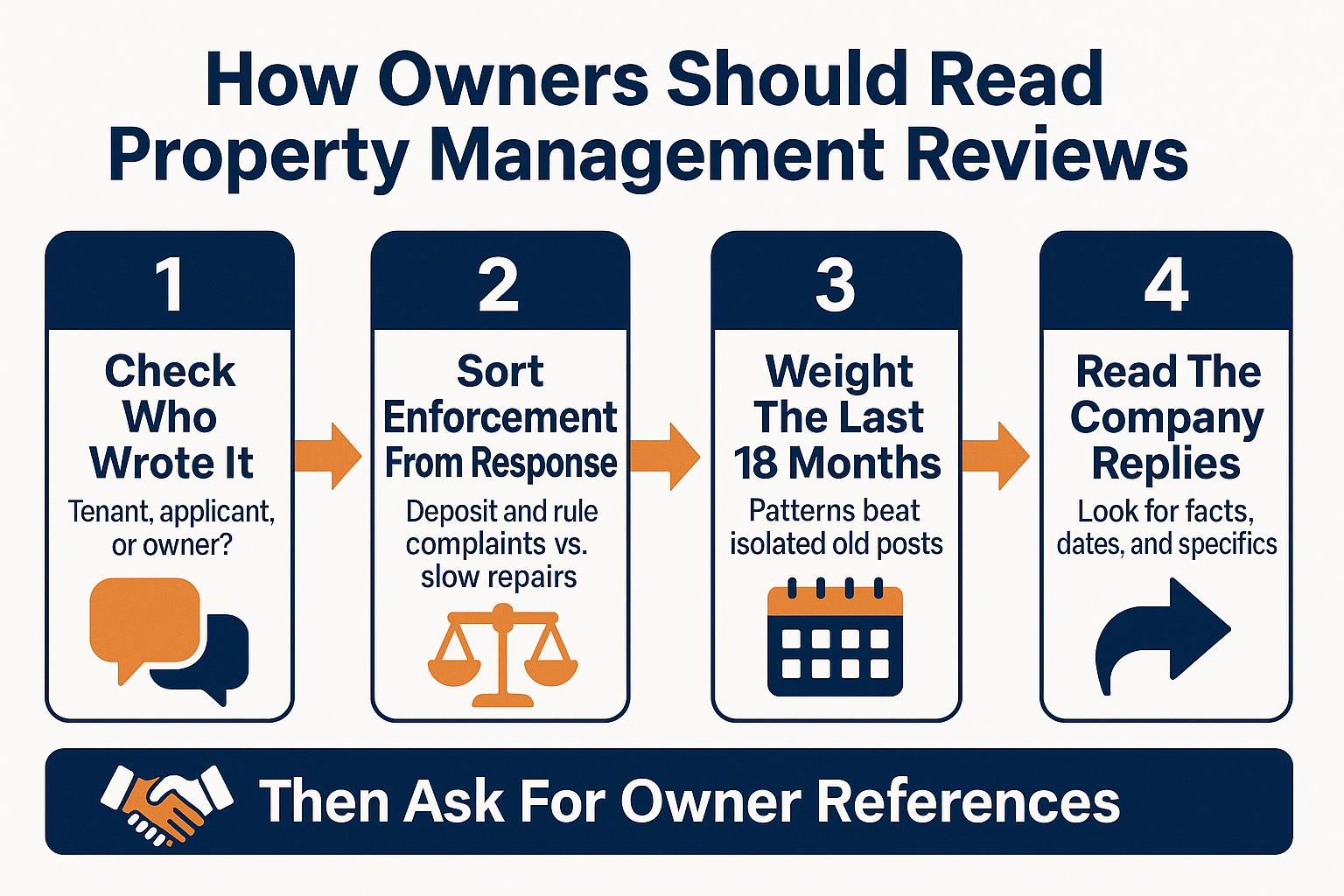
A Four-Step Filter for Reading a Review Page
Here is the sequence I would use before letting a star average influence a decision about a property worth several hundred thousand dollars or more.
Volume and Recency Matter More Than the Star Average
Here is the part most owners miss. Plenty of management firms on the Central Coast carry fewer than three dozen reviews spread across ten years or more.
At that sample size, the average is fragile. Three unhappy move-outs in a single summer can drag a visible rating down by more than a full star, and it will sit there for years even if the office fixed the underlying issue in month two.
So read chronologically instead of by rating:
- Sort by newest and read everything from the last 12 to 18 months first
- Ask whether the recent complaints are the same complaint or five different ones
- Treat a cluster of similar recent posts as a real pattern
- Treat an isolated complaint from 2019 as history, not a forecast
- Notice whether the company replies at all, and whether replies cite dates, lease terms, or documented facts
A reply that stays factual and specific tells you the office keeps records. A reply that argues in generalities tells you something too. Both are more informative than the number at the top of the page.
The Reviews That Actually Carry Owner Information
Some tenant reviews are gold for an owner, because they describe the exact operational machine you would be handing your property to. I read closely whenever a review mentions:
- How fast the phone gets answered and whether questions get real answers
- Leasing speed, how quickly a unit went from listing to signed lease
- Electronic paperwork, portals, online applications, and online rent payment
- Inspection quality, move-in and move-out walkthroughs with photos
- Staff by role, office staff, maintenance coordination, or the broker
One local review put it simply: “These ladies are really efficient, friendly and very knowledgeable” (Mauricio M.). Another said the office staff answer any question quickly. Neither reviewer was an owner, and neither meant to write anything about asset management. But efficiency and quick answers at the front desk are the same qualities that get your vacancy filled in Pacific Grove in three weeks instead of nine, and that keep a repair from sitting unaddressed.
That is the translation exercise. A tenant describing a well-run office is describing your future experience, just from the other side of the counter. This is also why understanding what full-service management actually covers matters more than the rating on any single platform.
Four Things to Ask For Instead of Reading Stars
Owners fall back on star ratings for a reason. Most property management websites on the Central Coast publish a bullet list of services and nothing else. No process detail, no sample reporting, no explanation of how maintenance approval works or when funds get disbursed.
That vacuum is the real problem. Fill it with direct questions instead:
- Ask for owner references specifically. Not tenant references, not a general testimonial page. Two or three current owners with properties like yours.
- Ask how long the average owner has stayed under management. Long owner tenure is the closest thing this industry has to an honest review score.
- Ask to see a sample monthly statement. You want to see how income, expenses, and reserves are laid out before you agree to anything.
- Ask for a live walkthrough of the owner portal. Have them log in and show you where the statements, invoices, and inspection reports live.
Then ask two Monterey County questions. How does the firm handle AB 1482 rent cap and just cause requirements, and how are they tracking the City of Salinas Residential Rental Registration Ordinance adopted in 2024? A firm that answers both without hesitating knows this market. It also helps to understand what a management agreement actually says before you sign, and how property management fees are structured in California.
Frequently Asked Questions About Property Management Reviews in Salinas
Why do property management companies have such low star ratings compared to other local businesses?
Because the reviewers are mostly tenants and applicants, and the review-writing moments are usually friction moments like a denied application, a deposit deduction, or a rule notice. A restaurant gets reviewed by happy customers. A management office gets reviewed by the person who just got a move-out statement. Owners, who are the actual clients, rarely post at all.
Should I be worried if I see complaints about deposit deductions?
Usually the opposite. California requires an itemized statement within 21 days of move-out, and deductions for real damage are how your property gets restored without you paying for it. What I would look at is whether the deductions sound documented, and whether the firm mentions move-in photos and a written condition report.
How many reviews are enough to trust a rating?
There is no magic number, but be cautious with anything under about 40 reviews spread over many years. At that sample size a couple of bad months can move the average more than a full star. Read the newest 15 posts instead and look for repeated themes.
Are there review sites that show owner feedback specifically?
Not reliably. Google, Yelp, and similar platforms do not separate owners from tenants, and most owner feedback in this industry happens privately or through referrals from other property owners, attorneys, and real estate brokers. That is exactly why asking for owner references beats scrolling further.
What is the single biggest red flag in a review set?
Repeated, recent complaints about unreturned calls and repairs left open. Enforcement complaints tell you the firm has standards. Responsiveness complaints tell you your emergency call at 11pm may not get picked up, and that is the one that costs owners money in Monterey County.
Want the Owner Side of the Story?
If you are evaluating management for a property in Salinas, Monterey, Carmel, or anywhere across Monterey County, the questions above are the ones worth asking of anyone you interview. We are always willing to walk an owner through a sample statement, a portal login, and how we handle AB 1482 and Salinas rental registration. Coast & Valley Properties can be reached at (831) 757-1270 or through the contact form at coastandvalleypm.com.