Vetting a Tenant for a Carmel Home When There’s No Pay Stub to Check
Direct Answer: When an applicant has no pay stub, verify income with two years of tax returns, business bank statements, a CPA letter, or documented assets and reserves, checked against written criteria you set beforehand.
An applicant walks through your Carmel home, says all the right things, and hands over an application with a high credit score and no pay stub. She owns a business. His income shows up as distributions a few times a year, not every other Friday.
This is the normal situation on a Peninsula home, not the exception. And the real fear I hear from owners is not a stranger with bad credit. It is the polished applicant who signs the lease and quietly runs out of room by month four.
So let me walk through what actually stands in for a pay stub, what each document proves, and how to judge all of it the same way every single time.
Why Pay Stubs Rarely Show Up on a High-Value Monterey Peninsula Application
General market data puts a three-bedroom rental in Monterey County somewhere around $4,407 a month, with four-plus bedrooms closer to $4,766. Figures like that move, and your home may sit well above them. But they tell you something useful: a Carmel, Pebble Beach, or Pacific Grove house lives in a bracket where the applicant pool is thinner and far less conventional than the apartment market.
The people who can carry that rent usually do not collect a W-2 from a single employer. In my experience they tend to fall into a handful of groups:
- Business owners who pay themselves irregularly
- Retirees drawing from investments, pensions, or a trust
- Executives relocating mid-year who have not started the new job yet
- Households between home purchases, sitting on sale proceeds
- Employees placed by a company that is actually signing the lease
Each one of those requires a different proof. A high credit score and a good first impression are not income verification. They tell you how someone handled debt in the past, not whether this household can pay this rent every month for a year without strain.
That is the only question screening needs to answer. Everything below is about answering it honestly.

What Stands In for a Pay Stub, and What Each Document Actually Proves
Not every document carries the same weight. Some show history, some show capacity, and a few show almost nothing once you look closely.
Here is the set I ask for, depending on the applicant:
- Two years of filed tax returns. The single strongest substitute for a pay stub on a self-employed applicant. Two years shows a trend rather than one good year. Owners can also ask applicants to request their own IRS records directly through the IRS transcript service when returns look incomplete.
- Business and personal bank statements, three to twelve months. These show deposits actually landing, not just reported income. Watch for deposits that stop, or a balance that lives on the edge.
- A letter from a CPA or bookkeeper. Useful as support, weaker as standalone proof, because it is a professional opinion rather than a filed record.
- Asset and reserve verification. Brokerage and retirement statements showing the household could cover the full lease term even if income paused. This matters most for retirees.
- An employer offer letter with salary and a confirmed start date. For relocations, this replaces the pay stub that does not exist yet.
- Proof of funds from a closed or pending home sale. Good for buyers in between houses, but pair it with something showing ongoing income.
I treat tax returns and bank statements as the backbone. The rest fills gaps.
How Much Weight Each Income Document Carries
A quick way to think about the documents landing in your file. Weight depends on how hard the document is to manufacture and how much of the year it covers.
| Document | What It Proves | Where It Falls Short |
|---|---|---|
| Two years of tax returns | Filed, multi-year income history | Lags behind a recent change in business |
| Business bank statements | Real deposits and cash flow rhythm | Gross deposits can overstate take-home |
| CPA or bookkeeper letter | Professional context for odd income | Opinion, not a filed record |
| Brokerage or retirement statements | Reserves to carry the lease term | Values move, and access can be restricted |
| Employer offer letter | Future salary and start date | Job can fall through before move-in |
| Proof of funds from a sale | Cash on hand right now | Says nothing about monthly income |
Written Standards Beat a Gut Read at the Showing
The protection for an owner is a written set of standards agreed on before the listing goes live, then applied the same way to every applicant who comes through the door.
That means settling these questions in advance, in writing:
- The income multiple you expect relative to rent
- The credit thresholds and how you handle thin or no credit files
- Rental history expectations and how far back you verify
- Exactly which documents satisfy a self-employed or retired applicant
- What a complete file looks like before anyone gets an answer
Public review data from denied applicants across this market clusters around the same two grievances: they were never told why an application failed, and their prior landlords were never contacted. Both of those come from inconsistent process, not from bad judgment. Even a sound decision creates friction when nobody can explain how it was reached.
Written criteria are not bureaucracy. They are the record showing every applicant was measured against the same yardstick, with the reasoning sitting in the file. That is also how we stay current with California’s complex and frequently changing rental rules without rebuilding the process on every new listing.
If you want the broader version of how this fits together, we covered how tenant screening works in California and where owners get it wrong in a separate piece.
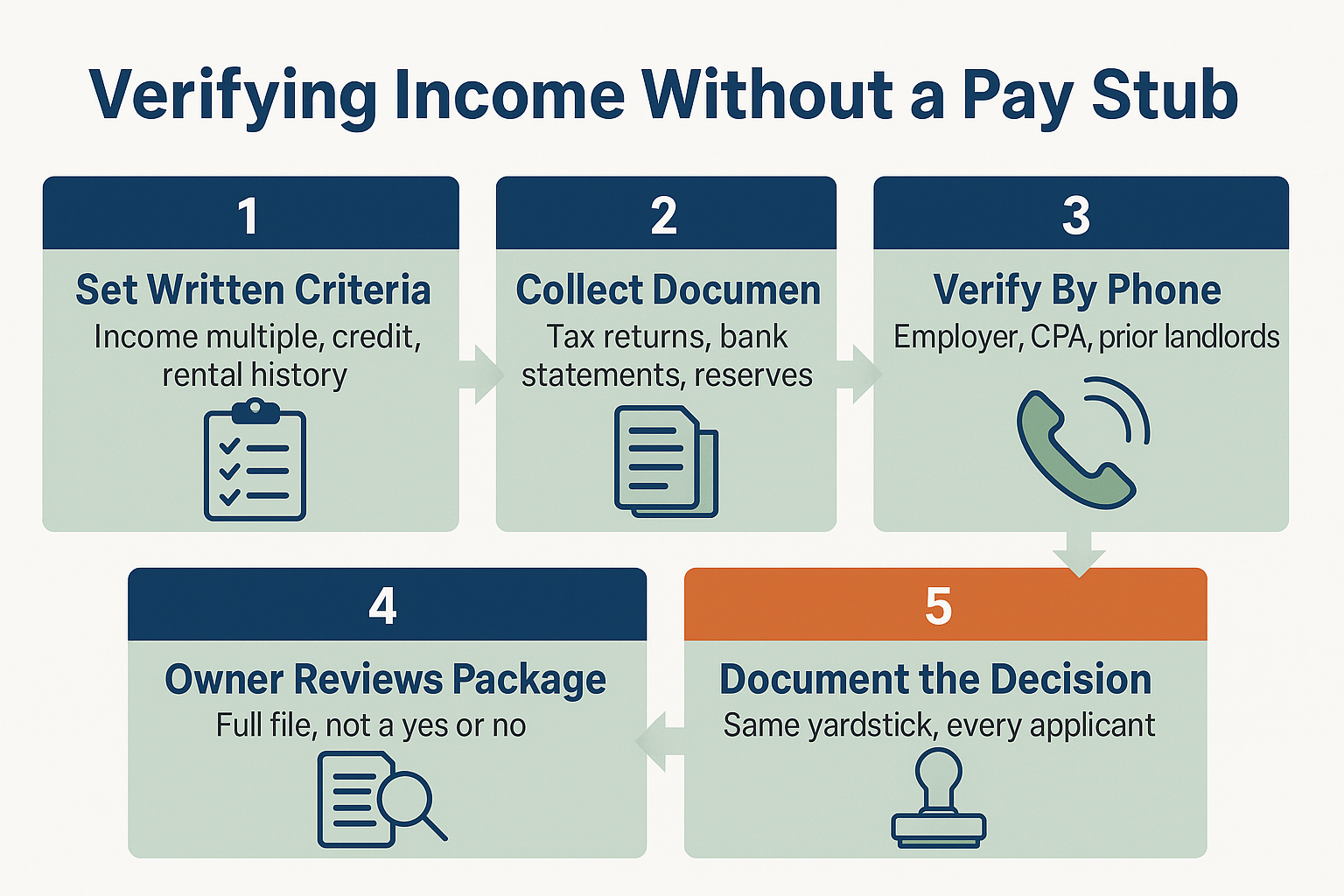
The Verification Sequence, Start to Finish
This is the order I work through an application when there is no pay stub in the file.
Relocations, Corporate Applicants, and Who Actually Signs
The thinner the applicant pool, the more tempting it is to bend the standard for the one person who showed up. The fix is knowing in advance which documents satisfy each type of applicant, so bending never becomes the easy option.
A few situations come up again and again on the Peninsula:
- Employer-sponsored moves. An offer letter plus a start date, and clarity on whether the employer will guarantee the lease.
- A company leasing for employee housing. Owners ask us about this directly. The signing entity, the occupants, and the responsibility for damage all need to be named in writing, which we walked through in leasing a Monterey home to a company.
- Third-party or agent-submitted applications. Find out early who is signing, who is paying, and who is actually living there. Those are often three different answers.
- Trust or estate income. Ask for the distribution records, not a summary letter.
In every one of these, the question is the same: whose name carries the obligation, and what proof supports that name. An occupant with no signature and a signer who never sets foot in the house is a workable arrangement, but only when it is documented from day one.
What a Screening Report Cannot Tell You
A credit file and a background check confirm history. They do not confirm behavior.
No report will tell you whether an applicant gave proper notice to a prior landlord, how the last house looked at move-out, or whether the occupancy and pet situation described at the showing matches what is written on the application. Those answers come from picking up the phone, and from a person who knows which follow-up question to ask when an employer’s receptionist sounds uncertain.
Speed is part of the work too. Renter reviews across this market complain constantly about applications that sit for weeks and follow-up calls that go unreturned. That is a tenant-side grievance with a direct owner-side cost, because a stalled application is a stalled lease, and every extra week of review is another week of vacancy on a house that is expensive to hold.
So the target is both rigor and turnaround. When a finished package lands on your desk, you should be able to answer four things in about five minutes:
- Does documented income or reserves support this rent for twelve months?
- Did a real person reach the employer or verify the business?
- Did prior landlords confirm notice, condition, and payment history?
- Does the application match what was said at the showing?
The Real Price of a Fast Yes
Here is the math in plain terms. The applicant who gets rushed through because the house has been empty for six weeks is usually the one who costs the most.
One wrong tenant on a Peninsula home is not just a disappointing year. It is turnover, a re-list in the slowest leasing season, repair work on a house that was not cared for, and a legal process no owner wants to sit through. We broke the vacancy side of that down in what an empty Monterey County rental actually costs.
Simply holding a California rental has gotten more expensive in recent years, insurance in particular. That leaves a thinner margin for a leasing mistake than owners had a decade ago.
A slower, documented yes is cheaper than a fast one. One Monterey County owner with several units wrote to us that managing everything alone had become increasingly demanding, and screening is usually where that feeling starts. If you have reached a similar point, when self-managing stops making sense covers the decision itself.
Frequently Asked Questions About Income Verification on Peninsula Rentals
How many months of bank statements should I ask a self-employed applicant for?
I like three months at minimum and twelve when the income is seasonal, which describes a lot of business owners in Monterey County. Three months catches current cash flow. Twelve shows you whether the slow season drains the account.
Can an applicant with no income qualify on assets alone?
Sometimes, and it is more common than people think with retirees and recently sold home owners. The standard should be written down in advance: documented, accessible reserves covering the full lease term, verified through actual account statements rather than a summary or a screenshot.
Is a high credit score enough if the documents are thin?
No. A score tells you how someone handled past debt, not whether this household can carry this rent. I have seen excellent scores paired with income that could not sustain a Peninsula lease past the first few months.
Can a company lease a residential home for its employees?
Owners ask us this regularly, and it is workable. The lease needs to name the signing entity, the approved occupants, and who carries responsibility for rent and damage. The verification shifts from personal income to the company’s standing and guarantee.
Do I have to tell an applicant why they were denied?
Treat it as a yes. Clear, consistent communication is what keeps a sound decision from turning into a dispute, and it is far easier when your criteria were written before the listing went live.
Thinking Through a Peninsula Application?
Our screening is handled in house, which means someone here can call a self-employed applicant’s accountant instead of waiting on an automated report, and the owner reviews the full application package before any lease is negotiated. We have been working with Monterey Peninsula and Salinas Valley owners under licensed broker ownership since 2009. If you have questions about verification standards or what management of your property would involve, a conversation at (831) 757-1270 or through the contact form at coastandvalleypm.com is the place to start.