CAM Reconciliation Season: What a Monterey County Commercial Owner Should See
Direct Answer: A CAM reconciliation compares what a commercial tenant paid in estimated common area charges all year against what the building actually spent, producing either a credit or a balance due.
It is October. Your tenant’s lease renews after the first of the year, and somewhere in the back of your mind is a quiet question you have not asked out loud: what exactly is the year-end accounting supposed to produce, and will it hold up if the tenant pushes back?
I get this call every fall from owners of small retail strips, office suites, and light industrial buildings around Salinas and the Peninsula. They have been collecting a monthly CAM estimate all year. They are not entirely sure what happens next.
This article walks through what a CAM reconciliation commercial lease arrangement should actually produce, the reports you should be able to pull up without phoning anyone, and the fall work that decides whether January is calm or expensive.
What a CAM Reconciliation Actually Is
CAM stands for common area maintenance. Through the year, your tenant pays an estimated monthly share of the costs of running the building: landscaping, parking lot upkeep, common area lighting, trash, insurance, and whatever else the lease folds in.
At year-end, those estimates get compared against what the building really spent. The gap goes one of two directions:
- The tenant overpaid, and gets a credit applied or refunded.
- The tenant underpaid, and gets a true-up bill for the difference.
- The two land close together, which is what a well-set estimate looks like.
Here is the part owners are often surprised by. None of this is driven by an outside rule. It is driven entirely by the language in your lease. The definition of recoverable costs, the exclusions, the cap on increases, the deadline to deliver the statement, the tenant’s audit rights, all of it lives in the document you signed.
That is why two buildings on the same block in Monterey can reconcile completely differently. One lease may exclude capital work on the roof. The next one down may pass it through on a schedule. If you have never read your own CAM clause line by line, the fall is the time. Our breakdown of what the ‘NNN’ in a triple net lease actually means for owners covers how those pass-through structures are built.
The Reports You Should Be Able to Pull Up on Your Own
Before a reconciliation goes out to a tenant, you should be able to open a portal and see the whole year yourself. Not request it. See it.
The standard set for a commercial building looks like this:
- Monthly balance sheet so you know what the property owns and owes.
- Income statement showing the month and the year to date.
- General ledger, the transaction-level record of every dollar in and out.
- Accounts payable detail showing what is owed to which vendor.
- Aged report showing who is behind on rent and by how long.
- Bank statement reconciliations tying the books to the actual account.
The general ledger carries the most weight in December. It is the record the reconciliation is built from, and it is the same record your CPA will ask for in January.
I have watched this go badly more than once. When an owner cannot see the full year in one place before the statement goes to the tenant, that reconciliation turns into an argument, and the argument happens in the same month you are trying to sign a renewal. Clean records end the conversation before it starts. If you are unsure what normal reporting rhythm looks like, we wrote about how much you should hear from your property manager in a typical month.
Year-End Commercial Reports and When Each One Matters
A quick reference for which report answers which question during reconciliation season.
| Report | What It Tells You | When It Matters Most |
|---|---|---|
| General ledger | Every transaction for the year, line by line | December reconciliation and January tax prep |
| Income statement | Revenue and operating costs for the period | Setting next year’s CAM estimate |
| Accounts payable detail | What is owed and to which vendor | Verifying vendor totals before the true-up |
| Aged report | Which tenants are behind and how far | Renewal decisions and collection follow-up |
| Bank reconciliations | Books matched against actual account activity | Any time a tenant questions a number |
| Balance sheet | Property assets, liabilities, and reserves | Capital planning and lender requests |
Next Year’s Budget Sets Next Year’s CAM Estimates
This is the step that gets the least attention and causes the most trouble. The budget you build now is what sets the monthly estimate your tenant pays all next year.
A working draft should exist a couple of months before the new fiscal year begins. It gets built from two inputs:
- What the building actually spent in prior years, pulled from the ledger.
- Any projects you already know are coming, like a parking lot reseal or an HVAC replacement.
Now the trap. It is tempting to set the estimate low so the tenant’s monthly number stays friendly, especially during a renewal negotiation. That does not make the cost disappear. It moves it to next December, when your tenant opens a large true-up bill and starts questioning every line on it.
I would rather deliver an estimate that lands within a few percent of actual and have a reconciliation nobody argues about. A tenant who trusts the math renews more easily, and a tenant who feels ambushed starts shopping other buildings on Alvarado Street or out toward the Highway 68 corridor.
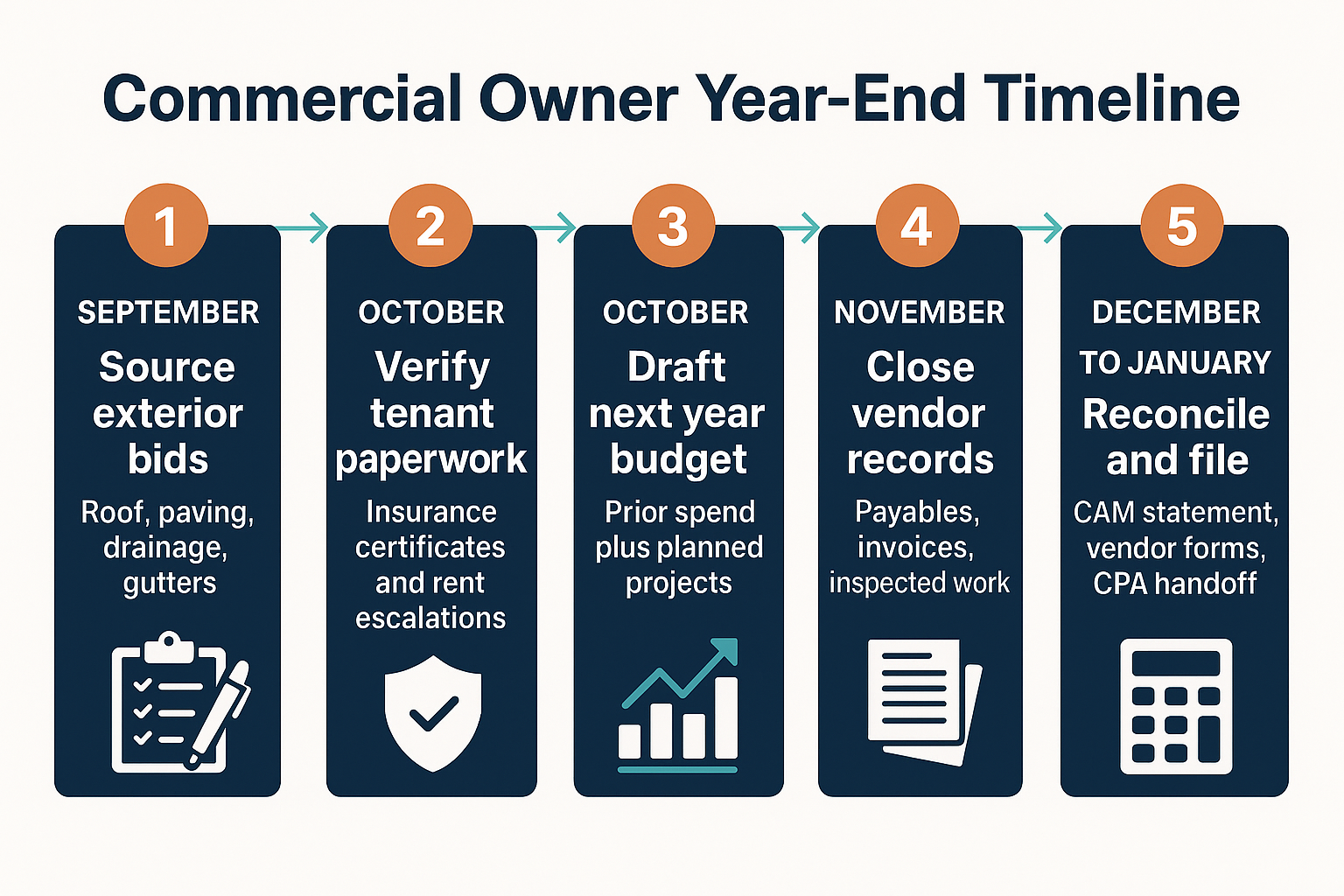
The Commercial Owner’s Fall-to-January Calendar
Here is the order the work actually happens in, from bid season through the tenant’s reconciliation statement.
Why January Gets Expensive for Owners With a Shoebox of Receipts
Plenty of commercial owners in Monterey County hold the building in an LLC or a family partnership, often because the property came through a parent or a business partner. That adds a reporting layer on top of the personal return.
When that owner hands their accountant a box of receipts, the accountant does bookkeeping at accountant rates. Hours of reconstruction work that could have been avoided show up as a bill.
What makes the handoff simple instead:
- Vendor 1099 preparation already handled, with current W-9s on file for every contractor who worked on the property. The IRS publishes the details on the form used to report payments to vendors.
- Complete payables records showing what was paid, to whom, and for what.
- A clean ledger that ties to the bank statements with no unexplained entries.
A year of loose bookkeeping does not feel like a problem in June. It becomes a real cost in January. For a broader look at what is and is not an owner’s responsibility on the commercial side, see our piece on what California commercial landlords are actually responsible for.
Fall Is Bid Season for Anything on the Outside of the Building
On the Central Coast, exterior work has a window, and it is closing now. Roof repairs, parking lot sealing, drainage corrections, and gutter clearing all get harder to schedule and more expensive once winter rain settles in over Monterey Bay.
The better roofing and paving crews serving Salinas and the Peninsula book out weeks ahead. Waiting until a leak shows up in January means taking whoever is available, at whatever they quote.
Three things I would insist on with any exterior project:
- Competing proposals, sourced and compared on the same scope, not on three different scopes.
- Finished work inspected before the vendor gets paid, with photos in the file.
- Written owner approval for any change in scope or cost, before the change happens.
That last one matters more than people expect. An owner should never discover a scope change by reading a monthly statement after the fact. Approving it in advance keeps the budget honest and keeps the reconciliation defensible.
Verify the Tenant Paperwork Instead of Assuming It
Certificates of insurance lapse quietly. Nobody notices until there is a claim or a lender asks for a copy, and then it becomes urgent in the worst way.
Ahead of a January renewal, three items are worth confirming in writing:
- The tenant’s insurance certificate is current and names the right parties.
- Any rent escalation written into the lease matches what is actually being billed.
- The renewal conversation has started, in the fall, not in the last two weeks of December.
I have seen escalation clauses sit unbilled for two or three years because nobody went back to the lease. That money is usually gone. Starting the renewal talk early also gives you room to negotiate from the budget you just built, instead of guessing.
Frequently Asked Questions About CAM Reconciliation
When should a CAM reconciliation statement go out to the tenant?
Whatever your lease says. Most commercial leases name a window after the fiscal year closes. The practical answer is to deliver it as early as your books allow, because a statement that arrives months late invites scrutiny you do not need.
What if the tenant disputes the reconciliation?
This is where the general ledger earns its keep. A dispute usually resolves fast when you can produce the transaction-level detail and the invoices behind each category. It drags on when all you have is a summary number with no backup.
Can I include a new roof in CAM charges?
Depends entirely on your lease. Some commercial leases exclude capital improvements from recoverable costs. Others allow them to be amortized over a period of years. Read the clause before you spend, not after.
My building is small. Is all this reporting overkill?
Not really. A four-suite retail strip still needs a ledger, a payables record, and vendor forms at year-end. The volume is smaller. The categories are the same, and so is the cost of reconstructing a year of records in January.
What does commercial property management cost in Monterey County?
It varies with the size of the building, the number of tenants, and the scope of services involved, so there is no single number worth quoting. We do not publish pricing, and the honest answer comes from a conversation about your specific property.
Thinking Through Your Year-End Commercial Accounting?
We have managed commercial property in Monterey County since 2009 under a broker owner, and the commercial side of our work is built around this exact calendar: reporting available through an owner portal, a budget drafted ahead of the new fiscal year, vendor proposals sourced and work inspected before payment, 1099 preparation, and support for your own accountant at tax time. Our team works out of Main Street in Salinas and is around for commercial questions at (831) 757-1270 or through the contact form at coastandvalleypm.com. No rush, and no pitch if you are just trying to understand how your own reconciliation should look.