Who Shows Up to Fix Your Salinas Rental, and How They Got on the List
Direct Answer: Before a vendor touches your rental, we verify active licensing where required, current liability and workers comp coverage, a signed W-9, and a written scope. Then we inspect the work before paying.
There is a moment most owners never really think about until it happens. A repair gets approved, a date gets set, and then a stranger is standing in your kitchen at 8 a.m. with a key to your property. You did not meet him. You did not check anything about him.
What you did not see is the stream of pitches behind that moment. In a single recent stretch, a Monterey County landscaping company asked to be added to our vendor list and offered to send over its company information, insurance, and W-9. A Salinas flooring contractor who does carpet and luxury vinyl plank stopped by one of our managed properties to introduce himself. A security patrol firm offered free walkthroughs.
Owners never see that traffic. But the filter that decides which of those companies gets your address is one of the most underrated parts of property management. That filter is what this article is about.
What a vendor has to clear before anyone gets a key
Getting on a vendor bench is not a handshake. Before a company works on a property we manage, we want a paper trail that holds up if something goes sideways.
Here is what that screen looks like in practice:
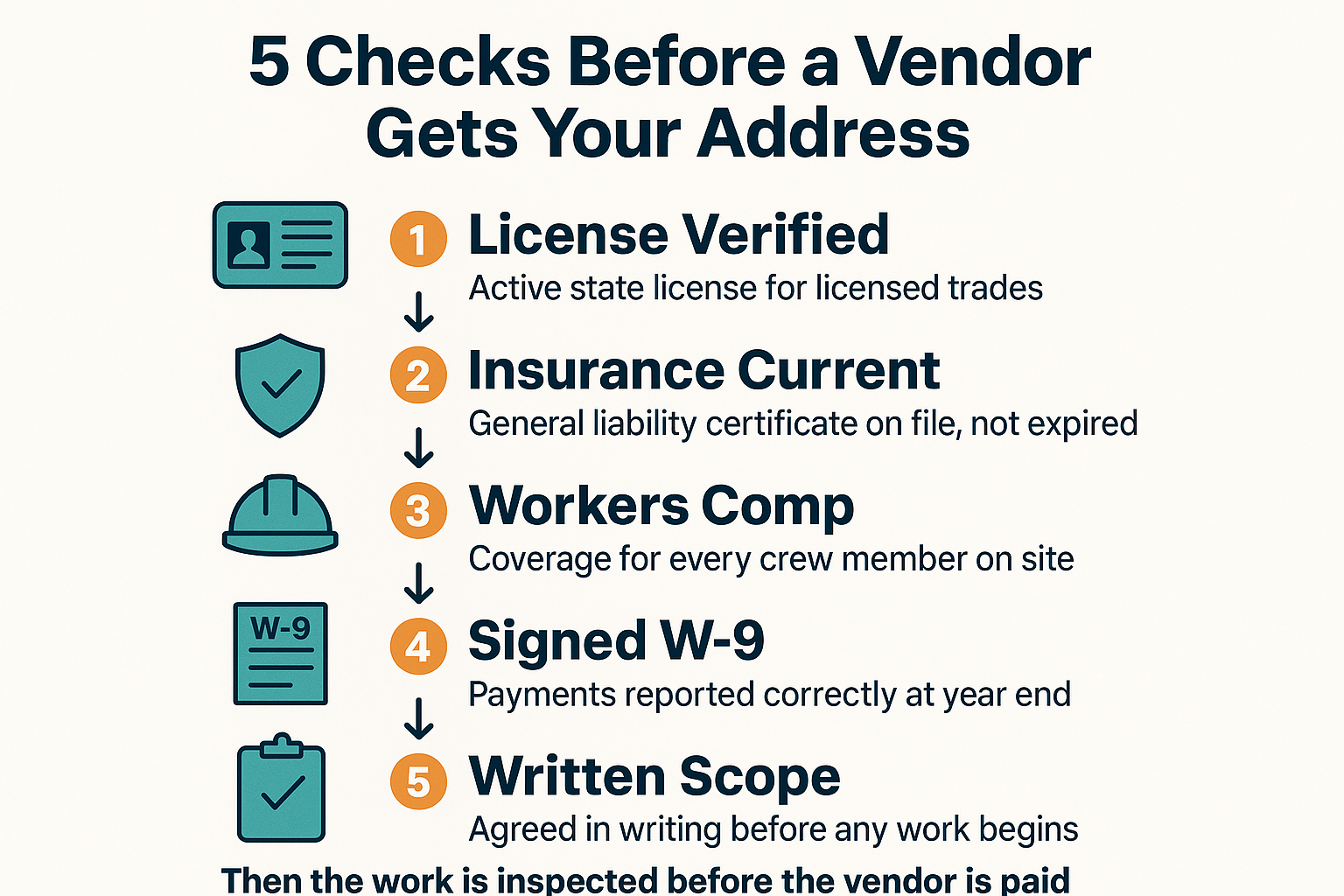
- Active license verification for any trade that requires one in California, checked at the state level, not taken on faith from a business card
- General liability coverage with a current certificate, because an expired policy on file is the same as no policy at all
- Workers compensation for anyone sending a crew, not just a solo operator
- A signed W-9 so payments are reported correctly at year end
- A written scope before work starts, so there is no argument later about what was agreed to
This protects you more than it protects us. When an uninsured worker falls off a ladder at your rental, or when work gets done wrong and has to be torn out and redone, the exposure tends to land on the person who owns the building.
California is not a forgiving place for loose paperwork. The liability environment here rewards owners and managers who keep clean files and punishes the ones who do not. A vendor who hesitates to send a certificate of insurance has told you something useful about how the rest of the job will go.

Your vendor list is not one list. It is several.
This is the part nobody local writes about, and it matters more here than in most markets.
A handyman who happily takes a call in north Salinas may turn down the same job in Greenfield or King City. Drive time eats the margin on a small repair. So an owner with a property in South County is often choosing from a much shorter bench than an owner a few blocks off Main Street, and that shows up as slower response, not higher prices. Anyone owning a rental in South County learns this fast.
On the Peninsula the problem flips. Distance is short, but the specialty requirement is real:
- Salt air and marine layer chew through exterior finishes and hardware faster than inland properties
- Wood windows and older housing stock in Pacific Grove and Carmel need finish carpenters and painters who understand coastal exposure
- Moisture management matters year round, which is why mildew on a Carmel rental wall is not always a simple cleaning job
Valley properties need a completely different skill set. Irrigation, well pumps, ag dust loading up HVAC filters, and inland temperature swings that run far hotter and colder than anything on the coast.
So the practical takeaway for an owner is this: a real vendor bench is organized two ways at once, by trade and by drive time. A single all-purpose list is a sign the list has not been used much.
What the Bench Looks Like by Area
The same repair request pulls from different people depending on where your property sits. Here is the rough shape of it.
| Area | What the housing stock demands | Where the bench gets thin |
|---|---|---|
| Pacific Grove, Carmel, Monterey | Finish carpentry, painting rated for coastal exposure, wood window repair, moisture control | Trades willing to work carefully on older homes without rushing |
| Pebble Beach estates | Discretion, scheduling around owners, specialists for high-end finishes and systems | Vetted specialists who handle access and privacy correctly |
| Salinas and north valley | General repair, plumbing, roofing, HVAC with heavy dust loads | Storm season, when everyone is booked at once |
| Soledad, Gonzales, Greenfield, King City | Irrigation, well pumps, septic, wide temperature swings | Drive time. Many Salinas vendors decline these calls outright |
The Five Checks Before a Vendor Gets Your Address
This is the sequence a company goes through before we will send them to a managed property.
Storm season is when the bench proves itself
Forecasters have put the odds of a very strong El Nino this fall and winter above 90 percent, with California leaning toward above-normal winter rain. That does not mean one bad night. It means the chance of repeated atmospheric rivers stacked back to back.
We watched how that plays out in the winter of 2023. Monterey County took nine atmospheric rivers in a row. The Salinas River topped flood stage at Salinas, Spreckels, and Bradley, and roads including River Road, Blanco, and Reservation went underwater. The county’s own record of major flood hazards shows this is a recurring pattern along the Salinas, Carmel, and Arroyo Seco rivers, not a freak event.
Here is what that does to repair logistics. Roofers, tree crews, and water mitigation companies triage by relationship and repeat volume. They answer the people who feed them work all year first.
So on day three of steady rain, the owner calling a stranger off a search result is at the back of a long line. The owner whose manager has used that same roofer eleven times since spring is not. That gap is the entire value of a bench, and it only exists if someone built it before the rain started. It also pairs with walking the property before the first storm, which is the cheaper half of the equation.
How you know the chosen vendor is the one who did the work
Approving a repair is a separate conversation. This one is narrower: how do you confirm the work actually happened, and happened right?
One Salinas owner we heard from had asked twice across several months whether the fence along the side of her rental had been replaced and whether an overgrown tree out front had been trimmed. She wanted photos of the finished work. That is a completely reasonable ask, and the fact that she had to ask twice is the problem.
A documented close-out should include:
- Before and after photos of the specific area, not a wide shot of the yard
- An itemized invoice that matches the approved scope line for line
- An inspection by someone on the management side before the vendor gets paid
- A record in the owner portal so you can pull it up months later without emailing anyone
That last step is the one that gets skipped most often. Paying first and checking later removes the only real leverage you have with a vendor. For more on how the approval side works, see who approves a repair at your Salinas rental.
What drives the cost, honestly
I am not going to quote numbers, because the real answer depends on trade, property, access, and season here on the Central Coast. But the mechanics are worth understanding.
- Competing estimates get pulled on larger jobs. For a small repair, three bids cost more in delay than they save in dollars. For a roof or a repipe, they are standard.
- Steady monthly volume changes the conversation. A vendor who gets regular work tends to offer better scheduling and sharper pricing than they would on a one-off homeowner call.
- After hours and storm work price differently than a Tuesday morning repair. That is true everywhere, and it is especially true when half the county is calling the same roofer.
If you want a figure for your specific property, that is a conversation, not an article. A walkthrough and a look at your actual systems will get you a far more useful number than any range I could print here.
Frequently Asked Questions About Vendor Vetting in Monterey County
Can I keep using my own handyman?
Often yes, as long as they clear the same screen everyone else does. Active license where the trade requires one, current liability coverage, workers comp if they bring a crew, and a W-9. Plenty of longtime owner contacts clear it without trouble. The ones who cannot usually turn out to have let insurance lapse.
What happens if a worker gets hurt at my rental?
This is the exact reason the paperwork matters. If the vendor carries proper coverage, their policy handles it. If they do not, the claim tends to find its way toward the property owner, which is a bad surprise to discover after the fact.
Do you get multiple bids on every repair?
No, and you would not want us to. Chasing three estimates for a leaking faucet costs you days of tenant frustration to save very little. On bigger work, competing proposals are standard practice.
Is the vendor list different for a Pebble Beach property than a Greenfield one?
Completely different. Coastal properties need people who understand salt air, older housing stock, and discretion on site. South County properties need irrigation and well pump knowledge, and a much shorter list of vendors who will even make the drive.
How do I see what was done without calling the office?
Through the owner portal. Invoices, financials, and reports sit there so you can pull up a completed job months later on your own schedule.
Want to Talk Through Who Is Working on Your Property?
We have been placing vendors in Salinas Valley and Monterey Peninsula properties since 2009, broker-owner led the whole way, and we sort through vendor solicitations constantly so owners do not have to. That means checking license and insurance status, sourcing competing proposals on larger jobs, and inspecting work before anyone gets paid. If you would like to talk through how your own bench is holding up, Coast & Valley Properties is available at (831) 757-1270 or through the contact form at coastandvalleypm.com.