Landlord Insurance on the Central Coast: What Changed and What Drives Cost
Direct Answer: Landlord insurance covers a rented home, the owner’s liability, and lost rent during repairs. In California, cost is driven mostly by wildfire zone, rebuild cost, and property condition.
The call I get most often these days starts the same way. An owner opens a renewal notice, sees a number that is nowhere near last year’s, and wants to know if it is a mistake. In some cases the letter is worse than a price hike, because the carrier is not renewing at all.
Monterey County makes this harder than most places. A rental in a flat Salinas neighborhood and a home up Carmel Valley Road get underwritten as two completely different risks, even though they sit twenty minutes apart.
So here is what I tell owners: your premium is not random, and most of it traces back to three things. Where the property sits, what it would actually cost to rebuild, and what condition it is in. This article walks through all three, plus the coverage mistakes I see cost owners real money.
Why Renewal Notices Got Ugly, and What the Numbers Look Like Now
California’s property insurance market tightened hard over the last few years. Carriers pulled back from fire-exposed areas, rebuild costs climbed with construction labor and materials, and the pricing that owners got used to a decade ago is gone.
Here is general market context, not a quote for anyone’s property. Industry sources reporting on 2026 put average California landlord premiums somewhere around $1,700 a year, with a common range of roughly $900 to $3,500 depending on the home.
Those same sources generally price landlord coverage about 15 to 25 percent above a comparable owner-occupied policy on the same house. That gap is not a penalty. It reflects the fact that a rented property carries occupancy risk, liability from people the owner does not control, and rental income that has to be replaced if the house becomes unlivable.
What those averages will not tell you is your own number. A three-bedroom in Gonzales, a duplex off Alisal, and an estate near Pebble Beach do not price anywhere near each other. Your address, your roof, your electrical, and your claims history do more work than any statewide average.
The California Department of Insurance is a useful starting point for understanding how coverage is regulated in the state, but the only real answer comes from a licensed agent quoting your specific property.

Wildfire Classification Is the Biggest Swing Factor Here
Nothing moves a Monterey County premium like fire classification. And it changes block by block, not city by city.
I have seen two homes on the same road land in different risk tiers because of slope, vegetation, and how far the nearest engine has to travel. Owners are often shocked that a neighbor pays a fraction of what they do.
Where the pressure shows up most in our area:
- Carmel Valley Road properties, especially the further up you go
- Carmel Highlands and the ridgelines above it
- The Big Sur coast, where access and response time are part of the math
- Hillside parcels in and around the Peninsula with heavy brush
- Agricultural estates on the valley edges with long private driveways
When a standard carrier walks away, owners in these zones often get pushed toward the state’s plan of last resort, commonly called the FAIR Plan. Most owners have never had to buy coverage this way, so the structure catches them off guard.
That plan is narrow by design. It is built mainly around fire and a short list of related perils, and it generally does not include the liability protection or the loss of rent coverage a landlord needs.
So owners end up stacking two policies. The last resort plan handles the fire exposure, and a second wrap policy from a private carrier fills in the gaps: liability, theft, certain water damage, and lost rental income. Two policies, two premiums, two sets of paperwork, and one very important question to ask your agent about where one ends and the other begins.
What Actually Moves Your Premium
These are the factors I see drive the biggest differences between two Monterey County rentals that look similar on paper.
| Factor | Why It Moves the Number | What an Owner Can Do |
|---|---|---|
| Wildfire classification | Drives eligibility and price more than anything else in this county | Ask the agent which zone the address falls in and whether brush clearance changes it |
| Roof age and material | Older roofs draw nonrenewal notices even without a claim | Keep dated proof of roof age and any replacement work |
| Electrical and plumbing age | Knob and tube, old panels, and galvanized supply lines trigger declines | Document upgrades with permits and invoices |
| Rebuild cost, not market value | Coverage is priced on construction, not the sale price | Get a rebuild estimate rather than guessing from a listing price |
| Occupancy and vacancy | Empty units are treated as a higher risk after a set number of days | Tell the carrier before the unit sits, not after |
| Claims history | Two claims in a few years can end a policy | Handle small repairs out of pocket when it makes sense |
The Mistake That Costs the Most: Never Switching the Policy
Plenty of Monterey County rentals started out as somebody’s home. A retiree moves in with family, an adult child inherits the house, a professional relocates for work and decides to hold the property instead of selling.
The house becomes a rental. The insurance policy never changes.
That gap is the single most expensive mistake I see. A homeowner policy is written around an owner living in the home, and a carrier can take a hard look at coverage when it turns out tenants have been there for two years.
A landlord or dwelling fire policy is built around a different set of risks:
- Tenant occupancy, including damage caused by residents
- Liability from people on the property the owner does not control
- Loss of rent while a covered repair takes the unit off the market
- Owner-owned contents like appliances, not a tenant’s belongings
Loss of rent is the piece owners forget until they need it. If a covered fire or water event puts the house out of service for four months, that coverage is what replaces the income while the work happens.
Anyone turning a former short-term rental into a long-term one should treat the insurance switch as step one, not an afterthought. The occupancy changed, so the policy has to change with it.
Five Things to Check Before Your Renewal Date
This is the short list I walk owners through when a renewal notice shows up and the number looks wrong.
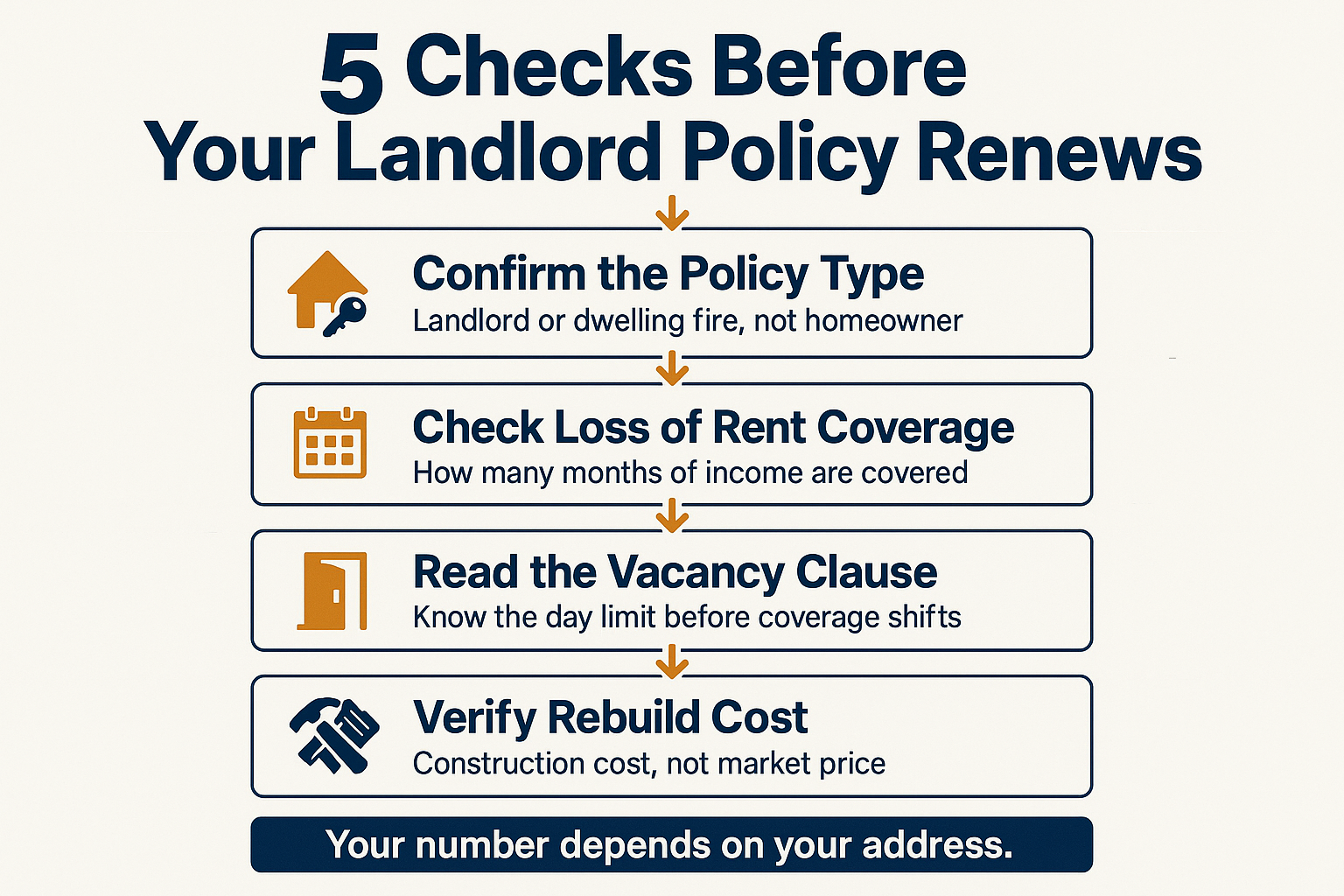
Vacancy Language Deserves Its Own Read
This one quietly bites owners more than any other clause in the document.
Many policies treat a unit that has sat empty past a set number of days differently than an occupied one. Coverage can narrow, certain perils can drop off, and a claim filed after that window can get a much harder look.
It matters most for three situations I see all the time in this county:
- Part-time owners who keep a Peninsula property between tenants while traveling
- Inherited properties sitting through an estate settlement
- Owners deciding on a rehab who let a unit sit for months while weighing options
The fix is simple and free. Find the vacancy clause, note the day count, and call the carrier before the unit goes empty rather than after something happens.
A vacant house in Salinas in January is not a low-risk house. Pipes fail, roofs leak, and nobody is there to notice for weeks. Anyone walking a rental before the first storm of the season should treat an empty unit as the one that needs the closest look.
Replacement Cost Versus Market Value: Both Directions Cost Money
This trips up owners in Monterey County more than almost anywhere, because land is such a large share of what a property is worth here.
A Peninsula home worth well over a million dollars may cost far less than that to rebuild, because a big piece of that value is the lot, the location, and the view. Insuring the full sale price means paying premium on coverage the owner can never collect.
The reverse happens in the valley. A Salinas home can cost more to rebuild than an owner assumes once current construction labor and required code upgrades get counted.
So I tell owners to ask the agent two direct questions:
- What rebuild cost is this policy actually based on?
- Does it include code upgrade costs, or is that a separate add-on?
Being wrong in either direction is expensive. Overinsured owners bleed money every month. Underinsured owners find out the gap on the worst day of the ownership, when the check does not cover the contractor’s bid.
Condition and Documentation Are Insurance Issues, Not Just Maintenance Issues
Carriers do not just price the address. They price the property, and increasingly they send someone to look.
I have seen local rental complaints involving a dryer that vented into a crawl space and a sprinkler leak that ran for months before anyone traced it. Those are exactly the conditions that turn into a denied claim, a liability argument, or a nonrenewal after an inspection.
The defense is boring and it works:
- Annual property inspections with written notes on what was found
- Dated photographs of the roof, water heater, panel, and crawl space
- A repair record showing what was fixed, by whom, and when
- Vendor invoices kept with the property file, not scattered in an inbox
When an adjuster questions whether damage was sudden or the result of long-neglected wear, that file is the whole argument. An owner with three years of inspection reports is in a very different position than one working from memory.
This is one of the real reasons self-managing stops making sense for some owners. Not because the work is hard, but because the documentation only helps if it exists before you need it.
Frequently Asked Questions About Landlord Insurance in Monterey County
Do I really need a landlord policy if the house is already insured?
If tenants live there, yes. A homeowner policy is written around the owner occupying the home, and a carrier can push back on a claim when it learns the property has been rented. A landlord or dwelling fire policy is the right product once occupancy changes.
Why is my Carmel Valley premium so much higher than my friend’s Salinas rental?
Wildfire classification, almost always. Slope, vegetation, access, and distance from fire response all feed into it, and those factors change block by block in this county rather than city by city.
What is a wrap policy and why would I need two policies?
When a standard carrier will not write the property, owners often end up on the state’s plan of last resort, which is built mainly around fire. That plan generally leaves out liability and loss of rent, so a private wrap policy fills in the rest. Two policies together do the job one policy used to.
Should I insure my rental for what it would sell for?
No. Coverage is based on rebuild cost, not sale price. On the Peninsula the land carries much of the value, so the sale price overstates the rebuild. In parts of the valley, code upgrades and current labor can push rebuild cost above what an owner expects.
Does my tenant need renters insurance?
Your policy covers your building and your liability, not your tenant’s belongings. Requiring renters insurance in the lease is common practice, and it keeps a tenant’s loss from turning into a dispute with you.
Will filing a small claim hurt me?
It can. In this market, two claims in a short span is enough to draw a nonrenewal letter. For minor damage, it is worth pricing the repair out of pocket before opening a claim file.
Insurance Questions and Property Condition Questions Are the Same Conversation
Most of what drives a premium here is condition, documentation, and how well the property has been kept up between tenants. Owners in Monterey County who want a set of eyes on a property’s condition ahead of a renewal are welcome to reach our office at (831) 757-1270 or through the contact form at coastandvalleypm.com. We are happy to talk through what we see, whenever the timing works for you.