Valley Fog, Farm Dust, and Inland Heat: What Salinas Weather Does to a Rental
Direct Answer: A Salinas Valley rental wears differently than a coastal one. Agricultural dust, tule fog, and wide day to night temperature swings are the main upkeep drivers, and most of that damage builds slowly.
Most of the rental maintenance advice written for this county was written for the coast. Marine layer, salt air, mildew on a north wall in Carmel. Useful if your property sits west of the hill. Not very useful if it sits on the valley floor.
I get calls from owners in Salinas, Gonzales, Greenfield, and King City who have read all of that and still feel like they are missing something a local would know. They are right. What holds up in Pacific Grove and what holds up in the middle of the valley are two different lists.
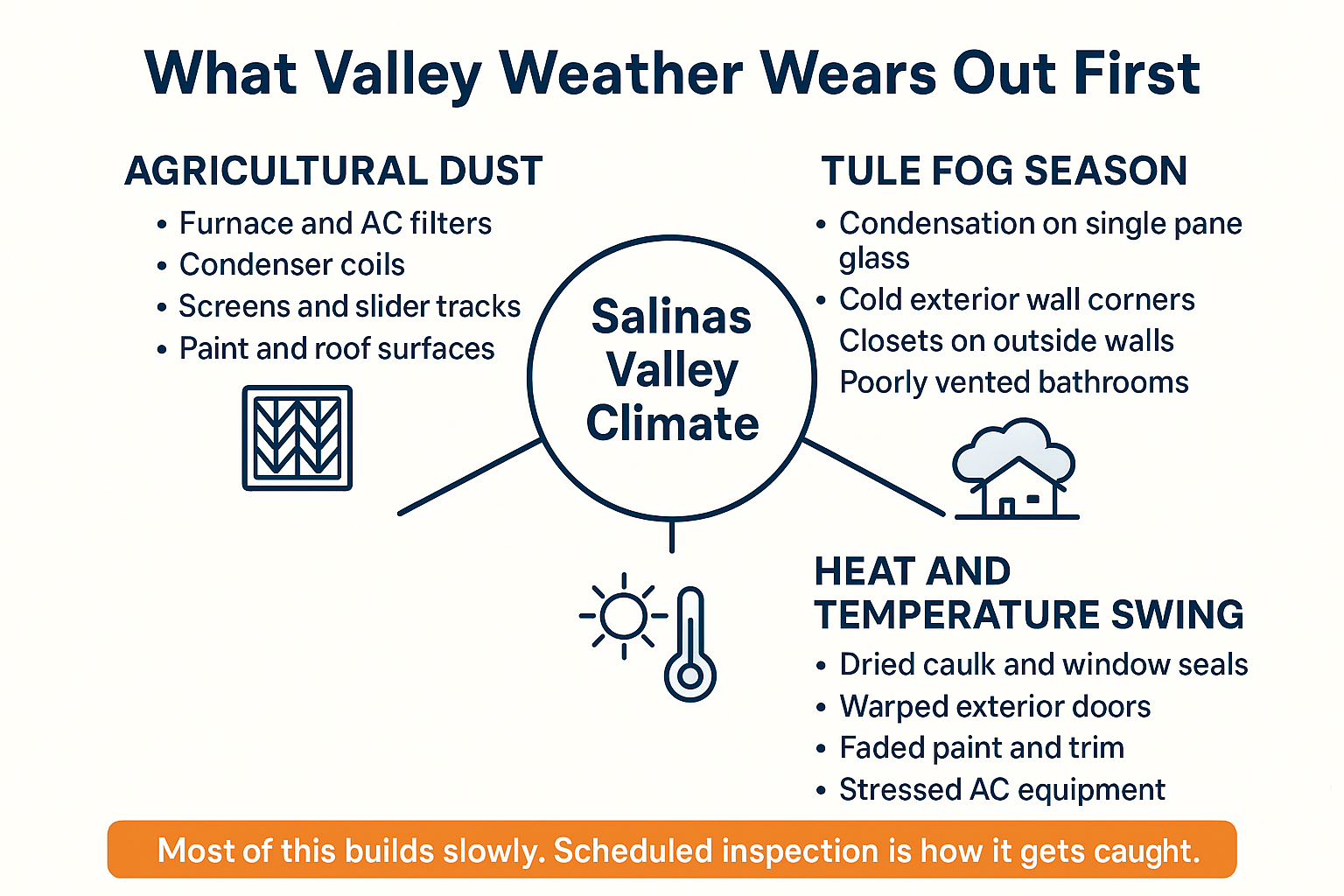
This article is the valley list. Three things drive Salinas Valley climate rental property upkeep: agricultural dust, tule fog season, and the big swing between a hot afternoon and a cold night. I will walk you through each one the way I would if we were standing in the driveway together.
Why Coastal Upkeep Advice Does Not Travel Inland
Drive Highway 68 east from Monterey and the air changes somewhere around Toro Park. The marine layer thins out, the temperature climbs, and the whole wear profile of a house changes with it.
A Peninsula property fights surface moisture as ordinary climate behavior. Condensation on glass, mildew on shaded siding, salt on hardware. That is normal coastal aging, and it gets managed on a coastal schedule.
A valley property fights a different set:
- Fine agricultural dust for much of the growing and harvest season
- Winter tule fog that can sit over the floor of the valley for days
- Day to night temperature swings that work on seals, caulk, and wood
- Real water exposure on parcels near the Salinas River and the lower drainage lines
- Dry heat and sun load that dulls paint and bakes roof surfaces
Same builder, same floor plan, two different aging curves. I have said this to owners who hold property on both sides of the hill, and it is the same point I make in why a Pebble Beach estate needs different management than a Salinas rental.
If you own in South County, the effect is stronger, not weaker. Hotter summers, dustier shoulder seasons, longer drives for vendors. I covered that market separately in owning a rental in Salinas Valley’s South County.
Agricultural Dust: The Problem That Never Announces Itself
This is the wear factor almost nobody writes about for owners, and it is the one I would put at the top of the list.
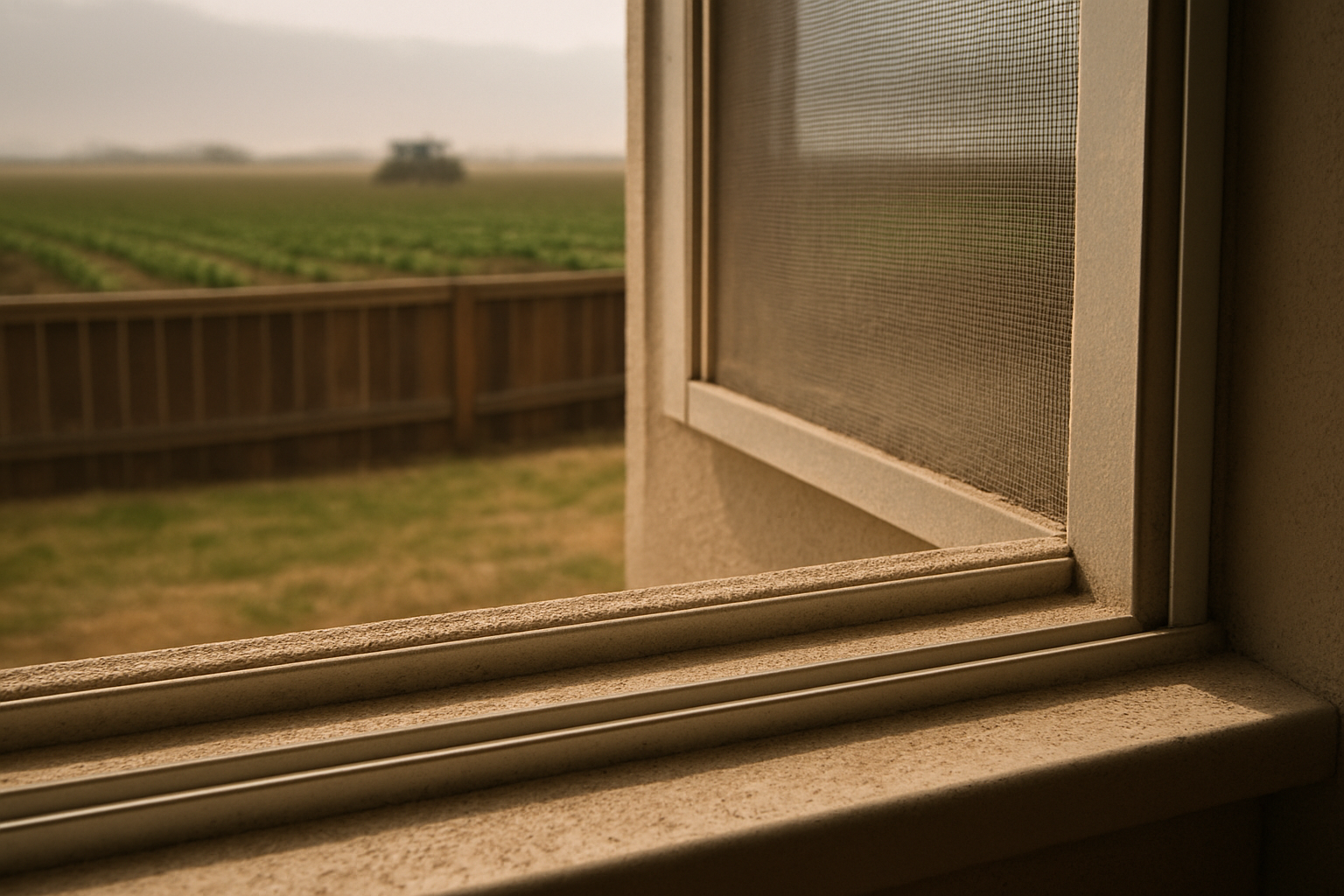
When the fields around Chualar, Gonzales, and Spreckels get worked, fine dust travels. It does not stop at the property line. Over a season it settles into the places that quietly matter:
- Furnace and air filters, which load up months faster than the label assumes
- Condenser coils on the AC unit, which lose their ability to shed heat
- Window screens and slider tracks, which stop sealing and stop sliding
- Exterior paint and roof surfaces, which go chalky and dull years early
- Dryer vents and bathroom fans, which lose airflow
Nothing breaks on a Tuesday. The filter just stops doing its job over eighteen months, the blower works harder, and the repair bill arrives years before it should have.
Here is how it usually surfaces: a tenant calls in July saying the AC is not keeping up, and everyone assumes the equipment failed. Often the coil is packed and the filter is gray. A coil cleaning and a filter change cost a fraction of a compressor, but only if somebody looks before the hot stretch.
My rule for valley properties is to treat the 60 to 90 day filter guidance as the ceiling, not the target, and to put eyes on the condenser before summer. If you are an owner who visits once or twice a year, you cannot see slow accumulation between visits. Nobody can.
Three Valley Forces and Where They Show Up
A quick visual of what each part of the valley climate actually attacks on a rental home.
Trees, Ivy, and Water Paths: What Cannot Wait Until Spring
Landscaping reads as cosmetic right up until a limb comes down on a carport or a fence lets go in a wind event. Then it is a real repair and sometimes a liability conversation.
One Salinas owner wrote to us about a front yard tree and put it plainly: “It is severely overgrown.” Months later, the follow up was still the same question, had the tree been trimmed and had the side fence been replaced. That gap between noticing and handling is where most of the money gets lost.
Another owner wrote in about ivy from the neighboring property swallowing the back fence and climbing onto the garage roof. Ivy on a fence looks charming. Ivy on a roof holds moisture against the surface and pries at flashing.
The water side matters just as much. Valley lots are flat, drainage is shallow, and a few seasons of leaf litter will reroute runoff straight at a foundation. I walk through the full pre-storm sequence in walking your Salinas rental before the first storm.
If you only do three things before the rains start:
- Clear gutters, downspouts, and the area drains at the low corners of the lot
- Get dead and overhanging limbs off the roof, the carport, and the power drop
- Pull vegetation off fence lines and roof edges before it has a wet season to work with
Can It Wait Until Spring? A Quick Triage
This is roughly how I sort a running list of small property items when an owner sends me photos in October.
| What You’re Looking At | Wait or Handle Now | How to Tell From a Photo |
|---|---|---|
| Limb hanging over a roof, carport, or driveway | Handle now | Any branch sitting above a structure or a parked car |
| Clogged gutters or a downspout dumping at the foundation | Handle now | Standing debris, staining on the wall below, soil washed away |
| Ivy or vine onto a roof edge or into a fence | Handle now | Growth touching shingles, flashing, or a leaning fence panel |
| Dull, chalky exterior paint | Can wait | Even fading with no bare wood or peeling |
| Overgrown shrubs away from the house | Can wait | Nothing touching siding, windows, or walkways |
| Hairline cracks in a driveway or walkway | Can wait, monitor | No lift, no trip edge, no water pooling at the crack |
Interior Moisture in an Inland House: Fog Season vs. a Real Problem
You get a text from the tenant with a photo of a damp corner and no context. Most of those photos are not emergencies. A few are.
In fog season, a closed up valley house with older single pane windows will produce moisture on glass and on cold exterior walls. Tenants heat in the evening, shut everything tight, cook, shower, and the house has nowhere to put that humidity. That is ordinary winter condensation, not a building failure.
Before I send anyone out, I ask the tenant the same questions in this order:
1. Is the moisture on the glass and the frame, or on the wall itself?
2. Does it dry out by midday or is it still wet in the afternoon?
3. Has the stain gotten bigger since last week, and do you have an earlier photo?
4. Does the bathroom fan run, and does the window get opened after showers?
5. Is anything above or behind that spot, like a shower, a roof valley, or a hose bib?
Condensation on glass that clears by noon is a ventilation habit conversation. A stain that spreads, a musty closet on an exterior wall, or a soft baseboard is a different conversation and gets a vendor.
The federal guidance on moisture and indoor mold is a reasonable plain-language reference for owners, and the EPA’s brief guide to mold, moisture and your home covers the basics well. For the coastal version of this same question, we answered a Carmel owner’s situation in mildew on a Carmel rental wall. The inland version is a different animal, which is the whole point of this article.
None of This Matters Unless Somebody Is Looking
Every item above is invisible unless someone walks the property on a schedule and takes pictures. The filter, the coil, the roof surface, the drainage path, the tree over the carport. None of them send you a notification.
A lot of the owners I work with are not driving by. One relocated out of state before renting out a Salinas house. Another wrote in from outside the county about a newly built property. The common thread is distance, and the common request is the same: send me photos showing the work got done.
That is a fair ask, and it is the standard I think owners should hold anyone to. You should be able to see what was found, what was recommended, and what got done, without chasing anybody. Annual inspections documented with photos, maintenance records in an owner portal, and a clear approval trail before money gets spent.
If you want the mechanics of that approval trail, I laid it out in who approves a repair at your Salinas rental, and how you know it got done. Proof beats assurances every time someone is managing an asset from three hundred miles away.
Frequently Asked Questions About Valley Climate and Rental Upkeep
How often should filters really be changed in a Salinas Valley rental?
The common 60 to 90 day guidance assumes a typical suburban house. On the valley floor, especially near active fields, I treat 90 days as the outside limit and plan closer to 60 during the dusty stretch of the year. It is one of the least expensive things you can do for an HVAC system here.
My tenant sent a photo of water on the windows. Is that an emergency?
Almost never. Fog season condensation on single pane glass is normal in a closed up valley house. Ask whether it dries by midday, whether the stain is spreading, and whether the wall itself feels damp. Spreading stains and soft baseboards get a vendor.
Does the maintenance advice I read for my Pacific Grove property apply to my Greenfield rental?
Partly, but the priorities flip. The coast is a moisture and salt story. The valley is a dust, heat, and drainage story. Same house, different list.
What does dust actually cost me if I ignore it?
It rarely shows up as one bill. It shows up as shortened equipment life, an earlier roof or paint cycle, and service calls during the hottest week of the year when vendors are busiest. Costs vary by property and equipment, so the honest answer is that a quick look before summer is worth far more than a guess.
I live out of state. How do I know inspection work is actually happening?
Ask for dated photos and a written summary of findings and recommendations, delivered through an owner portal you can check yourself. If you have to call and ask whether something was done, the reporting is not working.
Thinking through what your valley property needs this season?
We have managed properties on both sides of the hill since 2009, on the Monterey Peninsula and across the Salinas Valley into South County, which is why we can tell an owner that the same house ages differently in Pacific Grove than it does on the valley floor. If you want to talk through a specific property and what its climate is doing to it, our team at Coast & Valley Properties is reachable at (831) 757-1270.