
A Property Owner’s Guide to Property Management Fees in California
When investing in California's high-value real estate market, from the Monterey Bay Area to South County, a firm handle on property management fees is critical for protecting your ROI. As a general benchmark, you can expect to pay 7-10% of the monthly rent for full-service, ongoing management of your property. In addition, there is typically a tenant placement fee, which often lands between 50-100% of the first month's rent.
Of course, these numbers can shift depending on your property's location—whether a luxury home in Carmel or a multi-family unit in Salinas—and the specific concierge-level services your investment requires.
Understanding Property Management Fees in Monterey County

For busy professionals and serious investors with assets in Monterey County—from a luxury home in Pacific Grove to a portfolio of rentals in Salinas—understanding these costs is non-negotiable. The fee structure isn't just a number; it's a direct reflection of the service, asset protection, and peace of mind you are investing in.
In a state with notoriously complex landlord-tenant laws in California, that management fee is your direct investment in compliance and avoiding costly legal headaches.
A premier management partner does far more than collect rent. They are your local expert, protecting your asset's value through proactive maintenance, rigorous tenant screening, and sharp financial oversight. This is especially vital in a region as diverse as Monterey County, where the needs of a coastal property in Carmel are worlds away from a home near the agricultural heartland of Soledad or King City.
Actionable Guide: Typical California Property Management Fee Structure
To provide clear, actionable insight, we've outlined the common fees you'll encounter with property management firms across California. Use this as a checklist when evaluating potential partners.
| Fee Type | Common California Range | What It Covers & Actionable Tip for Investors |
|---|---|---|
| Monthly Management Fee | 7-10% of monthly rent | Actionable Tip: Ask if the fee is based on rent collected or rent due. A fee on collected rent aligns the manager's success with yours. |
| Tenant Placement Fee | 50-100% of first month's rent | Actionable Tip: Clarify if this fee includes professional marketing photography and syndicated listings to attract high-quality tenants faster. |
| Lease Renewal Fee | Varies (often a flat fee) | Actionable Tip: A great tenant is an asset. Ask if this fee can be reduced or waived for exemplary long-term tenants to encourage retention. |
| Maintenance Markup | 10-20% of the invoice | Actionable Tip: Request a list of their vetted, local vendors. A transparent partner should not prevent you from using your own trusted contractors. |
| Vacancy Fee | Sometimes a flat monthly fee | Actionable Tip: This fee should cover proactive services like weekly security checks and managing utilities, not just a "set it and forget it" charge. |
| Eviction Fee | Flat fee or hourly rate | Actionable Tip: Ask for a breakdown of what this covers (e.g., serving notices, court filing, representation). This fee highlights the value of their tenant screening process. |
Remember, these figures are a baseline. The objective for a serious investor is to find a partner whose fees directly translate into a higher-performing, better-protected asset for the long term.
Decoding the Numbers: Cost vs. Value
The fees you see are almost always tied directly to the level of service and the complexity of your local market. Higher costs often signify a more comprehensive, concierge-level service designed to save you time and, more importantly, prevent expensive mistakes. It helps to think of it not as a cost, but as an investment in a strategic partner dedicated to maximizing your returns.
Key Investor Insight: The true value of a property manager isn't found in the lowest percentage. It's in their proven ability to boost revenue, minimize vacancy, and shield you from liability. A transparent, all-inclusive fee from a firm like Coast & Valley often delivers a far better long-term ROI than a low base rate loaded with hidden charges.
A premier management company will always provide a detailed proposal that clearly explains how their fees translate into tangible benefits, like reducing your legal exposure. This guide will give you the foundational knowledge you need to confidently assess any management proposal and choose a partner who truly aligns with your financial goals.
The Monthly Management Fee: What Are You Actually Paying For?

The monthly management fee is the operational engine of your property management agreement. For any discerning investor in Monterey County, understanding what this fee truly buys you is the key to identifying a manager's real worth.
This core fee typically comes in two models: a percentage of collected rent or a flat-rate fee. Each is suited to different types of properties, from a luxury estate in Carmel to a multi-family building in Soledad.
The Percentage-Based Fee Model
The most common structure is the percentage-based fee, where the management company takes a percentage of the rent they successfully collect each month. In California, this typically falls between 7% and 10%.
This model is popular for one simple reason: it directly aligns the manager’s success with your own. They only get paid when you get paid. If your property in Salinas or Gonzales sits vacant, they aren't collecting a management fee, which gives them a powerful incentive to place high-quality tenants—fast.
Real-World Example: Imagine a high-end property in Pebble Beach renting for $10,000 a month. A 9% management fee ($900) should deliver a comprehensive suite of services:
- Secure Rent Collection: Utilizing modern online portals for secure and timely rent collection.
- Concierge-Level Tenant Relations: Acting as the professional point of contact for every tenant inquiry, request, and concern.
- Proactive Maintenance Coordination: Fielding all maintenance calls and dispatching vetted local vendors, ensuring quality work that preserves your asset.
- Compliance & Risk Management: Ensuring every action taken is in strict compliance with California's ever-changing landlord-tenant laws, protecting you from liability.
A higher percentage fee often translates directly into a higher caliber of service. It funds proactive asset preservation, more rigorous tenant screening, and a level of attentiveness that protects the long-term value of your high-end property.
The Flat-Rate Fee Model
Alternatively, some management companies offer a flat-rate monthly fee. This model provides absolute budget predictability. This can be especially appealing for owners of properties with very high rental incomes, where a percentage fee could become substantial.
For instance, a flat fee of $450 per month might seem more cost-effective for that luxury Carmel home than a 9% fee. The key, however, is to ensure the scope of services isn't diminished.
Actionable Step: When evaluating a flat-fee proposal, request a detailed "Scope of Work" document. Compare it line-by-line against a percentage-based offer to ensure you are still receiving the same full-service commitment to proactive care and tenant management.
The debate isn't which model is universally better, but which one is better for your specific asset and investment goals. The right partnership ensures your fee, whether percentage-based or flat, delivers exceptional value and peace of mind. Remember, these fees are typically an operating expense. You can learn more in our guide on key tax deductions for landlords.
Uncovering Ancillary Costs and Hidden Fees
A low monthly management percentage can look attractive on paper, but for a sophisticated investor, it’s often a red flag. The true cost of property management isn't in the headline number; it's buried in the fine print. An appealing 7% fee can quickly lose its luster when weighed down by a dozen "a la carte" charges that erode your cash flow.
For owners of high-end properties in Monterey County, from Salinas to Pacific Grove, scrutinizing these extra costs is non-negotiable. At Coast & Valley, we champion a transparent, all-inclusive approach, but it’s critical you know what to look for when comparing firms.
This image breaks down some of the most common fee percentages you'll run into in the California market.
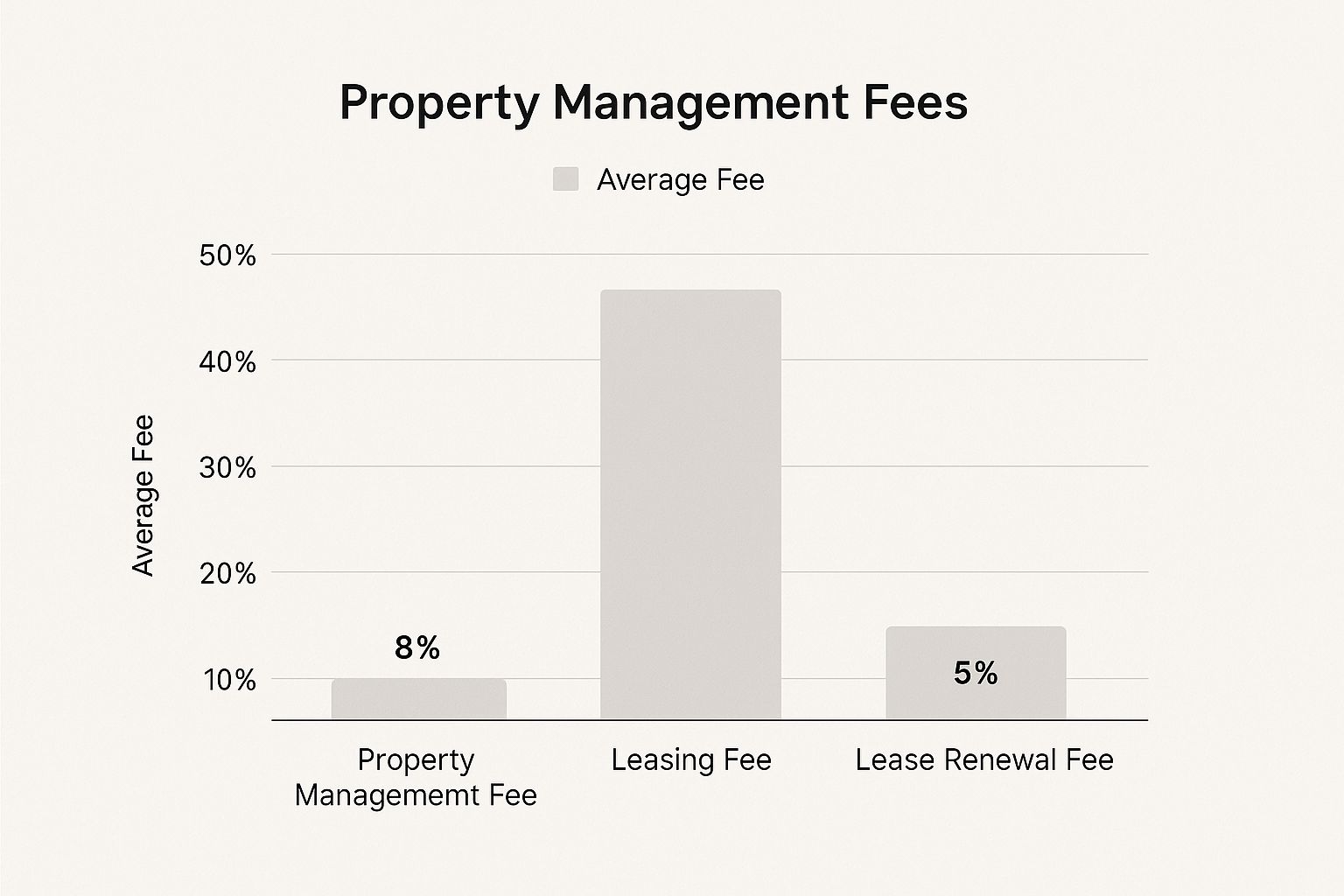
As you can see, the expenses go far beyond a simple monthly percentage. In many models, tenant placement and lease renewals are major, separate costs.
A Deeper Dive Into Common Ancillary Fees
Before signing any management agreement, you must ask pointed questions about these potential charges. Think of the base management fee as the vehicle's sticker price; ancillary fees are the dealership add-ons, taxes, and registration that determine what you actually pay.
Actionable Checklist: Common Ancillary Fees for Monterey County Landlords
| Fee Type | Typical California Cost | Actionable Question for Your Potential Manager |
|---|---|---|
| Tenant Placement Fee | 50% – 100% of the first month's rent. | "For a high-end rental in Carmel, this is a significant one-time cost. Does this fee also apply if a tenant breaks their lease early and you must find a replacement?" |
| Lease Renewal Fee | $200 – $500 flat fee. | "Keeping a great tenant saves me money on turnover. Is this fee negotiable for long-term, problem-free tenants in my Soledad property?" |
| Maintenance Coordination Fee | 10% – 20% markup on vendor invoices. | "This can create a conflict of interest. What is your policy if I want to use my own trusted local contractor for a repair?" |
| Routine Inspection Fee | $100 – $200 per inspection. | "For my coastal property in Pacific Grove, regular inspections are vital. How many inspections are included in the base fee versus charged separately? Are move-in/move-out inspections extra?" |
Getting straight answers on these items is the only way to ensure your partnership is built on trust and transparency from day one.
The Importance of Transparent Technology
A modern, professional property manager should use technology to create efficiency and transparency, not to obscure costs. The right systems provide a clear, real-time view of your investment's performance. You can learn more about how technology empowers owners in our guide to key property management technology trends. When vetting a partner, ensure their fee structure is simple, predictable, and fully aligned with your long-term financial goals.
How Monterey County Market Dynamics Affect Your Fees

While there are standard ranges for property management fees in California, what you actually pay is shaped by the unique realities of your local market. For an investor in Monterey County, understanding how our regional dynamics impact service needs—and therefore fees—is essential. A generic, one-size-fits-all approach from a national firm simply cannot account for the distinct variables across our communities.
Managing a luxury vacation rental in Carmel-by-the-Sea is a world away from overseeing a family home in Salinas or a multi-unit building in King City. The level of hands-on service, marketing strategy, and maintenance required are fundamentally different, and a professional management fee will reflect that complexity.
This is where true local expertise, like that of Coast & Valley founder Amy Salmina, whose family has fourth-generation roots in Salinas, becomes an investor's greatest asset.
Comparing High-End Coastal and Inland Properties
The Monterey Peninsula is a world-renowned destination, creating specific management challenges and opportunities.
- Coastal Properties (Pebble Beach, Pacific Grove): These assets demand proactive, preventative maintenance. The salt air corrodes metal fixtures, damages window seals, and ages exteriors. A premier manager must schedule regular, specialized inspections to mitigate these issues. This higher level of service commands a corresponding fee but is crucial for preserving your property's long-term value.
- Inland Properties (Salinas, Soledad, Gonzales): In agricultural hubs, the focus shifts to securing stable, long-term tenants from the local workforce. While maintenance may be more standard, the tenant screening process must be exceptionally rigorous to ensure consistent cash flow and asset reliability.
Investor Insight: A savvy investor knows the fee structure must align with the property's specific needs. Paying a premium for a manager who understands the hyper-local challenges of your asset—whether it’s coastal salt air or the Salinas rental market—is an investment in a better ROI, not just an expense.
Seasonal Tourism and Vacancy Rates
Monterey County's economy is heavily driven by seasonal tourism, from the AT&T Pebble Beach Pro-Am to Monterey Car Week. These events create peaks and valleys in the rental market that require expert navigation.
A skilled local manager leverages this seasonality to your advantage, knowing precisely when to pivot marketing from short-term executive rentals to long-term leases. This dynamic strategy minimizes vacancy and maximizes income, a high-value service that generic firms often overlook.
The Influence of Local Regulations and Tenant Pools
California’s rental laws are complex, but many cities in Monterey County have their own ordinances. This is where a locally-based leader provides an indispensable advantage, ensuring compliance and navigating community-specific expectations.
This regional specificity is a statewide phenomenon. For instance, market dynamics in other high-end California markets demonstrate how intense local competition and new regulations create unique fee environments. Ultimately, choosing a management partner isn't about finding the lowest number. It’s about securing a team with the on-the-ground expertise to navigate the specific challenges of your property's location, preserving its value and maximizing its return.
Calculating the ROI of Professional Property Management
As a sophisticated investor, you understand that the lowest fee rarely represents the best value. The critical conversation isn't about cost, but about Return on Investment (ROI), especially when evaluating property management fees in California. A top-tier, full-service management partner isn't an expense; they are a profit-generating asset working to maximize your returns.
Viewing management fees through the lens of ROI changes the entire equation. A slightly higher, all-inclusive fee from a firm like Coast & Valley often delivers a far greater financial return than a cut-rate service that charges for every task. While it's helpful to understand the general principles of ROI calculation, a property manager's value is measured in tangible financial outcomes.
From Cost to Tangible Financial Benefits: An Actionable Breakdown
A professional manager demonstrates their worth in key areas that directly and positively impact your profitability.
- Reduced Vacancy (Increased Revenue): An expert who knows the Salinas and Monterey markets can lease your property faster.
- Actionable Impact: If your $4,000/month rental is leased 30 days faster, that's $4,000 in revenue that directly offsets the annual management cost.
- Higher-Quality Tenant Placement (Reduced Risk): Rigorous screening is your best defense against late rent, property damage, and costly evictions.
- Actionable Impact: Avoiding a single eviction can save you $5,000 to $10,000+ in legal fees and lost rent, making the placement fee a high-ROI investment.
- Asset Preservation Through Proactive Maintenance (Cost Avoidance): Preventive care is always cheaper than emergency repairs.
- Actionable Impact: A $300 proactive plumbing repair that prevents a $15,000 flood and mold remediation bill delivers an immense ROI. This is critical for coastal homes in Pacific Grove constantly battling the elements.
The Financial Shield of Legal Compliance
Perhaps the most significant ROI comes from legal protection. California’s landlord-tenant laws are a minefield. A single misstep—like mishandling a security deposit or serving an improper notice—can lead to thousands in legal fees, penalties, and lost rent. A professional manager is your shield against this liability.
A Real-World Monterey County Example
An out-of-state owner of a single-family home in Salinas was self-managing to "save money" on fees. After a non-compliant eviction attempt, he faced a potential lawsuit that could have easily cost over $20,000. By engaging Coast & Valley, he not only resolved the issue correctly but also benefited from our proactive maintenance. We caught a failing water heater and replaced it for under $2,000, preventing a catastrophic flood. The management fee became a small price to pay to avoid massive losses. This is the tangible ROI we detail in our comprehensive property management financial reports.
Your Guide to Choosing a Management Partner in Monterey County
Selecting a property management partner is one of the most critical decisions for your investment. You are entrusting a high-value asset to their care. To choose the right firm in Monterey County, you must look beyond a simple comparison of property management fees in California. The goal is finding a partner whose value proposition—transparency, local expertise, and commitment to your ROI—aligns with your goals.
Your Actionable Evaluation Checklist
Use this step-by-step guide to vet potential management companies and make an informed decision.
-
Compare Fee Structures Apples-to-Apples: Don't focus on the monthly percentage. Request a complete fee schedule. Action Step: Ask them to model the total annual cost for your specific property, including potential tenant placement and renewal fees. A transparent partner will welcome this request.
-
Scrutinize the Service Agreement: This contract is your road map. Action Step: Pay close attention to the termination clause, service guarantees, and the exact scope of services, especially for high-end homes in Carmel or coastal properties in Pacific Grove that require specialized care.
-
Verify Local Reputation and Expertise: Look beyond their website. Action Step: Dig into online reviews, ask for testimonials from current clients with properties similar to yours, and verify their local involvement. A firm with deep roots, like our founder Amy Salmina's fourth-generation connection to Salinas, signals a long-term commitment to the community.
Key Investor Takeaway: True value is found in trust and performance, not the lowest price. A transparent, locally-rooted partner who treats your property as their own is the ultimate protection for your investment and your peace of mind.
To prepare for these crucial conversations, use our detailed list of questions to ask potential property management companies to ensure you cover all critical bases.
Ready to see how a professional partner can enhance your ROI? If you own property in Salinas, Monterey, or the surrounding South County communities, we invite you to take the next step.
Your Questions, Answered
When evaluating property management fees in California, especially in a high-value market like Monterey County, many questions arise. Here are clear, straightforward answers to the most common inquiries we receive from investors.
Can I Negotiate Property Management Fees in California?
Yes, negotiation is often possible, particularly if you own a portfolio of properties or a single high-end asset in a location like Pebble Beach. However, the most effective negotiation focuses on total value, not just the percentage point.
Actionable Tip: Instead of only asking to lower the management percentage, propose negotiating ancillary costs. A quality firm might be more flexible on a lease renewal charge or agree to waive a one-time setup fee for a long-term partnership. Frame the conversation around the all-in cost and the services included to protect your asset.
Is a Flat Fee or Percentage Fee Better for My Monterey County Property?
The optimal choice depends entirely on your specific property and investment goals.
- Percentage Fee: For a luxury home in a premium area like Carmel or Pacific Grove, a percentage-based fee powerfully aligns your manager's success with yours. They are incentivized to secure the highest possible market rent.
- Flat Fee: For more standardized long-term rentals, perhaps in communities like Salinas or Gonzales, a competitive flat fee can offer excellent budget predictability.
Actionable Step: Request proposals for both models if available. Analyze them against your property’s rent, your financial goals, and the level of service you expect. The best choice is the one that offers transparent, comprehensive service for your unique asset.
The Biggest Mistake to Avoid with Fee Structures
The most common and costly mistake an investor can make is choosing a property manager based solely on the lowest monthly percentage. This approach almost always backfires, leading to a barrage of hidden fees for leasing, maintenance, and inspections that cost far more in the long run. A transparent, slightly higher fee from a trusted local expert consistently delivers a superior ROI through quality tenants, proactive upkeep, and true asset protection.
Ready to partner with a team that offers concierge-level service backed by unmatched local expertise? Coast and Valley Properties provides transparent, value-driven management solutions designed to protect your investment and maximize your returns.