
A Practical Guide to Using a Rental Property ROI Calculator for Your Monterey Investment
When evaluating investment properties, it's easy to get caught up in the potential. But in a high-value market like Monterey County, you need more than a gut feeling. A rental property ROI calculator is the tool that separates serious investors from hopeful guessers, providing a clear, data-driven look at an investment's true potential.
This guide moves beyond simple napkin math to give you a realistic, actionable forecast of how a property in Salinas, Monterey, or surrounding communities will perform financially.
Moving Beyond Guesswork in Monterey Bay Real Estate
Investing here—whether it's a luxury vacation home in Pacific Grove or a multi-family building in Salinas—demands a sharp pencil and concierge-level analysis. The difference between a thriving portfolio and a financial headache often boils down to the quality of your upfront diligence.
A common mistake new investors make is simply comparing potential rent to the monthly mortgage payment. This is a dangerously oversimplified view for a market as nuanced as ours. It completely ignores the real-world expenses that ultimately determine if an investment is profitable. A professional-grade rental property ROI calculator forces you to take a more disciplined, CEO-like approach to your portfolio.
Why Detailed Calculations Are Non-Negotiable
A thorough ROI analysis provides the clarity needed to make decisions with confidence. It paints a true financial picture by accounting for all easily overlooked costs, many of which are unique to our area—like higher insurance premiums for coastal properties or seasonal maintenance driven by our local climate.
Before you commit any capital, you must run the numbers. Here is a step-by-step checklist of what to dig into:
- Operating Expenses: Account for property taxes, which can differ dramatically between Monterey and a South County town like Gonzales or King City.
- Vacancy Rates: Project for potential income loss when a unit is empty. This isn't a guess; it's a projection based on local Monterey County market trends.
- Capital Expenditures: Plan for future big-ticket items. A new roof or HVAC system isn't a surprise; it's a predictable future cost that must be budgeted for.
As a fourth-generation Salinas native, our founder Amy Salmina understands that local insights are everything. A generic online calculator won’t grasp the unique economic drivers of the Salinas Valley or the tourist-fueled cycles of the Monterey Peninsula. That’s where true local expertise and trust are built.
To get an accurate picture of your property's potential, you'll need to gather specific information. These are the core inputs that will fuel your calculation.
Essential Inputs for Your Monterey Property ROI Analysis
| Data Point | Why It Matters in Monterey County |
|---|---|
| Purchase Price & Closing Costs | The foundation of your investment. Closing costs in California typically run 2-5% of the purchase price. |
| Down Payment | Determines your loan amount and directly impacts your monthly cash flow and overall leverage. |
| Loan Details (Interest Rate, Term) | Your mortgage is often your largest single expense. Minor rate changes can significantly alter your returns. |
| Projected Monthly Rent | Must be based on current, local market rates for comparable properties in Salinas, Carmel, or your target area. |
| Annual Property Taxes | Varies significantly by city. Salinas, Monterey, and Carmel all have different tax structures. Use precise figures. |
| Annual Insurance Premium | Coastal properties or those in specific zones may face higher insurance costs. Obtain actual quotes for accuracy. |
| Monthly HOA Fees | Common in condos and newer developments; a fixed cost that directly reduces your net income. |
| Vacancy Rate (%) | An essential buffer. A 5-8% vacancy rate is a conservative and prudent estimate for financial planning. |
| Maintenance & Repairs (%) | Budgeting 1-2% of the property value annually is a smart rule of thumb for preserving your high-end asset. |
| Property Management Fees | For busy professionals, this is typically 8-10% of monthly rent. It's an investment in asset protection and your own time. |
Getting these details right is the most critical step. The quality of your analysis depends entirely on the accuracy of your inputs. Ultimately, running a detailed ROI calculation isn't just about a single percentage; it’s about building a solid financial model. This is the foundational work that allows you to confidently compare opportunities and protect your assets in the competitive Monterey Bay market.
Gathering Your Financials for an Accurate ROI

Any rental property ROI calculator is only as good as the numbers you plug into it. To move from fuzzy percentages to actionable insights, you must dig into the specific financial details of owning a property right here in Monterey County. This process goes far beyond the purchase price—it's a deep dive into the local costs that truly shape your investment's performance and preservation.
"Garbage in, garbage out" is a fundamental truth in real estate investment. To get a precise calculation, your data must be just as precise. A great first step is organizing your raw financial data. If you’re looking at a pile of bank statements, it helps to get them into a workable format. There are excellent guides that show you how to convert bank statements to Excel, which can simplify sorting your expenses significantly.
Once your records are organized, you can pull together the figures that truly matter in our local market.
Core Expenses for Your Monterey County Property
Before you can calculate returns, you need a rock-solid handle on every single cost. These are not numbers you can afford to guess on; they demand research and local know-how.
-
Property Taxes: This is never a one-size-fits-all figure. The tax rate for a luxury property in Pebble Beach will look very different from a family home in Salinas or a rural asset near Gonzales. You must use the specific tax rate for your property's exact location.
-
Landlord Insurance: California has its own set of insurance requirements. Furthermore, properties in coastal areas like Monterey or Carmel often need supplemental coverage, such as flood or earthquake riders. Don't estimate—get actual quotes. This is non-negotiable for accuracy and asset protection.
-
HOA Fees: Many high-end communities and nearly all condominium complexes come with Homeowners' Association fees. These are fixed costs that directly impact your bottom line and must be included in any professional analysis.
Projecting Variable and Ongoing Costs
Beyond fixed monthly bills, a savvy investor always accounts for the variable expenses that can erode profitability. Overlooking these is one of the most common and costly mistakes we see investors make.
At Coast & Valley, we advise our clients to be conservative with these projections. It’s far better to be pleasantly surprised by lower-than-expected costs than to have your projected returns derailed by an expense you failed to budget for. Trust and transparency begin with realistic forecasting.
A realistic budget for these moving parts is the key to calculating your true Net Operating Income (NOI), the foundation of any ROI analysis. You can learn more about getting this number right in our NOI in our detailed guide.
Consider these critical projections:
-
Maintenance & Repairs: Our coastal climate, with its fog and salty air, can accelerate wear-and-tear. We recommend setting aside 1-2% of the property's value annually for maintenance. This covers everything from routine landscaping to an unexpected plumbing issue, ensuring your property is preserved.
-
Vacancy Rate: No property stays occupied 100% of the time. Based on our experience in the Salinas and broader Monterey Bay markets, factoring in a 5-8% vacancy rate provides a realistic buffer for tenant turnover.
-
Property Management: For busy professionals and out-of-area investors, our full-service management is an investment in your peace of mind and ROI. This fee, typically 8-10% of the monthly rent, is a key expense that ensures your property is professionally maintained and your asset is protected.
Taking the time to pull these figures together is the single most important step. A detailed financial picture transforms a simple calculator into a powerful strategic tool, helping you make confident and profitable investment decisions in Monterey County.
Calculating Cash Flow, Appreciation, and True ROI
Once you’ve gathered all your financials, the real analysis begins. This is where we shift from data collection to calculation. A good rental property ROI calculator transforms those numbers into metrics that reveal the true story behind a potential investment.
First, you'll establish the foundation: Net Operating Income (NOI). This is your annual rental income minus all operating expenses—everything except the mortgage. From there, we can dig into two key performance indicators that every serious investor in Monterey County must master.
This visual breaks down the direct path from your initial investment to that final, all-important ROI percentage.
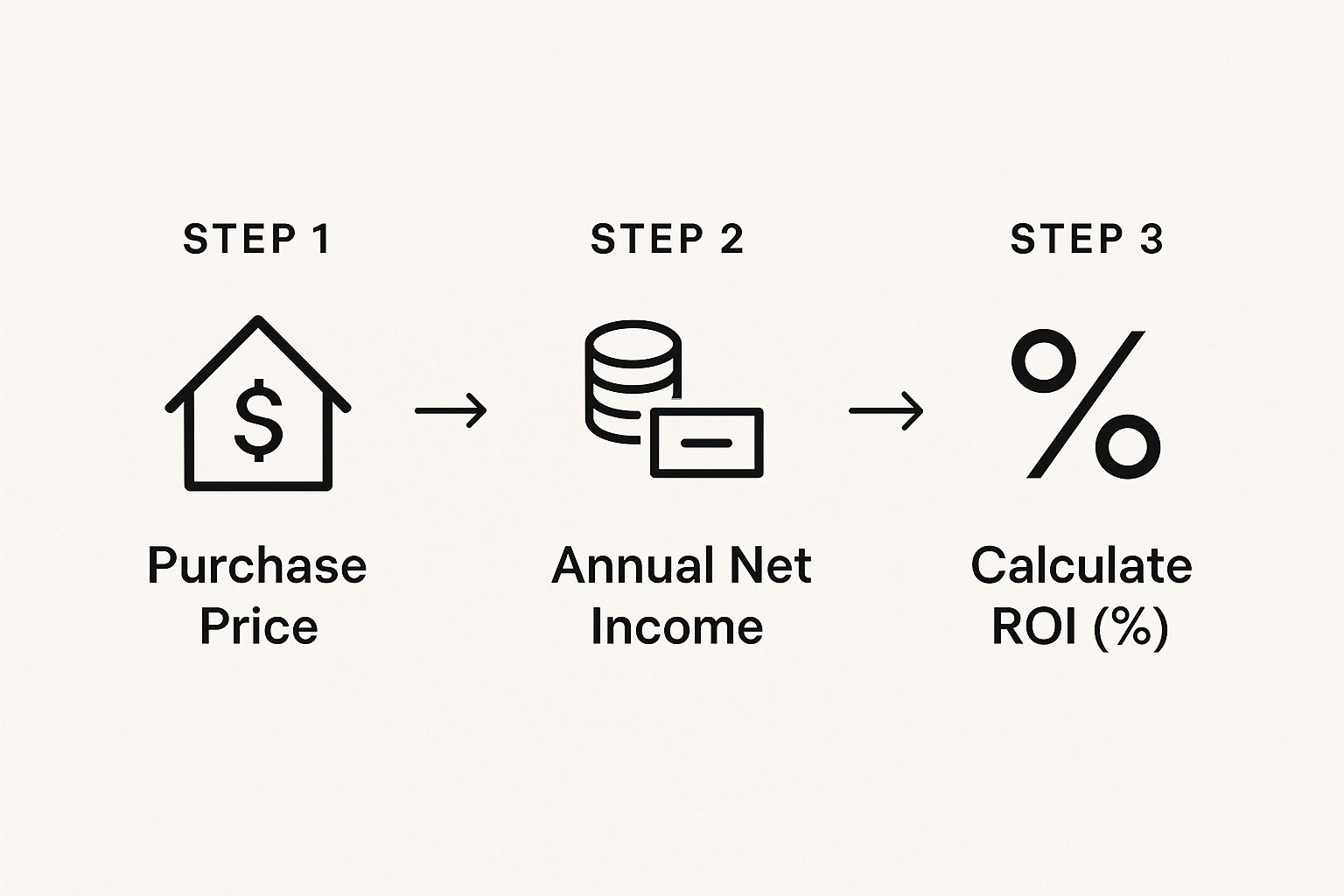
As you can see, a firm grasp of your purchase price and annual net income is the most direct route to a trustworthy ROI calculation.
Measuring Immediate Profitability with Cash-on-Cash Return
Your Cash-on-Cash Return is arguably the most powerful metric for understanding immediate profitability. It cuts to the chase, telling you how much pre-tax cash flow you’re generating each year relative to the actual cash you invested to acquire the property.
The formula is straightforward:
Annual Cash Flow / Total Cash Invested = Cash-on-Cash Return
Let's walk through an actionable, local example. Imagine you’re evaluating a duplex in a desirable Salinas neighborhood.
- Total Cash Invested: You make a down payment of $150,000 and pay $10,000 in closing costs. Your total cash investment is $160,000.
- Annual Cash Flow: After collecting rent and paying the mortgage, taxes, insurance, and maintenance, you have $12,000 left over for the year.
Your calculation is: $12,000 / $160,000 = 7.5%.
That 7.5% Cash-on-Cash return shows you precisely how hard your invested capital is working for you right now. It's an indispensable metric for comparing different properties, especially when deciding where to allocate your capital for the best immediate return. For a deeper dive, there are some great resources that explain how to calculate return on investment property in even more detail.
Factoring in Appreciation for Total ROI
Cash flow is critical, but it’s only half the story when investing in a high-value market like ours. The other, often more significant, piece of the puzzle is property appreciation—the growth in your property's value over time.
Total ROI provides a more complete picture by combining both cash flow and equity growth. This is especially true for long-term holds in sought-after locations like Pacific Grove or Carmel. Getting this full scope is why it's so critical to track your income and expenses meticulously. For more on that, you can explore our guide on mastering your Monterey County property’s financial reports.
While predicting appreciation is never an exact science, you can get a reasonable estimate by analyzing historical market trends here in Monterey County. By adding your annual cash flow to that projected equity gain, you get a holistic view of your investment’s power. This comprehensive understanding empowers you to make smart, wealth-building moves.
What a Good ROI Looks Like in Monterey County
So, you've plugged all the numbers into a rental property ROI calculator and it has produced a percentage. Now what? The critical question for a discerning investor is whether that number is actually good for an investment right here in Monterey County.
The truth is, there's no single magic number. What constitutes a great return is deeply personal and depends on your financial goals and the specific community you're investing in. The expectations for a high-end vacation rental in Carmel-by-the-Sea are worlds apart from a long-term family home in Soledad. One may offer lower cash flow but incredible appreciation, while the other provides a steady, predictable income stream.
Understanding these local nuances is the key to interpreting your results and aligning them with your goals.
Defining Your ROI Benchmarks
Many real estate investors target an 8% to 12% Cash-on-Cash Return. While this is a decent rule of thumb, it doesn't always capture the full picture in a premium market like ours. A lower cash-on-cash percentage can be more than acceptable if the property is in a sought-after area with a strong history of appreciation.
Consider this real-world example: A property in scenic Pacific Grove might generate only a 5% Cash-on-Cash Return. However, if it's also appreciating at 7% annually, your total return is very healthy. Conversely, a multi-unit building in King City could easily hit a 10% Cash-on-Cash Return with slower appreciation. Neither is inherently better—they simply fit different investment strategies.
The most practical way to judge a deal is to compare your calculated ROI against similar, recently sold properties in the same micro-market. This data-backed approach, a cornerstone of our service, tells you if your potential investment is performing at, above, or below the local standard.
Local Drivers That Influence Your Returns
Your ROI isn't a static figure. It’s a living number, constantly influenced by the unique economic pulse of the Monterey Bay Area.
A few key factors to keep in mind:
- Tourism & Seasonality: For properties in Monterey or Carmel, income will likely ebb and flow with tourist seasons. A busy summer and major events like Monterey Car Week can send revenue soaring, but you must budget for the quieter winter months to maintain stability.
- Agricultural Cycles: In the Salinas Valley, the health of the agricultural industry directly impacts rental demand and stability. Understanding these cycles is vital for accurately forecasting occupancy and rent in towns like Gonzales and Greenfield.
Navigating these local trends is precisely why so many high-end property owners turn to professional management. The industry is projected to grow from $24.18 billion to $52.21 billion by 2032, fueled by investors who need experts to handle rising rents and complex regulations to protect their ROI.
Ultimately, your ROI calculation is more than a number—it’s a strategic compass. It helps you decide when to refinance for better cash flow, when to sell for peak profit, or which new property is the right fit for your portfolio. To further optimize your returns, explore our guide on tax deductions for landlords in Salinas & Monterey County.
Actionable Strategies to Boost Your Property's ROI
Obtaining an initial number from a rental property ROI calculator is an excellent first step. Consider it a benchmark—a snapshot in time. For savvy investors in Monterey County, this calculation isn't the finish line; it's the starting line for building real wealth. Improving your property's financial performance means looking beyond simple rent hikes and taking a holistic, strategic view of your asset.
The real power lies in making smart, high-impact improvements that enhance your property's value and appeal to high-caliber tenants. This means focusing on the upgrades that residents in our local market value and are willing to pay a premium for.
Targeted Capital Improvements with Proven Returns
Not all renovations are created equal. While a fresh coat of paint is almost always a good idea, certain capital improvements provide a much bigger return by boosting your Net Operating Income (NOI) and, consequently, your ROI.
Actionable Example: For a family rental in a Salinas neighborhood, a modern kitchen is often the single most effective upgrade. Quartz countertops, new energy-efficient stainless steel appliances, and updated cabinetry can directly justify a higher monthly rent and attract a stable, long-term tenant, preserving your asset and cash flow.
Alternatively, for a luxury property in Pacific Grove, adding a beautifully landscaped, low-maintenance outdoor living space with a fire pit can significantly increase its desirability and rental value.
A key takeaway for our clients is to focus on improvements that enhance both aesthetics and functionality. Upgrades like smart home technology—thermostats, security systems, and keyless entry—are becoming standard expectations for premium tenants and can make your property stand out, justifying higher rent and reducing turnover.
Optimize Operations to Minimize Costs and Maximize Income
Beyond physical upgrades, some of the most effective ways to boost ROI involve fine-tuning your operations. Every dollar saved on expenses or prevented in lost income goes directly to your bottom line.
A thorough tenant screening process is your best defense against the high costs of vacancies and turnover. Finding a reliable, long-term resident ensures consistent income and less wear-and-tear on your property. Our guide on how to find good tenants provides a complete framework for this critical, time-saving step.
Proactive maintenance is another non-negotiable for property preservation. Here’s a simple checklist:
- Regular HVAC servicing to prevent system failure during a heatwave.
- Annual roof and gutter inspections, essential given our coastal climate.
- Scheduled pest control to keep the property clean, healthy, and desirable.
This hands-on approach not only prevents costly emergency repairs but also demonstrates a commitment to your tenants, which is key to retention.
The Financial Power of Professional Management
For many busy professionals and serious investors, the single greatest lever to pull for boosting ROI is partnering with a full-service property management firm. A professional partner handles every detail, from marketing and tenant relations to financial reporting and maintenance. This operational efficiency directly increases your NOI and frees up your most valuable asset: your time.
This isn't just a local trend; it's confirmed by global real estate data. For example, a recent report showed that even mature markets can see impressive growth with the right oversight, with annualized European total returns increasing to 4.8% and rents climbing by 4%. You can learn more about how market conditions and expert management drive returns from this global real estate outlook.
By putting these strategies into practice, you can transform your property from a passive asset into a dynamic, high-performing investment that grows in value and increases your returns, year after year.
Common Questions About Rental Property ROI
Even with a great rental property ROI calculator, it’s normal to have questions. What do these numbers really mean for your investment strategy here in Monterey County? Understanding the story behind the percentages is what separates a good decision from a great one.
Let's address some of the most common questions we hear from property owners like you, reinforcing the trust and transparency we're known for.
How Often Should I Recalculate My Property's ROI?
Your ROI isn't a "set it and forget it" number; think of it as a living metric for your investment's health. We advise our clients to run the numbers annually at a minimum. This yearly check-up ensures your analysis is current, factoring in changes to local property taxes, new insurance premiums, and shifting market rents across areas like Salinas and Monterey.
Actionable Advice: You should also recalculate ROI before any major financial move.
- Planning a capital improvement? Run the numbers first to project how the expense will impact future returns.
- Considering a mortgage refinance? A new interest rate will directly change your cash flow and bottom line. Model it out.
What Is a Good ROI in a High-Value Market?
This is the most common question, and the honest answer is always: it depends entirely on your goals.
You'll often hear a general target for Cash-on-Cash Return around 8-12%. But in a premium market like ours, that benchmark can be misleading. A property in a high-appreciation area like Pebble Beach might show a lower initial cash flow but could deliver spectacular total returns when you factor in its value growth over time.
Globally, what's considered a "good" return varies wildly. Some markets might boast rental yields over 10%, while others are much lower. This shows that ROI is always a product of location, risk, and economic stability. In Monterey County, the key is finding the right balance between immediate cash flow and powerful long-term appreciation.
The Biggest Mistake Investors Make
By far, the most common error we see is underestimating expenses. Investors often forget to budget for real-world costs: vacancy periods, nagging repairs, major capital expenditures (that new roof won't pay for itself), and professional management fees. A truly accurate ROI calculation demands a brutally honest look at all potential costs to ensure transparency and prevent future surprises.
How Does Professional Management Improve My ROI?
Hiring a professional property manager is not an expense—it's an investment that directly fuels your ROI. It works by improving your numbers in a few key areas, delivering peace of mind and time-saving solutions:
- Reduced Vacancy: Top-tier marketing and a rigorous tenant screening process find higher-quality tenants faster, keeping your property occupied and generating income. Our guide on proven tenant retention strategies dives deep into how keeping great tenants is one of the best ways to protect your cash flow.
- Lower Maintenance Costs: We focus on proactive, preventative maintenance. This approach catches small issues before they become expensive emergencies, preserving your asset.
- Optimized Rent: With deep local data, we price your property at the sweet spot—high enough to maximize your income but competitive enough to attract a pool of qualified applicants.
These efficiencies work together to boost your Net Operating Income (NOI), the real engine driving your ROI. While our world is rental properties, the core principle of using a dedicated financial tool to get clear on the numbers applies everywhere. For example, you can see how financial planning calculators work for other types of assets. The goal is always the same: gain clarity and make smarter decisions.