
A Guide to Commercial Landlord Responsibilities in California
Owning commercial property in California means more than just collecting rent. Your responsibilities are defined by state law and the lease agreement you sign with your tenant. In short, your job is to maintain a safe and functional property, follow the law, and honor your lease.
For investors in high-value markets like Salinas and Monterey, meeting these obligations is key to protecting your asset and maximizing your return. This guide offers practical, actionable steps for managing your commercial property effectively.
Your Core Duties as a California Commercial Landlord
For a serious investor, a commercial property is a high-performing asset. But maximizing that return on investment (ROI) requires a professional understanding of your legal and operational duties. This is especially true here in the Monterey Bay Area, where property values are high and tenants expect quality service.
Think of your responsibilities as the foundation of a profitable tenancy. If that foundation cracks because you've neglected a key duty, you can expect costly legal disputes, a damaged professional reputation, and a direct hit to your property's value. Whether you own a retail space in downtown Salinas or an office building in Pacific Grove, a proactive management style is essential.
Key Areas of Responsibility
Your duties fall into a few key categories. Mastering each one is crucial for your long-term success.
- Property Maintenance and Safety: This is your top priority. You are responsible for the building's structure—the roof, foundation, and common areas. This also means ensuring essential systems like HVAC, plumbing, and electrical are in good working order.
- Legal and Regulatory Compliance: California's laws change often. As a landlord, you must stay current on everything from ADA accessibility standards to new tenant protection laws that might affect your small business tenants.
- Lease Administration: Your lease is the most important document in your relationship with a tenant. It must be clear, detailed, and legally solid to prevent confusion and protect everyone involved.
- Financial Management: This covers the business side of things, including collecting rent on time, keeping accurate records, and handling security deposits according to state law.
Here's a quick checklist to keep these essential duties in mind.
Key Landlord Responsibilities at a Glance
| Responsibility Area | Core Tasks and Actionable Steps |
|---|---|
| Maintenance & Safety | Ensure structural integrity (roof, foundation), maintain common areas, and keep essential systems (HVAC, plumbing, electrical) fully operational. |
| Legal & Compliance | Follow all federal, state, and local laws, including ADA standards, building codes, and specific commercial tenancy regulations in Monterey County. |
| Lease Administration | Draft and enforce clear, legally sound lease agreements. Fulfill all landlord obligations outlined within the lease. |
| Financial Management | Collect rent on time, manage security deposits according to California law, and maintain accurate financial records for the property. |
| Tenant Disclosures | Provide all legally required disclosures to tenants, such as the presence of hazardous materials or known environmental issues. |
| Risk Mitigation | Carry proper insurance, implement safety protocols, and address potential hazards quickly to protect both tenants and your investment. |
For a deeper look into the legal framework, it’s helpful to understand the details of landlord-tenant laws in California. These rules provide the specific guidelines that both property owners and tenants must follow.
Juggling these duties takes time and expertise. It's not just about fixing problems as they appear; it's about having systems in place to prevent them. This professional oversight keeps your investment secure and growing in value, giving you the peace of mind that comes from knowing your asset is in expert hands.
Maintaining a Safe and Structurally Sound Property

As a commercial landlord in California, your most important job is to provide a safe and structurally sound property. This is the foundation of a good landlord-tenant relationship and the best way to protect your investment. This duty goes far beyond minor cosmetic fixes.
Think of it as being responsible for the "bones" of the building. Your job is to make sure the essential framework is always in top condition. This includes the roof, the foundation, the exterior walls, and all common areas.
The Landlord’s Domain: Key Structural and System Responsibilities
Knowing where your duties end and your tenant's begin is critical. In California, landlords are generally responsible for the major structural parts and building-wide systems.
Here’s what typically falls under your care:
- Structural Integrity: This means keeping the roof from leaking, ensuring the foundation is solid, and fixing any problems with the exterior walls. For example, the historic brick buildings in Oldtown Salinas require special masonry work—a classic landlord responsibility.
- Essential Building Systems: You must keep the main systems running smoothly. This includes the building's main HVAC (heating, ventilation, and air conditioning) units, central plumbing, and the primary electrical grid.
- Common Areas: Any space shared by multiple tenants is your responsibility. This includes lobbies, hallways, elevators, public restrooms, and parking lots. Keeping these areas well-lit, safe, and in good repair is a must.
Creating a Proactive Maintenance Schedule
Waiting for something to break is one of the costliest mistakes a property owner can make. A sudden HVAC failure or a major roof leak can disrupt your tenants' businesses, cause thousands in damage, and force you into expensive emergency repairs. A proactive approach is the mark of a professional.
"Preventive maintenance isn't a cost; it's an investment in your property's future and your tenants' satisfaction. A well-maintained property in areas like Pebble Beach or Carmel not only earns higher rents but also attracts and keeps high-quality, long-term tenants."
By setting up a regular maintenance schedule, you can catch small issues before they become major problems. This preserves your property's value and shows tenants you are a serious, professional owner, which builds trust and encourages lease renewals.
A Practical Checklist for Monterey County Properties
Every property is different. An office park in Monterey has different needs than a storefront in King City. However, this checklist can give you a strong foundation.
Your Preventive Maintenance Checklist:
- Semi-Annual Roof Inspection: Check for damaged tiles and weak seals. Clear debris from gutters, especially before the rainy season arrives in the Monterey Bay Area.
- Quarterly HVAC Servicing: Hire a licensed professional to service all central heating and A/C units. This ensures they run efficiently and keeps the filters clean.
- Annual Plumbing and Electrical Review: Have a plumber inspect main lines for leaks and an electrician check panels for safety and code compliance.
- Monthly Common Area Walk-Through: Check parking lots for potholes, test lighting in shared spaces, and inspect the condition of elevators, lobbies, and restrooms.
- Seasonal Landscaping and Exterior Upkeep: Maintain your property's curb appeal. Manage irrigation systems and touch up any exterior paint or siding.
Smart landlords also look into larger commercial property improvements to boost property value and keep tenants happy. These proactive steps don't just fulfill your legal duties—they build your reputation as a top-tier landlord. For busy investors, partnering with a professional property manager like Coast & Valley ensures this critical work gets done right, protecting your time and your ROI.
Navigating New Compliance Rules for Small Business Tenants
The world of commercial real estate in California is always changing. As a landlord, staying on top of new laws is essential to protecting your investment. If you own property in communities like Salinas or Monterey, you likely lease to small, local businesses. A major new law changes how you interact with these tenants.
As of January 1, 2025, a new law known as Senate Bill 1103 (SB 1103), or the Commercial Tenant Protection Act, is in effect. This law creates new rules for leases with 'qualified commercial tenants' (QCTs). This group includes microenterprises (five or fewer employees), small restaurants (fewer than 10 employees), and nonprofits (fewer than 20 employees). Landlords now have new duties around operating costs, lease terminations, and even language translation.
Who Is a Qualified Commercial Tenant?
First, you need to know who this law applies to. A tenant gets these new protections if they fit one of those small business categories and they give you a written notice stating their status. This is a key point for property owners in places like Soledad or Gonzales, where small businesses are common.
Here’s the breakdown. A tenant is a "Qualified Commercial Tenant" (QCT) if they are:
- A microenterprise with five or fewer employees (including the owner).
- A restaurant with fewer than 10 employees.
- A nonprofit organization with fewer than 20 employees.
AND
- They have notified you in writing that they qualify.
That written notice is the trigger. Once you receive it, a different set of rules applies to that lease.
New Landlord Obligations Under SB 1103
For any serious investor, compliance is about protecting your reputation and keeping your business running smoothly. SB 1103 brings several important changes.
1. Restrictions on Pass-Through Operating Costs: You can no longer pass on building operating costs to a QCT without providing detailed, itemized proof. Every charge must be backed up by actual invoices. If they ask for this proof in writing, you have 30 days to provide it.
2. Extended Notice Periods: The law now requires more advance warning for certain actions:
- Rent Increases: For any rent increase over 10% in a 12-month period, you must now give a 90-day written notice.
- Lease Termination: For a month-to-month tenant who has been there for over a year, you must now provide a 60-day notice to end the lease.
3. Lease Translation Requirements: If you negotiated the lease mainly in Spanish, Chinese, Tagalog, Vietnamese, or Korean, you must now give the tenant a translated version of the entire lease before they sign it.
This flowchart shows a typical workflow for maintenance, which relies on clear communication and documentation—the same principles SB 1103 now requires.
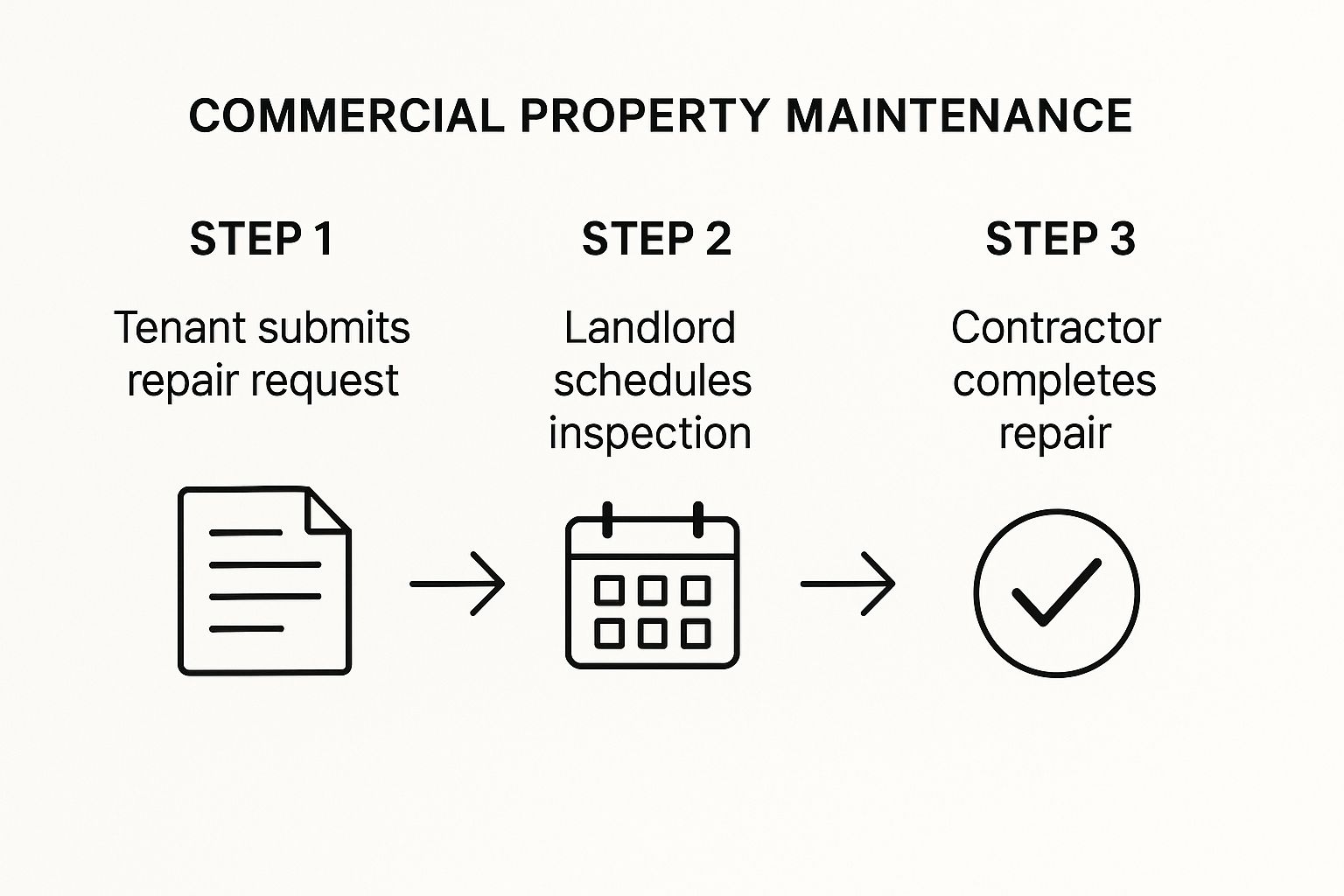
The image highlights that a structured, transparent process is vital in modern property management. That's exactly what this new law demands for your financial dealings with qualified tenants.
Actionable Takeaway: The responsibility for proof has shifted to the landlord. Detailed records and clear communication are now legal requirements when dealing with QCTs. Getting this wrong could lead to lawsuits, including financial damages.
To get ahead of these rules, you need to be proactive. Update your lease paperwork, keep perfect financial records, and ensure you find the right tenants from the start. Our professional tenant placement services can help you start every new tenancy on solid legal ground. By adopting these changes, you not only stay compliant but also build your reputation as a professional, trustworthy property owner in the Monterey Bay Area.
Crafting an Ironclad Commercial Lease Agreement
The commercial lease agreement is the most important document in your relationship with a tenant. It’s the legal foundation that defines every part of the tenancy. A vague lease is an invitation for future problems, while a clear, detailed agreement protects your investment and sets clear expectations from day one.
For owners of high-end properties in the Monterey Bay Area, using a generic lease template is a huge risk. The needs of a retail shop in downtown Monterey are very different from an ag-tech office in the Salinas Valley. Customizing your lease is a non-negotiable part of professional property management.
Essential Clauses Every California Lease Must Include
A strong lease is a detailed roadmap for both you and your tenant. It leaves no room for confusion and addresses potential conflicts before they happen. Every professionally drafted California commercial lease should include these key sections.
Here are the critical parts you can't afford to skip:
- Rent Terms: Clearly state the rent amount, due date, grace periods, and how late fees are calculated. This section must also outline the terms for any future rent increases.
- Permitted Use: This clause is vital. It defines exactly what the tenant can do on the property. This prevents a quiet office space from turning into a busy retail store.
- Maintenance Responsibilities: Clearly state who is responsible for what. Usually, the landlord handles major items like the roof and common areas, while the tenant manages repairs inside their own space. Spelling this out prevents costly arguments later.
- Insurance Requirements: Require your tenant to carry enough liability and property insurance. Your lease should state the minimum coverage amounts and require them to list you, the property owner, as an additional insured.
A well-structured lease reduces confusion and protects your ROI. It turns the landlord-tenant relationship into a clear, professional business partnership.
Defining Default and Remedies
Even with the best tenants, you must plan for worst-case scenarios. A strong lease clearly defines what a default is—like failing to pay rent or violating the "permitted use" clause—and outlines the steps you can take in response. This section should detail the notice periods required by California law and the legal options available to you, including eviction.
Having these rules in writing is crucial. It ensures that if a problem arises, you can act quickly and legally to protect your property and income. The clarity of a well-crafted lease is one of the most powerful tools a landlord has. For a complete overview of landlord duties, our commercial property management guide offers additional insights.
At Coast & Valley, we create custom lease agreements that address the unique needs of properties throughout Salinas and Monterey County. We ensure every lease is legally strong and tailored to protect your specific investment goals, giving you peace of mind.
Handling Accessibility Laws and Legal Disclosures
Your duties as a commercial landlord in California go beyond the lease agreement. State and federal laws require you to maintain an accessible property and provide tenants with specific legal disclosures. Getting this wrong can lead to expensive lawsuits and damage your professional reputation.
For the serious investor, handling these rules proactively is simply smart risk management.
Think of accessibility and disclosures as two sides of the same coin: transparency. One ensures physical access for everyone, while the other provides information about potential property issues. Both are non-negotiable.
Complying with the Americans with Disabilities Act (ADA)
The Americans with Disabilities Act (ADA) is a federal law that prohibits discrimination against people with disabilities. It has major impacts on commercial properties. While a lease can shift some duties, the landlord is almost always responsible for making sure the building’s permanent structures and common areas are compliant.
This is especially true for areas open to the public, such as:
- Parking Lots: You need enough clearly marked, accessible parking spaces.
- Entrances and Exits: This means providing ramps where needed and ensuring doorways are wide enough for wheelchair access.
- Common Area Restrooms: Public restrooms must meet all ADA requirements for stalls, sinks, and space to move.
While your lease should assign responsibility for making the tenant's specific space compliant, you, the owner, are ultimately responsible for the building's public areas. A regular ADA compliance audit is a smart investment to avoid costly legal battles.
As the property owner, you set the standard for compliance. A proactive audit can find and fix potential ADA issues in areas from Pacific Grove to King City before they become a legal problem, protecting both your asset and your bottom line.
Navigating Mandatory California Disclosures
Beyond physical access, California law requires landlords to give tenants specific written disclosures before a lease is signed. This ensures tenants know about any potential issues with the property. Failing to provide these can give a tenant legal grounds to break the lease or even sue.
Some of the most common required disclosures for commercial properties include:
- Hazardous Materials: You must disclose the known presence of any hazardous substances, like asbestos. This is especially important for older buildings. To help, we've prepared a detailed guide on the lead paint disclosure rules in California.
- Energy Consumption Data: For entire buildings over a certain size, you may need to disclose energy usage data to potential tenants.
- Construction Defect Lawsuits: If the property has ever been part of a construction defect lawsuit, that information must be disclosed.
For busy investors, keeping track of these requirements can feel like a full-time job. At Coast & Valley, we make compliance checks part of our core management services. We ensure your properties in Salinas and across the Monterey Bay Area meet every legal standard, protecting you from risk.
Protecting Your Investment with Professional Management

Managing a high-value commercial property in Monterey County is a full-time commitment. As we've seen, the list of commercial landlord responsibilities in California is long and requires real expertise in law, finance, and building operations.
For a busy investor, trying to juggle proactive maintenance, strict ADA compliance, and new laws like SB 1103 can quickly become overwhelming.
This is where professional property management makes all the difference. It's the most effective way to protect your asset, save time, and maximize your return on investment. A dedicated management partner handles the daily details, freeing you to focus on your larger investment strategy.
Your Concierge-Level Solution in the Monterey Bay Area
At Coast & Valley, we offer a full-service, concierge-level solution designed for serious property owners in Salinas, Monterey, and the surrounding South County communities. Our approach is built on deep local expertise and a personal commitment to protecting your asset as if it were our own.
We handle every landlord responsibility, so you don't have to:
- Proactive Maintenance: We create and follow strict preventive maintenance schedules to keep your property in top condition, preventing costly emergency repairs.
- Legal Compliance: Our team stays ahead of changing laws, ensuring your leases, disclosures, and operations are fully compliant with all state and local regulations.
- Ironclad Lease Administration: We draft and manage custom leases built to protect your interests and set clear expectations for tenants, which reduces disputes.
- Financial Oversight: You get transparent, detailed financial reports that give you a clear picture of your property’s performance. Understanding key real estate investment metrics is essential for success, and we provide the strategic oversight you need.
As a fourth-generation Salinas native, our founder Amy Salmina understands the unique demands of the Monterey County market. This deep local knowledge means your property is managed with an insider’s perspective, whether it’s a retail space in Pacific Grove or a professional office in Gonzales.
For owners of high-end properties, that kind of peace of mind is priceless. It’s the confidence of knowing a professional team is protecting your investment, handling tenant relations with care, and managing every legal detail.
This is how you enjoy the rewards of property ownership without the daily stress. We invite you to learn more about our dedicated approach to Pacific Grove property management and see how we can improve your investment experience.
If you’re ready to shift from being a hands-on landlord to a strategic investor, contact Coast & Valley. Let us show you how our professional management services deliver the trust, transparency, and results your property deserves.
Still Have Questions? Let's Clear a Few Things Up.
Navigating commercial property ownership can bring up many questions. Here are straightforward answers to common issues we see landlords in Salinas and the Monterey Bay Area face.
Who Is Responsible for ADA Compliance in a California Commercial Lease?
In California, it’s a shared responsibility. As the landlord, you are generally responsible for the "bones" of the building and its common areas. This includes parking lots, public entrances, lobbies, and shared restrooms.
The tenant's private space is where it gets tricky. Your lease agreement must clearly state who is responsible for making that specific area compliant. A professionally drafted lease is your best tool to avoid confusion and future legal problems over who pays for what.
What’s the Real Risk If I Ignore the New SB 1103 Rules?
Ignoring SB 1103 can lead to serious legal and financial trouble. If you have a "qualified commercial tenant"—like a small local restaurant or a microenterprise—they can sue you for actual damages, attorney's fees, and even punitive damages.
This is not a small penalty. It means that keeping detailed records and following the new notice and disclosure rules are non-negotiable when leasing to these protected small businesses. Claiming you didn't know the rules will not work as a defense in court.
Can I Pass All My Operating Costs on to My Commercial Tenants?
That depends on your lease. With a standard Triple Net (NNN) lease, it's common for tenants to cover property taxes, insurance, and common area maintenance (CAM) charges.
However, the rules change for "qualified commercial tenants" under SB 1103. The law places new limits and requires strict proof. You can't just send a bill; you must provide detailed, itemized invoices for any charge you pass through. Working with a professional ensures your leases are structured to recover costs while staying 100% compliant.
Juggling these responsibilities takes time, deep expertise, and knowledge of changing state and local laws. At Coast and Valley Properties, we provide the professional oversight you need to not only protect your asset but to ensure it’s performing at its best.
Schedule a consultation with our team to secure your investment's future.