
Rent Control in Monterey County: What Luxury Property Owners Actually Need to Know in 2025
For luxury property owners in Monterey County, the conversation around rent control in 2025 can feel confusing. While the county doesn’t have a universal rent cap, state laws like the Tenant Protection Act (AB 1482) and specific local rules create a complex web of regulations. Understanding these layers is critical to protecting your investment, whether you own property in Carmel, Pebble Beach, or Salinas.
Your 2025 Outlook for Monterey County Rent Control

As an owner of a high-end property, you’re focused on market trends, tenant quality, and preserving your asset. But today, the regulatory landscape is just as important. Many sources can tell you what the laws are, but they often miss the practical details that directly impact your ROI. This guide goes beyond dense legal text to give you actionable, concierge-level insights.
We connect the dots between legal rules and the real-world decisions you make every day. Our goal is to give you a clear snapshot of the current situation so you can manage your properties with confidence.
Navigating the Current Regulatory Climate
The biggest hurdle for owners is telling the difference between statewide mandates and local city rules. While Monterey County itself doesn't have a sweeping rent control policy, it’s not a regulatory free-for-all.
Here are the key factors you need to have on your radar:
- California Tenant Protection Act (AB 1482): This is the big one. This state law sets a cap on annual rent increases and establishes "Just Cause" eviction requirements for most properties.
- Local City Ordinances: Cities like Salinas have their own rent stabilization rules that can impose even stricter limits than the state law.
- Exemptions Under Costa-Hawkins: This act provides critical exemptions for single-family homes, condos, and properties built after 1995—a vital detail for many luxury property owners.
"Many landlords are unaware that first-year impressions and smooth onboarding are now essential under Just Cause rules. Our white-glove, compliance-forward approach ensures all leases and notices meet evolving standards from day one." – Amy Salmina, Founder of Coast & Valley Properties
To give you a quick summary, here are the most critical concepts for luxury owners.
| Key Rent Control Factors for Monterey County Luxury Properties in 2025 |
| :— | :— |
| Regulatory Factor | What It Means for Your Luxury Rental |
| AB 1482 Rent Caps | This state law likely limits your annual rent increases to 5% plus inflation, or 10% total, whichever is lower. |
| Just Cause Eviction | You can no longer end a tenancy without a specific, legally-defined reason after a tenant has lived there for 12 months. |
| Costa-Hawkins Act | Your newer single-family home or condo might be exempt from the rent cap part of AB 1482, but you must provide proper written notice to the tenant for the exemption to apply. |
| Local Ordinances | A property in Salinas may face different, stricter rules than an identical one in Monterey. Knowing city-level regulations is non-negotiable. |
This table highlights the areas where we see owners get tripped up the most. Getting these details right from the start is key to avoiding headaches later.
Why Proactive Management Is Non-Negotiable
Waiting for a problem to pop up is no longer a viable strategy. As tenant advocacy groups increase pressure in cities from Salinas to Seaside, owners need to get prepared now. This means reviewing lease clauses, understanding your property’s exemption status, and making sure every tenant interaction is documented.
Staying compliant while protecting your profits demands a sophisticated approach—one that blends legal awareness with operational excellence. Managing these details efficiently often means using the right tools. You can explore the latest property management technology trends to see how modern platforms can help streamline this process.
Understanding Statewide Laws vs. Local Ordinances
If you own a high-end rental property in Monterey County, you’re navigating two sets of rules. Think of it like this: California law sets the foundation, but individual cities can build their own, stricter regulations on top.
Understanding how these state and local laws interact is essential for running a compliant and profitable rental business.
The main statewide law is the Tenant Protection Act of 2019, also known as AB 1482. It created a statewide cap on rent increases and established "Just Cause" eviction rules that apply to most rental properties. It’s the framework every landlord in California must work within.
But local rules can add another layer of complexity. A property in Salinas, for example, could be subject to different regulations than an identical property just a few miles away in Monterey. This is why a one-size-fits-all approach to your leases and rent increases will get you into trouble.
The Statewide Foundation: AB 1482
First, let's break down the state law, AB 1482. Its rules generally apply to multi-family buildings older than 15 years and single-family homes owned by corporations. For luxury property owners, this law introduced two game-changing concepts you have to master.
- Statewide Rent Cap: AB 1482 limits how much you can raise the rent each year. The cap is 5% plus the local inflation rate (CPI), but it can never go higher than a total of 10%. This number changes, so you must check the current allowable percentage before sending an increase notice.
- "Just Cause" Eviction Protections: Once a tenant has been in your property for a full year, you can't simply ask them to leave. You now need a specific, legally recognized reason to end their tenancy. These reasons are split into two types: "at-fault" causes (like not paying rent) and "no-fault" causes (like you deciding to move into the property yourself).
The "Just Cause" rule fundamentally changed the landlord-tenant dynamic. It makes your initial tenant screening process more critical than ever. Since removing a problem tenant is now a more involved process, you have to be confident you're placing a high-quality, reliable resident in your property from day one. To get a better grasp of your rights and duties, check out our guide on California's landlord-tenant laws.
The Local Focus: Salinas's Rent Stabilization Ordinance
While the state sets the minimum rules, cities can go further. Salinas is a perfect example. Facing pressure on housing costs, the Salinas City Council passed its own Rent Stabilization Ordinance, adding a tighter set of rules for certain properties.
Starting January 1, 2025, this local ordinance caps annual rent increases at either 2.75% or 75% of the Consumer Price Index (CPI) increase—whichever is lower. That’s much more restrictive than the statewide cap.
But—and this is a big but—the Salinas ordinance mainly targets multifamily apartment buildings constructed before 1995. You can read more about the Salinas Rent Stabilization policy to see its specific exemptions, which usually include single-family homes, condos, and newer construction.
For luxury property owners, the lesson is simple: your strategy has to be hyperlocal. The rulebook for your upscale apartment complex in Salinas is completely different from the one for your modern, single-family home in Pebble Beach.
This two-tiered system means you can't rely on generic online advice. Every decision, from writing your lease to calculating a rent increase, must be filtered through both sets of regulations. This is where professional, local management pays off—turning dense legal text into a clear, actionable strategy that protects your valuable Monterey County asset.
How to Determine if Your Luxury Property Is Exempt
For owners of high-end properties in Monterey County, this is the million-dollar question: does rent control even apply to me? Figuring out if your property is exempt is the first step to operating with confidence. The answer is found in a state law called the Costa-Hawkins Rental Housing Act, which creates major exemptions for most luxury rentals.
This powerful act tells local rent control ordinances—like the one in Salinas—that they can't touch certain types of properties. This gives owners of these assets more freedom in setting and adjusting rents. If your property qualifies, you're exempt from local rent caps, but you still have to follow statewide rules under AB 1482 unless you provide the proper notices.
The good news? Most single-family homes, condominiums, and newer buildings fall under these protections. But the details matter, and getting them wrong can lead to expensive compliance headaches.
The Costa-Hawkins Exemption Checklist
Working out if your property is exempt is straightforward if you pay close attention to three things: property type, age, and ownership.
Here’s a simple framework to help you assess your Carmel, Monterey, or South County property:
-
Property Type: Is your rental a single-family home or a condominium? If yes, it's generally exempt from local rent control. This is the most common exemption for owners of high-end homes.
-
Construction Date: Was your property built after February 1, 1995? Any residential property that received its certificate of occupancy after this date is exempt from local rent caps.
-
Ownership Structure: Is the property owned by an individual, a living trust, or an LLC where every member is an individual? This detail is crucial. If a single-family home is owned by a corporation or a Real Estate Investment Trust (REIT), it loses its exemption and falls under the statewide rent cap.
This decision tree gives you a clean visual walkthrough to help figure out your property's status.
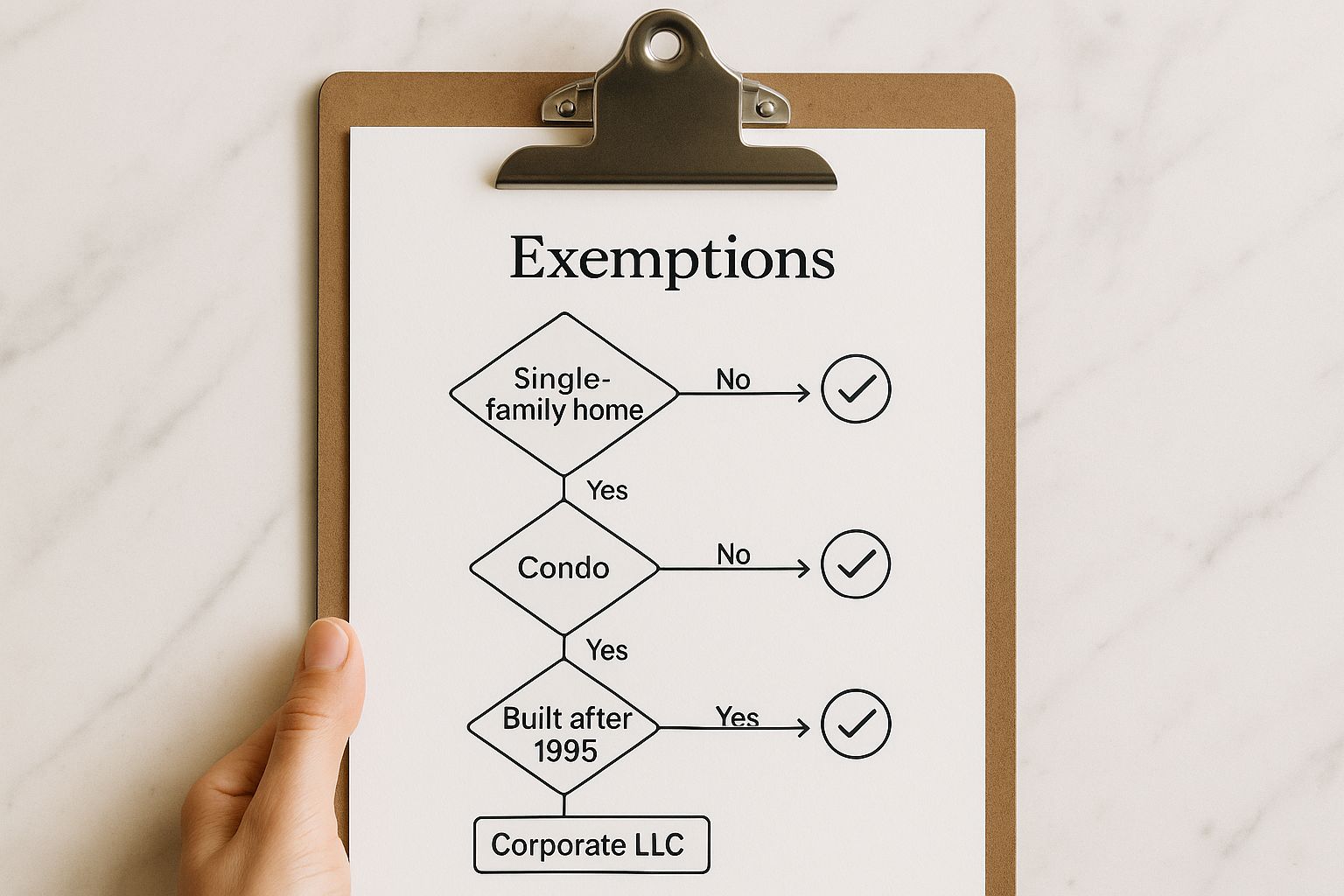
This chart cuts through the complexity, showing the clear paths to exemption and helping you spot potential compliance risks.
Nuances That Trip Up Sophisticated Owners
While that checklist seems simple, a few finer points often trip up even seasoned investors. Nailing these details is essential for staying on the right side of the law.
The most common mistake we see involves ownership structure. An investor might put their single-family homes into a corporate LLC for liability protection, not realizing that move could make those properties subject to statewide rent caps. The law is clear: for a single-family home to be exempt, it cannot be owned by a corporation.
"Verifying your ownership structure is just as important as knowing your property’s construction date. A simple detail in a deed can change the entire regulatory framework that applies to your investment, impacting everything from rent increases to lease renewals." – Amy Salmina, Founder, Coast & Valley Properties
Another tricky area is the "two or more dwellings on the same lot" rule. Let's say you own a luxury property in Pacific Grove with a main house and a detached guest unit (ADU) on the same parcel. That setup might not qualify for the single-family home exemption.
Navigating these gray areas demands a proactive and detailed approach. It means digging into deeds, trust documents, and property records. This level of diligence is a core part of our high-net-worth property management services. We make sure every asset is classified correctly to shield our clients from surprise liabilities.
Protecting Your ROI Under Rent Increase Limits
Even if your luxury property falls under rent caps, your return on investment is far from set in stone. Smart financial strategy isn't about finding loopholes; it's about creating value within the rules. For owners of premier properties in Salinas and across Monterey County, this means shifting from a passive approach to a proactive, business-minded one.
By focusing on three core areas, you can protect your property's performance and continue attracting top-tier tenants.
1. Set the Initial Rent Correctly
Your single most powerful tool for protecting long-term ROI is setting the initial rent correctly. This starting number is the anchor for every future increase. Each adjustment will be calculated from that original figure.
- If you set it too low, you're leaving money on the table for the entire tenancy.
- If you go too high, you risk long, costly vacancies that eat into profits.
The right approach demands a deep dive into the market, analyzing comparable luxury properties in your specific neighborhood, whether it's Pacific Grove or Soledad. Getting it right from day one is the most effective way to secure your revenue. This initial pricing decision directly impacts your property's financial health and is a key component when you calculate net operating income.
2. Add Value Through Ancillary Revenue
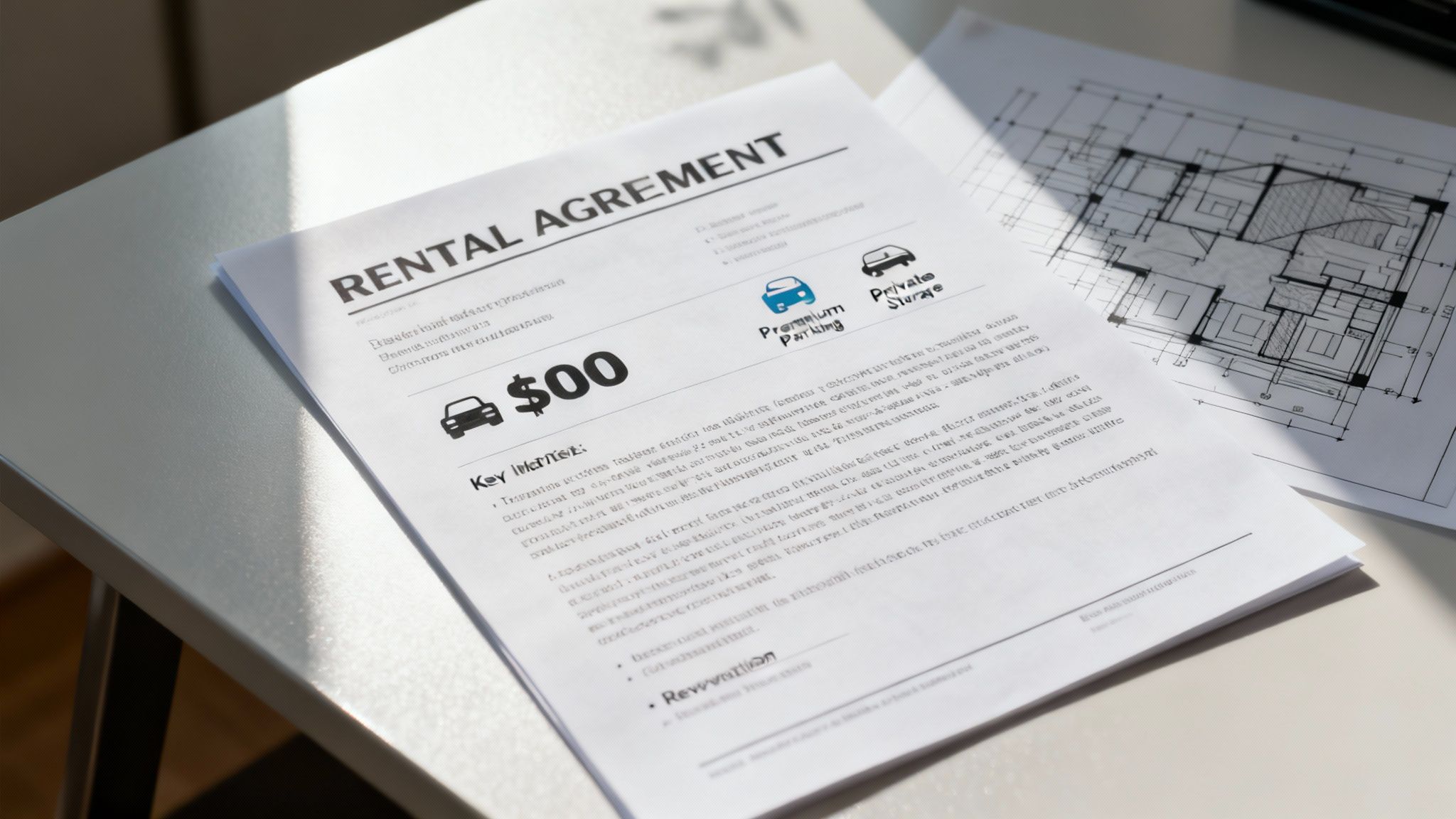
Rent caps apply to the base rent, but they don’t have to dictate your property's total income. One effective strategy is to unbundle services and offer premium amenities for an additional fee. This allows you to generate revenue streams separate from the regulated monthly rent.
Consider these practical examples:
- Premium Parking: Offer a reserved or garage parking space for a monthly fee.
- Private Storage: Lease secure, on-site storage units to tenants.
- Pet Fees: Instead of a one-time deposit, consider a monthly "pet rent" for approved animals.
- Furnished Options: Provide a turnkey, high-end furnished unit that commands a premium.
This approach not only boosts your bottom line but also improves the living experience for tenants. It's a win-win that adds value without touching the base rent. Of course, it's also important to implement strong strategies to protect your home when renting, ensuring your asset remains in top condition.
3. Use Renovations Strategically
Thanks to the Costa-Hawkins Rental Housing Act, landlords can establish a new, market-rate rent once a tenant voluntarily moves out. This is known as vacancy decontrol, and it makes strategic renovations one of your most powerful tools for resetting your property’s income potential.
To be clear, a renovation doesn't let you raise the rent on a current tenant beyond the legal limit. But investing in substantial upgrades between tenancies—like a full kitchen remodel or installing smart home tech—justifies a significantly higher asking rent for the next resident.
This proactive approach ensures your property keeps pace with the high expectations of luxury renters, allowing you to legally and ethically maximize its revenue potential over the long haul.
The Hidden Risks to Your Property's Long-Term Value
When people talk about rent control, the conversation usually sticks to the immediate financial impact—the yearly cap on rent increases. But for owners of high-end properties in Monterey County, the real story is much deeper. The true risks are more subtle, quietly chipping away at your property's long-term value and your operational freedom.
These consequences go beyond a simple rent ceiling. They can change tenant behavior and reshape market dynamics, creating hurdles that many landlords in Salinas, Monterey, and even South County towns like Soledad and King City don't see coming.
The Problem With Low Tenant Turnover
On the surface, low tenant turnover sounds great. But in a rent-controlled world, that stability can become a double-edged sword for a luxury property.
When tenants are locked into a rate that’s well below market value, they have a huge incentive to stay put. This creates a couple of major problems:
- Deferred Maintenance: It becomes nearly impossible to perform the deep maintenance and significant upgrades a luxury asset needs. A long-term tenant means you can't get in to do heavy lifting, so small issues can snowball into expensive repairs.
- Market Rate Disconnect: Every year, the gap between the controlled rent and what the property should be earning gets wider. You could have a beautiful home in Pacific Grove that should command $5,000 a month, but you're legally stuck collecting $3,000 from a long-term tenant.
This growing gap makes it hard to get the rent back up to fair market value without pouring a ton of money into a major renovation.
How This All Impacts Your Property’s Valuation
Beyond daily cash flow, rent control can directly harm your property's overall valuation. When potential buyers and appraisers look at your building, they are analyzing its income stream. A building full of below-market rents is simply worth less than an identical, non-regulated property.
It's a straightforward calculation: the property’s Net Operating Income (NOI) is artificially held down. A lower NOI always translates to a lower sale price, hurting your ability to leverage the asset or sell it for its true worth.
"The long-term risk of rent control isn't just about lost monthly income; it's about the erosion of your asset's capital value. Proactive management that focuses on preservation and compliance is the only effective defense against this silent depreciation."
Then there's the very real possibility of a shrinking rental supply. In San Francisco, for instance, studies revealed that rent control gave landlords a powerful incentive to get out of the rental business, leading to a 15% decrease in available rent-controlled housing.
This is where sharp, forward-thinking property management becomes non-negotiable. At Coast & Valley, we do more than just collect rent. We build strategies designed to shield your asset from these long-term risks. From proactive maintenance schedules to meticulous tenant vetting, our system is built to protect both the financial and physical health of your investment.
Your Proactive Compliance Checklist for 2025
Navigating rental regulations can feel like a full-time job. For owners of high-end properties in Monterey County, staying compliant isn't just about avoiding legal headaches; it's about protecting the long-term value of your investment.
Think of it as a core business practice. This checklist breaks down the legal jargon into clear, actionable steps to help you manage your properties with confidence in 2025.
1. Audit Your Lease Agreements and Disclosures
Your lease agreement is your most important document. It needs to be updated to reflect the latest laws, especially regarding exemptions.
- Action Step: Check your lease for the correct AB 1482 exemption language. If your single-family home or condo is exempt from statewide rent caps, your lease must contain the specific, legally required disclosure. Without it, your exemption is invalid.
- Action Step: For any properties in Salinas, double-check that your lease aligns with the city's Rent Stabilization Ordinance. This means having clear terms on rent, utilities, and services provided.
2. Confirm Property Records and Ownership Details
Your property's age and ownership structure determine which rules apply. Don't assume—get the official proof.
- Action Step: Find the certificate of occupancy to confirm if your property was built before or after 1995. This year is a critical dividing line for many exemptions under the Costa-Hawkins Act.
- Action Step: If you own a single-family home through an LLC, confirm that every member is an individual. Any corporate ownership, even partial, can eliminate your exemption from statewide rent caps.
Being proactive means treating your rental property with the same diligence as any other high-value investment. A yearly compliance audit ensures your documentation is as pristine as your property.
3. Systematize Your Processes and Documentation
Meticulous records are your best defense in a dispute. Good record-keeping demonstrates professionalism and creates a clear paper trail.
- Action Step: Keep a log of all important tenant communications, including maintenance requests. This is vital under "Just Cause" rules, where you might need to prove you properly addressed a tenant's concerns.
- Action Step: Create a standard process for calculating and issuing rent increase notices. Always provide the correct notice period (usually 30-90 days) and use legally compliant forms.
- Action Step: Consistently uphold your responsibilities under the California Warranty of Habitability. Keeping detailed maintenance records shows your commitment to providing a safe, quality home.
As you improve your compliance strategy, look at how technology can help. Exploring the top property management apps for 2025 can help you automate documentation, track communications, and handle finances with greater efficiency.
Your Top Questions About Local Rent Control
We get many questions from luxury property owners trying to make sense of rent control in Monterey County. Here are direct answers to what this means for your investment.
Does My Single-Family Home in Carmel Fall Under Any Rent Control Laws?
For the most part, no. Single-family homes in California are exempt from local rent caps thanks to the Costa-Hawkins Act, as long as they aren't owned by a corporation. This is a huge protection for most privately-owned properties.
However, your property is still subject to the statewide rent increase limits and "Just Cause" eviction rules of AB 1482. The only way around this is to include the proper exemption notice in your lease agreement. It's a small but critical detail that many self-managing owners miss.
How Do I Handle a Lease Renewal for My Luxury Apartment in Salinas?
If your property is covered by the Salinas ordinance (usually older multi-family buildings), any increase must stay within the city's annual cap.
You are also required to give proper written notice—typically 30-90 days, depending on the increase amount. This paperwork has to be perfect. For exempt properties, you still have to follow the statewide AB 1482 cap. Professional management ensures every calculation and notice is compliant, protecting you from legal headaches.
"A renovation does not permit you to raise the rent on a current tenant beyond the legal limit. However, once that tenant voluntarily vacates, you can typically set a new, higher market rate for the upgraded unit."
Can I Increase Rent After a Major Renovation on My Monterey Property?
This is a great strategy for boosting your property’s value, but timing is everything. You cannot use a renovation to raise rent on a current tenant beyond what the law allows.
The real opportunity comes when that tenant moves out. Once the unit is vacant, you can legally set a new, higher market rate that reflects the upgrades. This makes strategic improvements between tenancies a powerful tool for increasing your ROI. A good property manager can guide you on which renovations add value and how to legally reprice the unit to attract a top-tier tenant.
Confused about what local rent policies mean for your premium property? Coast & Valley offers policy-smart property management tailored to Monterey County’s unique market. Contact us to review your lease strategy and stay compliant while protecting your profits.